
AI search optimization for local businesses: how ChatGPT, Gemini and Google decide who gets named
ChatGPT, Gemini, Perplexity, AI Overviews and AI Mode rely on many of the same local business sources. This article separates vendor documentation from inference and sets out what to fix first.
Lachlan Fea 12 min read
In this article9 sections
AI search optimization is the work of making sure the systems that answer a question with generated text can find, read and repeat accurate information about your business. For a business with an address, that is five surfaces: ChatGPT, Gemini, Perplexity, and Google's own AI Overviews and AI Mode. None of the five publishes a ranking formula for local recommendations, and anyone quoting you one has invented it. All five do publish where their answers come from, and those sources overlap almost exactly with the things a local business was already meant to keep tidy.
In September 2026, page one for the term itself is Google's documentation, a Reddit thread and a run of agencies selling the acronym. Add "local business" to the query and the top result is a webinar listing. Almost none of it cites a primary source. This page quotes the vendors, links to what it quotes, says plainly where the documentation stops, and is the parent page for everything else we write about AI search for local business.
What AI search optimization means, and whether GEO and AEO are different
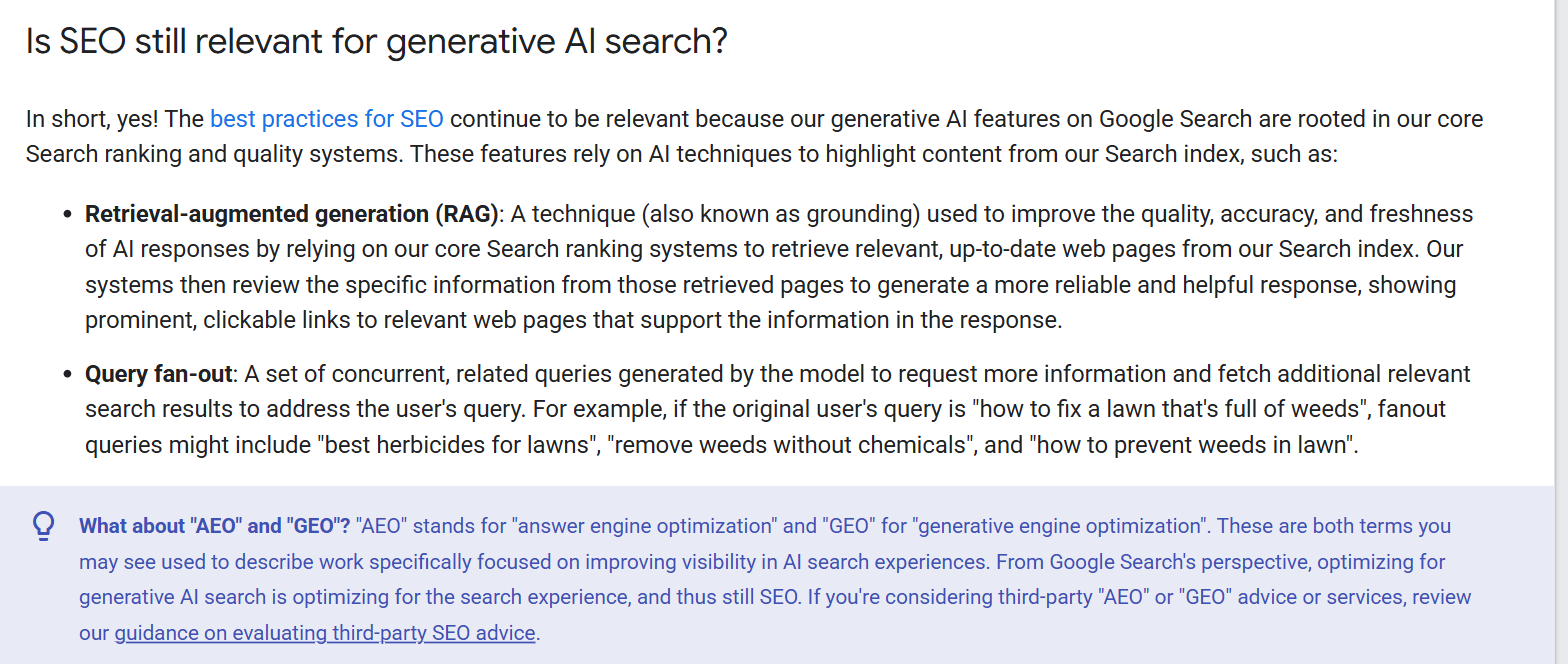
Google answers this one itself. Its guide to optimizing for generative AI features takes the two acronyms head on: "'AEO' stands for 'answer engine optimization' and 'GEO' for 'generative engine optimization'... From Google Search's perspective, optimizing for generative AI search is optimizing for the search experience, and thus still SEO."
For Google's surfaces there is no second discipline to learn. The same page, last updated in July 2026, says the generative features "are rooted in our core Search ranking and quality systems". The AI features guide opens with the line worth pinning above a desk: "There are no additional requirements to appear in AI Overviews or AI Mode, nor other special optimizations necessary."
ChatGPT and Perplexity do not run on Google's index, so there is a little more to it for them. It is still a short list, and none of it is exotic.
Grounding. Google describes retrieval-augmented generation as "a technique (also known as grounding) used to improve the quality, accuracy, and freshness of AI responses by relying on our core Search ranking systems to retrieve relevant, up-to-date web pages from our Search index". The model does not answer from memory. Something fetches pages first, and the answer is built out of what came back. Every assistant on this page works that way for a local question.
Query fan-out. Google defines it as "a set of concurrent, related queries generated by the model to request more information and fetch additional relevant search results". Its example: ask "how to fix a lawn that's full of weeds" and the fan-out queries might include "best herbicides for lawns", "remove weeds without chemicals" and "how to prevent weeds in lawn".
Fan-out is why the old habit of tuning one page to one phrase has stopped paying. "Best physio in Bondi" is not one search behind the scenes. It is several, about opening hours, about specific injuries, about parking, about who takes which health fund. A profile and a body of reviews that happen to answer six adjacent questions get retrieved more often than a page that answers one of them beautifully.
How AI search works for local businesses: the five surfaces
| Surface | What happens when someone asks | Where the local facts come from | What the reader sees |
|---|---|---|---|
| ChatGPT | The question is rewritten into one or more web searches sent to search partners | Whatever those searches return, plus an approximate location from the person's IP address | Citations, a Sources list, and on iOS and Android sometimes a map |
| Gemini | Google Search; in the developer API, a documented Google Maps tool | Google's index; for the Maps tool, Maps itself | Inline annotations linking to Google Maps sources |
| Perplexity | A live search of the open web | Public pages its crawler can reach | Numbered citations on every answer |
| Google AI Overviews | Retrieval from Google's Search index, with query fan-out | Your indexed pages and your Business Profile | A summary with supporting links, above the ordinary results |
| Google AI Mode | The same, tuned for comparisons and follow-up questions | The same | A longer response with links to supporting websites |
ChatGPT searches rather than remembers. OpenAI's help centre says it "can search the web to answer questions with current information and links to relevant sources" and "can also use location information to find local results" (Searching the web with ChatGPT). The rewriting is the part that surprises owners: ask "what are some good restaurants near me?" and, if ChatGPT reads San Francisco off your IP address, it "may rewrite your prompt into the search query 'top restaurants San Francisco'". What actually goes out is an ordinary local search, and the pages that come back are the raw material. Restaurants have one extra surface to think about, because the same help page says ChatGPT can show reservation times from OpenTable, Resy or Yelp. We pulled the ChatGPT half of this apart properly in does ChatGPT recommend businesses like yours.
Two lines on that page are worth reading before anyone sells you a guaranteed mention.
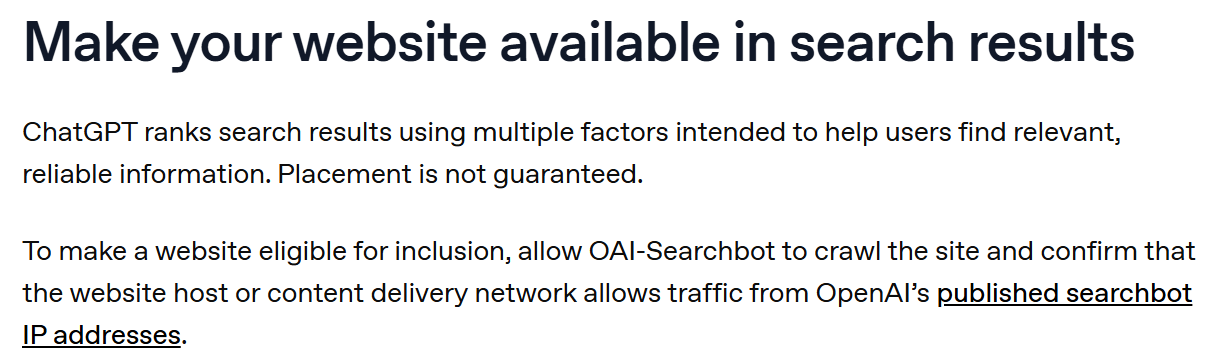
The second catches people out. Allowing the crawler in robots.txt is not the whole job: your host or CDN has to let OpenAI's published searchbot addresses through as well.
Gemini is the only one of the five whose documentation names reviews as an ingredient. Google's Grounding with Google Maps page describes a data retrieval step where the service "queries Google Maps for relevant information (e.g., places, reviews, photos, addresses, opening hours)", and lists place questions as the first use case.
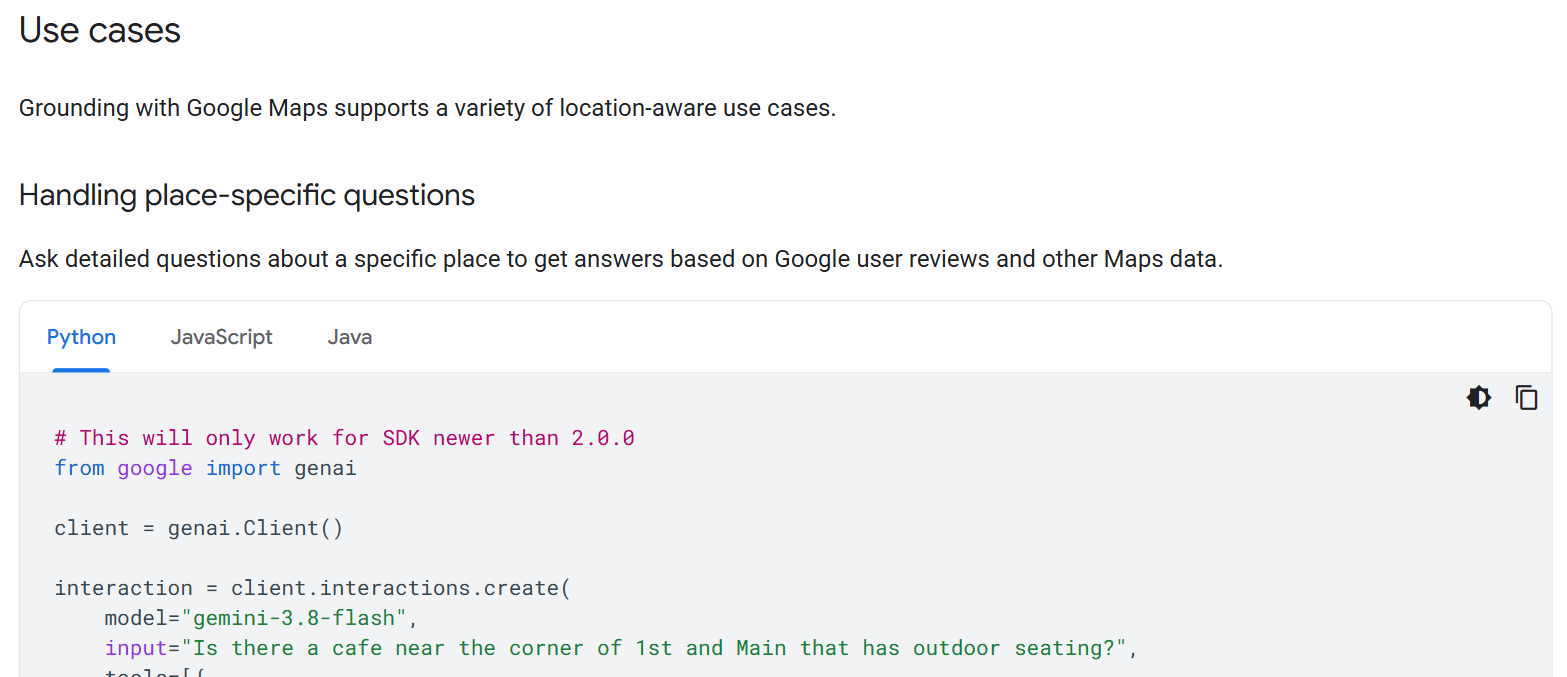
That documentation covers the Gemini API, which is what developers build on rather than what you get in the Gemini app. Read it as the clearest published statement that review text is read, not as a description of every Gemini answer.
Perplexity is the simplest and the least about your website. Its help centre says it will "search the internet in real-time" and that "each answer includes numbered citations linking to the original sources" (How does Perplexity work?); its crawler documentation names PerplexityBot as the one to let in. For a local question the answer is assembled from whatever public pages discuss your category in your area, which is usually directories, roundups and review sites before it is you.
AI Overviews and AI Mode run on the index you already rank in. Google's eligibility rule is one sentence: a page "must be indexed and eligible to be shown in Google Search with a snippet, fulfilling the Search technical requirements. There are no additional technical requirements." Two other lines matter to anyone measuring this. AI Overviews "are only shown when our systems determine that it is additive to classic Search, and as such, often don't trigger", so a query that shows one today may not tomorrow. And both features use fan-out to "display a wider and more diverse set of helpful links associated with the response than with a classic web search".
One switch can shut you out of both. Since 31 August 2026 every Search Console property has a Search generative AI control under Settings. Include is the default; exclude means "you won't receive any traffic or impressions from these features". Worth two minutes to confirm nobody has touched it.
The inputs all five have in common
Six things feed a local answer on every one of those surfaces. Only some are documented, and the table says which.
| Input | Who documents it | What you do about it |
|---|---|---|
| A complete Google Business Profile | Google, on local ranking and again in the AI features guide ("Checking that your Merchant Center and Business Profile information is up-to-date") | Right primary category, real hours, every field filled |
| How many reviews you have, and the rating | Google: "More reviews and positive ratings can help your business's local ranking" | Ask every customer, every week, not in bursts |
| What the reviews actually say | Google, in the Gemini Maps grounding docs | Ask at the moment the job finishes, so people describe the job |
| The same details on every site that lists you | Nobody publishes a weighting; ChatGPT reads whatever the web returns | Fix the directories that disagree with your profile |
| Pages elsewhere that mention you | OpenAI and Perplexity both describe crawling and citing public pages | Get onto the roundups and association lists the answers already cite |
| A site the crawlers can reach | OpenAI, Perplexity and Google all publish crawler names | Check that robots.txt and your CDN allow OAI-Searchbot, PerplexityBot and Googlebot |
Review text and citations elsewhere are the two inputs local businesses often overlook.
Review text is the input almost nobody works on. Count and rating get the attention because they are visible on the profile. But nobody writes "great service" in an answer about rotator cuff rehab or emergency gas fitting. If forty of your reviews name the treatment, the technician, the breed or the machine, an assistant has forty sentences it can match against a specific question. If all forty say "highly recommend", it has none, and you are competing on star rating alone. You get that language by asking promptly, not by asking for it.
Citations elsewhere are the input you cannot buy. Perplexity will happily answer a local question without touching your website, using the directory pages and local roundups that rank for your category. Reading the citation list under an answer is the fastest work list in this whole discipline: if the same roundup is cited every month and you are not in it, that is a job with a name.
Both of those come out of ordinary review work. How to get more Google reviews covers the ask and the timing, and adding your business to Google Maps covers finishing the profile.
What does not work
Paying. Google's local ranking page states it flatly: "There's no way to request or pay for a better local ranking on Google." OpenAI says the same about ChatGPT's ads, which began as a US test in February 2026 and has since expanded to Canada, Australia, New Zealand and several other markets: "Ads do not influence the answers ChatGPT gives you", and an ad is "always clearly labeled as sponsored and visually separated from the organic answer" (Testing ads in ChatGPT, updated 11 August 2026). Buying the ad buys the ad.
Filtering who you ask. Sending happy customers to Google and unhappy ones to a private form is against Google's prohibited and restricted content policy, which stops merchants who "discourage or prohibit negative reviews, or selectively solicit positive reviews from customers". It also produces a review corpus that does not describe your business, which is exactly the wrong outcome when the text is being read back to a customer. Cloutly has not had a rating step in front of the review sites since 2021. Review gating is the longer version.
Asking customers to include keywords. The same policy tells merchants they should not "request that specific content be included". The template that says "please mention emergency plumbing in Newcastle" is a policy breach on the profile you can least afford to lose, in exchange for an effect no vendor has ever documented. Ask promptly instead. A customer asked the same day writes about the job they just had, and the language arrives on its own.
Writing reviews with AI. Generated review text is fabricated review text no matter who typed the prompt. Every platform that hosts reviews bans it, and it corrupts the one asset on this list that an assistant reads as evidence.
The file-and-markup tactics. Google's mythbusting section names them one by one. On llms.txt: "You don't need to create new machine readable files, AI text files, markup, or Markdown to appear in Google Search (including its generative AI capabilities), as Google Search itself doesn't use them." On rewriting: "You don't need to write in a specific way just for generative AI search." On buying mentions: "seeking inauthentic 'mentions' across the web isn't as helpful as it might seem." And on schema: "Structured data isn't required for generative AI search, and there's no special schema.org markup you need to add", though it stays worth having for rich results.
That list is specific to Google, and Google says so: keeping an llms.txt file for other services that use one "will neither harm nor help your site's visibility or rankings in Google Search". So the file is site hygiene for the non-Google assistants if you want it. It is not the lever, and an agency selling it to a plumber as one is selling the wrong thing.
Google adds a warning about the tools built on top of all this, and it applies to every vendor in the category including us: "Be wary of third-party tools that promise ranking success or claim to use 'internal' Google metrics. No third-party tool has access to our internal ranking or AI systems."
AI answers send fewer people to your site. Being named is the point.
An assistant that answers the question well has given the customer what they came for. Some of those people will never click anything, and no vendor publishes a click-loss figure for local queries, so treat any number you are quoted as somebody's estimate rather than a measurement.
What Google does publish is the shape of what is left: "when people click from search results pages with AI Overviews, these clicks are higher quality (meaning, users are more likely to spend more time on the site)." Fewer visitors, further along.
For a business with a phone number this is less of a change than it is for a publisher. Your outcome was never a session. It was a call, a booking, a direction request or someone walking in. Being named in the answer, with the right phone number attached, does that job whether or not anyone visits your website on the way. So measure the outcome rather than the traffic, and check the naming separately.
For Google's surfaces you now have a first-party report. Search Console's Generative AI performance report was rolled out to all websites worldwide on 31 August 2026 and covers AI Overviews and AI Mode. Read it for what it is: impressions, grouped by page, country, date or device. Nothing outside Google Search appears in it, so for ChatGPT, the Gemini app and Perplexity the only honest method is still to ask them and write down what comes back.
How to get found in AI search: the monthly check
Spend ten minutes on the same day each month and write the results down. One answer is only one sample. Look for the pattern across months and the source list that keeps appearing.
- Fix eight prompts and stop changing them. Mix the shapes: "best [category] in [suburb]", "[category] near [landmark] open [day]", "who should I see for [a problem you solve] in [suburb]", "is [your business] any good", "[your business] or [a rival you actually lose to]". The full set is in does ChatGPT recommend businesses like yours.
- Name the location in the prompt. OpenAI's own advice when local results show the wrong area is to "include your city, neighborhood, or postal code in your question". Do not let the assistant guess it from your office connection.
- Run each prompt in a fresh chat, signed out where you can be, in all three assistants. Memory and chat history change the rewritten query. Testing inside your logged-in account measures your account.
- Record seven things. Whether you were named, where in the list, which rivals were named, which sources were cited, whether the phone number and hours came back right, which assistant, and the date.
Treat every result as one sample. These systems are not deterministic and a re-ask can differ, so one miss is not a verdict and one hit is not a ranking. If you would rather not run it by hand, Cloutly's AI search visibility asks ChatGPT, Gemini and Perplexity discovery questions such as "best {category} in {locality}" once a month and records whether each location was named and which rivals were.
Where to start
If you run one site, in this order:
- Finish the Google Business Profile. Primary category first, then hours, then every remaining field.
- Check the crawlers can reach you: robots.txt, your CDN's bot rules, and the Search generative AI control in Search Console. Blanket AI blocks were fashionable in 2023 and some are still sitting there.
- Start asking every customer for a review, promptly, forever. Not a drive.
- Fix the two or three directory listings that carry an old phone number or an old address.
- Run the monthly check for three months before you conclude anything.
If you run a network, the order changes, because your problem is variance between sites rather than absence:
- Make one location correct end to end and use it as the reference. Category, hours, description, photos.
- Run the check per location, not per brand. The flagship being named tells you nothing about the suburban sites, and it is usually the suburban sites that are invisible.
- Sort by worst first. A weak location drags only itself, so the return is highest where the profile is emptiest.
- Get every site asking for reviews the same way, so the corpus is comparable and no location is running on a manager's memory.
- Fix the details centrally. Twenty listings drifting in twenty directions is a listings problem before it is an AI problem.
Where to go deeper
The pieces below each take one part of this page further.
How it works
- Does ChatGPT recommend businesses like yours? How to check
- AI Overviews for local businesses: how to appear
- SEO for Google AI Mode: what a local business has to change
- Perplexity and Gemini answer local questions differently from ChatGPT
Measuring it
- How to monitor AI search visibility: eight prompts, five assistants, one log
- When AI gets your business details wrong (and how to fix it)
- AI search visibility for multi-location brands: why the suburbs get missed
- AI search visibility tools: what they measure and how to choose
The reviews link
- Do Google reviews affect ranking? What Google confirms, and what it doesn't
- AI and Google reviews: do they change what AI says?
- The AI summary above your reviews: where it comes from and what to do about it
The vocabulary
- GEO vs SEO, AEO and LLMO: what the acronyms mean for a local business
- AI visibility explained: what it measures, what it can't
- Do you need an llms.txt file?
For the numbers behind any of it, AI search statistics carries a publisher, an edition and a sample on every figure.
Frequently asked questions
Does AI search replace my Google Business Profile?
No. It reads it. Google names Business Profile information in its own generative AI guidance, Gemini's Maps grounding queries Maps directly, and a ChatGPT search on a local question returns the local results your profile sits in. The profile has become more load-bearing, not less.
Which assistant should I care about most?
Nobody publishes a share of local questions by assistant, so anyone ranking them for you is guessing. Ask all three directly, watch the AI Overview on your own category search, and notice that they fail differently. ChatGPT and Perplexity miss you when you are absent from the pages they retrieve. Google's surfaces miss you when your profile is thin.
How long before any of this changes an answer?
Nobody outside the vendors can say, and it is not one lever with a lag. A review appears on your profile in a day or two. The next answer might reflect it immediately or not at all, because the answer is rebuilt from a fresh retrieval each time. Check monthly and read the trend, not the run.
Do I need a separate version of my website for AI?
No. Google warns that spinning up content for every variation of how somebody might search, done to manipulate rankings or AI responses, breaches its scaled content abuse spam policy. Write for people and organise with ordinary headings and paragraphs. The one genuine adjustment for the non-Google assistants is making sure the facts a customer needs, which for a local business means hours, address, phone, services and prices, sit in text on a page rather than inside an image or a script.