
AI and Google reviews: do they change what AI says?
One vendor names reviews as an input, in writing. Everything else you have been told about reviews and AI answers is inference, or a guess.
Lachlan Fea 8 min read
In this article7 sections

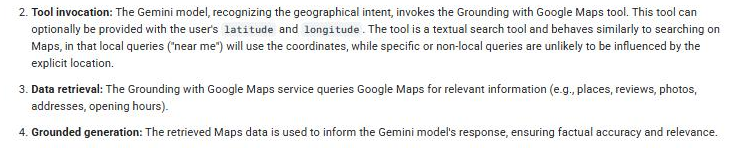
Yes, and only one vendor documents it plainly. Google's Gemini API says its Maps grounding step "queries Google Maps for relevant information (e.g., places, reviews, photos, addresses, opening hours)", and answers questions about a place "based on Google user reviews and other Maps data". Everything else written about AI and Google reviews is inference from that, or somebody's guess dressed as a ranking factor.
Every quote below has a link and a date. Where a vendor has published nothing, this page says so instead of filling the space. AI search optimization for local businesses explains how these systems answer local questions; this page covers the reviews input.
AI and Google reviews: which assistants document reviews as an input
Four surfaces, and they are not equally forthcoming. Only Google names reviews as something retrieved, and only in its developer documentation.
| Assistant | What the vendor documents about reviews | Where that leaves you |
|---|---|---|
| Gemini | Grounding with Google Maps (updated 2 September 2026): the service "queries Google Maps for relevant information (e.g., places, reviews, photos, addresses, opening hours)", and the first use case is answers "based on Google user reviews and other Maps data" | Reviews named as a retrieved input, in writing |
| Google AI Overviews and AI Mode | No review-specific rule. The AI features guide (updated 10 December 2025) says "the best practices for SEO remain relevant" and there are "no additional requirements to appear in AI Overviews or AI Mode". The optimization guide (updated 10 July 2026) says Google Business Profiles "can help your products and services to be visible in both AI responses and other Google Search results" | Reviews reach it the way they reach ordinary local Search |
| ChatGPT | Reviews are not named at all. What is documented is the mechanism: ChatGPT search "typically rewrites your query into one or more targeted queries" sent to search providers, and the answer is built from what those return | Your reviews count when a page carrying them is retrieved |
| Perplexity | Reviews are not named. Documented: it will "search the internet in real-time", and "each answer includes numbered citations linking to the original sources" (How does Perplexity work?) | Same as ChatGPT. Reviews count through the pages that carry them |
Two things follow that most of the advice on this topic skips.
The Gemini quote comes from the developer API, which is what an application gets built on rather than a description of every answer the Gemini app gives. Read it as the clearest published statement that review text gets retrieved and read, not as proof that it happens on every query.
And for ChatGPT and Perplexity, your reviews are not a signal the assistant holds an opinion about. They are content on a page. If a Google Maps place page, a directory listing or a local roundup carrying your reviews comes back in the retrieval, the text of those reviews is in front of the model. If nothing carrying them comes back, they may as well not exist. OpenAI is blunt about the ceiling: "ChatGPT ranks search results using multiple factors intended to help users find relevant, reliable information. Placement is not guaranteed."
How AI reads reviews: the nouns are the point
Reviews are the longest piece of writing about your business that you did not write. That is the whole argument. A model answering "who can see a rabbit in [suburb] on a Saturday" is looking for text that matches "rabbit" and "Saturday", and the only place those words are likely to appear about your clinic is in what your customers wrote.
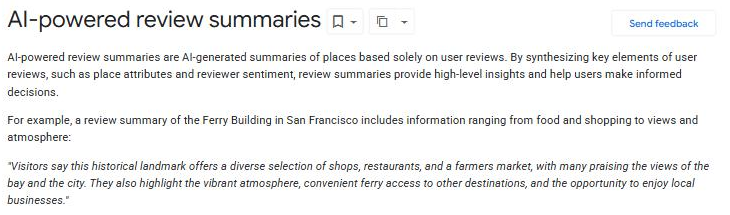
Google demonstrates this on its own surface. The Places API's AI-powered review summaries (updated 1 September 2026) are "AI-generated summaries of places based solely on user reviews", produced "by synthesizing key elements of user reviews, such as place attributes and reviewer sentiment". Solely. Not your description, not your website copy. It is a developer feature, and Google says the summaries are not guaranteed for every place, so do not read it as something every listing gets. Read the principle: given a place, Google will write a description of it out of review text alone.
Take Rowan Street Vet, a fictional two-vet clinic with 96 reviews at 4.8 stars. Eighty of them say some version of "lovely staff, highly recommend". Those eighty are not useless. They hold the rating up, and the rating is real. But there is no sentence in them about rabbits, about after-hours, about a nervous dog or the cost of a dental. Nothing in them matches a question.
The other sixteen say things like "took our rabbit in on a Saturday morning when nobody else would look at an exotic" and "explained the dental quote line by line before doing anything". Those sixteen name a species, a day, a service and a behaviour. When somebody asks a question shaped like any of those, there is text to match.
Nothing about that requires you to script anything, and scripting it breaks Google's rules anyway. It follows from when you ask. A customer asked the same afternoon writes about the thing that just happened to them. A customer asked six weeks later writes "great service", because that is all they still remember.
Do review volume and recency change what AI says?
Volume and rating have documented weight in one place, and it is not an AI system. Google's local ranking page describes prominence as "how well-known a business is", then: "This factor's also based on info like how many websites link to your business and how many reviews you have. More reviews and positive ratings can help your business's local ranking." That is a statement about local Search and Maps. Gemini grounds on Maps, and a rewritten ChatGPT search returns local results, so the effect reaches the assistants second-hand. Second-hand is still real. It is also still second-hand, and most of the pages on this topic quietly drop that word.
Recency is different. Nobody documents it. Not Google, not OpenAI, not Perplexity. What can honestly be said is an observation: a profile whose most recent review is from 2023 reads as abandoned to a person, and retrieval systems generally favour current pages. Both are reasonable. Neither is published. So when somebody hands you a freshness window or a monthly review quota, the useful question is which document it came from, and the answer will be that it came from them.
Weighting is the same story. Nobody publishes what a review is worth against a link, whether Google reviews count differently from a trade directory's, or whether any threshold exists at all. Google's position on its own local ranking is that "we do our best to keep the search algorithm details confidential to make the ranking system as fair as possible for everyone", and no assistant has been more generous than that. Whether reviews move your local ranking is the fuller version of the documented half.
Your replies are text too
Everything above applies to what you write under a review. Google puts it in the reader-facing form on the same local ranking page: "When you reply to customer reviews, it shows that you value their feedback. Positive reviews and helpful replies can help your business stand out."
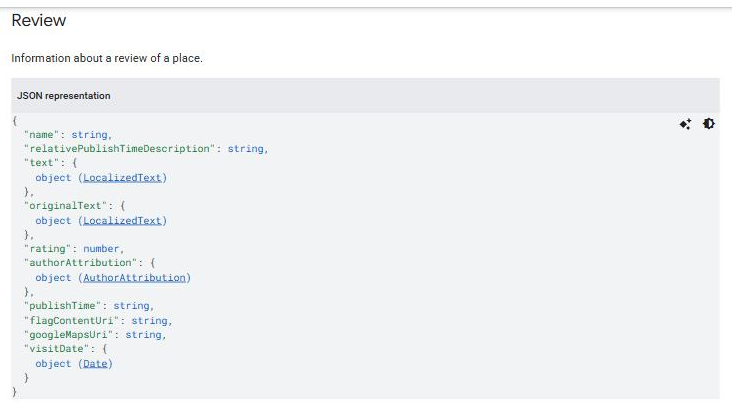
Where a reply gets read is worth being precise about. The Places API's review object carries the review text, the rating, the author, the timestamp, a flag link, a Maps link and a visit date. There is no field for the owner's reply. And the AI review summaries are drawn solely from user reviews. A reply is not reaching a model down either of those routes.
It reaches a model the way any other text does. Your reply is visible on the Maps place page and on any site that renders your reviews, so it is there to be read when one of those pages is retrieved.
What that means in practice is unglamorous. A reply that says "Thanks Sam" adds nothing to the page. A reply that names the treatment, corrects a factual error in the review, or states your actual cancellation policy adds a sentence of your own words to the only page about you that a customer and a model both read. Review response examples covers what a good one looks like for each kind of review.
The tactics that do not work, in Google's own words
Three tactics are being sold against this topic right now. All three break Google's prohibited and restricted content policy, which governs the profile you can least afford to lose.
Filtering who you ask. Sending happy customers to Google and routing unhappy ones to a private form is covered directly: merchants must not "discourage or prohibit negative reviews, or selectively solicit positive reviews from customers". It also defeats everything above. If review text is the raw material an assistant reads, a filtered corpus is one that does not describe your business. Cloutly has not had a rating step in front of the review sites since 2021, and review gating is the longer argument.
Incentives. The policy prohibits merchants who "offer incentives" of any kind, naming payment, discounts and free goods or services, "in exchange for posting any review or revision or removal of a negative review". The permitted version sits in the same document and is the whole job: "solicit or encourage the posting of content that does represent a genuine experience, without offering incentives to do so or attempting to influence the rating or the contents of the review."
Asking for specific words. This is the one that looks clever after reading the section above, and the policy names it twice. Merchants must not attempt "to influence the rating or the contents of the review", and the prohibited list covers merchants requesting that staff "solicit reviews that include specific content, including content that identifies a staff member". The template that says "please mention emergency plumbing in [suburb]" breaks the rule in exchange for an effect no vendor has ever documented. Ask promptly instead and the specifics arrive on their own, because the customer still remembers them.
There is a fourth, which is less a tactic than a category error. Search anything in this area and something will offer to write your Google reviews for you with AI. Nothing that comes out of that is a review. It is a paragraph about a visit nobody made, banned on every site that would host it, and worthless to an assistant for the same reason real reviews are valuable: nobody experienced it.
What to do instead
None of it is new work. It is the same three jobs, done for a reason that has changed. The acronyms sold around it are unpacked in GEO vs SEO, AEO and LLMO, and Google's own surface has SEO for Google AI Mode.
- Ask everyone, at the moment the job finishes. Not a drive, not a filtered list. Everyone, promptly, so the review describes the specific thing rather than the general feeling. How to get more Google reviews covers the ask and the timing.
- Reply to everything, with a sentence that carries information. The reply is public text on the page an assistant reads, and Google says helpful replies help you stand out.
- Keep the listing consistent everywhere. ChatGPT reads whatever the web returns about your hours and phone number, and OpenAI's own warning is that "search results and citations can be incomplete, outdated, or incorrect". Adding your business to Google Maps is the setup guide for the profile all of this rests on.
Then check whether any of it moved. There is no report for this, so the honest method is to ask the assistants the questions your customers ask and write down what came back, month after month, treating each answer as one sample rather than a rank. Does ChatGPT recommend businesses like yours has the prompt set and the log. Cloutly runs that sweep for you: AI search visibility asks ChatGPT, Gemini and Perplexity discovery questions such as "best {category} in {locality}" once a month and records whether each location was named and which rivals were.
No review count guarantees a mention in an AI answer. Anyone quoting one has made it up. Specific, current reviews put something about your business in front of the model in language that matches what somebody asked. Whether it gets used is not yours to control.
Frequently asked questions
Does ChatGPT use Google reviews?
Not directly, and OpenAI does not name reviews anywhere in its documentation. ChatGPT rewrites the question into a web search and builds the answer from the pages that come back. If one of those is your Google Maps listing, a directory entry or a local roundup that carries your reviews, the review text is in front of the model. If not, it is not.
How many reviews do I need before AI recommends my business?
Nobody knows, and nobody has published a threshold. Google documents that more reviews and positive ratings can help local ranking, and stops there. A number quoted at you came from the person quoting it.
Do reviews written by AI help?
No. They are fabricated, they are prohibited on every site that would host them, and they defeat the purpose. What makes a review useful to an assistant is that a real customer described a real thing.
Do old reviews stop counting?
No vendor documents an expiry, a decay curve or a freshness window. What is observable is that a profile with nothing recent looks dormant to a human reader, and that these systems retrieve from the current web rather than a snapshot. Treat steady collection as the sensible default, not as a documented requirement.