
SEO for Google AI Mode: what a local business has to change
Google's answer to what you should change for AI Mode is nothing. The interesting part is what the feature does to the question itself.
Lachlan Fea 10 min read
In this article8 sections

SEO for Google AI Mode is the SEO you were already doing. Google puts it in one line in its guidance for site owners: "There are no additional requirements to appear in AI Overviews or AI Mode, nor other special optimizations necessary." No submission, no markup, no file to upload. What changes is the question your customer asks. AI Mode is built for the long comparative questions people used to break into four separate searches.
Everything below is quoted from Google's own help pages, developer documentation and announcements, checked on 6 September 2026. Where Google has published nothing, this post says so rather than filling the gap with a number somebody invented. The broader guide to how AI search decides which local businesses get named covers the other surfaces.
What is Google AI Mode, and where can people use it?
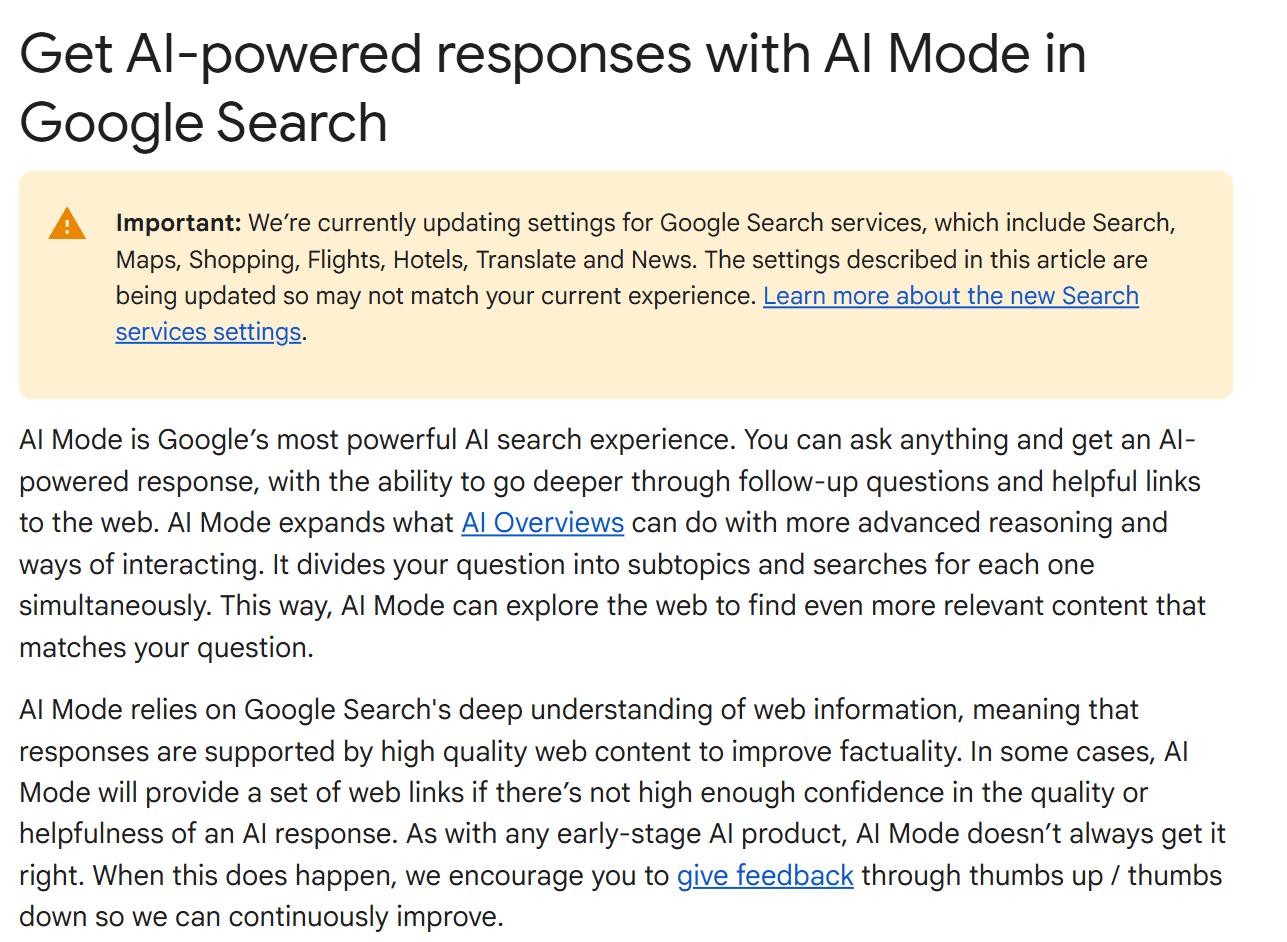
AI Mode is a separate search experience with its own page. Google Search Help calls it "Google's most powerful AI search experience", where "You can ask anything and get an AI-powered response, with the ability to go deeper through follow-up questions and helpful links to the web" (Get AI-powered responses with AI Mode in Google Search). People reach it three ways: at google.com/ai, by tapping AI Mode after typing a question on google.com, or from the home screen of the Google app.
The rollout, in Google's own announcements:
- 5 March 2025. AI Mode arrives as an opt-in experiment in Labs, offered first to Google One AI Premium subscribers (Expanding AI Overviews and introducing AI Mode).
- 20 May 2025. Google begins "rolling out AI Mode in the U.S.", with "no Labs sign-up required" and a new tab in Search and in the Google app (AI in Search: Going beyond information to intelligence).
- 21 August 2025. Google says it will "expand AI Mode to over 180 new countries and territories in English" (AI Mode in Search gets new agentic features and expands globally).
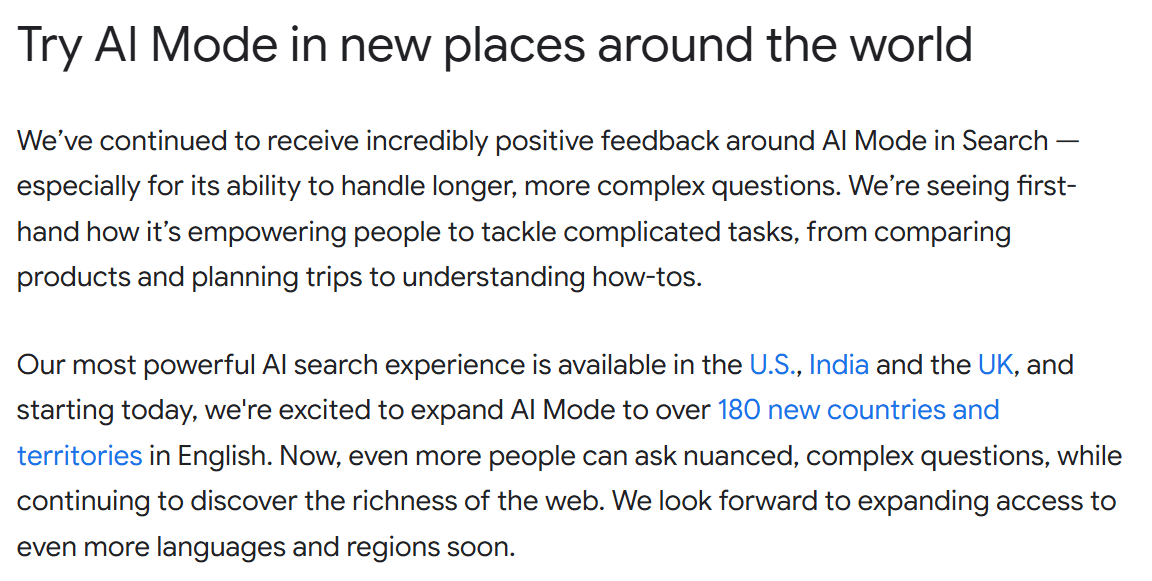
The live country list sits on the help page rather than in the announcement. On 6 September 2026 it named Australia, New Zealand, the United Kingdom, the United States, Canada and Ireland. If you serve any of those markets, your customers can already ask AI Mode who to call. Google maintains that list and changes it, so read the page rather than this sentence. One caveat from the same page, before you treat any answer as authoritative: "AI Mode doesn't always get it right."
AI Mode and AI Overviews are not the same feature
They get talked about as one thing. Google says otherwise: "AI Mode and AI Overviews may use different models and techniques, so the set of responses and links they show will vary" (AI features and your website).
| AI Overview | AI Mode | |
|---|---|---|
| Where the customer meets it | Above the ordinary results, unasked. Google says they "are only shown when our systems determine that it is additive to classic Search, and as such, often don't trigger" | Its own page, entered on purpose, at google.com/ai or through the AI Mode button |
| What it is built for | Getting "to the gist of a complicated topic or question more quickly" | Queries "where further exploration, reasoning, or complex comparisons are needed" |
| The shape of the question | Usually one, typed as normal | "Nuanced questions that might have previously taken multiple searches", then follow-ups in the same thread |
| When the AI is not confident | Not documented | "In some cases, AI Mode will provide a set of web links if there's not high enough confidence in the quality or helpfulness of an AI response" |
| What you have to do differently | Nothing. The eligibility rule covers both | Nothing |
The difference that matters commercially is who arrives. Somebody who opens AI Mode, describes the problem and asks two follow-ups has done their shortlisting inside the answer. By the time they click, the comparison is over. A searcher who glanced at an AI Overview on the way to the map pack has not. AI Overviews for local businesses covers that other surface on its own terms.
What query fan-out means when someone asks for a local business
AI Mode does not run the question you typed, and that changes which of your pages can be pulled into an answer. Google's help page: "AI mode uses a 'query fan-out' technique, dividing your question into subtopics and searching for each one simultaneously across multiple data sources." The developer glossary defines the same thing as "a set of concurrent, related queries generated by the model to request more information and fetch additional relevant search results to address the user's query" (Optimizing your website for generative AI features). Google adds that both AI Mode and AI Overviews may use it, so fan-out is not an AI Mode exclusive.
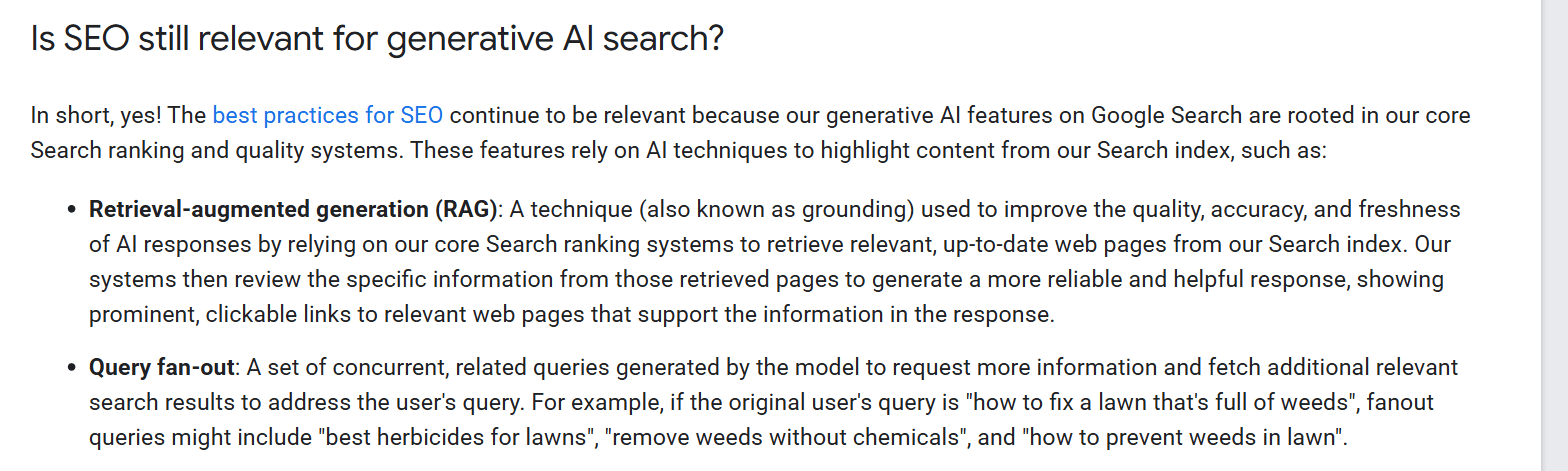
Google's own example is a lawn. Ask "how to fix a lawn that's full of weeds" and the fan-out queries might include "best herbicides for lawns", "remove weeds without chemicals" and "how to prevent weeds in lawn". One question, several searches, one assembled answer.
Now put a local question through the same machine. Somebody types: my dog is limping after a run, who should I take her to in Newtown and what will it cost. Google has not published the fan-out for that query and nobody outside Google can see it, so treat what follows as the shape of the thing rather than a leaked list. It is not one search. It is a question about limping in dogs, one about which kind of clinic treats it, one about vets in that suburb, and one about price.
So your service page is no longer competing only for "vet Newtown". It is one of several documents that can satisfy a branch of a question nobody typed that way. A page explaining what a limp usually means and what an assessment costs answers two branches at once. A page headed "Newtown's most trusted vets" answers none of them.
That is not an invitation to spin up a page per fan-out query. Google bans it in the same guide: creating separate content for every possible variation of how people might search, "primarily to manipulate rankings or generative AI responses in Google Search violates Google's scaled content abuse spam policy". Depth on the questions you get asked, not breadth across guessed ones.
The upside is Google's own claim. Its models "identify more supporting web pages" while the answer is written, so AI features "display a wider and more diverse set of helpful links associated with the response than with a classic web search". More links from more angles is an opening for a business too small to hold position three for its head term.
What AI Mode shows when the question is about a place
Business information is in scope. Search Central's generative AI guide says "Where appropriate, generative AI responses can include product listings, product information, and information about local businesses", and that Merchant Center and Google Business Profiles "can help your products and services to be visible in both AI responses and other Google Search results". Its sibling page turns that into a checklist item: "Checking that your Merchant Center and Business Profile information is up-to-date."
AI Mode also reaches Google's place data, not the open web alone. Announcing the agentic version on 21 August 2025, Google wrote that "AI Mode uses the live web browsing capabilities of Project Mariner, direct partner integrations on Search, and the power of our Knowledge Graph and Google Maps to help users take action on the web", starting with restaurant reservations and "expanding soon to local service appointments and event tickets". The fine print matters: that booking behaviour launched as a US Labs experiment, not as the general feature.
There is one published description of how a place answer looks. Writing about travel on 27 August 2026, Google said an AI Mode hotel search returns "a visual list of options, complete with guest reviews and key factors to compare" (3 new ways to plan and book travel in Search). Guest reviews inside the answer, in Google's own account of its own feature.
What Google has published nowhere: which fields of a Business Profile appear in an AI Mode answer, how a set of businesses is chosen, or any weighting given to reviews inside AI Mode. If a vendor tells you AI Mode reads your last thirty reviews, or that 4.6 stars is the threshold, they made it up. What Google does publish about ranking a local business sits on the local ranking page: results "are mainly based on relevance, distance, and popularity", and "More reviews and positive ratings can help your business's local ranking". That page is about local results, not about AI Mode, and the honest position is that the two overlap without Google having said how much. Whether Google reviews affect your ranking works through the documented half.
SEO for Google AI Mode: the four things you can change
None of them is new. That is Google's point, not a rhetorical flourish.
- Be indexed and snippet-eligible. That is the whole technical requirement: "To be eligible to be shown as a supporting link in AI Overviews or AI Mode, a page must be indexed and eligible to be shown in Google Search with a snippet, fulfilling the Search technical requirements. There are no additional technical requirements." Businesses fail it by accident, usually a
noindex,nosnippetormax-snippetleft behind after a redesign. Search Console also carries a setting that excludes a site from generative AI features outright. Check both before you buy anything. - Finish the Business Profile and keep it current. Google names it on both guidance pages, it costs an afternoon, and it is the input you control most directly. Our guide to adding your business to Google Maps has the setup and verification steps.
- Make your details identical everywhere you are listed. AI Mode reaches Maps and the Knowledge Graph as well as the open web, so an old phone number on a directory is a number Google has seen. Dull work, and the highest-yield hour on this list.
- Write the page that answers a branch of the question. The questions your customers ask in the first ten minutes of an appointment are the pages: what a symptom usually means, what the options cost, what you do that the place down the road does not.
There is nothing to install. Google's generative AI guide is blunt about it: "You don't need to create new machine readable files, AI text files, markup, or Markdown to appear in Google Search (including its generative AI capabilities), as Google Search itself doesn't use them." Any quote you are handed for an llms.txt file or an AI-flavoured rewrite of your service pages is a quote for work Google says it ignores.
Reviews sit underneath all of it, and the way to get them is to ask every customer rather than the ones you expect to be pleased. Google's contribution policies bar merchants from offering "payment, discounts, free goods and/or services" in exchange for a review, and from moves that "Discourage or prohibit negative reviews, or selectively solicit positive reviews from customers". A filtered profile describes a business that does not exist, which is a poor thing to hand a model. How to get more Google reviews covers the timing and the follow-up.
What AI Mode does to your clicks
Google is the only party with the aggregate data, so this section quotes Google and stops. On 6 August 2025, Liz Reid, VP and Head of Google Search, published the company's line: "Overall, total organic click volume from Google Search to websites has been relatively stable year-over-year", along with the concession underneath that average, that "user trends are shifting traffic to different sites, resulting in decreased traffic to some sites and increased traffic to others" (AI in Search is driving more queries and higher quality clicks). Google has published nothing about clicks from AI Mode specifically. Read the rest for what it is: a company describing its own product in aggregate with no method attached, not a finding about your website. The figures circulating elsewhere are not Google's and do not agree with each other.
How to check what AI Mode says about your business
Search Console covers the website. A manual check covers the business itself.
Your website. Search Console's generative AI performance report "shows data about how your site performs in generative AI features on Google Search", counting impressions, which Google defines as "how many times links to your site were shown to a user in a generative AI feature on Google Search". As of 31 August 2026 Google has "rolled out these insights to all websites worldwide". Two limits to know before you open it: the report covers AI Overviews and AI Mode together with no way to separate them, and it excludes anything a person saw inside a Search Labs experiment. An empty report usually means too few impressions, or a site excluded from generative AI features.
Your business. Search Console reports on your site, not on your Business Profile, and an impression count says nothing about whether the answer named you, described you correctly or sent the customer to a rival. For that you run the questions your customers run, from the area they are in, and write down what comes back. How to check whether AI assistants recommend your business has the prompts, the sign-out settings and the log, including how to run AI Mode cleanly.
Do the other assistants while you are there, because they answer local questions from different sources and cite different pages. Does ChatGPT recommend businesses like yours covers where each one gets its local answer. Cloutly's AI search visibility asks ChatGPT, Gemini and Perplexity discovery questions such as "best {category} in {locality}" once a month and records whether each location was named and which rivals were. It does not sample AI Mode, so for Google's own surfaces the hand check and Search Console are what you have.
Frequently asked questions
Is Google AI Mode available in Australia and New Zealand?
Yes. On 6 September 2026, Google's AI Mode help page listed Australia and New Zealand, along with the United Kingdom, the United States, Canada and Ireland. Google announced the expansion to "over 180 new countries and territories in English" on 21 August 2025. It maintains the list and changes it, so check the page rather than this sentence.
Do I need schema markup or an llms.txt file for AI Mode?
No. Google says you don't need new machine readable files, AI text files, markup or Markdown to appear in Google Search including its generative AI capabilities, "as Google Search itself doesn't use them", and that structured data "isn't required for generative AI search". Keep your structured data for rich results in ordinary Search. That is what earns its place.
Can I see AI Mode traffic on its own in Search Console?
No. The generative AI performance report combines AI Overviews and AI Mode and does not split them, and both are also counted inside the ordinary Performance report under the Web search type. There is no AI Mode filter.
How many reviews do I need to be named in AI Mode?
Google has never published a number, for AI Mode or for local results generally. It documents reviews as an input to local ranking, in the words "More reviews and positive ratings can help your business's local ranking", and it has documented nothing about how reviews are used inside an AI Mode answer. Anyone quoting you a threshold invented it.