
Does ChatGPT recommend businesses like yours? How to check
Three vendors document where their local answers come from. None of them documents a formula, and that gap is where most of the advice on this goes wrong.
Lachlan Fea 9 min read
In this article7 sections
Does ChatGPT recommend businesses? Yes. Ask it for the best physio in your suburb and it will name three or four of them, with links. Whether it names yours depends on what it can find about you on the open web at the moment somebody asks, and none of the assistants publishes a ranking formula for local recommendations. What OpenAI, Google and Perplexity do publish is where the answer comes from, and that is enough to work with.
Most of what is written on this is guesswork, including several of the pages ranking for it today. So this piece quotes only what the three vendors have published themselves, says where that runs out, and gives you a test you can run in ten minutes a month.
How does ChatGPT recommend local businesses?
ChatGPT answers a local question by searching the web, working out roughly where you are, and reading what it finds. OpenAI's help centre is direct about it: ChatGPT "can search the web to answer questions with current information and links to relevant sources" and "can also use location information to find local results, including restaurants, news, and weather" (Searching the web with ChatGPT, updated August 2026). Four details on that page matter to a business owner.
The question is rewritten before it is searched. OpenAI's own example: ask "What are some good restaurants near me?" and, if ChatGPT works out from your IP address that you are in the San Francisco area, it "may rewrite your prompt into the search query 'top restaurants San Francisco'". What goes out is an ordinary local search, and the pages that come back are the raw material for the answer. If the person has memory switched on, saved facts get folded into the rewrite too, which is one reason the same question from two people returns different businesses.
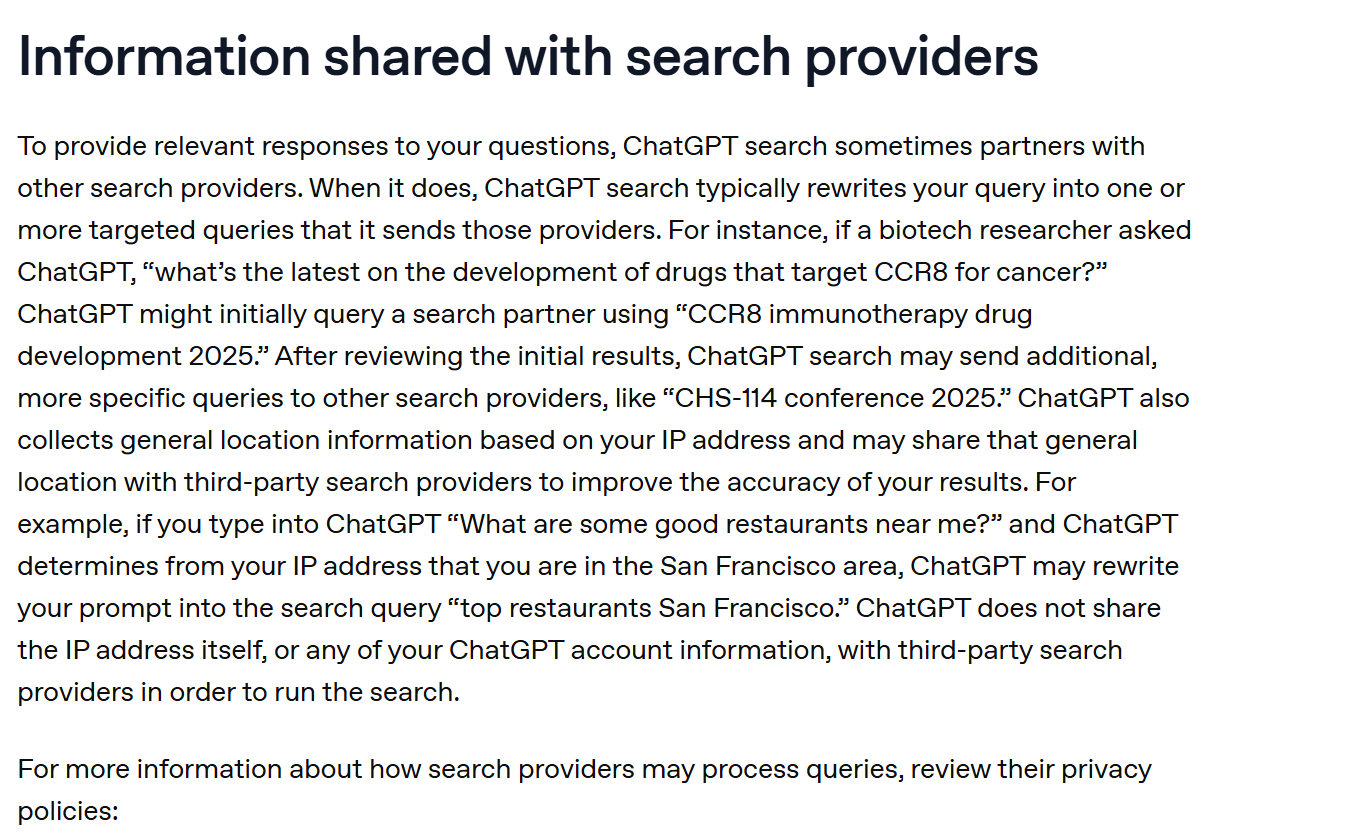
Location is approximate unless the customer hands over more. ChatGPT uses "an approximate location based on your IP address", and device location sharing "is optional and off by default". Someone on a home connection three suburbs away can be shown a different set of businesses from someone standing outside your door.
The sources are visible. Responses that use web search "may include citations", with a Sources control that opens the full list, and on iOS and Android "relevant results may also include a map". Read that list. It tells you which pages the answer was built from.
A website can be shut out, and no website is ever guaranteed in. OpenAI's crawler documentation says "sites that are opted out of OAI-SearchBot will not be shown in ChatGPT search answers, though can still appear as navigational links", and a robots.txt change takes about 24 hours to register. If somebody once dropped a blanket AI block into yours, check that before anything else here. Going the other way, the help centre closes off the ranking speculation in one line: "ChatGPT ranks search results using multiple factors intended to help users find relevant, reliable information. Placement is not guaranteed."
One correction, because it appears on most of the pages ranking for this question: ChatGPT does not answer local questions out of training data any more. Web search reached everyone, signed in or not, on 5 February 2025. "It only knows what it was trained on" was true in 2023 and is a bad model of the thing now.
Gemini and Perplexity get their answers somewhere else
The three assistants work differently, so your effort should follow the sources each one uses.
| Where a local answer comes from | How it places you | What the reader sees | |
|---|---|---|---|
| ChatGPT | A rewritten web search sent to third-party search providers, plus partner data | Approximate IP location; device location optional and off by default | Citations, a Sources list, and a map on mobile |
| Gemini | Google Search, and for developers a documented Google Maps grounding tool | Coordinates supplied by the app, or the place named in the question | Inline annotations linking to Google Maps |
| Perplexity | A live web search across pages its crawler can reach | The place named in the question | Numbered citations on every answer |
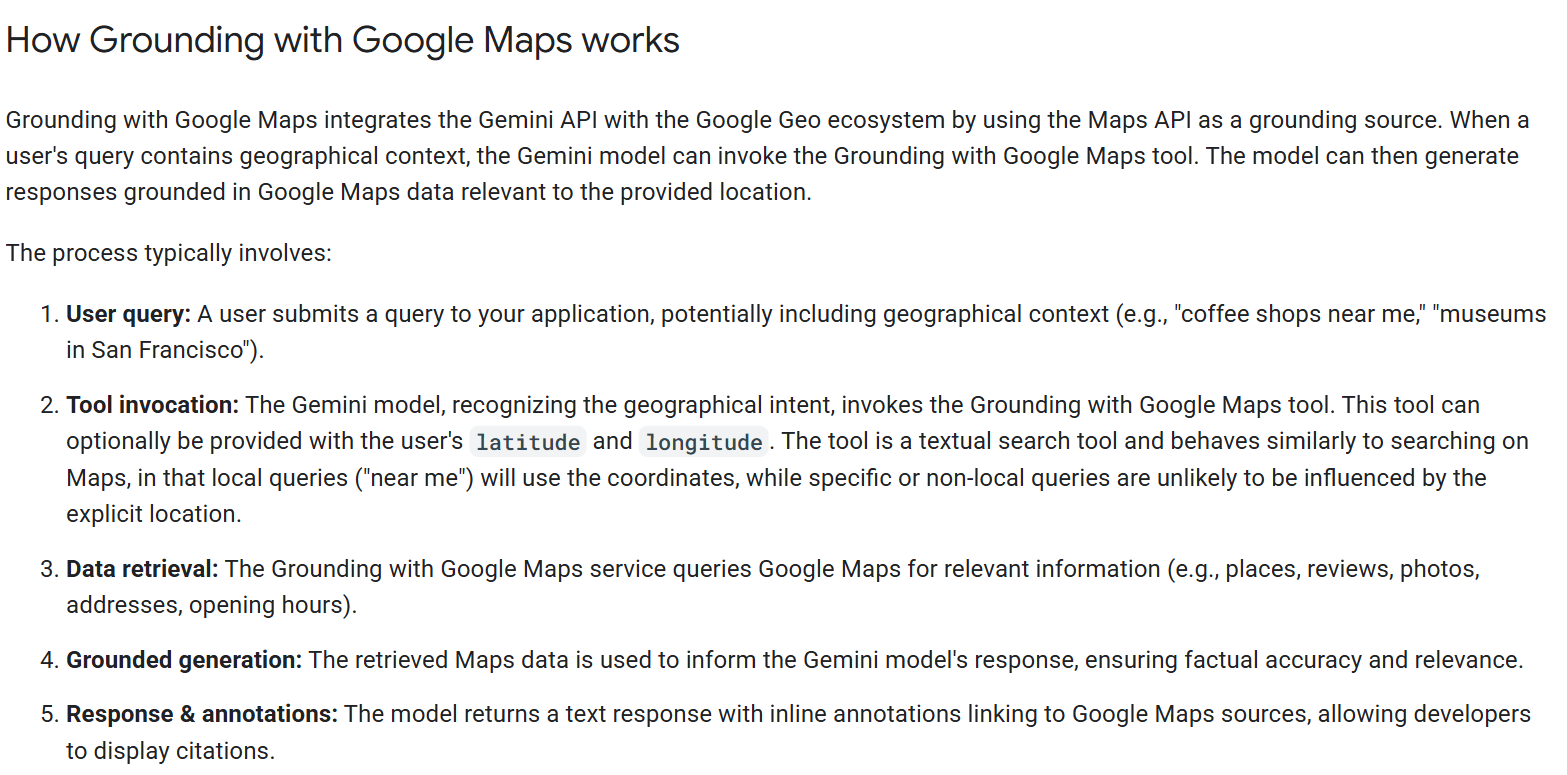
Google's Gemini API documents a tool called Grounding with Google Maps, and it is unusually specific about the ingredients. At the data retrieval step the service "queries Google Maps for relevant information (e.g., places, reviews, photos, addresses, opening hours)", the model answers out of that, and the response carries "inline annotations linking to Google Maps sources". The first use case Google lists is handling place-specific questions: "Ask detailed questions about a specific place to get answers based on Google user reviews and other Maps data."
That is the clearest statement any vendor has made that your reviews are read as text when an assistant answers a question about your category.
For Google's consumer surfaces the guidance is shorter and points at the same place. Search Central says generative AI responses "can include product listings, product information, and information about local businesses", and that "Merchant Center feeds and Google Business Profiles can help your products and services to be visible in both AI responses and other Google Search results" (guide to optimizing for generative AI features). Its AI features guide opens by saying there is no separate game to play.

Perplexity is the simplest of the three. Its help centre says it uses AI to "search the internet in real-time" and that "each answer includes numbered citations linking to the original sources" (How does Perplexity work?). Its crawler documentation adds that PerplexityBot exists "to surface and link websites in search results on Perplexity". For a local query, the answer is assembled from whatever public pages mention your category and your area: directories, review sites, roundups, your own site.
For a business with an address, that is three of five surfaces. AI search optimization for local businesses covers all five, including Google's own AI Overviews and AI Mode, and the inputs they share.
Does ChatGPT recommend businesses based on reviews?
Partly, and reviews are the only input on this list that a vendor has documented reading as text. Nobody publishes weightings for any of it. What follows is what the three vendors say they read, ordered by how much you can do about each one.
A complete Google Business Profile. Google's page on local ranking says local results "are mainly based on relevance, distance, and popularity", and that to improve relevance you should "provide complete and detailed business info". You cannot change how far you are from the person asking. You can finish the profile this afternoon.
Review count and rating. The same page, on prominence: "This factor's also based on info like how many websites link to your business and how many reviews you have. More reviews and positive ratings can help your business's local ranking." Gemini grounds on those local results, and a rewritten ChatGPT search returns them.
Review recency, which nobody documents. Google says nothing about it. Neither does OpenAI. It is a reasonable assumption, because a profile whose newest review is from 2023 looks abandoned to a person and probably to a model. It stays an assumption. Anyone quoting you a freshness window as a ranking factor invented the number.
What the reviews say, not only how many there are. The input most owners skip. Gemini's documentation makes it concrete: a question about a place is answered out of review text. Nobody writes "great service" in an answer about rotator cuff rehab. If forty of your reviews name the treatment, the technician, the breed or the machine, you have forty sentences an assistant can match to a question. If they all say "highly recommend", you have none.
The same details everywhere you are listed. ChatGPT rewrites the question into a web search and reads what comes back, so whatever the web says about your hours and phone number is what it repeats. OpenAI's warning is worth putting in front of anyone who assumes accuracy: "search results and citations can be incomplete, outdated, or incorrect."
Pages the assistants can read that mention you. Directories, local roundups, a supplier's stockist page, an association member list, a news mention. These are the citations that turn up under a local answer, and they are why a business with a thin website can still get named.
Can you pay ChatGPT to recommend your business?
No, and that is documented rather than assumed. OpenAI began testing ads in ChatGPT in February 2026, on the Free and Go tiers, and the announcement is explicit on the point that matters here: "ads do not influence the answers ChatGPT gives you", and an ad is "always clearly labeled as sponsored and visually separated from the organic answer" (Testing ads in ChatGPT, updated 11 August 2026). Buying the ad buys the ad. It does not buy the recommendation above it.
There is also nothing to install. Google's mythbusting section is blunt: "you don't need to create new machine readable files, AI text files, markup, or Markdown to appear in Google Search (including its generative AI capabilities)". No llms.txt, no special schema, no AI-flavoured rewrite of your pages.
The shortcut people do try is buying reviews, and it is banned in the place the assistants read. Google's contribution policies disallow "reviews or ratings that have been paid for, directly or in kind" and forbid merchants from offering "incentives such as payment, discounts, free goods and/or services" in exchange for them. Filtering is the same problem in a nicer suit: the policy also stops merchants who "discourage or prohibit negative reviews, or selectively solicit positive reviews from customers", and a filtered profile does not describe your business anyway. Ask everyone or ask nobody.
How to test whether ChatGPT recommends your business
Run the check once a month, on the same day, and write the results down. Ten minutes is enough. A single answer is not the point. The trend across months is, and so is the list of sources you keep seeing.
- Write eight prompts and then stop changing them. Vary the shape, not the wording, month to month:
best [category] in [suburb][category] near [landmark] open [day]who should I see for [a specific problem you solve] in [suburb]best [category] in [suburb] for [customer type][category] in [suburb] with [the thing people ask for: parking, late nights, a particular insurer]is [your business name] any good[your business name] reviews[your business name] or [a rival you actually lose to]
- Name the location in the prompt. OpenAI's advice when local results show the wrong area is to "include your city, neighborhood, or postal code in your question". Do not rely on the assistant guessing it from your office connection.
- Run every prompt in a fresh chat, in all three assistants, signed out where you can be. Memory and chat history change the rewritten query, so testing inside your logged-in account measures your account, not the world.
- Record six things per run. Whether you were named, where in the list, which rivals were named, which sources were cited, whether your phone number and hours came back right, and the date.
- Treat each result as one sample. These systems are not deterministic, so a re-ask can differ. One miss is not a verdict and one hit is not a rank.
- Read the citations, because that is the work list. If the same directory or roundup is cited every month and you are not on it, that is a concrete job. If your Business Profile is the only source cited, everything rests on one page.
A spreadsheet with seven columns holds all of it. Two rows from a first month, one hit and one miss:
| Prompt | Assistant | Named? | Position | Rivals named | Sources cited | Facts correct? |
|---|---|---|---|---|---|---|
| best physio in [suburb] | ChatGPT | yes | 2 | two rivals | Business Profile, a local roundup | phone number wrong |
| best physio in [suburb] | Gemini | no | three rivals | Maps |
If you would rather not run it by hand, Cloutly's AI search visibility asks ChatGPT, Gemini and Perplexity discovery questions such as "best {category} in {locality}" once a month and records whether each location was named and which rivals were.
What changes when you ask every customer for a review
Here is the shape of it, with an invented business so nobody mistakes this for a case study. Coastline Physio has two sites and 31 Google reviews between them, most written in 2023, most of them one line long. Six months of asking every patient at the end of a course of treatment takes that to 180, all current, a good share of them naming the injury and the physio who treated it.
Three things follow, and they are not equally certain. The local ranking has a documented reason to improve, because Google says more reviews and positive ratings can help it. The reviews now carry language that matches real questions, which follows from Gemini's documentation on reading Maps reviews. And the profile stops looking dormant, which is the recency argument: plausible, undocumented.
What does not change is the certainty. There is no number of reviews that buys a mention in an AI answer, and a vendor promising one is selling something they cannot deliver. What reviews buy is candidacy: you become a business the assistant has something to say about. The rest is the unglamorous work it always was. Get more Google reviews steadily rather than in bursts, keep your Google Business Profile complete and accurate, and reply to the reviews you get so the profile reads as tended. Whether reviews move your local ranking is the longer answer.
FAQ
How do I get ChatGPT to recommend my business? There is no submission form and no setting. Finish your Google Business Profile, make your details match everywhere you are listed, collect current reviews whose text names what you actually do, and check your site is not blocking OAI-SearchBot or PerplexityBot. Then test monthly and work the sources the answers cite.
Why does ChatGPT name my competitor and not me? Usually for a reason you can check. They are cited in a source the assistant reached and you are not, or their profile answers the specific thing that was asked and yours does not, or the assistant placed the customer nearer to them. The Sources list tells you which.
How often should I check? Monthly. More often is misleading: a re-ask can return a different answer, so short-interval checking measures noise. Same prompts, same day each month, in a log you keep.