
AI Overviews for local businesses: how to appear
Google's own line is that there are no additional requirements to appear. That makes this a shorter job than the industry selling it would like.
Lachlan Fea 9 min read
In this article9 sections
AI Overviews are the AI-written answer Google puts at the top of some results pages, and for a business with an address the honest headline is that there is nothing new to install, submit or mark up. Google's guidance for site owners says it in one sentence: "The best practices for SEO remain relevant for AI features in Google Search (such as AI Overviews and AI Mode). There are no additional requirements to appear in AI Overviews or AI Mode, nor other special optimizations necessary." The profile, the reviews and the pages you already have are the whole lever.
For a local business, the practical question is when an AI Overview appears and what it reads when it does. Every claim below that belongs to Google is quoted from Google's own pages, checked on 6 September 2026. Where Google has not documented something, this post says so rather than guessing. This article sticks to Google's AI Overview; AI search optimization for local businesses covers all five surfaces together.
What is an AI Overview?
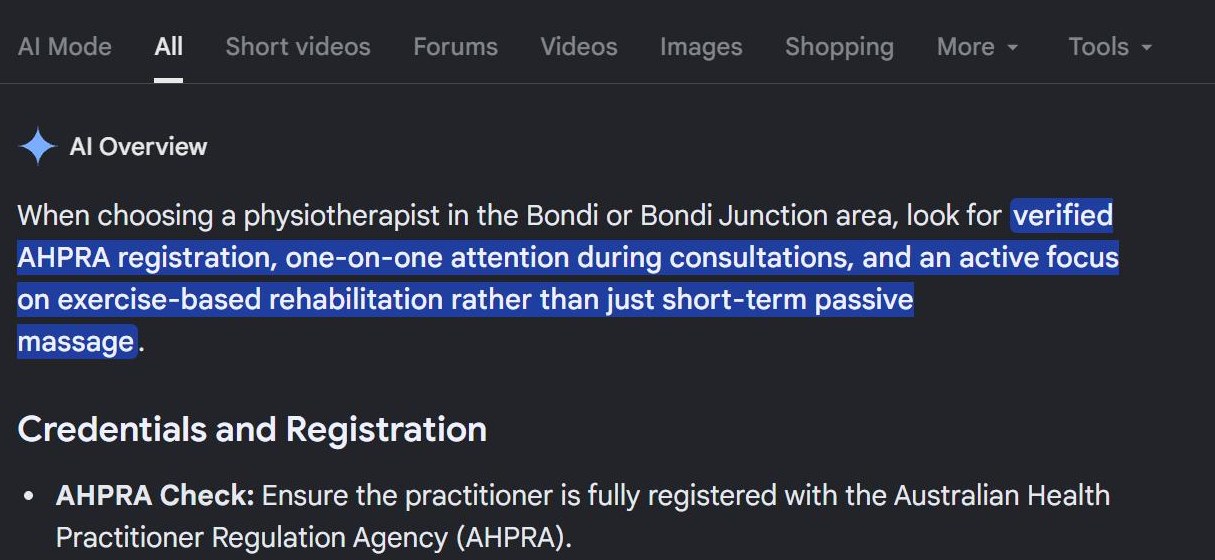
An AI Overview is a summary Google writes at the top of a results page, with links to the pages it drew on. Google Search Help calls it "an AI-generated snapshot with key information and links to dig deeper". Search Central adds the purpose: they "help people get to the gist of a complicated topic or question more quickly, and provide a jumping off point to explore links to learn more" (AI features and your website).
It is not an ad unit, so there is no placement to buy. And your customers cannot switch it off. Google's help page says AI Overviews are "a core Google Search feature, like knowledge panels. Features cannot be turned off", though a searcher can apply the Web filter after searching to see "only text-based links without features like AI Overviews" (AI Overviews in Google Search). Site owners can still control what Google takes from their own pages.
When does Google show an AI Overview for a local search?
Less often than the coverage suggests. Google's own wording is that AI Overviews "were designed to show up on queries where they can add additional benefits beyond what people might already get on Search", and, further down the same page, that they "are only shown when our systems determine that it is additive to classic Search, and as such, often don't trigger."
Here is what that looked like on 6 September 2026, from one Australian connection that Google placed at Carole Park in Queensland while I searched for a Sydney suburb.
- "best physio in bondi" returned a Places block: three profiles, a map, a "Top rated" filter chip, and a quoted line from a customer review under each listing. No AI Overview.
- "what should I look for when choosing a physio in bondi" returned an AI Overview with headed sections on credentials, treatment approach and local fit, a panel of three cited articles, and an "Ask anything" box underneath it. No Places block.
Two searches on one day from one location is an observation, not a rule. I ran the second one twice within a few minutes and the opening sentence came back differently each time: same shape, different wording, a different thing emphasised. One AI Overview is one sample, which is worth remembering before anyone reads a trend into a screenshot.
The pattern does line up with what Google documents. The shopping question already had a good answer in the form of three profiles, so a summary added nothing. The research question had no such answer, so it got one. The searches closest to a booking are still being answered by your Business Profile, and AI Overviews are turning up on the questions people ask before that. For the profile half, whether Google reviews affect your ranking covers the three factors Google publishes for local results.
What do AI Overviews use to answer a local question?
They run on ordinary Search. Google's guide to generative AI features describes the mechanism as retrieval-augmented generation, "a technique (also known as grounding)" that relies "on our core Search ranking systems to retrieve relevant, up-to-date web pages from our Search index" (Optimizing your website for generative AI features). Alongside it sits query fan-out, "a set of concurrent, related queries generated by the model to request more information".
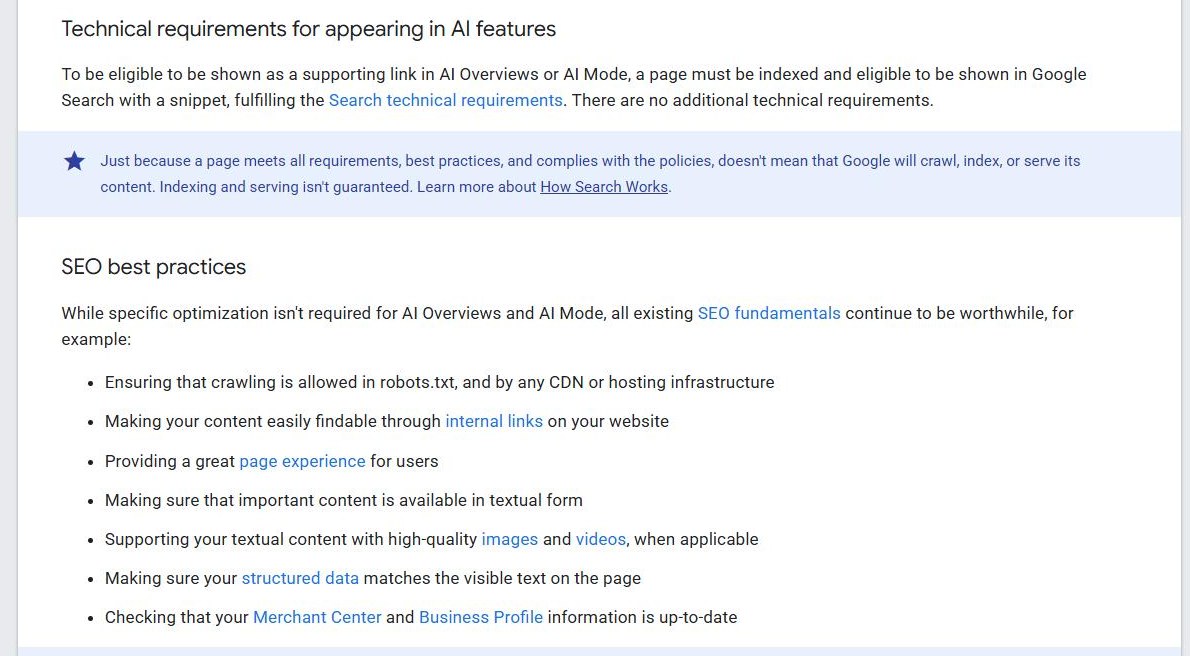
So the entry requirement is the ordinary one. Search Central: "To be eligible to be shown as a supporting link in AI Overviews or AI Mode, a page must be indexed and eligible to be shown in Google Search with a snippet, fulfilling the Search technical requirements. There are no additional technical requirements."
Your Business Profile is named, twice. The generative AI guide has a section headed "Optimize your local business and ecommerce details" saying that "generative AI responses can include product listings, product information, and information about local businesses", and that Merchant Center and Google Business Profiles "can help your products and services to be visible in both AI responses and other Google Search results". The AI features guide repeats it as a checklist item: "Checking that your Merchant Center and Business Profile information is up-to-date."
What sits behind that profile is not only what you typed into it. Google's Business Profile help says the information is compiled from publicly available sources "such as crawled web content", licensed third-party data, users who contribute facts and content, and Google's own interactions with the place (how Google sources business information).
Reviews: what is documented, and what is not. Google documents reviews as an input to local ranking. Its local ranking page puts them inside prominence and says "More reviews and positive ratings can help your business's local ranking." Google also documents that generative AI features are "rooted in our core Search ranking and quality systems".
What Google has never published is a sentence saying AI Overviews read, weigh or quote your individual reviews. Not the count, not the rating, not the text. Anyone telling you how many reviews an AI Overview needs invented the number. The one Google product that does document reading review text is the Gemini API's Grounding with Google Maps tool, a developer product rather than the AI Overview on a search page. That, and the equivalent documentation from OpenAI and Perplexity, is covered in does ChatGPT recommend businesses like yours.
Is there special markup or a file for AI Overviews?
No, and Google spends a section saying so. From the mythbusting part of the generative AI guide:
You don't need to create new machine readable files, AI text files, markup, or Markdown to appear in Google Search (including its generative AI capabilities), as Google Search itself doesn't use them.
The same section rules out special schema.org markup and says there is no requirement to break your content into tiny pieces for AI to understand it. It also warns against the tactic usually sold next to this one, which is spinning up a page for every question variation. Creating separate content for every possible search "primarily to manipulate rankings or generative AI responses in Google Search violates Google's scaled content abuse spam policy". If an agency is quoting you for an llms.txt file, an AI-flavoured rewrite of your service pages or forty new suburb pages, that quote is for work Google says it does not use.
How to appear in AI Overviews as a local business
Start at the top of this list and work down. None of it is new.
- Check you are indexed, snippet-eligible and not excluded. Indexing and snippet eligibility are the only technical requirements, and they are also how a business gets shut out by accident:
nosnippet,data-nosnippet,max-snippetandnoindexall limit what Google can show from your pages. There is a second switch. Google's generative AI guide says a site "must be included in Search generative AI features in Search Console to be eligible for display in generative AI features on Google Search". Inclusion is the default, so most businesses have nothing to do here. Check it anyway if an agency has been in there. - Finish the Business Profile. Google's local ranking page asks for the full address, the hours including special hours, the right category and attributes like parking and Wi-Fi, and says "Businesses with complete and accurate info are more likely to show up in local search results." Adding your business to Google Maps has the setup and verification steps.
- Keep collecting reviews, and reply to them. Google's documented claim here is about local ranking rather than AI answers, and it is worth having on those terms: more reviews and positive ratings can help, and "Positive reviews and helpful replies can help your business stand out." Ask every customer, not only the ones you expect to be pleased. Google's contribution policies bar merchants from moves that "discourage or prohibit negative reviews, or selectively solicit positive reviews from customers". How to get more Google reviews covers the timing and the follow-up.
- Make your details identical everywhere you are listed. Profiles are built partly from crawled web content and licensed third-party data, so an old phone number on a directory is a number Google has seen. Fixing the outliers is dull work and the highest-yield hour in this list.
- Write the page that answers the question. In the AI Overview I looked at, the cited sources were articles from clinics and health providers about how to choose a physiotherapist. Not a directory, not an SEO agency's listicle. Google's guidance points the same way, asking for a "unique point of view" and contrasting commodity content, "something like '7 Tips for First-Time Homebuyers'", with a piece that carries real experience. You know the questions your customers ask in the first appointment. Those are the pages.
What AI Overviews do to your clicks
Only Google has the aggregate data. In August 2025, Liz Reid, VP and Head of Google Search, published the company's position: "Overall, total organic click volume from Google Search to websites has been relatively stable year-over-year" (AI in Search is driving more queries and higher quality clicks, 6 August 2025).
The same post concedes the obvious. For quick-answer questions, "like 'when is the next full moon,'" people "may be satisfied with the initial response and not click further", and "user trends are shifting traffic to different sites, resulting in decreased traffic to some sites and increased traffic to others." Read it for what it is: Google's account of its own product, in aggregate, with no method published. The only number that describes your site is in your own Search Console.
AI Overviews and AI Mode are not the same thing
Google says the two features behave differently: "AI Mode and AI Overviews may use different models and techniques, so the set of responses and links they show will vary."
| AI Overview | AI Mode | |
|---|---|---|
| Where it is | At the top of an ordinary results page, when Google decides it adds something | Its own tab and its own page, entered deliberately |
| What it is for | Getting "to the gist of a complicated topic or question more quickly" | Queries "where further exploration, reasoning, or complex comparisons are needed" |
| Follow-ups | The AI Overview I saw offered a box to continue in | Built around them: "ask anything and get an AI-powered response, with the ability to go deeper through follow-up questions and helpful links to the web" |
| Your job | Identical. No additional requirements for either | Identical |
The difference for a local business is who arrives. Someone who opens AI Mode and asks three questions in a row is further into a decision than someone who glanced at a summary. SEO for Google AI Mode: what a local business has to change covers that surface on its own.
How to check whether you appear in AI Overviews
Google now reports it. The generative AI performance report in Search Console "shows data about how your site performs in generative AI features on Google Search", and as of 31 August 2026 Google has "rolled out these insights to all websites worldwide". Four things to know before you read it.
- It counts impressions, "how many times links to your site were shown to a user in a generative AI feature on Google Search". There is no position or ranking figure in it.
- It covers AI Overviews and AI Mode together and does not split them.
- You can group it by page, country, date or device, which is how you find out which of your pages is doing the work.
- It reports on your website, drawing on the Web search type in the ordinary performance report. Your Business Profile is a separate surface with its own reporting, so a strong profile and a quiet report are not a contradiction.
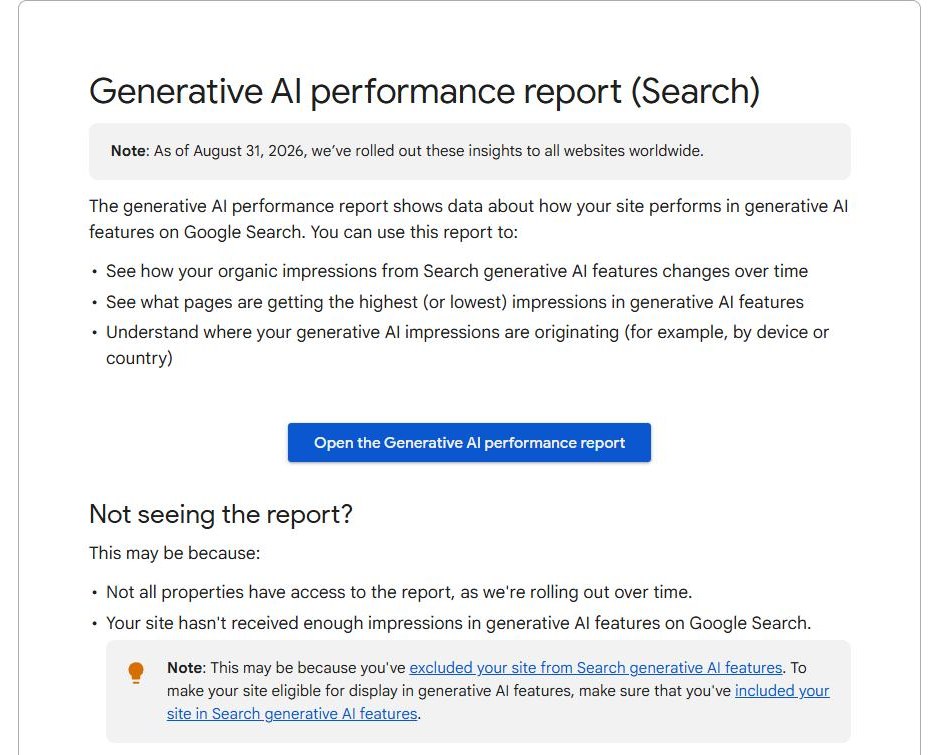
If the report is empty, Google names two causes worth checking: your site has not had enough impressions in generative AI features yet, or it has been excluded from them.
Search Console covers Google and nothing else. ChatGPT, Gemini and Perplexity answer local questions from different sources and cite different pages. For those, run the same searches your customers run, from the area they are in, and read the citation list as a work list. Cloutly's AI search visibility asks those three assistants discovery questions such as "best {category} in {locality}" once a month and records whether each location was named, and it does not sample AI Overviews, so Search Console stays the record for Google's own surfaces. How to monitor AI search visibility is the procedure for checking the assistants by hand.
Frequently asked questions
Can I stop my business appearing in AI Overviews?
For your website, yes. Search Console has a Search generative AI control under Settings, rolled out to all sites on 31 August 2026. Including your site is the default; excluding it covers AI Overviews, AI Mode and generative AI features in Discover, takes one to two days, and costs you the impressions and traffic those features send. Google says the control "isn't used as a ranking or inclusion signal affecting other parts of Search", so it is narrower than nosnippet and noindex, which are Search-wide and take your ordinary snippet with them. None of it governs your Business Profile. That is a separate surface and this switch does not touch it.
Do I need schema markup to appear in an AI Overview?
No. Google's wording is "Structured data isn't required for generative AI search, and there's no special schema.org markup you need to add." It is still worth having for rich results in ordinary Search, which is the reason to keep it.
Does an AI Overview replace the map pack?
Google has published nothing saying one displaces the other. In the two searches above, on 6 September 2026, they did not appear together: the profile-shopping query returned the Places block and no AI Overview, and the question-shaped query returned an AI Overview and no Places block. One day, one location. Run your own searches, from the suburb you serve, and write down what you see.