
AI search visibility for multi-location brands: why the suburbs get missed
A brand can pass "is Coastline Physio any good" and fail "best physio in Bondi" at forty addresses. Those are two measurements, and most networks run one.
Lachlan Fea 10 min read
In this article8 sections
AI search visibility for a multi-location brand is two measurements, not one. "Best physio in Bondi" is a location question, answered from what the web and Google Maps hold about one address. "Is Coastline Physio any good" is a brand question, answered from what they hold about the whole network. A brand can pass the second at every assistant and fail the first at forty of its sites.
For a network of 20 to 400 sites, use how AI search decides which local businesses get named as the starting point. At one location the check is ten minutes a month and none of the sampling below applies.
The category itself does not make the distinction. Search "ai search visibility" today and page one is trackers: Ubersuggest, Rankscale, Semrush's free checker, a couple of scoring tools. They define the measurement the same way, as the share of AI answers that name your brand, and they all track a brand. Not one of them has a row for an address. That is a reasonable unit for a software company with one website. It is the wrong unit for a business with forty front doors.
The brand answer and the location answer are different questions
Marketing leads find this out the same way every time. Somebody asks ChatGPT about the brand, gets a warm paragraph back, and concludes the network is fine. Then a franchisee three train stops away asks for the category in their own postcode and the brand is nowhere. Both results are correct. The assistant answered two different questions out of two different piles of material.
The brand question retrieves what the web says about the name: your website, your press, roundups, aggregator pages, and the reviews of whichever sites happen to be documented well enough to surface. One answer for the whole network, mostly built out of things head office controls.
The location question retrieves what the web says about one suburb. Google defines query fan-out as "a set of concurrent, related queries generated by the model to request more information and fetch additional relevant search results to address the user's query", and for a local question those concurrent queries are about hours, parking, a health fund, whether you see children. Almost none of that lives on the brand website. It lives on one location's Business Profile, in one location's reviews, and on the listings for one address.
Gemini makes the split literal. Google's Grounding with Google Maps documentation describes a retrieval step where the service "queries Google Maps for relevant information (e.g., places, reviews, photos, addresses, opening hours)", and the tool call in Google's own sample takes a latitude and a longitude.
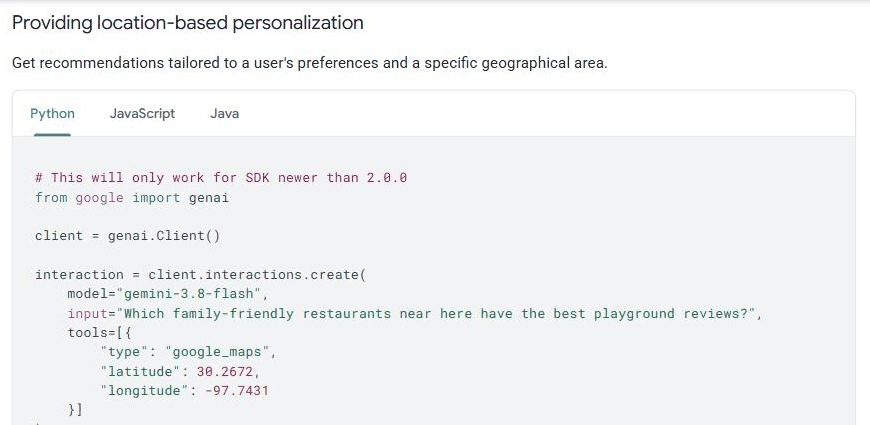
Maps is organised by address. There is no network row in it.
Two ways a network fails, and only one of them is obvious
A weak site drags only itself, until the brand answer picks it up
In the location answer, a weak site drags only itself. Nothing about a thin profile in Parramatta stops the Bondi site being named in Bondi.
The brand answer does not work that way. It is assembled from material about the name, and nothing makes the model prefer your best-documented site over your worst. A location carrying a disconnected phone number, an old address, a "permanently closed" flag or a 3.1 rating is part of what an assistant reads when somebody asks whether the brand is any good. One site can put a sentence into the brand answer that is true of that site and false of the other forty.
Nobody measures this, because head office only ever asks the brand question and it usually comes back clean. It comes back clean until the day retrieval happens to pull the wrong site. When AI gets your business details wrong covers tracing a wrong detail back to whatever is carrying it.
The brand is named, but the wrong branch is
The second failure is quieter and costs bookings the same week. A customer in Newtown asks for the category near them, the assistant names your brand, and it names the Bondi site because that is the address the web documents best. The customer rings a clinic forty minutes away, or more often does nothing.
No brand-level check shows you this, because the brand was named. It surfaces only when the check runs in the suburb the customer is standing in, which is the whole argument for prompting per location. The cause is nearly always the same: the suburban profile is thin, so retrieval falls back to the site with enough material to retrieve.
What gets read per location, and what gets read once for the brand
Sort the inputs by whether the thing exists once or once per site. That decides who fixes it, and how many times.
| What gets read | Held per location or once for the brand | What that means for a network |
|---|---|---|
| Google Business Profile | Per location. Google's guidelines: "Do not create more than one page for each location of your business, either in a single account or multiple accounts" | Every site needs its own profile, complete, and only one. Google also says "businesses with complete and accurate info are more likely to show up in local search results" |
| Review count and rating | Per location, on that location's profile | Google's local ranking page: "More reviews and positive ratings can help your business's local ranking" |
| What the reviews say | Per location | Forty reviews at one site that name the service are forty sentences that site can be matched against. Forty saying "great service" are none |
| Directory listings | Per location, and they drift per location | Nobody publishes a weighting. A phone number that disagrees is a fault at one address, not a network fault |
| Your website | Once for the brand, unless you run a page per location | The one input head office fully controls. Without location pages the brand has no first-party text about any suburb |
| Pages elsewhere that mention you | Both. Suburb roundups are per location, trade press is brand-wide | The citation list under an answer tells you which kind is doing the work |
Most of what decides a location answer is not centrally editable. Head office can mandate it, fund it and chase it, but the material sits on 200 profiles and in 200 review corpora. That makes it a governance problem, which is where the multi-location review management playbook arrives from the reviews side.
The cheapest wins are structural rather than editorial. A duplicate profile splits one location's reviews across two cards and halves the rating a customer sees, which is a retrieval problem as much as a reputation one. Multiple locations with the same name covers clearing a duplicate, and getting a location onto Google Maps properly covers the profile. Neither is glamorous and both outrank anything you could write about AI.
How to check AI search visibility across 200 locations without a full-time job
Two hundred sites, eight prompts and three assistants is 4,800 runs a month. Nobody does that by hand, and a network that tries will do it once and never again. Do not measure everything every month. Run two tracks instead.
Track one: a fixed panel, every month. Pick ten sites and do not change them. Take them from the top of whatever you already rank on, revenue or review volume, and add one or two you know are weak so the panel is not flattering. Run the eight prompts from how to monitor AI search visibility against each, same day each month, signed out, one fresh chat per prompt, suburb written into the sentence.
Ten sites, eight prompts and three assistants is 240 runs, which is about a day for one person once a month. If that is too much, cut the assistants before you cut the sites. One assistant across ten sites tells you more than three assistants across three.
Track two: every site once a quarter, on rotation. Two hundred sites over three months is roughly 67 a month, or about 17 a week. Give each site two prompts and one assistant: the plain discovery prompt for its category and suburb, and one constrained prompt built from a filter your customers apply, such as opening on a Sunday, taking a particular health fund, or seeing children. That is 34 runs a week, which is an hour.
Do not spend rotation runs on the named prompts. "Is {brand} any good" is a brand question and the panel answers it already.
Fix the sentences once and change only the values inside them. The moment somebody rewrites a prompt, the quarter stops comparing to the last one.
Use one sheet with a location column. Date, location, assistant, prompt, named or not, rivals named, sources cited, facts correct. The location column turns 200 separate checks into a network measurement, and it is the column people forget when they set this up in a hurry.
If running it by hand does not fit, Cloutly's AI search visibility asks ChatGPT, Gemini and Perplexity discovery questions such as "best {category} in {locality}" once a month and records whether each location was named and which rivals were.
How to read the results
Three things come out of the sheet, and only three are worth an executive's attention.
Named or not named, per site. Treat it as a binary and ignore where in the list you appeared. The ordinal is one sample of a system that is not deterministic, so a site that was second in September and fourth in October has told you nothing. Named in September and absent in October has told you something worth checking.
Which rivals were named. The most useful column, and the one people skip. The same rival in every suburb is a brand-level competitor whose brand-side material is better than yours, and that is a head-office job. A different rival in each suburb is normal, and it means the fight is local and the work goes to the sites.
Whether the facts came back right. A wrong phone number in an answer is worse than not being named, because the customer tried. Log it separately from the naming result and fix it at whatever source carries it, rather than by complaining to the assistant.
Report two network numbers, both carrying their denominator: how many of the sites you sampled were named by at least one assistant, and how many had a fact wrong. "31 of 67 sites named this quarter, 4 with a wrong phone number" survives being questioned. Report movement as flips rather than as a percentage. "Three sites started being named, one stopped" is defensible on one sample per site. "Share of voice up 2.4 points" is not, and somebody in the room will eventually ask what the denominator was.
The count tells you the size of the problem and nothing about where it is. At 200 locations the same proportion can mean one weak region or a thin spread everywhere, so put the count on the slide and the list of sites that missed in the appendix. Only the list can be worked.
What to do with a location that is never named
A site that misses once is noise. A site that misses in three consecutive quarters is a work list, and it is usually the same list in the same order.
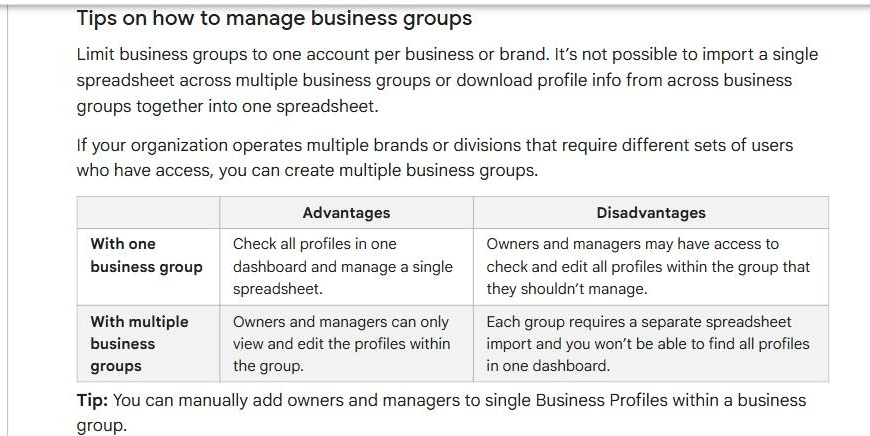
You can only work 200 profiles if you can reach 200 profiles. Google's business groups are the mechanism, and the trade-off is written down: one group gives you every profile in one dashboard and one spreadsheet, several groups keep each region's people out of profiles they should not be editing and cost you the single view.
- Check it has a profile, and only one. A duplicate splits the reviews and the rating across two cards, so neither card is strong enough to be retrieved. Clear it before anything else.
- Finish the profile. Primary category first, then hours, the description, photos, every remaining field. One hour of work that changes more than the rest of the list combined.
- Read the constrained prompt result. If "physio in {suburb} that bulk bills" names three rivals and not you, and you do bulk bill, the problem is not the assistant. Nothing public says you do.
- Read the citation list. If the same suburb roundup or directory is cited every time and the site is not in it, that is a job with a name and an owner.
- Get the site asking for reviews the same way as the rest of the network. A site running on a manager's memory produces a corpus nobody can match a question against. The trigger and the timing are set centrally, the wording stays local, and how to get more Google reviews covers the ask itself.
- Give it two quarters. Nothing on this list moves an answer in a fortnight, and a site panicked over weekly gets worse rather than better.
One thing not to do, and it comes up at every network this size: do not filter who gets asked. Routing happy customers to the review sites and unhappy ones to a private form breaches Google's contributed-content policy, which says merchants must not "discourage or prohibit negative reviews, or selectively solicit positive reviews from customers". It also produces a corpus that does not describe the location, which is the last thing you want when a machine is reading that text back to a customer. Cloutly has not had a rating step in front of the review sites since 2021.
Reporting AI search visibility to the board
Two sources, measuring different things. Say which is which on the slide.
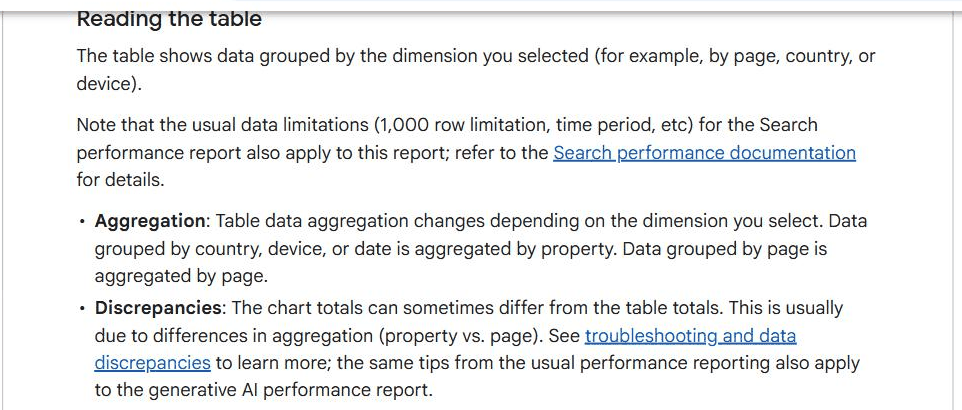
Google's own surfaces have a first-party report. Search Console's generative AI performance report covers AI Overviews and AI Mode, and as of 31 August 2026 Google has rolled it out to all websites worldwide. Read it for what it is. It reports impressions, defined as "how many times links to your site were shown to a user in a generative AI feature on Google Search", and nothing else. No clicks, no position. You can group by pages, countries, dates or devices.
Two things about that report bite at network scale. The usual Search Console limits apply, the 1,000-row limit included, so a 400-site network with a page per location will not see every location in one view of the page table. And nothing outside Google Search appears in it at all, so it says nothing about ChatGPT, the Gemini app or Perplexity.
Everything else is your sweep, and a sweep is a sample. Report it as the counts above, each with its denominator.
Put the caveat on the slide rather than in the speaker notes. These results are a point-in-time sample of a non-deterministic system. One sample each, and a re-ask can differ. Say that up front and the first quarter's number stays a reading instead of becoming a target.
Google adds a warning that belongs on the same slide, because it applies to every vendor in this category including us: "Be wary of third-party tools that promise ranking success or claim to use 'internal' Google metrics."
What not to put on the slide: a share-of-voice percentage with no stated denominator, an average across the network, and any number presented as a rank.
Frequently asked questions
Should we check AI search visibility by brand or by location?
Both, and separately. The brand check answers "what does an assistant say about us", which is one answer for the whole network. The location check answers "does an assistant name this site when somebody in this suburb asks", which is a different answer at every address. Networks that run only the brand check are usually measuring their best-documented site by accident.
Can one bad location affect how AI describes the whole brand?
In the location answer, no. A thin profile in one suburb costs that suburb and nothing else. In the brand answer, yes: a site carrying a wrong phone number, an old address or a much lower rating is part of the material an assistant reads when somebody asks about the brand by name, and nothing makes the model prefer your strongest site.
Is AI search visibility the same as our local ranking?
No. Local ranking is one of the inputs an assistant reads, not the output it produces, and an assistant can name a site that is nowhere near the map pack for the same query. Track both, separately, and do not let a rankings report stand in for the sweep.