
Google Business Profile: multiple locations with the same name (and how to fix a duplicate)
Two shops with the same name are not a duplicate. Two profiles for the same shop are, and that is the one quietly splitting your reviews.
Lachlan Fea 8 min read
In this article11 sections

Google allows multiple locations with the same name, and for a chain it insists on it. The rule is one profile for each location, and every location in the same country carries the same business name unless a site genuinely trades under a different one. What Google does not allow is two profiles for one location. That is a duplicate, and it splits your reviews across two cards while showing customers the wrong one.
Most of what you will read on this still calls it Google My Business. The name went in 2021 and the separate dashboard went the year after, which matters here because the menus moved with it: one profile is managed from your own Google Search result, a set of them from Business Profile Manager at business.google.com.
Can two locations have the same name on Google?
Yes. Google's guidelines say "all business locations within the same country must have the same name", with one exception: "if some of your locations consistently use a different name on their storefront, website, or stationery, these locations can use this different name" (Guidelines for representing your business on Google). Each location still gets its own profile.
So four clinics called Coastline Physio should all be called Coastline Physio. What separates them is the address, the phone number and the primary category. Google prints the address under the name in Maps and in the local results, and that is how a customer tells one from another.
Multiple locations with the same name, or a duplicate?
Only the second row below is a duplicate. The rest are legitimate, and treating one of them as a duplicate is how a business deletes a profile it needed.
| What you have | Allowed? | What to do |
|---|---|---|
| Same name, different addresses, different phone numbers | Yes. This is a chain. | One profile per location, all under the same name |
| Two profiles for one location, same address, same category | No. This is a duplicate. | Keep the verified one with the reviews, clear the other |
| Same name, no shopfront, overlapping service areas | Usually no | One profile unless each site has its own staff and its own base |
| Two genuinely different businesses at one address | Yes | A profile each, with different names and separate signage |
Google's wording on the second row is blunt: do not "create more than one page for each location of your business".
How to name your locations so Google keeps them apart
The name field is not where you separate locations. Google wants "your business's real-world name, as used consistently on your storefront, website, stationery, and as known to customers", and puts keywords and location details in the other fields on the profile rather than in the name.
Adding the suburb is only right when the storefront reads that way. If the sign above the door says Coastline Physio and nothing else, so does the profile. A profile named "Coastline Physio Newtown Sports Injury Clinic" is a common reason a new location gets suspended, and a suspension costs you that card, reviews included, until it is reinstated.
What should differ on every profile:
- The address. One physical location each, with permanent signage at it. A virtual office or a PO box does not qualify.
- The phone number. A local number that rings at that site, not the head office switchboard.
- The primary category. Usually the same across a chain, but that is where a site doing something different says so.
- The website field. Point each profile at that location's own page, not the homepage.
How to add and manage several locations at once
Past two or three sites, do this in Business Profile Manager rather than one profile at a time.
- Sign in to Business Profile Manager.
- At the top right, select Add profile.
- From the dropdown, select Import profiles.
- Select Download the template for a blank spreadsheet, or Download sample spreadsheet to see one filled in.
- Add every location you manage, then upload the sheet (Create a bulk upload spreadsheet).
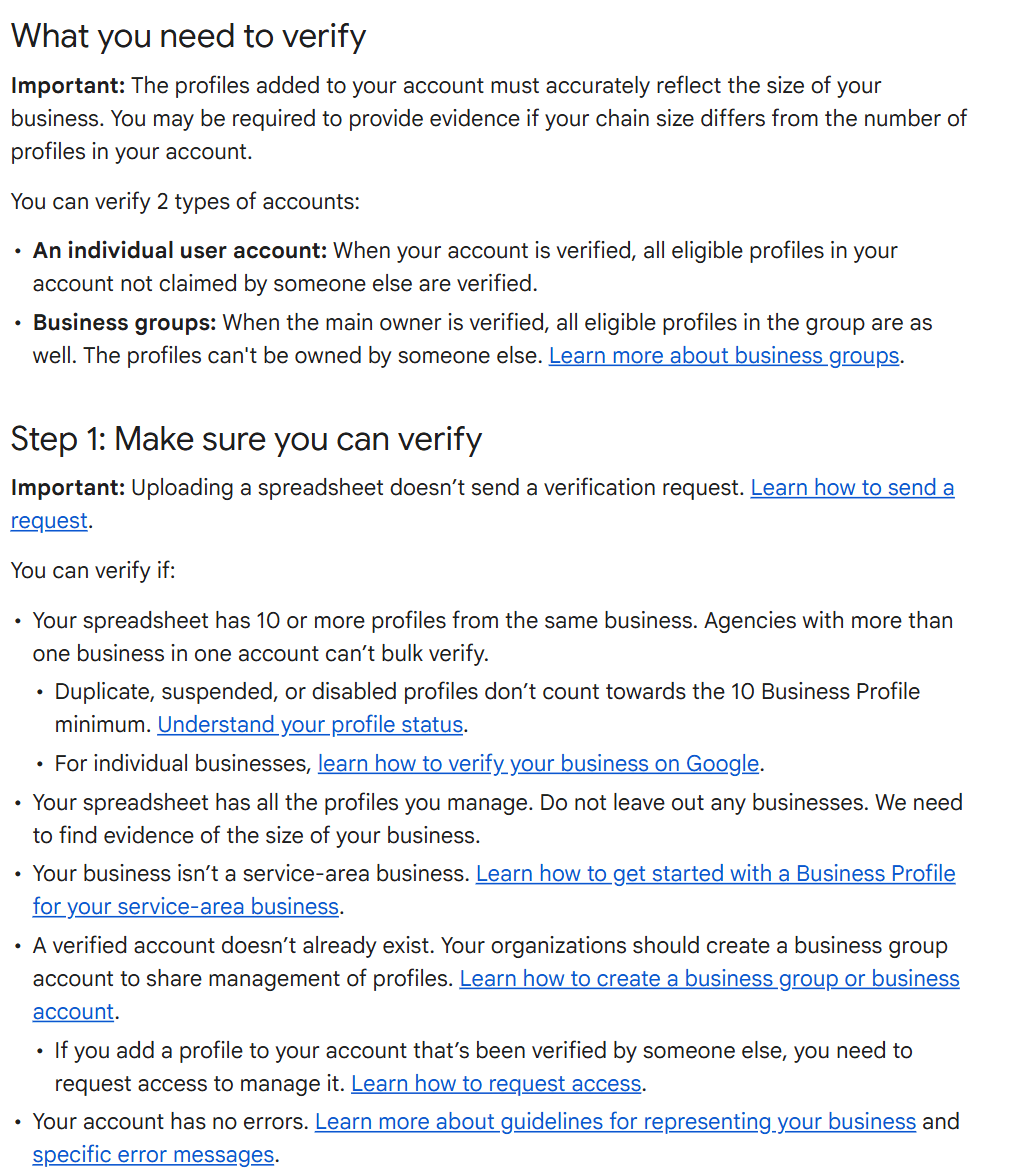
Verification is where the time goes. Profiles are verified one at a time until you are big enough for the bulk path, and Google's threshold is that "your spreadsheet has 10 or more profiles from the same business". Your duplicates will not get you there, because "duplicate, suspended, or disabled profiles don't count towards the 10 Business Profile minimum". Service-area businesses are excluded, and an agency holding several unrelated businesses in one account cannot bulk verify at all. Request it from Verifications in the left menu, then Chain, then Start (Verify Business Profiles in bulk). Google does not publish how long that review takes.
Who should own each profile, and who should manage it
Settle this before you have twenty profiles, not after.
Put the profiles in a business group. Google calls it "a more secure way to manage and share access to your Business Profiles with co-workers. It's like a shared folder for your profiles", and the part that matters at scale is that anyone you add "can access all current and future profiles placed in the group" (Create and manage business groups). Create one from Business Profile Manager, top right, once you have two.
Then the roles. A profile can have several owners but only one primary owner, and the difference that bites is narrow: managers can do nearly everything, but only owners can add or remove users and remove a profile. The primary owner cannot step away until they transfer that role, and a newly added owner or manager waits seven days before some controls open up, deleting a profile among them (Add and remove profile owners and managers).
The model that holds up: the company holds owner access on every profile, the person running each site is a manager, and no profile is left owned by someone's personal Google account or by an agency you stopped paying. For a franchise, where this has to survive an operator selling up, multi-location review management covers writing the access model into the agreement.
How to find your duplicates
Duplicates are almost always created in good faith, by someone adding a location Google already knew about.
- Search your business name with each suburb in Google Maps and look for two cards at one address, one usually with no photos and a handful of reviews.
- Open the profile list in Business Profile Manager and scan for two rows carrying the same street address.
- Check the sites you acquired or rebranded. An old trading name at the same address is a duplicate in disguise.
- Watch for Google saying so. It flags cases where "a verified profile already exists for the same business on Google", where "multiple profiles have the same address", and where "multiple profiles exist for the same business that offer different services" (Resolve duplicate profiles and ownership issues).
How to merge or remove a duplicate
Google has no one-click merge button. The route depends on who holds the duplicate, and how to merge Google Business Profiles covers what happens to the reviews on each.
If you manage both profiles. Keep the verified one carrying the reviews and remove the other from its own settings. Google warns that when you remove a duplicate profile "all content and linked managers will be removed", so check twice which card you are on. Delete the verified one by mistake and you lose the review history and start verification again.
If someone else has verified the duplicate. Request access from the current owner, who gets three days to reply. Approval lets you manage the profile and then clear it. A denial leaves you an appeal, or a suggested edit on Maps. Google says that if nobody replies in those three days "you have the option to claim the profile", then immediately adds that the option "isn't always available", so do not build a plan on it.
If the duplicate belongs to nobody. Report it on Google Maps as a suggestion, marking the card as a duplicate of the real one. Google's line on this is that "all merge requests are subject to review".
Be realistic about timing. Three days is the only clock Google publishes anywhere in this process. Removing a profile you control is immediate; everything else is a queue with no published turnaround, so give it to a named person and let them chase it. If the duplicate is a location you actually closed, removing a business from Google is the right way to handle it, and it is rarely deletion.
What happens to your reviews when profiles merge
Google answers this in one sentence, inside a collapsed section on its duplicate page. When two profiles are merged, "their reviews are combined, but replies to reviews may be lost".
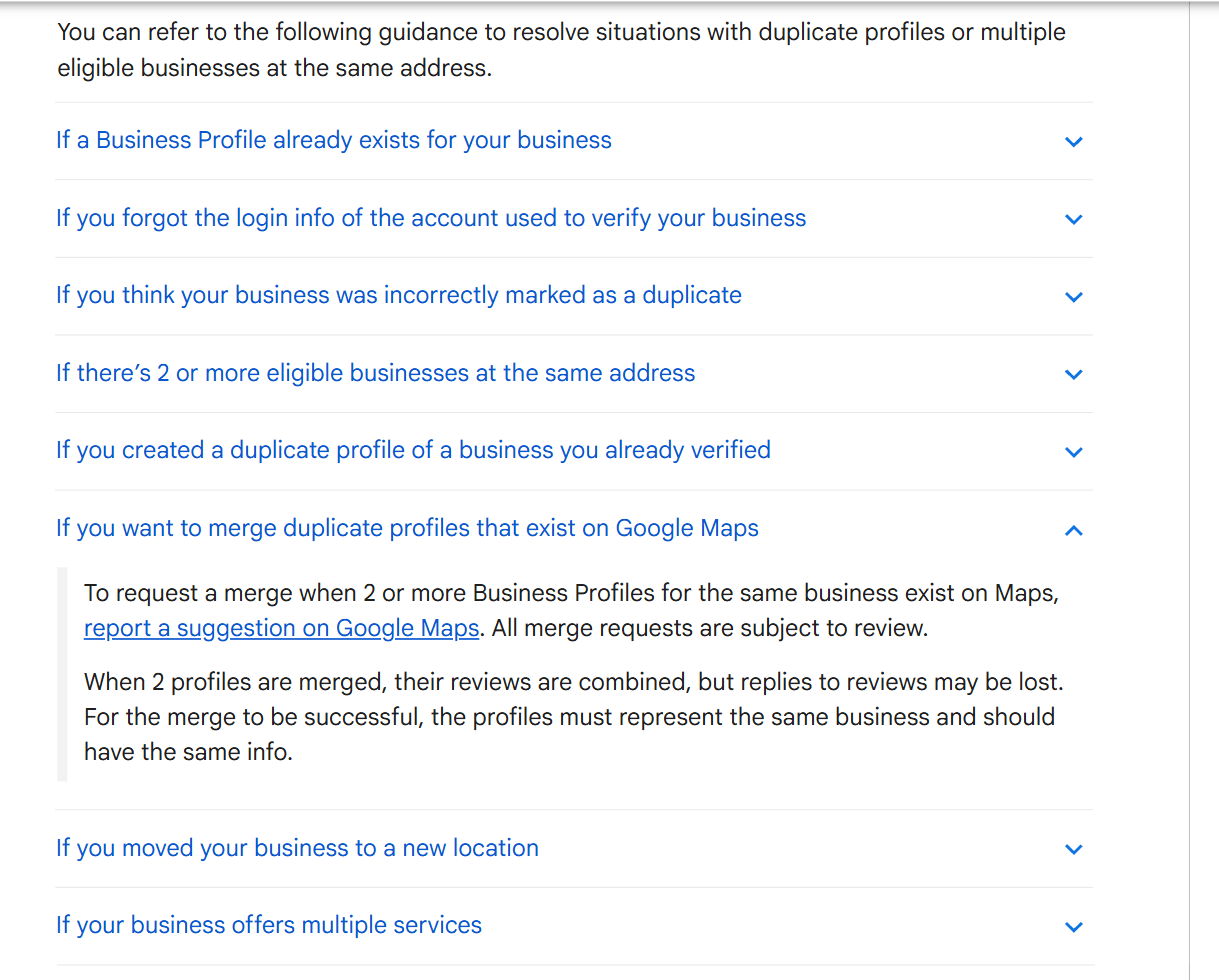
The reviews survive. The replies might not. Copy them out before you start, at least the ones you took trouble over, then post them again on the surviving profile. Where to find your Google reviews covers reading them on each profile you manage.
The other half only shows up in networks. Reviews attach to the profile they were left on and never move between two legitimate locations, so the way you ask decides where they land. The classic mistake is one review link copied out of head office into every site's messages: the network's reviews pile up on one card and the rest look abandoned. Every location needs its own Google review link, and how to get more Google reviews covers making the ask the same everywhere.
Two businesses at the same address
Sharing an address is allowed when there really are two businesses, and Google is specific about what has to be visibly different.
Departments first. A publicly-facing department that operates as a distinct entity can have its own profile, but its name "must be different from that of the main business", its categories have to be distinct, and Google expects a separate customer entrance. Co-located food brands are held to the same standard: they "each must have permanent separate signage".
Individual practitioners are the other common case. A practitioner gets their own profile if they work in a public-facing role and can be contacted directly at the verified location during stated hours. A physiotherapist working inside a clinic qualifies. The receptionist does not, and neither does a second profile for each of that physio's specialisations.
The test before you create that second profile: if a customer on the footpath cannot tell there are two businesses there, Google reads it as one, and the second profile is a duplicate.
Keeping every location right once you have a few
The setup is a one-off. The drift is permanent. One site changes its Sunday hours in the booking system and not on Maps, a number gets ported, a location moves two doors down and updates the website only. Nobody notices until a customer arrives at a closed door and writes about it. At three locations a calendar reminder covers that. Past ten it needs a system.
Cloutly's listings management keeps one record per location, publishes name, phone, website, description, address and hours to Google Business Profile and Facebook after you approve a preview of exactly what will change, and checks Google's public view, Yelp, Facebook and TripAdvisor against that record weekly. For a network rather than a handful of sites, the multi-location page covers the rest of that job.
If some of your sites are not properly on Google yet, start at adding a business to Google Maps and come back once each one has a profile of its own. It also covers service areas, for sites with no shopfront.
FAQ
Can two businesses have the same name on Google?
Yes. Two unrelated companies can share a name and Google does not police that. Within one chain Google goes further and requires it: every location in the same country carries the same name, unless a site consistently trades under a different one on its storefront, website and stationery.
How do I merge two Google Business Profiles?
There is no one-click merge. If you manage both, remove the profile that has no verification and no reviews. If someone else holds the duplicate, request access and wait the three days Google gives them to reply. If nobody manages it, report it as a duplicate suggestion on Google Maps.
What happens to reviews when Google Business Profiles merge?
Google says the reviews are combined, and warns that replies to reviews may be lost. Copy your replies out before you start, then post them again on the surviving profile. Reviews never move between two legitimate locations: each profile keeps the reviews left on it.
How long does it take Google to remove a duplicate?
Google publishes one timeframe in the whole process: the owner of a profile has three days to answer an access request. Removing a duplicate you already control is immediate. For anything else, including a merge suggestion on Maps, Google says only that requests are subject to review.
Can I have two profiles at the same address?
Only if there are two genuinely separate businesses. Google expects each to have a different name, its own category and permanent separate signage, and for a department, its own customer entrance. Two profiles for one business at one address is a duplicate.