
Blog Facebook ReviewsGuidesReviews
Facebook reviews for business: the complete 2026 guide
Facebook replaced star reviews with Recommendations years ago. Most guides still describe the 2021 Page. Here is what the setting is actually called now.
Lachlan Fea 12 min read
In this article14 sections

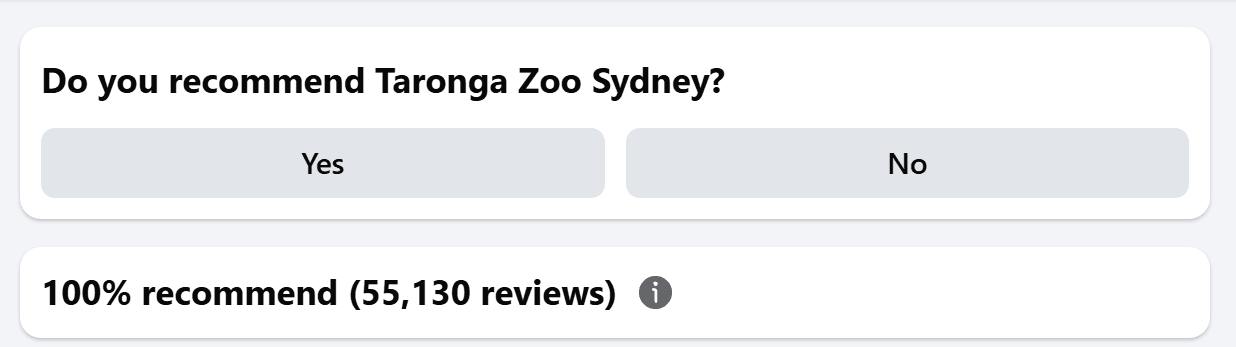
Facebook reviews for business are called Recommendations. A customer answers yes or no to "Do you recommend this business?", writes a short post, and your Page shows the share of people who said yes next to the number of reviews behind it. Recommendations are off until someone switches them on, and Meta says a Page may not have a rating at all until it has received at least five reviews.
That is the whole model, and most guides ranking for this topic still describe a Page layout Facebook retired years ago. I checked everything below on 6 September 2026 against Meta's current help pages, its developer docs, the FTC's own rule guidance and a live Facebook Page.
Facebook reviews vs Facebook Recommendations
There is no difference. Meta uses both words for the same feature, sometimes in the same sentence. The toggle in your Page settings says reviews, the button a customer taps says recommend, the tab on your Page is called Reviews, and the help article is called Turn Recommendations on or off for your business Page.
What changed is the shape of the answer. There is no five-star selector on a Page any more. A customer picks Yes or No, writes something, and chooses who can see it. Your Page then shows a percentage and a count, so it might read "82% recommend (214 reviews)" where it once read "4.6 stars".
The name matters less than two practical details.
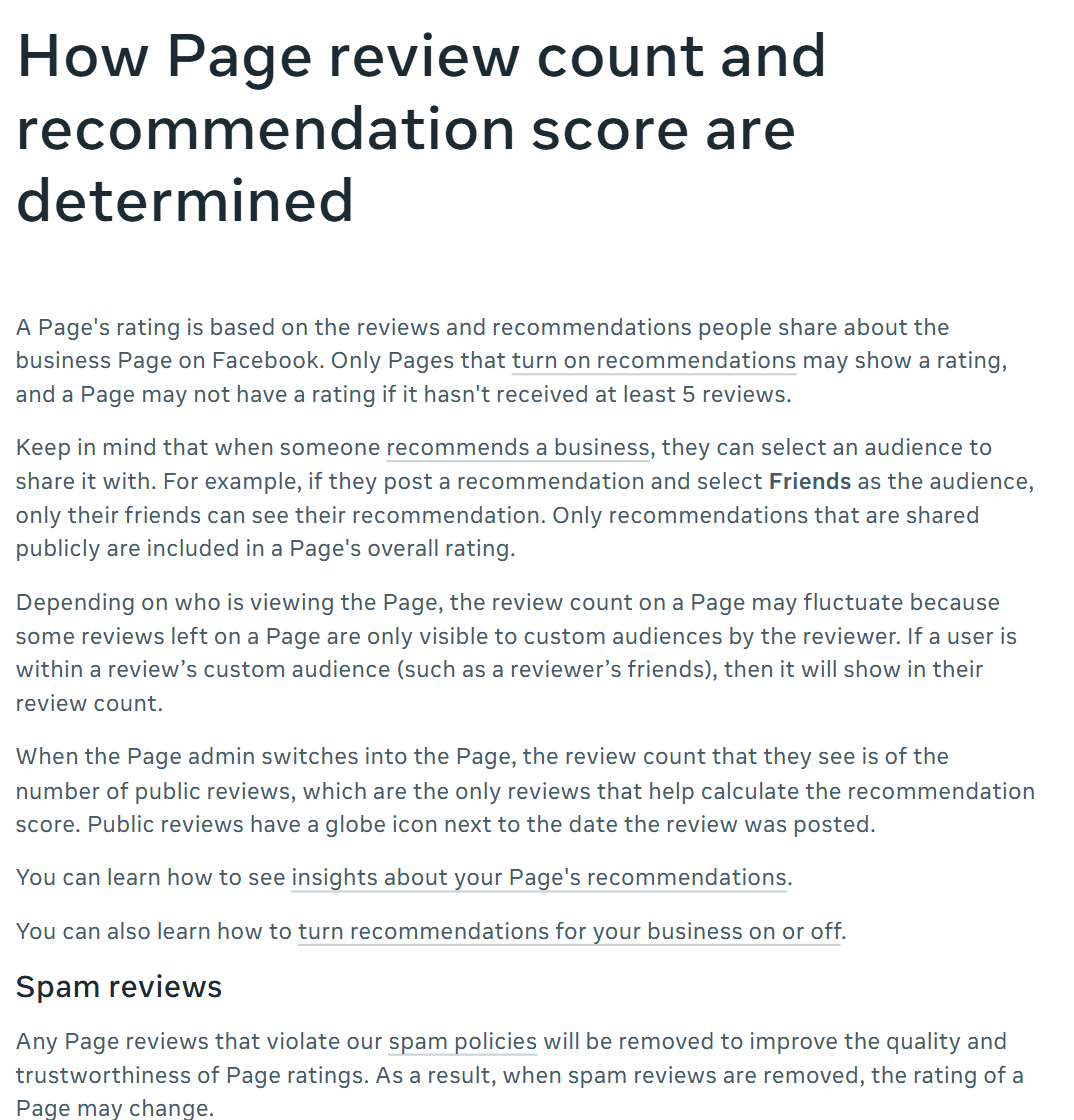
Only public recommendations count. A customer who chooses Friends as the audience leaves a recommendation their friends can see and that never touches your score. Meta is explicit: "Only recommendations that are shared publicly are included in a Page's overall rating." Public ones carry a globe icon next to the date.
Your review count is not one number. Meta says the count "may fluctuate" depending on who is looking, because a viewer inside a reviewer's chosen audience sees that review and other viewers do not. Switch into your Page as an admin and the count you see is the public one.
There is also a second, separate thing called reviews on Facebook. If you run Meta ads, Meta may ask customers who bought after seeing one to rate their purchase experience. Those ratings live in the ads experience and in a Ratings and reviews tool inside Meta Business Suite, not on your Reviews tab. Two systems, one word. Most guides do not mention the second at all.
Why Facebook reviews for business matter, and how much
Honestly: for most service businesses, less than Google. Facebook recommendations never show up in Google's local pack or on Google Maps, which is where a plumber, a clinic or a salon gets found. Finish the Google reviews playbook, and the Business Profile it runs on, before anyone spends a week on Facebook.
The numbers back that ordering without erasing Facebook. BrightLocal's Local Consumer Review Survey 2026, a panel of 1,002 US consumers, found 34% had left a Facebook review in the past year, against 45% for Google and 24% for Yelp. Second, ahead of Yelp, is not nothing.
Facebook is worth real effort in four cases.
- Your customers live in local Facebook groups. Trades, childcare, pet care, gyms and community venues get a steady flow of "can anyone recommend a..." posts. A Page with 200 recommendations wins those threads; a Page with none is invisible in them.
- You run Meta ads. Meta says business ratings and reviews "will be visible within the ads experience", so a rating sits next to the ad you are paying for.
- You are a venue. Restaurants, pubs, function spaces and attractions collect Facebook recommendations without asking, because people post about going out.
- Your Page outranks your website. For plenty of small businesses the Page is the first or second result for the business name, so whatever is on it is the first impression.
If none of those describe you, switch Recommendations on, reply to what arrives, and spend the rest of your time on Google.
How to turn Facebook Recommendations on (and off)
This is the step every old guide gets wrong, because it describes the pre-2022 Page layout with a left-hand settings column and a Templates and Tabs screen. Neither exists now. The current path, from Meta's help article:
- Log into Facebook, then click your profile photo in the top right.
- Click See all profiles, then select the Page you want to switch into.
- Click your Page's profile photo in the top right.
- Click Settings & privacy, then Settings.
- Click Page and tagging.
- Toggle Allow others to view and leave reviews on your Page? on or off.
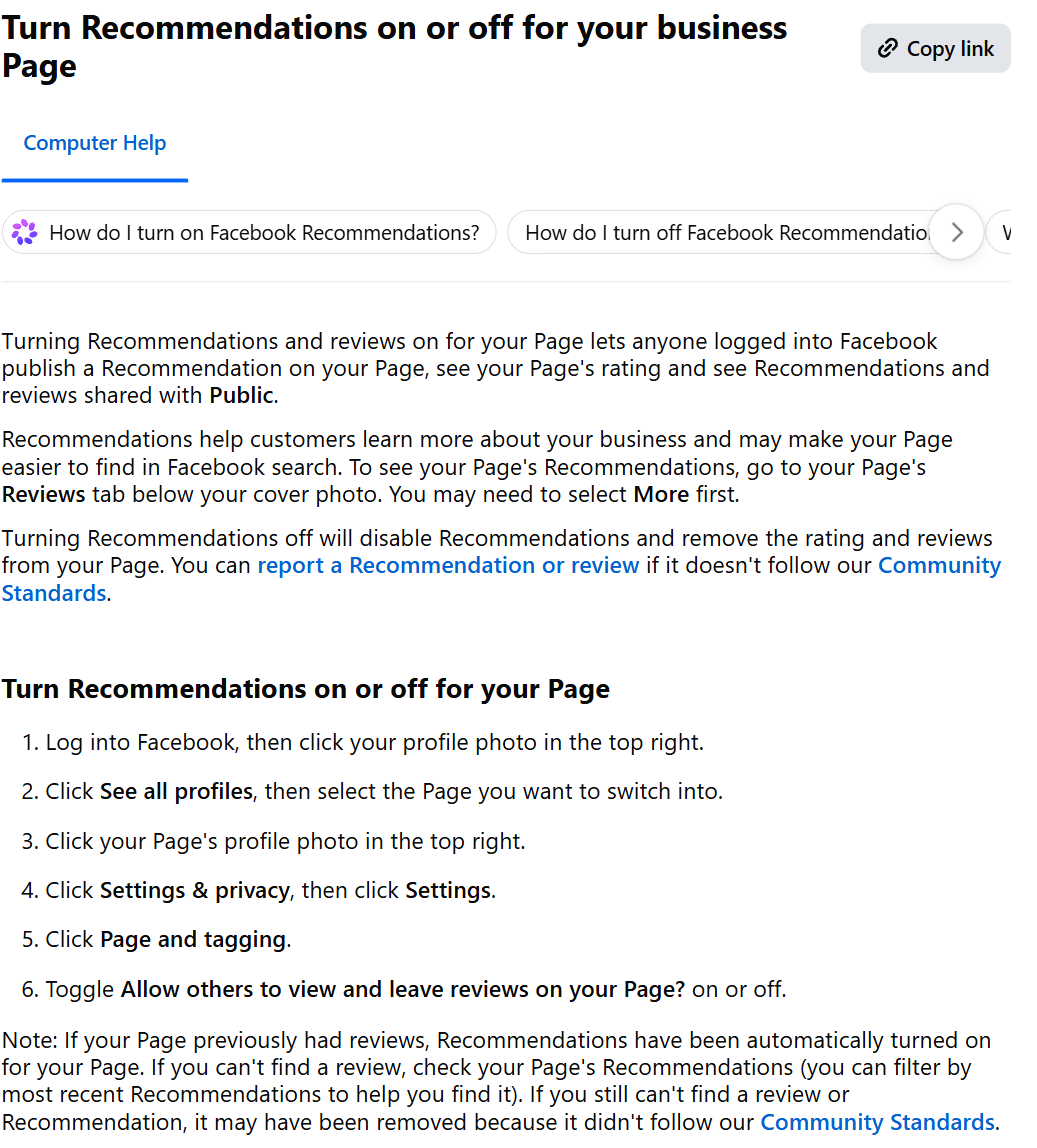
The setting sits under Page and tagging, which is not where anyone expects reviews to be, so use the search box in Settings if the menu has moved again by the time you read this. If your Page had reviews before the change, Meta says Recommendations were turned on for it automatically. Once they are, the reviews sit on a Reviews tab below your cover photo, and Meta notes you may have to select More to find it.
Turning it off is the same toggle. Meta is clear about the consequence: "Turning Recommendations off will disable Recommendations and remove the rating and reviews from your Page." It hides the whole tab, not the one review you dislike. There is a section on that below.
Meta makes one claim for the feature: Recommendations "help customers learn more about your business and may make your Page easier to find in Facebook search". Note the "may". Treat any guide promising a Facebook ranking boost with suspicion, and ignore anyone who tells you Facebook recommendations lift your Google ranking. There is no evidence they do. Google ranks on its own signals, and Google reviews are the ones that feed them.
How to get more Facebook reviews
The mechanics are the same as any other review site, with one wrinkle: the customer has to be logged into Facebook, on Facebook, to leave one. That is a bigger ask than a Google link.
- Turn Recommendations on first. Asking for reviews on a Page that cannot accept them is the most common wasted campaign there is. Load your own Page's
/reviewsURL in a private window and check that the Yes and No buttons render. - Ask soon after the job. Same day if you can. The specifics a good recommendation needs, the name of the person who helped and what got fixed, fade within a week.
- Ask everyone, not the ones you expect to be kind. Screening customers by how they feel before you decide who gets the link is review gating. It is the fastest route to a rating nobody believes, and where it shades into offering something for a good review it is now unlawful in the US. The Meta and FTC rules are set out below.
- Send one link, not instructions. "Leave us a review on Facebook" makes the customer go and find the Page. A link straight to your Reviews tab does not.
- Ask by text or email, not only in person. An ask at the counter converts far worse than a message the customer can act on later, and it depends on somebody remembering.
- Reply to the ones you get. Public replies are the cheapest signal you have that a person reads this Page.
If Facebook is your second priority behind Google, send everyone to Google and add a Facebook ask for the segment that already engages with your Page: people who message you, comment on your posts, or found you through a group. The pillar guide on getting more reviews covers timing and wording, and all of it transfers.
How to get your Facebook review link
Your Reviews tab has a direct URL:
https://www.facebook.com/YourPageUsername/reviews
Swap in the username from your Page's address. It opens the Reviews tab with the recommend buttons in view, which is as close to a one-tap ask as Facebook allows. Copy the address out of your own Page rather than assuming it: not every Page has a tidy username to type.
Test it in a private window first. If Recommendations are off, the URL renders "This content isn't available right now", which is exactly what a customer would see and what you would never otherwise find out.
How customers tag your business on Facebook
A recommendation is not the only way a customer's post reaches your Page. When someone types @ followed by your Page name in a post or a comment, Facebook turns it into a link to your Page. They can also tag your Page in photos, which Meta documents under Interact with Pages.
Tagged posts are where "can anyone recommend a..." threads get answered, so a tag is a recommendation in everything but format: it names you, it comes from a customer, and it reaches people who were already asking. You cannot make customers do it, but you can make it easy. Spell the Page name the same way everywhere, so the autocomplete finds it and it matches your signage. Then reply from the Page when a tag arrives. A tagged post with a reply reads as a live business; the same post ignored for three weeks reads as a closed one.
What you cannot do: Meta's rules and the FTC's
Two sets of rules apply, and they overlap.
Meta's. Its guidance to reviewers is short: focus on the product or service, base the recommendation on personal experience, and "you should not leave a recommendation for a business if you help manage its Page". That last line rules out the staff-and-family launch strategy half the internet still recommends. Meta also says plainly that it does not verify whether a reviewer bought anything, which is why a sudden burst of recommendations from new accounts is a bad idea.
The FTC's. The Rule on the Use of Consumer Reviews and Testimonials, 16 CFR Part 465, went into effect on 21 October 2024. It bans buying and selling fake reviews, bans compensation conditioned on a review expressing a particular sentiment, and bans reviews by an officer, manager, employee or agent that do not disclose the connection. Courts can impose civil penalties for knowing violations, and in December 2025 the FTC sent warning letters to companies over incentives for five-star reviews, noting that penalties reach $53,088 per violation. If you sell into the United States it applies to you whichever platform the review sits on.
The FTC's own question and answer page is more precise than most of the advice written about it. Incentives are not banned outright: "The rule does not prohibit giving incentives for reviews, as long as there isn't an express or implied requirement that the reviews have to express a particular sentiment." Paying for five-star reviews is out even if the reviewer discloses the payment, and the FTC answers that one with a flat No. Failing to disclose an incentive is a separate problem under the FTC Act.
So: ask anyone, remind them once, and if you offer something, offer the same thing whatever they write and say you offered it. More on how platforms catch the rest in how to spot fake reviews.
How to respond to Facebook reviews
A public recommendation is a post, so you reply the way you reply to any post: switch into your Page, open the Reviews tab, and comment as the Page rather than as yourself. Check the byline on the comment box first. Replying as your personal profile is the most common Facebook reply mistake and everyone can see it.
The purchase-experience reviews are the ones Meta routes through Business Suite. Its instructions: go to Meta Business Suite, click All tools, then under Manage click Ratings and reviews, then Respond in the Actions column, write the response and click Publish response. Meta checks the response against its Community Standards before it goes live, and you can edit or delete it afterwards from View response.
What to write is the same job on every platform: thank the specific thing, answer the specific complaint, keep it short, and move the argument to a private channel. The worked examples in our review response examples hub apply here unchanged.
If you already run review software for Google, check whether it covers Facebook properly before you add another tab to your day. In Cloutly, Facebook reviews and Messenger threads land in the same inbox as Google's across every location, and your hours, phone and address publish to the Facebook Page as well as to Google Business Profile through listings management.
How to hide, report or remove a Facebook review
You cannot delete a recommendation about your business. Meta's position on reviews generally is blunt: businesses "may reply to reviews, but they can't edit or remove reviews. Reviews are only removed if they go against our Community Standards." For Page recommendations the only two levers Meta documents are the report flow and the on/off toggle. That leaves three real options.
| What you want | What is actually available |
|---|---|
| Remove one bad recommendation | Report it, and only if it breaks Community Standards. Meta decides. |
| Remove all recommendations | Turn the toggle off in Page and tagging. It hides the tab, the rating and every review, including the good ones. |
| Stop a particular person posting | Ban them from the Page. It stops future posts and comments but does not delete what they already wrote. |
The middle option is the one to think hardest about. You lose every good review to hide one bad one, and a Page with no Reviews tab looks like a business that switched it off, because that is what it is. A week while you handle something serious is defensible. Leaving it off is a decision to run without social proof.
The third option is covered step by step in how to ban someone from your Facebook business Page, and if the same person is flooding your inbox, turning off Messenger for the Page is the blunter tool. The equivalent process on Google, which is the one most businesses need more often, is in how to remove negative Google reviews.
How to report a fake review on Facebook
Meta's steps for a Page recommendation:
- Click Reviews under Details below the Page cover photo.
- Tap See all next to Recent reviews.
- Click Options in the top right corner of the post you want to report.
- Select Report post.
- Follow the on-screen instructions.
Two limits are worth knowing before you spend an afternoon on it. Meta says "Recommendations that only include a star rating can't be reported", so a bare rating with no text has no report path. And a report is judged against Community Standards, not against whether the review is fair or whether the person was ever a customer. A detailed but untrue review from someone who never walked in usually survives. Something abusive, off-topic or obviously spam usually does not.
For the ads-linked reviews the report route is inside Business Suite: All tools, Ratings and reviews, then Report next to the Actions column. Meta says the review stays publicly visible while it is assessed, and the Status column changes from Published to Pending.
For the rating-only rule, what Meta does after you report, and what running more than one Page changes, see how to remove a review from a Facebook Page.
Why can't I see all my Facebook reviews?
This is the most searched Facebook reviews problem and it almost always has one of five causes.
- Recommendations are off. The tab and every review with it disappear from the Page. Check the toggle in Page and tagging.
- The review was not public. The reviewer chose Friends or a custom audience, or changed the audience after posting. It exists, their friends can see it, and it does not appear in your public count or your score.
- You are under five reviews. Meta says a Page may not have a rating until it has at least five.
- It was removed. Meta removes reviews that break Community Standards and reviews caught by its spam enforcement, and it says a Page's rating can change as a result.
- You are looking as the wrong identity. Switched into the Page as an admin you see the public count. Logged in as yourself you may see more, because you sit inside somebody's friends audience.
If the count moves and nothing else explains it, spam removal is the usual answer, and Meta does not notify you when it happens.
How to embed Facebook reviews on your website
There is no plugin that embeds your Reviews tab, and there never has been. Meta's Page plugin renders "timeline, events, messages" and nothing else. Meta also discontinued several of its older social plugins on 10 February 2026 and says in the social plugins FAQ that "no replacement plugins are being provided". The retired ones "gracefully degrade to invisible elements", a polite way of saying the box on your homepage may already be gone and nobody told you.
What you can do:
- Embed one public recommendation as a post. A recommendation is a post, and Meta's Embedded Posts plugin embeds public posts. Fine for a single strong review on a landing page, unworkable as a wall.
- Use a review widget that reads your Page. Third-party widgets pull the reviews through an integration and render them as HTML you control, which is also the only version that survives Meta changing its plugin lineup again.
- Screenshot it. Legitimate, and out of date the moment the review count moves.
Most businesses want a mixed wall rather than a Facebook-only one, and the practical guide to that is how to embed Google reviews.
How to leave a review on Facebook
Send this to a customer who asks how. From Meta's instructions:
- Go to the business's Page.
- Click Reviews.
- Click Yes to recommend the Page, or No if you would not.
- Select the audience for your review.
- Write the recommendation.
- Click Post.
Step 4 is the one to flag when you ask, because Public is the only setting that counts towards the rating. A customer who leaves the audience on Friends has written you a lovely review your Page will never show. It is recoverable: Meta lets a reviewer change the audience afterwards from the post's own Edit privacy option, so "would you mind switching it to Public?" is a real fix rather than a lost cause.
Facebook reviews across multiple locations
Everything above applies per Page, which is the difficulty when you run more than one site.
Every location needs its own toggle checked. Recommendations are a Page setting, not an account setting, and there is no bulk control. Thirty Pages is thirty checks. Do them once, in a spreadsheet, with each Page's /reviews URL in a column so anyone can re-test one in a click.
Every location needs its own review link. One link for the brand sends a customer in Geelong to review the Newcastle store, or to a Page nobody local manages. Build the per-Page URL for each site and put it in that site's follow-up message.
Decide who replies. Meta grants access Page by Page: its Business Suite reviews tool needs Facebook access to the Page, or task access to Community activity. Either the location manager replies and you accept variable quality, or head office replies and you accept a slower reply time. The failure mode is both sides assuming the other is doing it.
Deal with duplicate Pages before you start asking. Unofficial and place Pages get created for locations all the time, and recommendations sit on the Page they were left on. Two Pages for one site means a split count and a customer flipping a coin. Work out which Page you are pointing people at, and point everything there.
The broader playbook for running one review programme across many sites is on our multi-location reputation page.