
How to remove a Google review (2026): what Google will and will not take down
You can't delete a Google review. You can report it, appeal once, and then choose between the legal route and the arithmetic.
Lachlan Fea 13 min read
In this article12 sections

You can't delete a Google review yourself. You can report it, and Google takes it down only if it breaks one of its content policies. If the report is declined you get one appeal, and after that the routes left are legal or arithmetic: a removal request on legal grounds, or enough new reviews that the bad one stops setting your average.
That choice decides everything else. Most of the wasted weeks I see come from picking the wrong route on day one.
Checked on 6 September 2026 against Google's help pages, its Maps content policies and the text of the FTC's consumer reviews rule. Two things have changed since this guide was last revised. Reporting and appealing now run through Google's Reviews Management Tool, which replaced the free-text small-business support form. The FTC's rule on consumer reviews also came into force in October 2024, making the suppression of honest reviews a civil-penalty matter in the US.
Can you remove a Google review?
No, a business cannot remove a Google review. Only Google can take a review down, and it does that when the review breaks one of its content policies, not when it is negative, unfair or bad for business. Reporting is free and takes a few minutes. Google says review evaluation typically takes several days.
There are four routes. Tell them apart before you spend a week on the wrong one.
- Report the review. Free, and the only route that works on a policy breach.
- Appeal, once. One attempt per review, so it is worth preparing rather than firing off.
- A legal removal request. For content that is unlawful where you trade. Narrow and slow.
- Ask the customer. Once you have fixed the thing they wrote about, this works more often than owners expect.
There is a fifth route nobody sells you: leave it up, answer it well, and make it a smaller share of a bigger number. The arithmetic is further down, and it is better than it sounds.
The same routes exist on the other sites under different names: Yelp, Tripadvisor, a Facebook Page and Glassdoor.
What Google actually removes: the policy list
Google publishes the policies its reviewers apply, in prohibited and restricted content for Maps contributions. Google judges your report against that list and nothing else, so work out which line the review breaks before you open the form. The rest of the rules sit in the Google review policy.
The list changed after 2022. Fake engagement and rating manipulation now sit underneath fake and misleading content. "conflict of interest", which the earlier version of this guide treated as a category of its own, is no longer a heading. A competitor or an ex-employee posing as a customer is now misrepresentation.
| Policy | What it looks like on a review | Removal odds |
|---|---|---|
| Fake and misleading content | A review from someone who was never a customer, or an account posting the same text on several businesses | The strongest case you can make |
| Rating manipulation | Ratings traded, bought or posted to move a score up or down, including by a competitor | Strong when the pattern shows across profiles |
| Misrepresentation | A current or former employee, a contractor or a competitor posing as a customer | Strong, and often the real category for a "fake" review |
| Off-topic | Politics, another branch, or something that never happened at that location | Moderate, and often misjudged |
| Harassment | Threats, doxxing, or content aimed at a named staff member | Strong |
| Personal information | A staff member's phone number, home address or medical detail | Strong |
| Obscenity and profanity | Profanity used to offend rather than to describe | Moderate |
| Advertising and solicitation | A competitor's phone number or offer inside a review of you | Strong |
| Impersonation | An account pretending to be you, a staff member or another organisation | Strong |
| Unclear and repetitive content | Character strings that carry no meaning, or the same review posted again and again | Moderate |
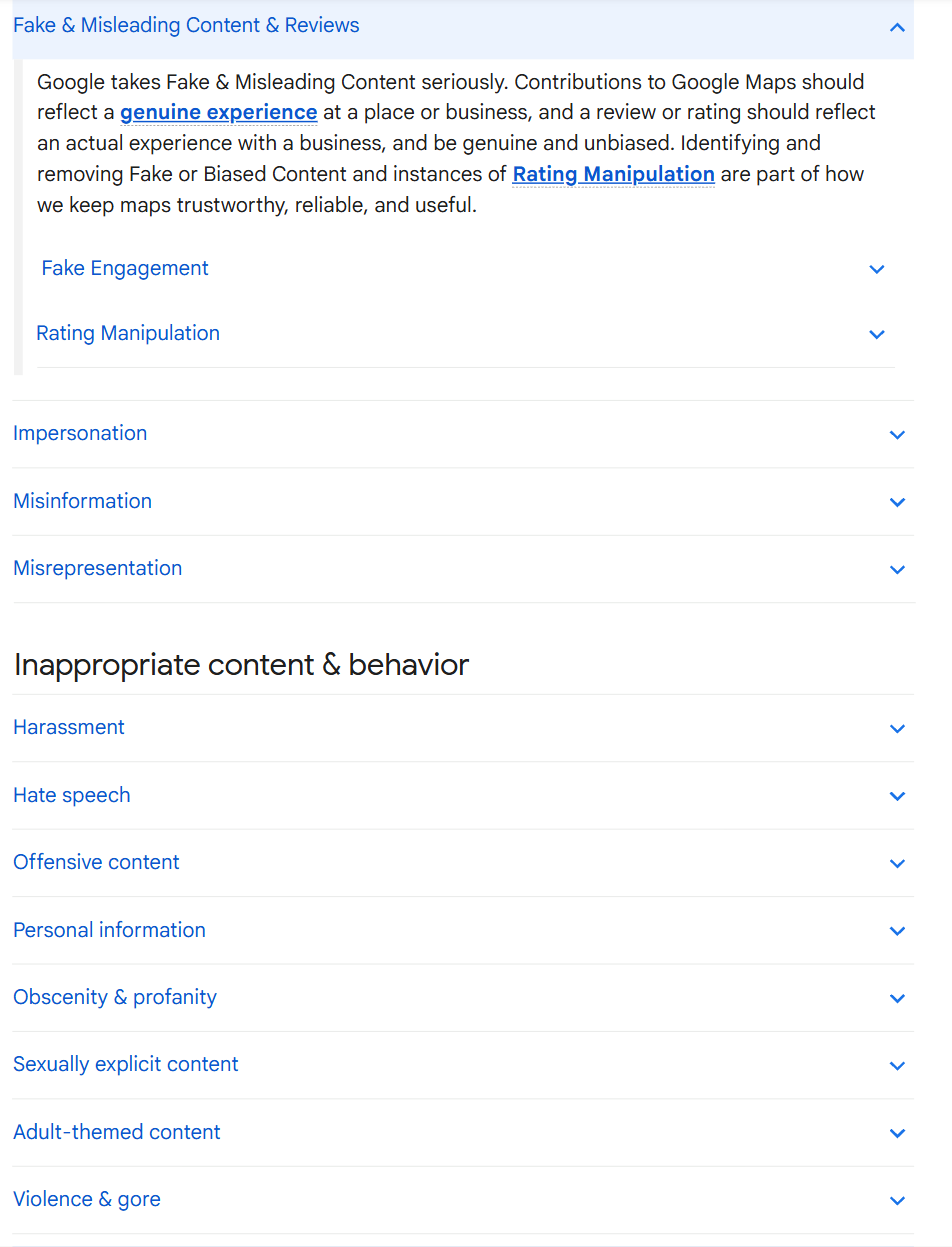
Google's policy page, September 2026. Rating manipulation is a sub-policy of fake and misleading content, not a category of its own, which is why a report filed under the wrong heading reads as a complaint rather than a breach.
Nothing on that list says "the customer is wrong" or "we have no record of this booking". Google's own instruction is blunt: do not report a review just because you disagree with it or dislike it, and Google does not get involved in conflict between businesses and customers. A report that argues unfairness gets declined, and it burns the appeal you may need later.
How to identify and report a fake Google review, step by step
Before you report anything, look at the reviewer. An account with no photo, no other contributions and a review posted minutes after two others on nearby businesses is a different case from a one-line 1-star left by a real local account. Check the review against your booking records for that week, and search the exact wording. Identical text sitting on other profiles is the cleanest evidence of a fake there is. Our guide to spotting fake reviews goes through the rest of the patterns.
Google documents two reporting routes. Both are free, and both need you signed in to the account that manages the profile.
From your Business Profile
- Open your Business Profile from Google Search or Google Maps, signed in as an owner or manager.
- Select Read reviews.
- Next to the review you want to flag, select Report.
- Select the reason for the flag, then select Send report.
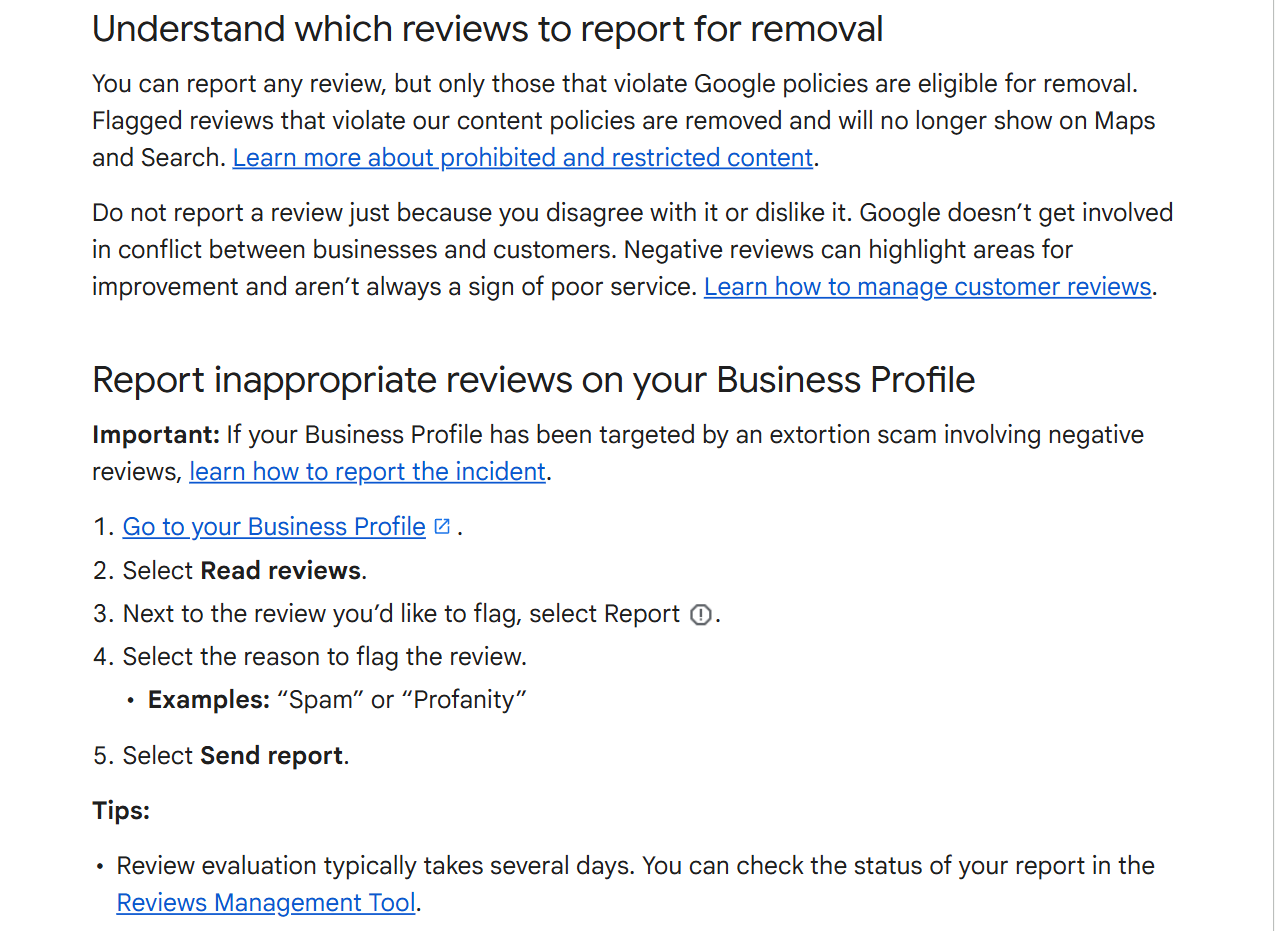
The steps as Google documents them in September 2026. Note the line above them: reports are only eligible for removal if the review violates a policy.
From the Reviews Management Tool
- Open Google's Reviews Management Tool.
- Confirm the email address shown, or select Switch account if the profile sits under another login.
- Select your business.
- Select Continue, then Report a new review for removal, then Continue.
- Next to the review you want to flag, select Report.
- Pick the reason in the new tab, then select Submit.
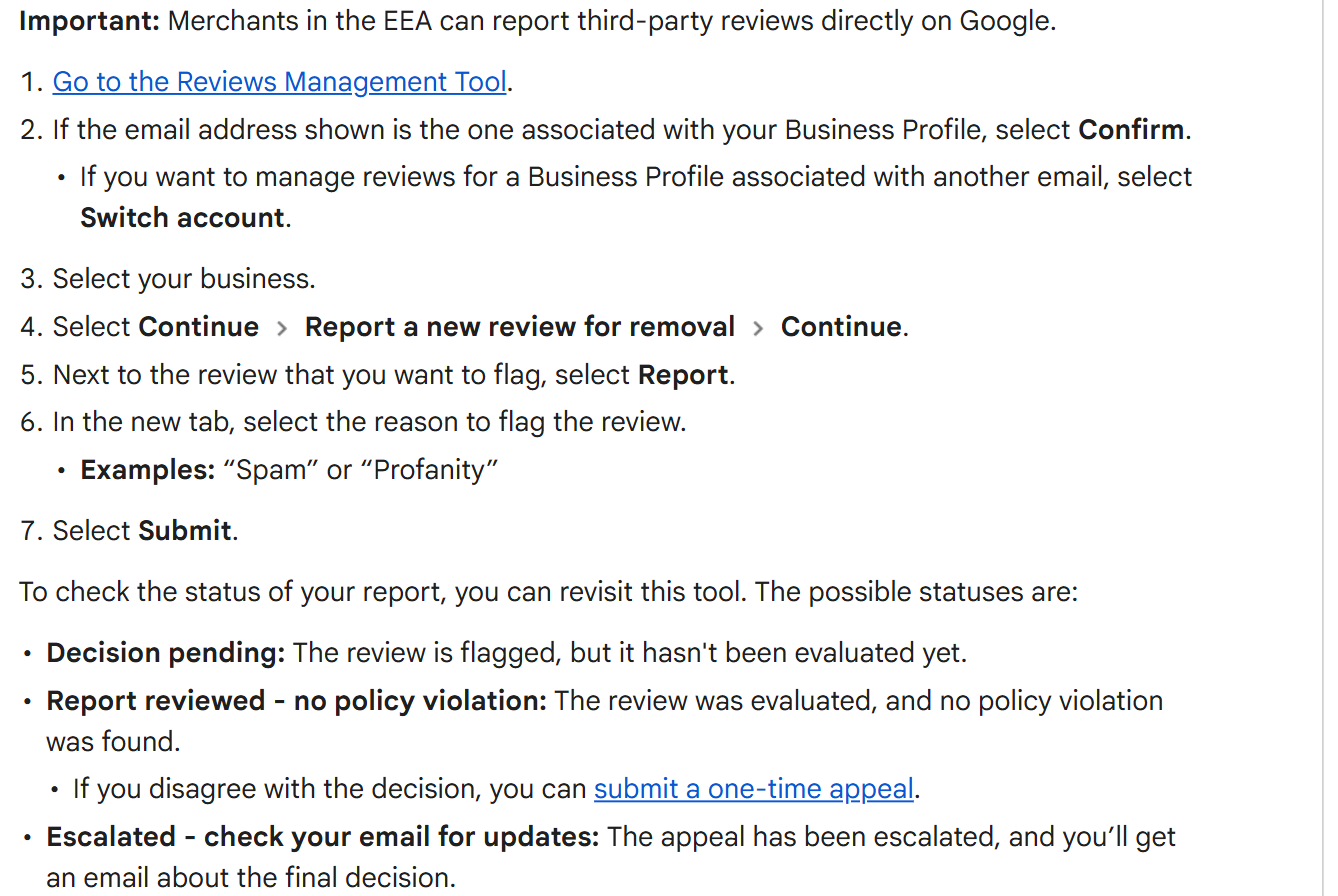
The tool is where the status and the appeal live. The three status strings at the bottom are the vocabulary to search for when a report has gone quiet.
The tool is the better of the two routes, because the status and the appeal are there and you are not opening a dozen profiles one at a time. If an older guide sent you to business.google.com/locations, that is not where any of this happens now.
Two things do not help. Google evaluates the review against its policies, and nothing it publishes promises a second look because a review has been flagged more often. Asking eight staff to report the same review is effort spent for nothing. The form asks for a category, not an essay. Keep your evidence for the appeal, which is where a person reads it.
How to dispute a Google review removal
Check the status in the Reviews Management Tool first. Google shows one of three things. Decision pending means the review is flagged and has not been evaluated yet. Report reviewed - no policy violation means it was evaluated and declined. Escalated - check your email for updates means an appeal has gone up a level and the final decision arrives by email. That last one is also the status a review keeps once an appeal has been assessed and the review stayed up, which is why the tool can look stuck when the matter is closed.
If Google declines your report, you get one appeal per review. In the same tool, choose Check the status of a review I reported previously and appeal options, then Appeal eligible reviews at the bottom, select the review, and fill out the form. You can put up to ten reviews through at once. Google emails the result. There is only one attempt, so write it properly.
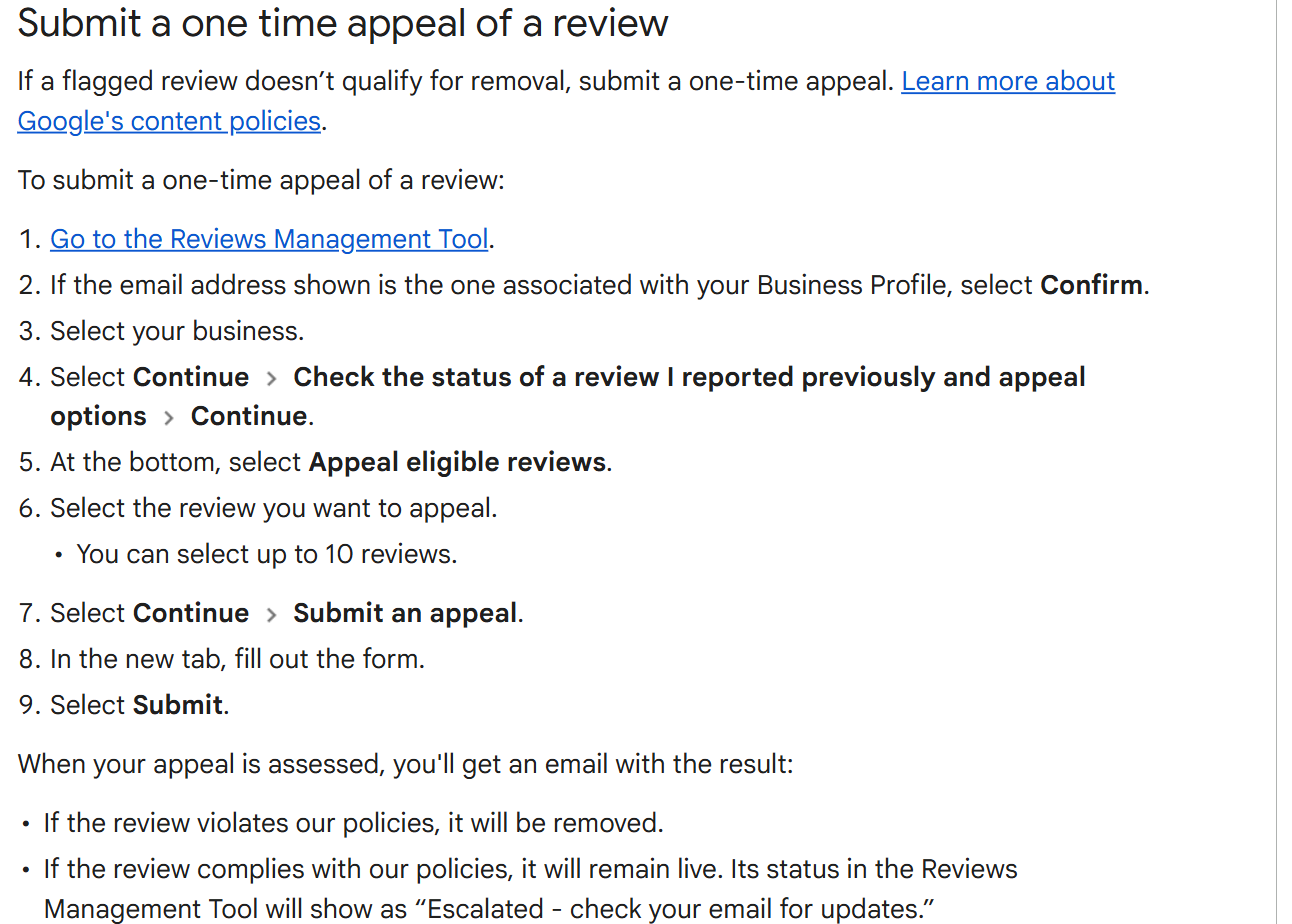
The appeal path, buried four clicks into the same tool. "Appeal eligible reviews" sits at the bottom of the list, which is why owners miss it.
What moves an appeal
- The policy, named. "Misrepresentation: the reviewer is a former employee" rather than "this review is unfair".
- Proof the person was never a customer. Dates, booking records, no trace of that name in the period the review describes.
- The same text sitting on other business profiles, with links.
- The words that break the policy, quoted, where the breach is harassment, personal information or advertising.
What does not move an appeal
- Revenue harm. Google does not weigh it.
- The reviewer's tone, or a general claim that a competitor is behind it with nothing that shows it.
- Your reply to the review, however good it is.
The reverse case is common and follows a different process: Google removes or hides a genuine review your customer really did leave. That is a filtering problem with its own fixes. We covered it in why a Google review is not showing up.
How to remove a 1-star review with no text
A star-only rating with no comment is the hardest kind to get removed. Google's policy list has no rule against rating a business without writing anything, so a report has to rest on a different policy, almost always fake and misleading content or misrepresentation, and you have to be able to show it.
That makes the case about the account rather than the rating. A rating from someone with no booking, no visit and no record with you is reportable as fake. A rating from a real local account who came in and did not enjoy it is not going anywhere.
Do not report it as off-topic. That is the category owners reach for and it is the wrong one. A rating of your business is on-topic by definition, and a declined report costs you your appeal.
When it is a legal removal, not a policy removal
If a review states something false as a matter of fact, rather than something harsh as a matter of opinion, you may have a legal route where you have no policy route. Google has a separate path for it: the Report content on Google troubleshooter. It takes defamation claims and court orders, and assesses them against the law where you are rather than against Google's content policies.
This is not legal advice, and defamation law differs by country and by state. The line that matters nearly everywhere is fact against opinion. "The physio was rude and the room was cold" is opinion. "They charged my card twice and refused to refund it" is a statement of fact, and a statement of fact can be shown to be false.
Here are the two post-refusal routes side by side, because most guides describe one and pretend the other does not exist.
| Policy appeal | Legal removal request | |
|---|---|---|
| What you argue | The review breaks a named Google policy | The content is unlawful where you trade |
| Where it goes | The Reviews Management Tool | Google's legal troubleshooter |
| Who decides | Google, against its own policies | Google's legal team, or a court |
| What it costs | Your time | Legal advice, and court costs if you need an order |
| Evidence that works | The policy breached, plus proof the reviewer was not a customer | The false statement of fact, and why it is false |
| Timeline | Google says several days | Weeks, or months with a court order |
| Attempts | One appeal per review | As many as your budget allows |
| The risk | You spend the appeal and get nothing | Proceedings are public, and a claim can draw far more attention to the review than it had on its own |
Which leaves the removal companies. Search "Google review removal service" and you will find plenty of them. There is no paid channel into Google's review team: the routes Google documents are the report, the single appeal and the legal request, so a removal service is using the ones you already have, plus whatever legal process it is willing to run on your behalf. That is worth paying for when a review is genuinely defamatory and you do not want to run a legal matter yourself. It is worth nothing when the review is a real customer's honest opinion, and a service promising to remove those is either failing quietly on a no-win-no-fee basis or doing something you do not want your business attached to. We went through one of them in our look at Removify. A cruder trade works the same fear from the other end and sends you a fake review notification.
The FTC review rule, and why "just delete it" is now the riskier move
The FTC's Rule on the Use of Consumer Reviews and Testimonials (16 CFR Part 465) came into force on 21 October 2024. Most coverage of it is about buying fake reviews. The part that matters to a business trying to get one taken down is the section on suppression.
Under that section it is unlawful to use an unfounded or groundless legal threat, a physical threat, intimidation or a public false accusation to stop someone posting a review, or to get an existing one taken down. It is also unlawful to misrepresent that the reviews you display are most or all of those submitted, when you are holding negative ones back on the basis of rating or sentiment. The rule does let you withhold a review that is defamatory, that carries someone's personal information or a trade secret, that is clearly false or misleading, that you reasonably believe is fake, or that has nothing to do with what you sell.
The FTC has moved from writing the rule to using it. In December 2025 it sent warning letters to ten companies over practices it says may breach the rule, and that notice puts civil penalties at up to $53,088 per violation.
Three points follow for anyone reading this with a bad review in front of them.
Emailing a customer to say your lawyers will be in touch unless the review comes down, when you have no claim to bring, is the thing the rule names. Reporting a review to Google is not, and neither is asking politely whether the customer would revisit it once you have fixed what they complained about.
Filtering the reviews on your own website so the widget shows the good ones while implying it shows all of them is the second exposure, and the more common one. If you publish a selection, do not describe it as everything.
Routing unhappy customers to a private feedback form while sending happy ones to Google is the practice the rule was written around, and it breaches Google's policies too. Do not build it, and do not buy software that does it for you. We wrote about why review gating is a bad trade even where it is lawful.
That rule is US law, and the same instinct causes trouble in the other markets we sell into. The ACCC's guidance for Australian businesses says a business may mislead consumers if it suppresses or edits negative reviews or removes genuine ones, and that fake reviews breach the Australian Consumer Law. In the UK, hiding negative reviews and presenting star ratings that give an inaccurate picture fall under the banned practices the Digital Markets, Competition and Consumers Act 2024 introduced, which the CMA has covered since April 2025 in its fake reviews guidance.
Why you can't just take every negative review down
Even if you could, you should not. Writing for Northwestern's Spiegel Research Center, Tom Collinger cited GetApp research finding that purchases were most influenced by an average star rating between 4.2 and 4.5 rather than by a perfect five. A profile carrying a hundred reviews and no criticism reads as bought, because often it is.
A negative review with a considered reply under it does more for a hesitant customer than its absence would. It also tells you something worth knowing. Three reviews in a month about waiting times is not a reputation problem, it is a scheduling problem with a public symptom. Our collection of bad review examples has the patterns worth watching for.
How to respond to genuine negative reviews
Answer within a day or two, in public, once. Name the specific thing that went wrong, say what changed because of it, and give one route to take the rest offline.
Hi Sam, thanks for telling us. Waiting 25 minutes past your appointment time isn't the standard we hold ourselves to and I'm sorry. We've put a 15-minute buffer on late-afternoon bookings so it stops happening. If you'd like the session redone, call the clinic and ask for Emma.
Four sentences doing four jobs: accept the fact, apologise for the specific thing, show what changed, offer a way back. What it does not do is argue, quote policy, or say "we have no record of your visit", the reply that turns one bad review into a thread. For the rest of the range we keep a library of worked replies in review response examples, and a guide to responding to a 1-star review.
The only reliable fix: outweigh it
Work out what the review is actually costing you before you decide how hard to fight it, because the number is very different at 20 reviews and at 200.
A business with 20 reviews averaging 4.8 holds 96 rating points. Add one 1-star and it has 97 points across 21 reviews, an average of 4.62, which Google displays as 4.6. The star drops where customers can see it. The same 1-star at a business with 200 reviews averaging 4.8 takes it from 4.80 to 4.78, and the displayed rating does not move at all.
Recovery runs on the same maths. Pulling that first business from 4.62 back to a displayed 4.8 takes twelve new five-star reviews: 157 points across 33 reviews is 4.76. Twelve is a fortnight of asking properly, and unlike a removal it holds, because the next bad review lands on a bigger base.
This is the part software is genuinely for: Cloutly's review campaigns ask each customer once rather than once per transaction, skip anyone who has reviewed you in the last 90 days, and stop the follow-ups the moment a review lands, while every review across every location arrives in one inbox to answer.
If you want the mechanics of the ask rather than the tooling, start with how to get more Google reviews.
How do I remove a review I wrote on Google?
If you wrote the review yourself and want it gone, open Google Maps, click Menu, then Your contributions, then Reviews, and use More beside your review to choose Edit review or Delete review. Google's help page carries the Android and iPhone steps on their own tabs.
Before you edit rather than delete, know this: Google shows the date of the last edit as the review's post date. A two-year-old review you soften today reappears as if it were written today.
Taking down the listing rather than the review is a different job again, and it takes every review on the profile with it.
Frequently asked questions
Can a business remove a Google review?
No. A business can report a review and appeal a declined report, but only Google removes reviews, and only where the review breaks one of its content policies. Being negative, inaccurate in your view, or damaging to sales is not a policy breach and is not grounds for removal.
How long does Google take to remove a review?
Google says evaluation of a reported review typically takes several days. You can check progress in the Reviews Management Tool, where a report shows as decision pending, reviewed with no policy violation, or escalated. Appeals take longer, and Google sends that outcome by email rather than showing it in the tool.
Can you pay to have Google reviews removed?
No. Google has no paid removal channel, and the routes it documents are free: report the review, appeal once, or submit a legal removal request. A removal service uses those same routes on your behalf and may run a legal process, which is the only part you cannot do without help.
Can you remove a 1-star review with no comment?
Rarely. Google has no policy against rating without commenting, so a report has to rest on another policy, usually fake and misleading content, and you need something showing the account was never a customer. Where you cannot show that, new reviews are the only thing that moves the number.
What happens if Google denies my removal request?
You get one appeal per review, through the Reviews Management Tool, and you can put up to ten reviews through at once. If the appeal also fails the review stays, unless you have legal grounds to pursue removal through Google's legal troubleshooter. At that point the practical move is to reply well and rebuild the average.
Does responding to a review help get it removed?
No. Responses and removal are separate processes, and a reply has no bearing on Google's decision. Reply anyway. Your response is read by the next customer weighing you up, which is the audience the review was going to influence.