
Removify review (2026): what it costs and when it's worth it
Removify does not publish a price. Here is what it reportedly costs, what it can actually remove, and when the money is better spent somewhere else.
Lachlan Fea 10 min read
In this article12 sections

Last updated 6 September 2026. Every price, policy and date below was checked against the source linked beside it on that day.
Removify is a done-for-you content removal service. You send it a review, it argues to the platform that the review breaches that platform's rules, and you pay only if the review comes down. It publishes no price. The only public numbers come from third parties who collected quotes during 2026, and they put a single Google review somewhere between $500 and $2,500, with most cases landing between $595 and $895.
Cloutly and Removify are not competitors. Cloutly is software that asks your customers for reviews and brings the ones you get into one inbox. Removify is a service that tries to get existing content taken down. We have no commercial relationship with them, and nobody is paying for this page.
What is Removify?
Removify takes cases where a business or a person wants online content removed, and argues the case to the platform hosting it. Its own description of the method, from its FAQ: "Most cases will involve us creating, submitting and managing a detailed application for the removal of the offending content by the publishing website." The same answer adds that "most removals require multiple submissions and ongoing correspondence with the website publisher". That ongoing back-and-forth is what you are paying for.
It covers Google reviews, Glassdoor, Indeed, RateMDs, Vitals, TripAdvisor, Facebook and OpenTable, plus Google search results, images and articles. It also sells review monitoring and a review-generation product called Amplify.
Removify started in Melbourne, and its Australian site still names Andrew Whitford and Nick Bell as the founders and lists an office in South Yarra. In May 2025 the company was acquired by Software Combined, a Sydney software aggregator. The removify.com site now runs from a head office in Tempe, Arizona, so the scrappy Australian startup framing in older write-ups, including this article's first version, is out of date.
Is Removify legit?
Yes. There is a real company behind it: named founders, an Australian office, a US head office and a corporate owner since May 2025. It is not a site that takes your money and vanishes, and the no-win-no-fee structure means a failed case is supposed to cost you nothing beyond a deposit the FAQ says is "fully refundable if we are unsuccessful".
What it cannot be is a guarantee. Nobody can force Google, Glassdoor or TripAdvisor to take a review down. Every removal service is submitting an argument to a platform that decides on its own policies, and Removify says as much on its own Google reviews page: "It is unfortunately common that an application is rejected by Google at this stage." What you are buying is the argument and the persistence, not the outcome.
Treat its own numbers carefully. Removify's home page shows a Google badge reading 5.0 from "300+ reviews". Its Australian site shows 4.9 from the same "300+ reviews". Both were live on 6 September 2026. The figures do not agree. The 88% success rate this article quoted back in 2021 is not on the home page, the FAQ, the about page or the Google reviews page today.
What Removify can and cannot remove
A removal case is only as strong as the policy it points at. Google's prohibited and restricted content policy decides most Google cases, so read it before you pay anyone. It tells you whether you have a case at all, and we go through it in our guide to Google's review policy.
| What you want removed | What usually happens |
|---|---|
| A review from someone who was never a customer | Strongest case. Falls under fake engagement and misrepresentation. |
| A review from a competitor, an ex-employee or a family member | Strong case. Conflict of interest is no longer its own heading; it sits inside rating manipulation and misrepresentation. |
| A review naming a staff member, or carrying personal details or abuse | Strong case under harassment, personal information, and obscenity and profanity. |
| A rant about politics, or a review left on the wrong business | Good case under off-topic. |
| A review of a real experience, badly worded, one star | No policy breach, so no removal. Nobody can take this down for you. |
| News articles, court records and government pages | Publishers and official bodies are the least likely to agree to a removal request. |
The bottom two rows are where money gets wasted. If you are not sure which side of the line a review falls on, our post on how to identify fake reviews covers the signals platforms act on.
How much does Removify cost?
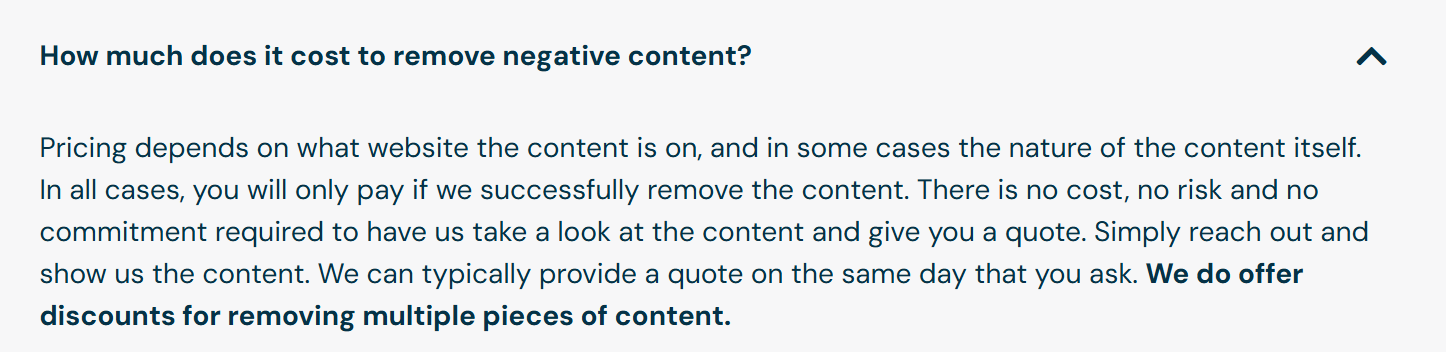
Removify does not publish a price, and neither does any other removal service I looked at. The FAQ answer at the top of this page is the whole of it: "Pricing depends on what website the content is on, and in some cases the nature of the content itself." They look at your review, judge how likely they are to win, and price the case accordingly.
What the company does state publicly, checked 6 September 2026:
- You pay only for successful removals: "In all cases, you will only pay if we successfully remove the content."
- A deposit is taken before work starts, and is "fully refundable if we are unsuccessful".
- Quotes are free and usually same day: "We can typically provide a quote on the same day that you ask."
- "We do offer discounts for removing multiple pieces of content."
- If the content is still up after 60 days, the FAQ says you get a full refund.
For an actual number you are relying on people who have collected quotes. TrueReview's comparison, published 29 May 2026, reports $500 to $2,500 per Google review, with most cases falling between $595 and $895. It also discloses on that page that it sells review tooling of its own. ReputationZilla, the other page ranking for this query, reports "$500 to $900+" and sells review disputes at a flat $150. Neither figure came from Removify.
There is no neutral published price for this service anywhere on the web. Both sources that give you a range have something else to sell. You cannot budget a removal programme in advance or compare two providers without going through both sales processes.
How Removify works, step by step
- You send the review or the URL. Removify assesses it free, usually the same day, and quotes on how likely it thinks it is to win. Cases it does not rate, it declines.
- You pay the refundable deposit, and Removify submits an application to Google citing the policy it believes has been breached.
- Google's first response comes within about seven days. A rejection at that point is normal rather than final, and the application goes back in with a different argument.
- Removify's published range is 24 to 48 hours at best and 60 days at worst, with the majority landing inside one to four weeks. You pay the balance only if the content comes down.
Can I remove negative reviews myself?
Often, yes, and it costs nothing. Google's process is public and takes a few minutes per review.
In your Business Profile, open Read reviews, select Report next to the review, choose the reason and select Send report. Google says evaluation "typically takes several days". The other route is Google's Reviews Management Tool, which is where you see the status of everything you have already reported, and where your one appeal lives.
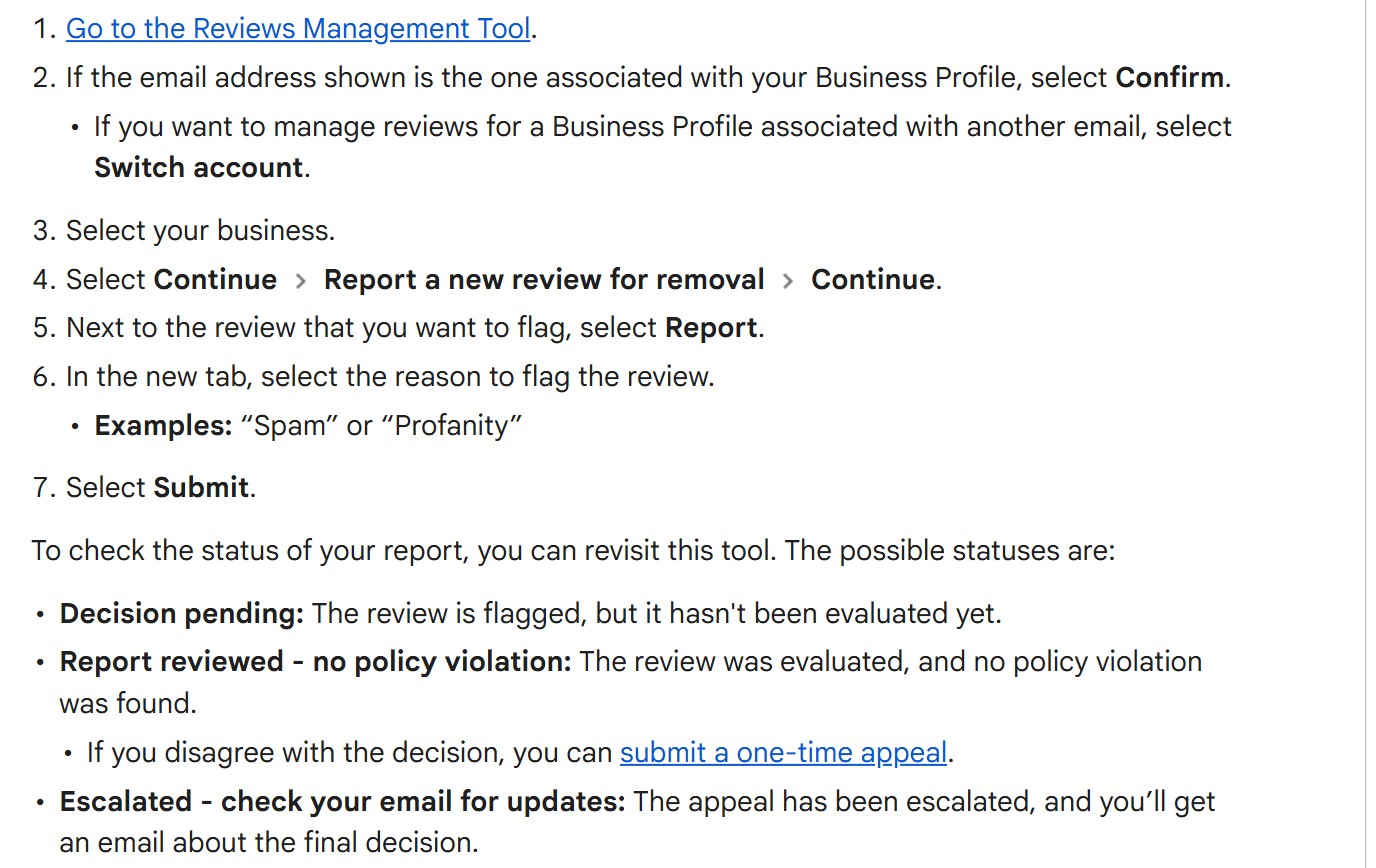
Google Business Profile Help, 6 September 2026. The appeal is one per review, and it lives in the same tool.
Google is blunt about the limits, and the wording is worth reading twice before you spend money:
Do not report a review just because you disagree with it or dislike it. Google doesn't get involved in conflict between businesses and customers. Negative reviews can highlight areas for improvement and aren't always a sign of poor service.
The work that decides a DIY case is the same work a removal service does: naming the exact policy, and documenting why the review breaches it. Our walkthrough is in how to remove negative reviews from Google, including what to do when the appeal fails.
Do it yourself when the breach is obvious and you have one or two reviews rather than twenty. A service earns its fee on volume, and on cases that need three or four attempts on platforms with worse self-service than Google's.
Removify and the alternatives, compared
| Option | What it is | Published price | Model |
|---|---|---|---|
| Removify | Removal service. Google, Glassdoor, Indeed, RateMDs, Vitals, TripAdvisor, search results, images | None | Pay on success, refundable deposit, one to four weeks typical |
| Erase.com | Removal and search suppression. Google, Glassdoor, Indeed and others | None | "Pay only when results are delivered", free assessment |
| Guaranteed Removals | Removal service. Google, Glassdoor, Indeed | None | "Payment is due only after the review is confirmed removed", plus a lifetime re-removal guarantee |
| Doing it yourself | Google's report flow and Reviews Management Tool | Free | Your own time, one appeal per review |
| Review management software | Asks customers for reviews and monitors what arrives. See what reputation management software does, and our NiceJob comparison for one example | Usually published, per location per month | Subscription. Removes nothing |
Not one removal service in that table publishes a price. Guaranteed Removals is at least specific about timing, 7 to 14 days for clear-cut violations and 30 to 90 days for restricted content that needs legal escalation, and candid about what drives a quote: "the Google policy category, the strength of the evidence, the reviewer's profile complexity, and whether legal escalation is needed". Removify is the only one of the three with an Australian origin, which matters if you want a case argued on Australian law.
What the FTC rule changed
Since 21 October 2024 the United States has had a rule on this, 16 CFR Part 465. Most of the coverage was about fake reviews. The part that matters when you are shopping for a removal service is §465.6, review suppression.
It bans using an unfounded or groundless legal threat, a physical threat, intimidation, or a knowingly false public accusation to stop someone leaving a review or to get one taken down. The FTC says the rule "authorizes courts to impose civil penalties for knowing violations", and the FTC Act's maximum sits at $53,088 per violation under the adjustment that took effect on 17 January 2025.
It does not touch the legitimate route. Asking a platform to remove a review because it breaches that platform's published policy is not suppression, and the FTC says replying publicly and contacting the customer are fine too. What the rule catches is threatening a defamation action nobody intends to file, or publicly calling a reviewer fake when you know they are not.
So ask any removal service what it actually sends. An application to the platform is the route Google itself documents. Legal letters to reviewers put you at risk, because the rule binds the business, not the contractor you hired. The same caution applies to anyone offering to manufacture positive reviews to bury the bad one, which is the other half of the same rule.
The UK has its own version, in force since 6 April 2025 under the Digital Markets, Competition and Consumers Act 2024. It aims at fake and concealed incentivised reviews rather than suppression tactics, and the CMA's guidance is CMA208.
The maths: four removals against twenty-four new reviews
No removal service I looked at publishes this calculation. Here it is, worked through on a fictional clinic.
Coastline Physio has 120 Google reviews at a 4.3 average. Four of them are one-star reviews from people who were never patients. That is 516 star points spread over 120 reviews.
Pay to remove all four and the profile becomes 512 points over 116 reviews, which is 4.41. Google rounds that to 4.4. At the reported $595 to $895 a review it costs $2,380 to $3,580, and only if all four cases succeed. The review count drops to 116.
Ask more customers instead. Twenty-four new five-star reviews take the same profile to 636 points over 144 reviews, which is 4.42. Google shows 4.4. Identical rating, and the count goes up rather than down.
The rating is the same either way, but the costs are very different. The four removals are finished the day they land. The twenty-fourth review is the twenty-fourth of a flow that keeps going, and next quarter's reviews dilute the next bad one without anyone doing anything, which is the only defence that works against a complaint that is legitimate and therefore unremovable.
None of which makes removal a bad buy. If those four reviews really are fake, they are defamatory, they sit at the top of the profile, and a real business asked those patients for nothing. Remove them. The point is that removal is a repair, and it is priced like a repair.
Cloutly's role here is narrow: it does not remove reviews and cannot. What it does is ask your customers for reviews by text and email on the timing you set (review campaigns), and read 39 review sites into a single inbox across every location, so a review that does breach policy is in front of you the day it appears rather than the month somebody notices.
Removify reviews: what customers say
There is no neutral aggregate to point you at. What is public is the badge Removify runs on its own home page.

Removify's home page, 6 September 2026. Its Australian site shows 4.9 from the same "300+ reviews".
The testimonials running under that badge are about fake or misdirected reviews taken down quickly, which is the case type Removify is strongest on. The number that would tell you something useful, a current success rate, is not published by Removify or by anyone else.
When paying for removal is the wrong answer
The review is true. A slow appointment, a botched job. No policy covers it, no service will win it, and a public reply is worth more than a removal would have been. Our guide to responding to a one-star review covers what to write.
You have one bad review and 40 reviews in total. The problem is not the one-star review. It is the 40. A profile that thin swings a tenth of a star on a single review either way, which is exactly why it feels so urgent. Volume is the cheaper fix.
You are budgeting for it as a recurring cost. If you are removing reviews every quarter, something upstream is producing them, and $595 a time is an expensive way to treat a symptom.
FAQ
Does Removify actually work? Sometimes, and nobody can tell you the odds for your case in advance. It no longer publishes a success rate, and the decision is Google's, not theirs. The free assessment is the closest thing to an answer: a case they decline is a case they do not rate.
How much does Removify cost? Removify does not publish a price and quotes case by case. TrueReview reported $500 to $2,500 per Google review in May 2026, most cases between $595 and $895. Volume discounts are available, and the deposit is refundable if the removal fails.
Is it legal to pay someone to remove a review? Yes, when what you are paying for is a policy application to the platform. What is not legal in the United States, under 16 CFR Part 465 since October 2024, is using groundless legal threats, intimidation or knowingly false accusations against a reviewer to get a review taken down.
Can I get a Google review removed for free? Often, yes. Report it in your Business Profile under Read reviews, or through the Reviews Management Tool, and appeal once if it is declined. The full process is here.
Is Removify worth it? It is worth it for a small number of reviews that clearly breach a platform's policy, on a profile with enough reviews for the removal to move the average, when nobody internally has time to fight the case. It is not worth it for a complaint that is legitimate, and it is not a line that belongs in a recurring budget.