
30 review request email subject lines that get opened
Grouped by the moment you send them rather than by tone, because what gets a review request opened is that it names something the customer remembers.
Lachlan Fea 9 min read
In this article7 sections

A review request email subject line gets opened when it names something the customer remembers. The visit, the day, the job, the person who did it. Keep it under about forty characters so it survives a phone lock screen, write it the way you would text a regular, and leave out anything that sounds like a promotion, because the inbox will file it as one.
Below are thirty subject lines, grouped by the moment you send them rather than by tone. They are written for service businesses asking for a Google review after an appointment, a job or a visit, and they come from different trades on purpose: a physio does not sound like a sparky and should not have to borrow their wording. Most lists like this one are written for ecommerce product reviews, and most of them still suggest offering a discount. Google prohibits that outright, and in the United States it can put you inside a rule that carries civil penalties. There is a section on both below.
What makes a review request subject line get opened
Four things, and none of them is cleverness.
It names the visit rather than the relationship. "Your appointment on Thursday" beats "We value your feedback" because the first is a fact the reader can check and the second is a category of email they already delete.
It comes from a person. The sender name does at least as much work as the subject and it sits in the same row on a phone. "Emma at Coastline Physio" is a different email from "Coastline Physio Marketing" before anyone has read a word of the subject, and "no-reply" is a different one again.
It is short enough to survive a lock screen. A phone shows the sender, then part of the subject, then part of the preview text, and how much of each depends on the device, the app and the reader's text size. Put the meaning in the first three or four words and treat the rest as a bonus.
And it promises nothing. No discount, no draw, no "exclusive". Those are the words a promotions filter is built to catch, and they are the words that turn a legitimate ask into an incentivised review.
30 review request email subject lines
Merge fields are in square brackets: [First name], [Business], [Name] for whoever is signing, [day], [job type], [item]. Replace the brackets and nothing else. Bear in mind that a line grows once the fields fill in, so read the bracketed ones back with your longest business name in them before you save. These are subject lines only. The bodies that go under them are on the review request email templates page.
After an appointment or a visit
- How did we do, [First name]?
- One question about yesterday
- Your appointment on [day]
- [First name], how's it feeling today?
- How's it sitting after the first wash?
- Getting on all right with the new glasses?
After a job at the customer's place
- Your [job type] on [day]
- [First name], is the [item] behaving?
- Still running quietly?
- Invoice settled, and thanks for the work
After a first visit
- Your first visit to [Business]
- First time in. What did you notice?
- [First name], you're new to us
A first-timer notices the things your regulars stopped seeing about a year ago, which is why number 12 is worth sending even though it never uses the word review.
For a long-standing customer
- [First name], after all this time
- Three years of appointments, one ask
- I've never asked you for this
- A favour, and then I'll stop
After you sorted out a complaint
- Glad we got that sorted
- [First name], did the repair hold?
- About the problem you had last [day]
Send one of these only once the customer has told you they are happy. A review request that lands while a complaint is still open is not a request, it is a prompt.
The follow-up, the second send
- Re: How did we do, [First name]?
- The link again, in case it got buried
- Last email about this, [First name]
- No rush and no pressure
- Missed my last one?
Send the second one three to five days after the first, keep it shorter than the first, and let the reader off the hook inside the subject itself. The first ask often lands while somebody is at work, which is the whole reason the second one is worth sending. Two messages is the programme. A third is nagging, and the customer who was going to review you will get to it on their own day regardless.
From the person who did the work
- It's [Name] from [Business]
- [Name] here. I did your [job type] on [day]
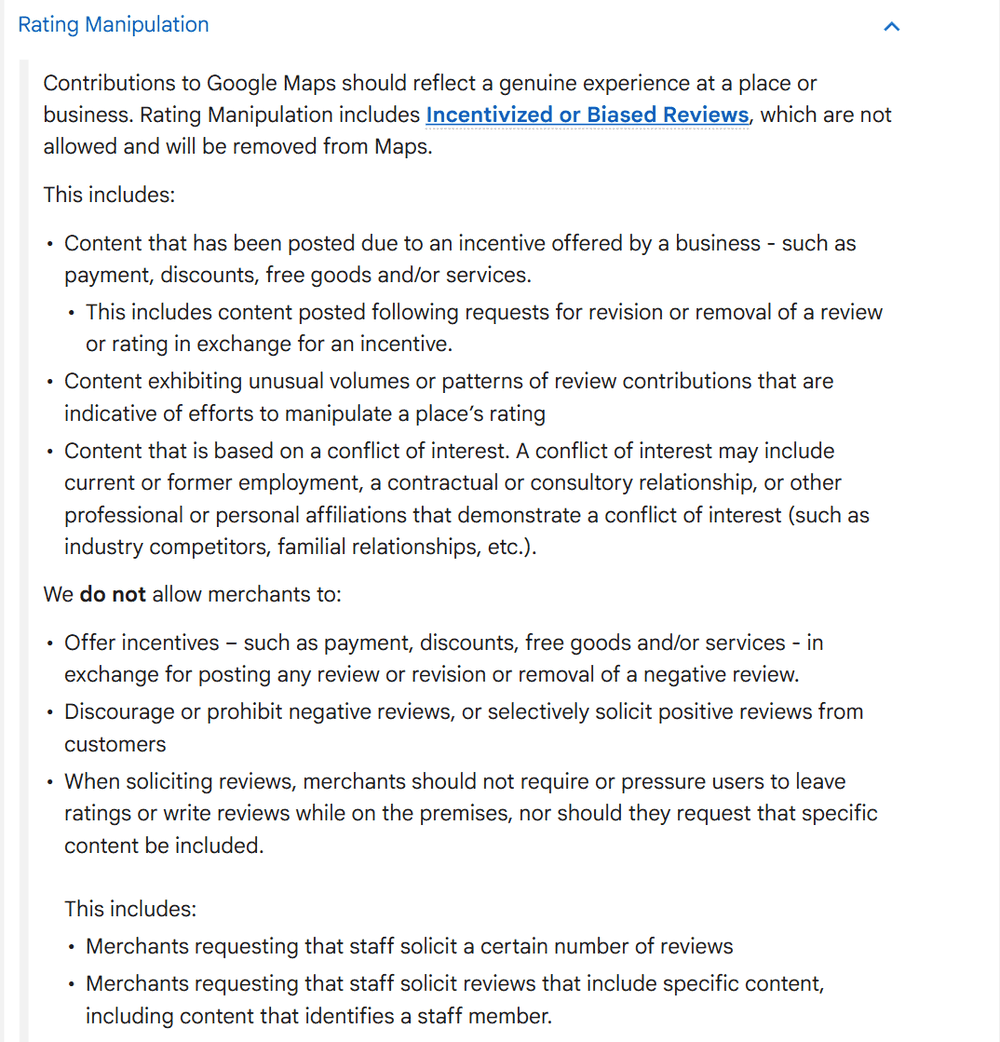
Send it from the person by all means. Do not ask the customer to write that person's name into the review. Google's rating manipulation policy tells merchants not to "request that specific content be included", and the example it gives is content identifying a staff member. If you want your team recognised, give each of them their own review link and let the arrival do the crediting.
Under 30 characters
- Two minutes, [First name]?
- Were we any good?
- One line about us?
Those last three exist because a phone gives you very little room, and the reader decides on what fits. There is no truncation point that holds everywhere, but thirty characters is a fair worst case on a narrow phone with the text size turned up. Here is what survives it.
| Subject line | The first 30 characters | Does it still say anything? |
|---|---|---|
| Your appointment on Thursday | Your appointment on Thursday | Yes. The whole line fits with room to spare. |
| It's Sam from Coastline Physio | It's Sam from Coastline Physio | Yes, at exactly 30. Sender and reason, both. |
| Thank you so much for choosing us, we would love to hear about your recent visit | Thank you so much for choosing | No. It has spent the whole budget on manners. |
Subject line, preview text and sender name
The subject is one of three fields the phone shows, and the other two are usually sitting on their defaults.
Preview text is the second. Clients pull it from the first lines of copy in the email unless you set it, which is why so many review requests show "View this email in your browser" next to the subject. Litmus recommends keeping preview text under 90 characters, and notes that depending on the reader's client and settings it can run to about five lines, roughly 278 characters, or show nothing at all. Write the first line of the email as though it is the second half of the subject, because that is what it is doing.
The sender name is the third, and it is the field most businesses never touch. Use a first name with the business name, sent from an address somebody reads. Part of what comes back will not be reviews at all. It will be the thing the customer was never going to put in public, and a no-reply address throws it away.
None of this carries over to a text message. There is no subject line in SMS, so the first six or seven words of the message are doing this job instead, and the business name has to be inside them. Which channel to use, and what a text costs you once it runs past a single message, is on the review request email templates page.
Subject lines to never send
Four kinds. Two of them break Google's policy. The other two just do not work.
Anything that promises a reward. "Get 10% off for a review", "Review us and go in the draw", "Tell us you loved it and get a free coffee". Google is explicit: "Offering incentives, like free or discounted goods or services, in exchange for customers to post reviews, change reviews, or remove negative reviews is considered fake & misleading content and is strictly prohibited" (Google Business Profile help).
The American position is narrower, and worth getting right, because half the pages ranking for this search recommend the opposite of it. The FTC's Consumer Reviews and Testimonials Rule, 16 CFR Part 465, took effect on 21 October 2024. It does not ban incentives. What section 465.4 bans is compensation conditioned on the review expressing a particular sentiment, and the FTC's worked example of crossing that line is a business writing "Tell us how much you loved your visit to John's Steakhouse and get a $5 coupon". Courts can impose civil penalties for a knowing violation.
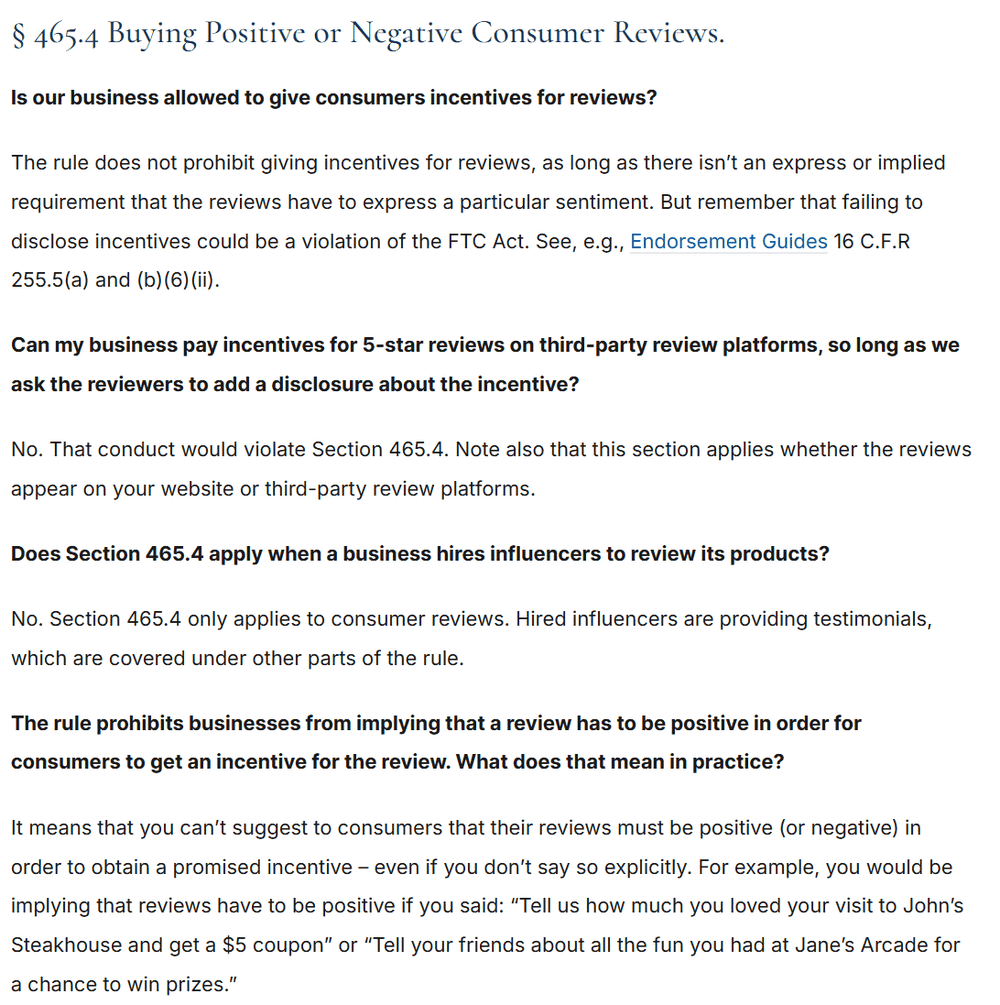
Put the two rules next to each other. Google will not have a paid review at any price. The FTC will not have a bought opinion. Google is where you want the reviews to land, so no subject line you send mentions a discount, a draw or a free anything.
Anything that asks for a rating. "Rate us 5 stars", "How was your 5-star experience?", or five star emoji in the subject. Google permits you to solicit reviews "without offering incentives to do so or attempting to influence the rating or the contents of the review". Naming the number you want is an attempt to influence the rating. It is also the top of the slope into review gating, which breaches the same policy in its own right.
Anything that reads like a survey. "Customer satisfaction survey", "Help us improve", "Your feedback matters", "2-minute questionnaire". These get filed with the airline questionnaires, and the reader who does open one is expecting radio buttons rather than a link to Google. A review is a public thing a customer writes in their own words. Say that instead.
Fake urgency and broken personalisation. "Action required", "Final reminder", "URGENT: your review". Nothing about a review request is urgent, the reader knows it, and the word only buys you the next email being ignored too. The other one is a merge field with no data behind it, which is how "Hi , how was your visit to ?" reaches a customer at nine on a Monday morning.
One clarification, because the lesson usually gets taken too far. "Quick favour?" on its own is the cliché, not the word favour. The problem is a subject line that says nothing except that you want something. Number 15 uses the same idea and works, because it says how long the person has been a customer before it asks.
What to test, and how to read the result
Most service businesses do not have the volume for a split test to mean anything: at forty review requests a week you will be reading noise for months, and you are better off picking a sensible line and leaving it alone. Measure reviews landed rather than opens: a vague, curiosity-driven subject can lift the open rate and lower the review count, because the reader opens it, sees that it is a review request, and closes it.
If you do have the volume, start with the sender name. A person's name against the business name is a bigger change than any rewording of the subject. After that, test naming the event against naming the feeling: number 3 against number 1. Both work, and which one wins depends on how routine the visit is for your customers. Test the first name in and out as well, because personalisation is not automatically better here. For a business somebody uses every week, their own name in the subject can read as a mailing list rather than a message.
Then test the send day and the hour, which has nothing to do with the wording and can move more than the wording does. Change one thing at a time and run it long enough that a public holiday cannot explain the result. What usually comes out of testing this properly is not a better subject line. It is the discovery that the timing and the follow-up were doing the work.
What goes in the email body
Short version: the name, the job, one sentence of ask, one link, signed off by a person. If it runs past six lines, something in it is competing with the link.
The full templates, each with its text-message version and a note on when to send it, are on the review request email templates page. Who to ask and how often is in how to get more Google reviews, and five-star Google review requests covers what volume does to an average and why naming the number you want backfires.
Decide who does not get the email before you write it. Cloutly's review campaigns work off the contact rather than the transaction: a second booking moves the ask instead of adding one, anyone who reviewed you in the last 90 days is skipped, a contact who has opted out is never re-enrolled, and the follow-up runs on the day spacing you set and stops once the review lands.
Frequently asked questions
What is a good subject line for a review request?
One that names the visit and comes from a person. "Your appointment on Thursday", "How did we do, Emma?" and "It's Sam from Coastline Physio" all work, because each one is a fact the reader can place. Keep it under about forty characters, and leave out anything that promises a reward, names a star rating, or reads like a survey.
How long should a review request subject line be?
Under about forty characters, with the meaning in the first three or four words. There is no fixed cut-off: the sender name shares the same row on a phone, and the truncation point moves with the device, the app and the reader's text size. Write it so it still makes sense once the tail is gone.
Should you use the customer's name in the subject line?
Usually, for a business somebody visits every few months. For one they visit weekly, a first name can read as a mailing list rather than a message from you, so try a version without it. Never send it with an empty merge field: "Hi , how was your visit?" costs you more than the personalisation gains.
Can you offer a discount for a review?
Not for a Google review. Google treats an incentive offered in exchange for a review as fake and misleading content, and removes the review. American businesses have a second problem on top: section 465.4 of the FTC's Consumer Reviews and Testimonials Rule, in force since 21 October 2024, bans compensation conditioned on a review expressing a particular sentiment, and courts can impose civil penalties for a knowing violation.
How many times should you follow up?
Twice in total. The first ask, then one reminder three to five days later, ideally by text if the first went by email. Keep the second shorter than the first and say in the subject that it is the last one. If that gets nothing, leave it there and ask again after their next appointment.
Should you put the word "review" in the subject line?
Not every time. It is honest and it works in a first ask. A business that puts it in every subject teaches its regulars which email to skip, so alternate between naming the review and naming the visit.