
AI search visibility tools: what they measure and how to choose
Every tool in this category samples a system that answers differently on a re-ask, then prints a percentage. The useful question is what sits in the denominator, and whether it can ask per location.
Lachlan Fea 13 min read
In this article7 sections
AI search visibility tools all do the same four things. They put a fixed list of questions to the AI assistants on a schedule, record whether your business was named and which rivals were, repeat the run so you can compare this month against last, and turn the count into a percentage. What separates one from another is which assistants it asks, how often, whether it can ask per location rather than per brand, whether it checks that the facts in the answer are right, and whether it will show you the arithmetic behind the number.
Cloutly publishes this page, and Cloutly sells one of the tools on it. That is the disclosure, and it belongs up here rather than in a footnote. Every fact about another vendor comes from that vendor's own public pages, read on 6 September 2026, and where a vendor does not publish something this page says so instead of borrowing a figure from a comparison blog. There is no "cheaper than" anywhere below, because these products are not priced in the same unit and the arithmetic would be dishonest. The tools are listed alphabetically. If a vendor's site says something different today, the vendor's site is right and this page is stale.
The category also gets sold as AI visibility tools, GEO tools, AEO platforms or a ChatGPT visibility tracker. The labels move faster than the products do. Read the specification instead.
What AI search visibility tools actually do
The whole category is a sampler with a spreadsheet attached. It runs your prompts, stores the answers, and counts.
That matters because of what sits underneath. An assistant asked the same question twice can name a different set of businesses, so no tool here is reading a ranking. Each one samples something that moves and presents the average as a number, and a product reporting a stable rank is presenting a sample as a fact. AI visibility explained has the arithmetic, including why two tools pointed at the same business in the same week disagree. This page is the buying decision on top of it.
Read Google's guidance before you spend anything. Its guide to optimising for generative AI features carries a warning box: "Be wary of third-party tools that promise ranking success or claim to use 'internal' Google metrics. No third-party tool has access to our internal ranking or AI systems." That is not an argument against buying one. It is the standard to hold a vendor to.

Six questions that decide which AI search visibility tool you buy
Ask these on the call. Most can be answered from a pricing page before you book anything.
1. Which assistants does it ask?
Get the list, not the count. "10+ AI platforms" is a number that includes Grok, Meta and Mistral, and if your customers ask ChatGPT and Gemini then eight of the ten are padding.
Ask which assistants come with the plan you are quoted, because coverage is the most common upsell here. Profound's entry plan tracks ChatGPT and nothing else. AIclicks lets you pick three models from a list of eleven, and the fourth is the next tier up. Nightwatch is the exception, with the same six on every plan.
Then ask how the tool reaches the assistant. SE Ranking is the only one of the six that answers in public: "SE Ranking's AI Search Toolkit retrieves results through direct UI-based monitoring. It sends queries to AI platforms and captures the responses as a real user would see them." A model reached by API is not always the model your customer sees in the app.
2. How many prompts, how often, and how many samples of each?
Three numbers, and vendors usually publish the first two.
Prompt count is what you are buying. Fifty prompts is one business with a good list of questions; five hundred is a network. Frequency is how quickly you get a trend, and every tool below runs daily on some plan. The third number is the one to say out loud: how many times is each prompt asked, per assistant, per month? Vendors who publish a monthly response allowance beside the prompt count are telling you indirectly, so divide. Nightwatch's Starter is 50 prompts against 1,500 answers; Profound's is 50 against 1,500.
Watch the entry tiers on the platform products. Ahrefs includes AI prompts in every paid plan, but Lite carries five of them and 150 checks a month, which is a taste rather than a programme.
3. Does it work per location, or only per brand?
This question eliminates most of the category for a business with addresses, and nobody asks it in the demo.
A brand-level tool measures whether the assistants talk about your company. A location-level tool measures whether they name your Parramatta site when somebody in Parramatta asks. Passing the first tells you almost nothing about the second. Coastline Physio can be described warmly by every assistant on earth and still be absent from "best physio in Bondi" at nine of its eleven clinics.
So ask what the geographic unit is. It is usually nothing at all, a country, or a place you can name. Ahrefs bills a check as one prompt on one platform in one location. Nightwatch advertises prompts tracked in any location. Profound counts regions, and both published plans include one. AIclicks counts countries per project. A country is not a suburb, and for a service business the suburb is the whole question. AI search visibility for multi-location brands covers why the flagship gets named and the suburbs do not.
4. Does it check whether the answer is right, or only whether you were in it?
Being named in an answer that gives out a phone number you gave up two years ago is worse than not being named, because the customer rings the number.
Most tools here score presence and sentiment. Accuracy is rarer: of the six below, five document no accuracy check anywhere public, and ours checks one field, the phone number. Ask anyway, because the answer tells you what the product is for. If the tool does not check, the check is manual and belongs in your log. When AI gets your business details wrong is what you do once you find one.
5. Will it show you the denominator?
Every product here reports a share-of-voice or visibility percentage, and the percentage means nothing until you know what it is a percentage of.
Ahrefs publishes its definition plainly: AI Share of Voice is "the percentage of AI responses within your topic set that mention or cite your brand versus competitors". That sentence is usable, because it tells you the denominator is your topic set and therefore yours to change. Profound describes its method but publishes no formula behind any score.
The consequence is practical. Add three prompts your rivals happen to win and your score falls with nothing changed about your business. Ask what counts toward the number, whether custom prompts feed it, and whether movement is reported in percentage points or as a count of prompts that flipped. A score you cannot reconstruct is a score you cannot act on.
6. What does the price move with?
The billing units here are the plan, the check and the location. Per-plan pricing is a flat fee with a prompt allowance, predictable until you hit the ceiling. Per-check pricing, where one check is one prompt on one platform in one location, gets expensive at scale in a way you can forecast on a napkin. Per-location pricing tracks the thing you are measuring, which suits a network and is unnecessary for one shop.
Ask what the bill looks like at location twenty before you sign anything, and ask whether AI visibility sits on the tier you are being quoted or the one above it.
Best AI visibility tracking tools: what six vendors publish
Six tools, listed alphabetically. Five are products Google returns for this search; the sixth is ours. Every cell comes from the vendor's own public pages, read on 6 September 2026, and where a vendor does not publish something, this table says so.
| Tool | Best suited to | AI assistants covered | Location handling | Price published? | Free trial |
|---|---|---|---|---|---|
| Ahrefs (Brand Radar) | SEO teams who want AI visibility alongside a search index | AI Overviews, AI Mode, ChatGPT, Perplexity, Gemini, Copilot; Claude on custom prompts | Yes, as a billing dimension: "Tracking one prompt on one platform in one location uses 1 check" | Yes, in USD, on the pricing page | No trial. "We never run discounts"; a free AI Visibility Checker and a free tier exist |
| AIclicks | Agencies tracking many client brands cheaply | Choose 3 to 6 from ChatGPT, Gemini, Perplexity, AI Overviews, Claude, Copilot, AI Mode, Grok, Meta, DeepSeek, Mistral | Countries per project: 1 on Starter, unlimited above | Yes, in USD, on the pricing page | 3 days on Starter and Pro, no credit card |
| Cloutly | Service businesses measuring each location, alongside their reviews | ChatGPT, Gemini and Perplexity. Not Copilot, not AI Mode | Per location. Questions are asked for each site and the league table ranks sites | Yes, per location, in the visitor's currency, on /plans | 14 days, no card, starts on an email |
| Nightwatch | Teams who want AI prompts and rank tracking in one tool | ChatGPT, Claude, Gemini, Perplexity, AI Mode, AI Overview, on every plan | Yes: prompts "tracked daily, in any location or language", across "107,000+ locations" | Yes, in euros, on the pricing page | 14 days, no credit card |
| Profound | Marketing teams at brands with a national or global footprint | ChatGPT only on Starter; three engines on Growth; up to nine on Enterprise | Regions: 1 on Starter, 1 on Growth, custom on Enterprise | Yes, in USD, for two of three tiers | "Try for free" on Growth; no trial length published |
| SE Ranking | Agencies who need GEO reporting inside an SEO platform | ChatGPT, Perplexity, Gemini, AI Mode and AI Overviews, per its FAQ | Not published. The AI visibility page describes no city, country or market unit | Yes, in USD, with AI tracking sold partly as an add-on | 14 days, no credit card |
Read the price column with the units in mind. One of these bills per check, one bills per location, and the rest bill per plan with a prompt allowance. The digits are not comparable and lining them up would mislead you.
Ahrefs
Brand Radar is the most transparent product here about how its numbers are built. Its FAQ defines the four metrics it leads with, and it says out loud where the index is weak: it "works best for established brands or topics with meaningful search demand, since the index is built on Ahrefs' keyword database and may have limited coverage for brands with little or no search volume". A suburban physiotherapy clinic is exactly that case.
It is also the only per-check model here. Plans run from US$129 a month (Lite) to US$1,499 (Enterprise, annual commitment required), each with a prompt allowance: five prompts and 150 checks on Lite, twenty and 600 on Advanced. Brand Radar sells standalone from US$199, and prompt packages start at US$50 for 2,500 checks, so a multi-location sweep prices out exactly. No contracts and no trial: asked about discounts, Ahrefs answers "We never run discounts" and points site owners at its free tier.
AIclicks
AIclicks scales on prompts and models rather than seats. Starter is US$59 a month for 30 tracked prompts, three models and one country per project; Pro is US$189 for 150 prompts, four models and unlimited countries; Business is US$499 for 300 prompts and six models. Prompts run daily on all three, and every plan publishes a monthly response allowance beside the prompt count.
Its FAQ is straight about what drives the bill: "Pricing is based on three things: the number of prompts you track, the number of AI engines monitored, and the volume of AI answers analyzed per month." Trials are three days, no credit card. The geographic unit is the country and the pricing page describes nothing smaller, which is fine for an agency and wrong for one business across eleven suburbs.
Cloutly
Our own scope, stated the way the product states it. Cloutly's AI search visibility asks ChatGPT, Gemini and Perplexity discovery questions such as "best {category} in {locality}" once a month, and records whether each location was named and which rivals were. There is an on-demand check across all three with a daily allowance. It does not sample Copilot or Google AI Mode.
The unit is the location. Each site gets its own questions and its own row, and the league table sorts worst first. Share of voice counts the standard questions only, and movement between sweeps is reported as flips: how many locations gained a mention and how many lost one. The fact check reads the phone number and nothing else. Results are a point-in-time sample of a system that is not deterministic, one sample each, so a re-ask can differ.
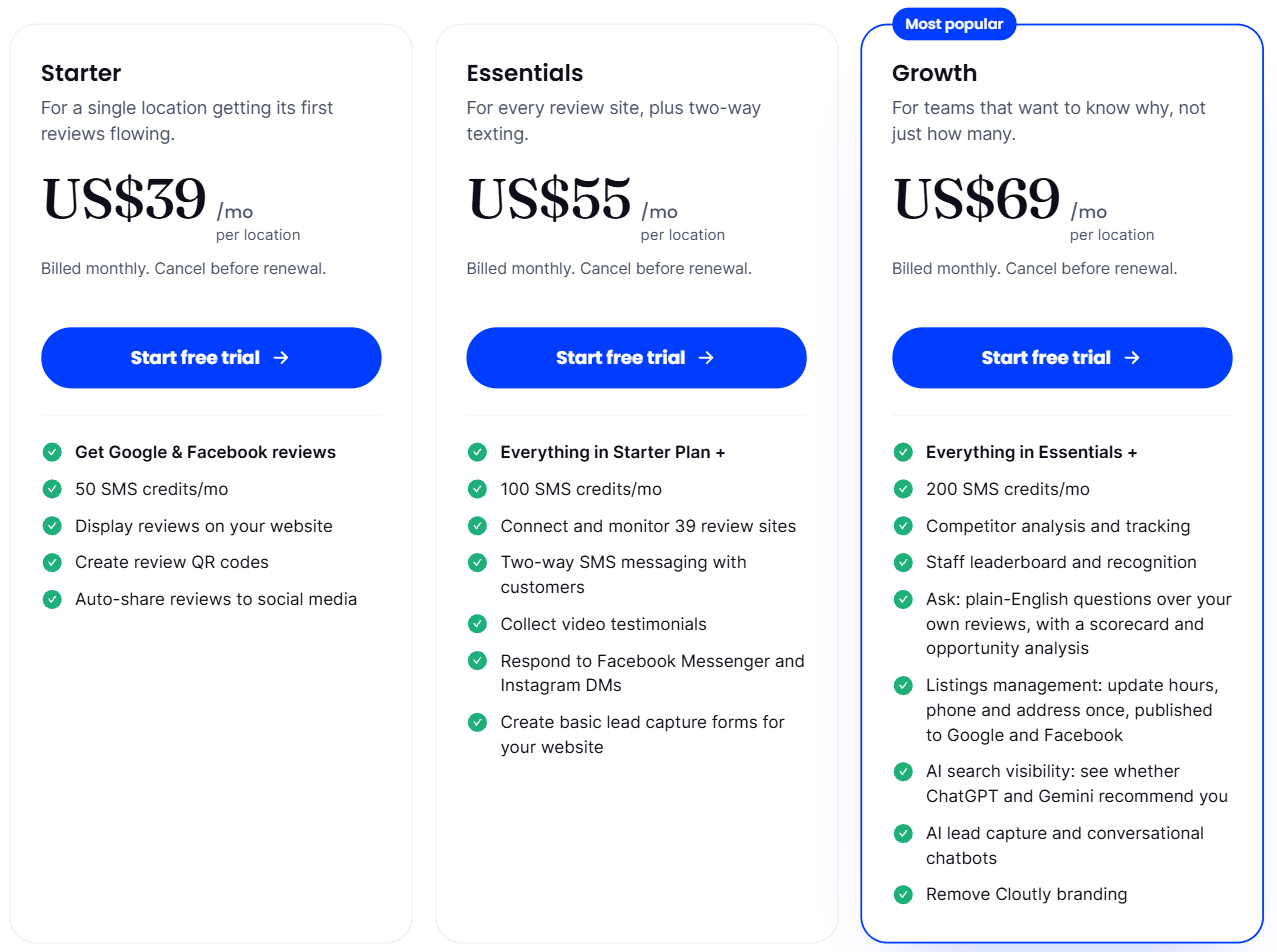
Pricing is published per location on our plans page, in the visitor's own currency, and reads US$39, US$55 and US$69 today, with 14 days free and no card. AI search visibility sits on the Growth plan, the US$69 one, where the inclusion line names ChatGPT and Gemini and the sweep also covers Perplexity. There is no content optimisation, no crawler analytics, no prompt research and no Grok, because this is one instrument inside a review management product rather than an AEO workbench.
Nightwatch
Nightwatch is a rank tracker that added AI prompts, and its location handling is why it is on this list. Every plan carries the same six AI platforms, and prompts are "tracked daily, in any location or language" across what the pricing page calls "107,000+ locations across 190+ countries".
Plans are Starter at €79 a month for 50 AI prompts and 1,500 AI answers, Professional at €159 for 150 and 4,500, and Agency at €399 for 500 and 15,000, all with a 14-day trial and no credit card. Sentiment and citation analysis sit on every plan, but the compare table puts white-label reports, API access and unlimited seats on Professional and above, which is worth reading against the "no per-seat fees" line at the top. Prices are in euros, and it is a rank tracker first, so you buy keyword tracking to get the prompts.
Profound
Profound is the most enterprise-shaped product here. Starter is US$99 a month and tracks ChatGPT only, with 50 prompts and 1,500 responses. Growth is US$399 for three answer engines, 100 prompts and 9,000 responses. Enterprise is custom and opens up to nine engines. Prompts run daily on all three tiers, and a "billed yearly" toggle offers two months free.
Its FAQ describes the method in one line: "Profound runs structured prompts across AI platforms daily, analyzing where and how your brand appears in responses, tracking citations, sentiment, ranking, and competitive presence." What it does not publish is the formula behind any score, so question five is live on the sales call.
The line to read carefully is Regions: one on Starter, one on Growth, custom on Enterprise. Languages are the same. For a national brand asking national questions, one region is right. For eleven clinics in eleven suburbs, you are in the Enterprise conversation before you start.
SE Ranking
SE Ranking sells AI visibility inside an SEO platform, and it is the most explicit of the six about collection method, quoted in question one. Its FAQ says the toolkit analyses ChatGPT, Perplexity, Gemini, AI Mode and AI Overviews. It is also the only vendor here that answers the question buyers actually have about their score: "There's no benchmark yet as AI search is too new for the industry."
Plans are Core at US$129 a month and Growth at US$279, both with 14-day trials and no credit card, listing 100 and 250 prompts to track daily. A separate AI Search add-on is US$89 a month for 200 prompts and competitor research; whether those prompts stack with the in-plan allowance or replace it is not stated, so confirm it on the call. The free checker gives five checks a day with no account. On location it says nothing a service business can use: no city, country or market unit at all.
Do the free checks before you buy anything
Two of these cost nothing and will tell you whether you need a subscription.
Google publishes AI performance data to the people who own the site. Its guide sends you to the Generative AI performance report in Search Console to see "how people are discovering your content through generative AI features on Google Search". It is first-party, it is free, and no third-party tool has better access to it than you do.
Then run the vendors' free checkers. Ahrefs runs one with no signup, and SE Ranking gives five checks a day without an account. Neither gives you a series, because one check is one sample, but in ten minutes they will tell you whether the assistants name you at all. If the answer is a flat no, buying a dashboard to watch a zero is an expensive way to feel busy. How AI search decides which local businesses get named is the work list then.
When a spreadsheet is enough
Use this test before you buy one.
You do not need a tool yet if you have one or two locations, you can write down eight prompts your customers would actually type, and you will spend twenty minutes on the first of every month. How to monitor AI search visibility is the procedure: eight prompts, a signed-out assistant, a fresh chat for each, and a seven-column log of whether you were named, which rivals were, what was cited and whether the facts were right. Doing it by hand has one advantage no dashboard matches, which is that you read the answers.
What breaks it is arithmetic. Eight prompts across three assistants is 24 answers a month at one location and 264 at eleven, and nobody does 264 by hand twice. The other thing that breaks it is a person: if the check depends on whoever remembers, it stops in the third month. When either is true you are buying automation, and you should price it as automation.
How to run a trial that tells you something
Two weeks is plenty if you decide beforehand what you are testing. Most trials here get spent admiring the dashboard.
- Enter your real prompts on day one, not the ones the tool suggests. Discovery questions with no brand name in them, per location. A tool scored on brand-name prompts flatters everybody.
- Check the geographic unit immediately. Set one prompt to a suburb rather than a country and see whether the answer changes. If it does not, the tool is not asking a local question.
- Ask the same prompt twice in one day, once through the tool and once by hand. That is the sampling noise you will be reading all year, and you want its size before you start reacting to it.
- Open one answer in full. If you cannot read the paragraph the assistant actually wrote, you are buying a number rather than a finding.
- Ask support for the denominator in writing. A vendor who cannot answer that in a sentence has not decided.
- Add a second location and see whether the price moves the way you expected and whether reporting rolls up or leaves you exporting.
On the last day, ask what you would have done differently because of the tool. If the honest answer is "nothing", the spreadsheet was the right product.
Questions people ask
What is the best AI search visibility tool? There is no single answer, because these tools are priced and scoped for different buyers. The question that narrows it fastest is whether you need per-location measurement. If you do, most of the category is out immediately, because it counts countries or nothing at all.
How do I check my AI visibility for free? Search Console's Generative AI performance report covers Google's AI features for a site you own. For the assistants, several vendors run free checkers, including Ahrefs with no signup and SE Ranking at five checks a day. And you can ask the assistants yourself: eight prompts, signed out, a fresh chat each time.
Are AI visibility tools accurate? They are accurate about what they observed, which is not the same as being accurate about your position. Each answer is one sample of a system that can reply differently minutes later, so a single result is evidence and a trend over months is a measurement.
How much do AI search visibility tools cost? The published monthly prices among the six above run from US$50 for a prompt package to US$1,499 for an enterprise plan, with one vendor priced in euros and ours priced per location, at US$69 a location a month for the tier that carries AI search visibility. Compare what a month of measurement costs at your number of locations, not the headline.
Do I need a GEO tool if I already do local SEO? Not necessarily, and Google's position is that the underlying work is the same. What a tool adds is the observation: whether the assistants name you, at which addresses, and what they are reading when they do.