
AI visibility explained: what it measures, what it can't
Learn how AI visibility scores are calculated, what they leave out and why different trackers return different numbers.
Lachlan Fea 7 min read
In this article9 sections
AI visibility is how often, and how accurately, an AI assistant names your business when a customer asks it a question you want to be the answer to. It counts four things: whether you were named, whether you were cited, whether the facts were right, and how you compared with rivals.
It is a measurement, not a ranking, and none of it is guaranteed. This is the vocabulary page for how AI search decides which local businesses get named: what the term means, how a score gets built, and where the measurement stops being reliable.
The term arrived with the tools, not with anything Google or OpenAI published, which is why it gets used so loosely. Search it and the top of page one is software: a free report, an analytics dashboard, a tracker. SE Ranking's own FAQ answers the obvious question, what counts as a good score, with the line most of its rivals leave out: there is no benchmark yet, because AI search is too new for the industry to have set one.
What AI visibility measures
Four results come out of one answer, and they fail for different reasons.
Named or not. The binary, and the one that matters. A customer asks for the best physio in their suburb and gets a shortlist of five. You are on it or you are not, and nothing else here counts until you are.
Cited or not. Whether your own pages were among the sources shown. Being named without being cited is common and not a fault: the assistant read a directory page, a roundup or your Google Business Profile and never touched your website. The citation list is the more useful half of the screen, because it names the pages deciding your category.
Facts right or not. The phone number, the hours, whether you bulk bill. An answer that names you and hands out a number you disconnected in 2023 is worse than no answer at all, and you never hear about it.
Share against rivals. Of the answers you sampled, how many named you, and who was named instead. This is the only one of the four that comes out as a number, which is why the tools lead with it.
An owner asking whether they are visible in AI means the first. A tool selling AI visibility means the fourth. Most of the confusion here sits in that gap.
What it is not
It is not a ranking. An assistant's list has an order, and that order is real for the answer in front of you, but it is not a position you hold. It moves with the phrasing, with the location the assistant inferred, and on a re-ask. Read it as one sample with an ordinal attached. Google's local ranking guidance closes off the shortcut as well: "There's no way to request or pay for a better local ranking on Google."
It is not a traffic number either. An assistant that answers well has given the customer what they came for, so a rise in AI visibility need not show up in your sessions at all. Your outcome was never a session. It was a call, a booking, someone walking in. Measure it there and treat visibility as the leading indicator.
AI visibility vs SEO
For Google's own AI features the work is the same work, and Google says so itself in the guide quoted in the next section. What differs is the thing being measured, and the two numbers behave nothing alike.
| Traditional SEO | AI visibility | |
|---|---|---|
| What is measured | A position for a query, on a page of results | Whether a generated sentence names you |
| Stability | Moves over days and weeks | Can differ on a re-ask, minutes apart |
| First-party reporting | Search Console, per query and page | Google's surfaces only, and impressions only |
| What counts as a win | Being on the page | Being named in the sentence, with the right details |
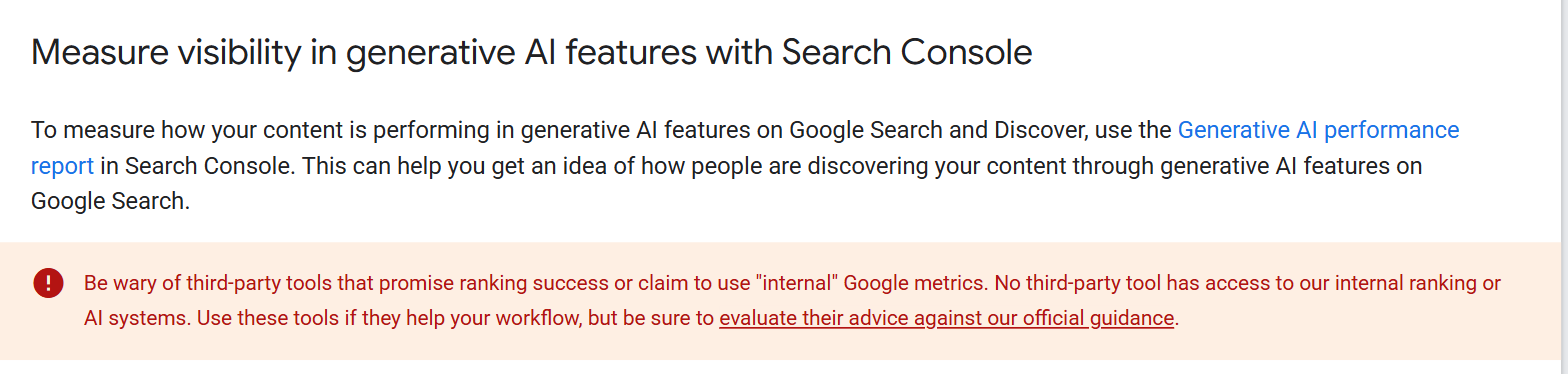
Google provides first-party reporting for its own surfaces and nobody else does. Search Console's generative AI performance report, live for all websites worldwide since 31 August 2026, counts impressions in AI Overviews and AI Mode. For ChatGPT, Gemini and Perplexity there is no equivalent, which is why this gets measured with a log or a tool rather than a dashboard you already own.
AEO, GEO and AI visibility name the same work
Google takes the acronyms on directly in its guide to optimizing for generative AI features, last updated 10 July 2026: "AEO stands for 'answer engine optimization' and GEO for 'generative engine optimization'... From Google Search's perspective, optimizing for generative AI search is optimizing for the search experience, and thus still SEO."
The same page closes off the tactics usually sold alongside them. On files and markup: "You don't need to create new machine readable files, AI text files, markup, or Markdown to appear in Google Search (including its generative AI capabilities), as Google Search itself doesn't use them." On style: "You don't need to write in a specific way just for generative AI search."
AEO and GEO name the work, and Google says the work is SEO. AI visibility names what you measure afterwards. If somebody quotes you a GEO retainer on top of an SEO retainer, ask which line item is not already SEO. What the acronyms mean for a local business has the longer version.
What an AI visibility score is, and how it is calculated
Every score in this category is built the same way, whatever it is called.
- A prompt set. A fixed list of questions, chosen by whoever set the tool up.
- A set of assistants, in whatever combination the tool covers: ChatGPT, Gemini, Perplexity, Copilot, AI Mode.
- A run. Each prompt asked once, or a handful of times, per assistant, per period.
- A count. How many of those answers named you.
- A percentage, sometimes weighted by where in the list you appeared, sometimes by whether your own site was cited.
The arithmetic is worth doing once by hand. Eight prompts, three assistants, once a month, is 24 answers. Named in nine of them is a score of 37.5%. Weight a first mention above a fifth and the same 24 answers give a different number. Add a ninth prompt your rivals happen to win and the score drops with nothing changed about your business.
That is the limit of what it carries: a direction, for one business, over several months, as long as the questions stay identical. It cannot carry a level, because the denominator is yours. A vendor quoting you an industry benchmark has invented it.
Cloutly's AI search visibility ranks each location by share of voice, counted from the standard questions only, since custom queries do not feed it. Movement between sweeps is reported as flips, meaning locations that improved and locations that lost, never as a change in share points.
Why two tools give you two different scores
Run two trackers on the same business in the same week and the scores disagree. Four reasons, none of them a bug, and what the tools actually measure covers how to choose between them.
The prompts are different. There is no standard set. One tool asks discovery questions, another asks about your brand by name, and brand-name prompts score far higher, because an assistant asked about you will talk about you. Two tools asking different questions are measuring different things and calling both visibility.
The sample size is different. One answer per prompt per month, or ten. Every extra sample costs the vendor money and steadies the number, so each picks a point on that trade-off and few publish where they landed. Ask before you compare anything.
The model is different, even inside one assistant. Google's AI Mode help page describes a Pro option running Gemini 3 Pro next to the Fast model that handles most questions, and you have to be signed in to a personal Google account to choose it. A tool querying an API is not necessarily reaching the model your customer sees in the app.
The system is not deterministic. The same help page tells searchers to "ask multiple versions of your question to get the best answers", because AI Mode splits a question into subtopics and searches each of them separately. Read that as an admission: the answer to one phrasing is not the answer to the question. A tracker that asks once has sampled once, and the location and the account it asked from move the result again, which how to monitor AI search visibility works through in detail.
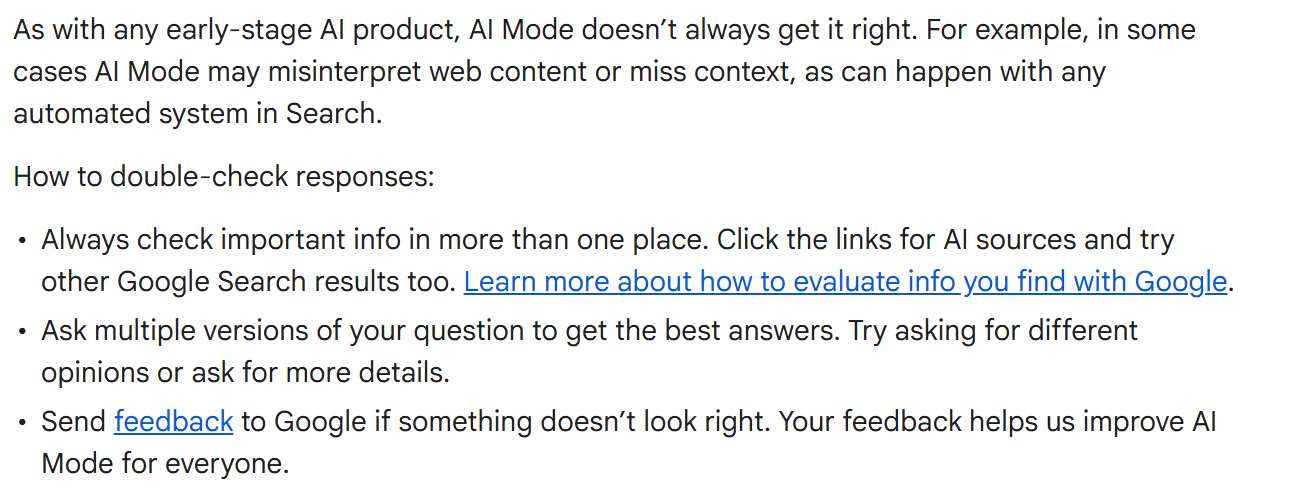
Google's warning about the tools built on all this applies to every vendor here, us included: "Be wary of third-party tools that promise ranking success or claim to use 'internal' Google metrics. No third-party tool has access to our internal ranking or AI systems."
How to measure AI visibility without a tool
With one or two locations, use a log rather than buy a tool.
- Write eight questions a customer would type, covering plain discovery, a constraint, a problem, your business name and you against a rival. Then stop changing the sentences.
- Ask each in a fresh chat, signed out where the assistant allows it, with the suburb in the wording.
- Record four things: were you named, who else was, what was cited, were the phone number and hours right.
- Same day each month. Read the series, not the run.
The full procedure, with the eight prompt shapes, the private-mode setting each vendor documents and a seven-column log, is in how to monitor AI search visibility.
What moves AI visibility
AI visibility moves with ordinary local-search inputs: a complete Google Business Profile, a review count and rating that keep growing, reviews whose text describes the actual job, the same phone number and hours everywhere you are listed, pages elsewhere that mention you, and a site the crawlers can reach. The parent piece sources each item and gives the order to work in.
The one a review vendor can speak to rather than an SEO is the text. Nobody writes "great service" in an answer about rotator cuff rehab, so a profile whose reviews all say "highly recommend" gives an assistant nothing to match against a specific question. Whether reviews change what AI says separates what is documented from what is assumed.
Frequently asked questions
What does AI visibility mean in plain terms?
Whether an AI assistant names your business when a customer asks it for one, and whether what it says about you is correct. Every metric in the category counts those two things across more questions and more assistants.
Is AI visibility the same as SEO?
The work is. Google says optimising for its generative features is still SEO, and that no separate files, markup or writing style are needed. The measurement is not: a ranking is a position in an index you can check, while AI visibility is whether a freshly generated sentence names you.
What is a good AI visibility score?
There is no benchmark, and a vendor quoting one is quoting their own arithmetic. Compare a location against itself over several months with the questions held identical, and against the rivals named in the same answers. Ignore the absolute figure.
Can you pay to improve AI visibility?
No. Google's local ranking page says there is no way to request or pay for a better local ranking. OpenAI's help centre is just as plain about ChatGPT: it "ranks search results using multiple factors intended to help users find relevant, reliable information. Placement is not guaranteed." Anyone selling a guaranteed mention is selling something they cannot deliver.