
44 AI search statistics for 2026
44 current figures on who uses AI search and what generated answers mean for clicks. Every entry names its source and sample, and the article tracks which businesses get cited.
Lachlan Fea 11 min read
In this article8 sections
About half of US adults (49%) now use AI chatbots, Google says AI Overviews has over 2.5 billion monthly active users, and 45% of US consumers have asked an AI tool for a local business recommendation. Every figure below carries its source.
Most AI SEO statistics pages are a pile of numbers with no year on them, tracing back through three blogs to a study nobody can open. This page is the opposite. Forty-four AI search statistics. We opened every one at the publisher's own page on 6 September 2026, and every one carries its edition, its sample and a link to the source. One publisher is the exception: BrightLocal sells review software of its own, so we name it in full and do not link it. Where a publisher does not state a sample, it says so.
If you want the explanation rather than the numbers, AI search optimization for local businesses is the piece these figures sit under.
How many people use AI assistants for search
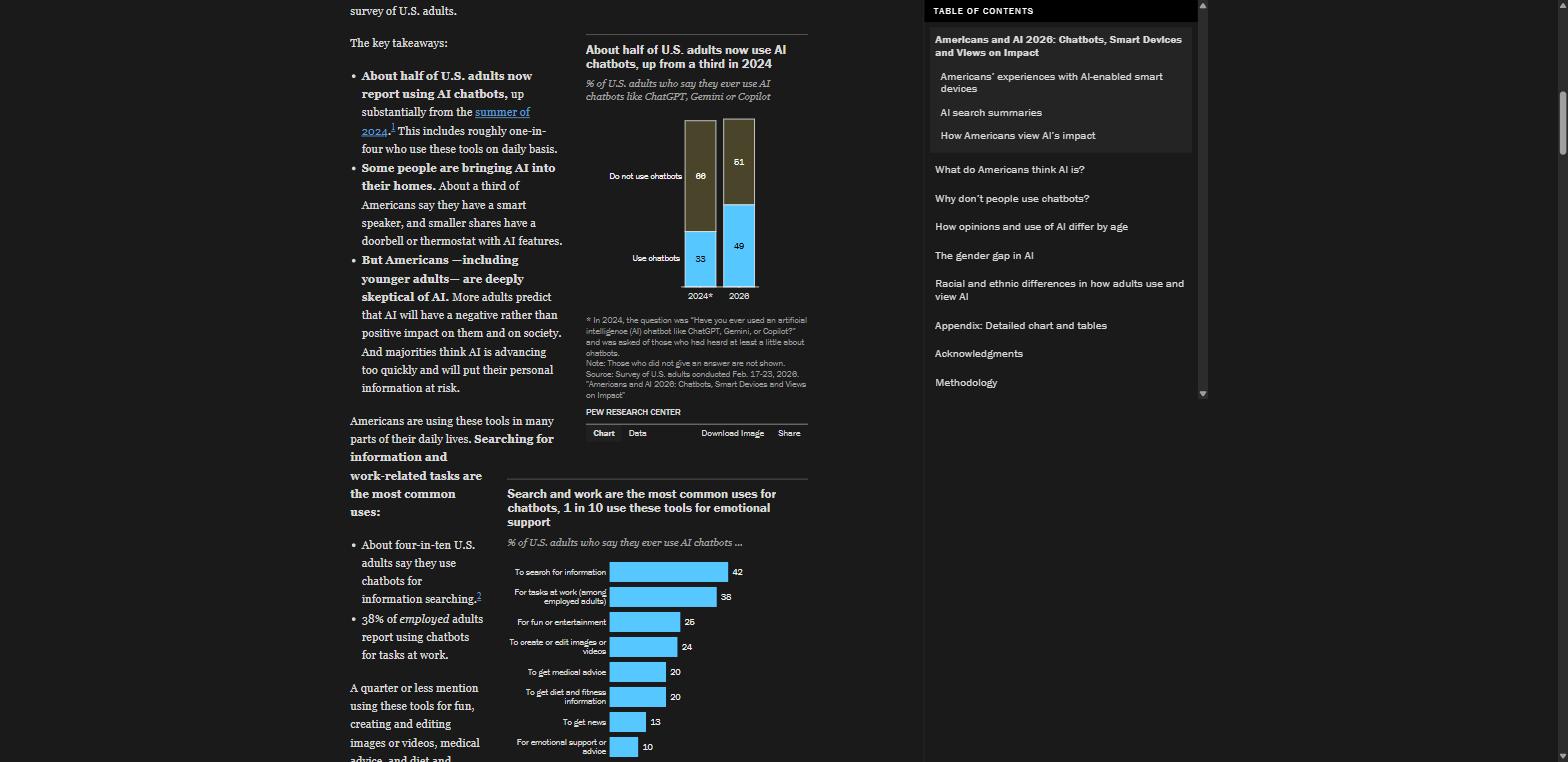
- 49% of US adults say they ever use AI chatbots like ChatGPT, Gemini or Copilot, up from 33% in 2024. Pew Research Center, "Americans and AI 2026: Chatbots, Smart Devices and Views on Impact", published 17 June 2026, 5,119 US adults surveyed 17 to 23 February 2026.
- 24% use a chatbot daily, made up of 12% who use one several times a day, 8% about once a day and 4% almost constantly. Another 25% use one several times a week or less. Pew Research Center, 17 June 2026.
- 42% use chatbots to search for information, the most common use of all. Work tasks come second, at 38% of employed adults. Pew Research Center, 17 June 2026.
- 44% of US adults use ChatGPT, up from 34% a year earlier, 23% in 2024 and 18% in 2023. Pew Research Center, 17 June 2026. Read the trend with Pew's own note attached: from 2023 to 2025 the question was "Have you ever used ChatGPT?" and went only to people who had heard at least a little about it, and in 2026 it asked about other chatbots too.
- Gemini is used by 24% of US adults, Copilot by 17%, Meta AI by 14%, Grok by 8%, Claude by 6% and Character.ai by 3%. Pew Research Center, 17 June 2026.
- ChatGPT has more than 1 billion weekly active users, up from more than 900 million six months earlier, when OpenAI also reported more than 50 million consumer subscribers. OpenAI, "A milestone in expanding access to AI", 31 August 2026, and OpenAI, "Scaling AI for everyone", 27 February 2026.
- The Gemini app has 950 million monthly active users, with daily active users tripling in the previous year. Alphabet Q2 2026 earnings call, remarks from Sundar Pichai, 22 July 2026.
- Three-quarters of consumer ChatGPT conversations are practical guidance, seeking information and writing, and 49% of messages are classified as "Asking" rather than task completion. OpenAI and Harvard's David Deming, "How people are using ChatGPT", a National Bureau of Economic Research working paper published 15 September 2025, from a privacy-preserving analysis of 1.5 million conversations on consumer plans.
The most common thing people do with an assistant is ask it something they would once have typed into a search box.
How many people use AI for local business recommendations
The public record is thinnest here and it is the part a business with an address actually needs. One current survey covers it properly.
- 45% of consumers used an AI tool to get a local business recommendation in the past year, up from 6% a year earlier. BrightLocal, Local Consumer Review Survey 2026 (1,002 US consumers).
- 31% used ChatGPT specifically for a business recommendation in the last 12 months. BrightLocal, Local Consumer Review Survey 2026 AI trust analysis (published 10 March 2026, 1,002 US consumers).
- 23% used Google's AI Mode for a business recommendation, putting it second behind ChatGPT. BrightLocal, Local Consumer Review Survey 2026 AI trust analysis (10 March 2026, 1,002 US consumers).
- 42% trust AI platforms for local recommendations as much as they trust reviews. BrightLocal, Local Consumer Review Survey 2026 (1,002 US consumers).
- 97% of the consumers who use AI for recommendations at least sometimes check the answer against real reviews. BrightLocal, Local Consumer Review Survey 2026 AI trust analysis (455 AI users).
- 82% of consumers read AI-generated review summaries. BrightLocal, Local Consumer Review Survey 2026 (1,002 US consumers).
Then there is the practitioner view. Whitespark asked 47 local search experts to score 187 factors, separately for the local pack and for AI search visibility, and the two lists disagree in a way that is easy to miss.
- The presence of a business on expert-curated "best of" and similar lists ranks 1st of 187 factors for AI search visibility. Whitespark, 2026 Local Search Ranking Factors, published 6 November 2025, 47 local search experts.
- The authority of the third-party sites a business's reviews sit on ranks 5th, high numerical Google ratings rank 8th, and the diversity of sites carrying a business's reviews ranks 11th. Whitespark, 6 November 2025.
- A dedicated page for each service ranks 2nd, prominence on key industry-relevant domains 3rd, and a scannable content structure across the whole website 10th. Whitespark, 6 November 2025.
On the local pack list the top two factors are the primary Google Business Profile category and proximity to the searcher, and neither has anything to do with reviews. On the AI list, four of the top eleven are about where else on the web your business and its reviews appear. Whether reviews change what an assistant actually says is a narrower question with a narrower answer, and do reviews affect AI search separates what is documented from what is guesswork.
What share of Google searches show an AI Overview
- 18% of the Google searches in Pew's browsing panel produced an AI summary, and 58% of the panel saw at least one during the month. Pew Research Center, 22 July 2025, 68,879 searches run by 900 US adults who agreed to share their browsing, collected in March 2025.
- 60% of US adults say they ever read the AI summaries at the top of search results. 30% say they do not and 10% are not sure. Pew Research Center, 17 June 2026, 5,119 US adults.
- AI Overviews has over 2.5 billion monthly active users. Google, "New opportunities, control and insights for website owners", 3 June 2026.
- AI Mode passed one billion monthly users within a year of launch, with queries "more than doubling every quarter since launch". Google, "A new era for AI Search", 19 May 2026.
- 80% of the desktop keywords that triggered an AI Overview were informational, transactional keywords were under 3% of all AI Overview triggers, and 82% of desktop AI Overviews appeared on keywords with fewer than 1,000 monthly searches. Semrush AI Overviews study, published 22 July 2025, 200,000 keywords (100,000 desktop, 100,000 mobile) sampled 1 to 10 September 2024. Dated. It is the only published intent breakdown of that size, and the AI Overview has changed a great deal since the sample was taken.
Two of those numbers get conflated constantly. Pew's 18% is the share of one panel's real searches that returned a summary in March 2025. Google's 2.5 billion is a user count, not a query share. Neither tells you how often an AI Overview appears on the terms your own customers use, which you can only get by looking. AI Overviews for local businesses covers how to check your own.
What AI answers do to clicks
- Users who saw an AI summary clicked a traditional search result on 8% of visits, against 15% of visits where no summary appeared. Pew Research Center, 22 July 2025.
- They clicked a link inside the summary itself on just 1% of visits. Pew Research Center, 22 July 2025.
- They ended the browsing session outright on 26% of pages carrying an AI summary, against 16% of pages without one. Pew Research Center, 22 July 2025.
- The presence of an AI Overview correlates with a 58% lower average clickthrough rate for the top-ranking page, worse than the 34.5% the same team measured in April 2025. Ahrefs, "Update: AI Overviews reduce clicks by 58%", 4 February 2026, 300,000 keywords split evenly between those with and without an AI Overview, comparing December 2023 with December 2025.
- The effect shrinks down the page: 58% at position one, 50.8% at position two, 46.4% at position three and 19.4% at position ten. Ahrefs, 4 February 2026.
Google's own position is two claims, neither of them comparable with the studies above. On the Q2 2026 earnings call it said it is "now sending billions of clicks to websites every week through AI features in Search" (Alphabet, 22 July 2026) without publishing a denominator, and its documentation says that when people click from a results page carrying an AI Overview, "these clicks are higher quality (meaning, users are more likely to spend more time on the site)" (Google Search Central, AI features and your website, updated 10 December 2025). Nobody outside Google can check either one, which is worth saying rather than repeating them as findings.
Which sources AI answers cite
- 88% of AI summaries cited three or more sources and 1% cited a single source, with a median summary length of 67 words. Pew Research Center, 22 July 2025.
- 37.9% of the URLs cited in AI Overviews also appear in the first ten results on the same search. 31.2% sit between 11 and 100, and 31% do not appear in the top 100 at all. Count organic blue links only and the non-ranking share rises to 36.7%. Ahrefs, "Update: 38% of AI Overview citations pull from the top 10", 2 March 2026, 863,000 keyword SERPs and 4 million AI Overview URLs from Ahrefs Brand Radar.
- The most-cited domains in AI Overviews are youtube.com at 22.9%, reddit.com at 18.5%, facebook.com at 10.1%, google.com at 8.8%, instagram.com at 5.6%, quora.com at 4.7% and en.wikipedia.org at 4.0%. The denominator matters: Ahrefs calls this mention share, meaning a domain's citations as a percentage of the citations collected by the 50 most-cited sources, not of every citation. Ahrefs, "The 50 most-cited websites in Google AI Overviews (September 2026)", published 2 September 2026, over 3 million US queries.
- YouTube URLs account for 5.6% of all AI Overview citations and 18.2% of the citations that do not rank in the top 100. Ahrefs, 2 March 2026.
Nearly a third of citations come from pages that do not rank at all, and the domains at the top of the list are platforms other people post on rather than company sites. It supports the same finding Whitespark reported.
How Google's AI Mode is rolling out
Every total in this section was superseded within months, so it is a chronology and the older entries are milestones rather than current facts.
- 28 October 2024. AI Overviews "will begin rolling out in more than 100 countries and territories around the world", which Google said at the time would give it "more than 1 billion global users every month". Google, "AI Overviews in Search are coming to more places around the world". The billion is a forecast in that post, not a measurement.
- 5 March 2025. AI Mode launches as an early, opt-in Labs experiment in the US, offered first to Google One AI Premium subscribers. Google, "Expanding AI Overviews and introducing AI Mode".
- 21 August 2025. AI Mode expands "to over 180 new countries and territories in English". Google, "AI Mode in Search gets new agentic features and expands globally".
- 19 May 2026. Personal Intelligence in AI Mode expands "to more people in nearly 200 countries and territories across 98 languages", with no subscription required. Google, "A new era for AI Search".
- 22 July 2026. "Since expanding AI Mode globally last October, we've surpassed 1 billion monthly active users." Alphabet Q2 2026 earnings call.
What businesses are doing about AI search
- Google finished rolling out its AI-features controls and reporting to all websites worldwide on 31 August 2026. Site owners get a Search Console toggle deciding whether their site can appear in and ground generative AI responses, plus impression and geography data for AI answers. Google, "New opportunities, control and insights for website owners", published 3 June 2026 and updated 31 August 2026.
- Sites appearing in AI Overviews and AI Mode are counted inside the existing "Web" search type in Search Console, not in a separate AI report. Google Search Central, updated 10 December 2025.
- Google says no new files or markup are needed. Its words: "You don't need to create new machine readable files, AI text files, markup, or Markdown to appear in Google Search", and on llms.txt specifically, "Google Search ignores them". Google's guide to optimizing for generative AI features, updated 10 July 2026.
- 28% of domains now publish a valid llms.txt file. Ahrefs llms.txt study, published 15 June 2026, 137,210 domains using Ahrefs Web Analytics in May 2026.
- 97% of those llms.txt files received zero requests in May 2026. Of the requests that did arrive, 96% came from bots and 19.5% from AI bots, and no AI bot went looking for an llms.txt file that did not exist. Ahrefs, 15 June 2026.
- Adding schema markup did not increase AI citations. Citations in AI Overviews fell 4.6%, a drop the authors call statistically significant; AI Mode rose 2.4% and ChatGPT 2.2%, both indistinguishable from zero. In a separate look at 6 million URLs, 53% of AI-cited pages carried JSON-LD, making them almost three times more likely to have it than uncited pages, which is a correlation the experiment did not reproduce. Ahrefs schema and AI citations study, published 11 May 2026, a matched difference-in-differences design over 1,885 treated pages against 4,000 controls, August 2025 to March 2026.
- Searches for the vocabulary grew faster than the evidence for it: "generative engine optimization" up 997% and "geo vs seo" up 982% over eighteen months, with "AI search tracking" up 184%. Ahrefs, "5 AI search trends I'm seeing in 2026", 24 July 2026, Ahrefs Keywords Explorer, US volumes.
- ChatGPT Ads reached $1 billion in annualised revenue run rate in under 200 days and is available in more than 40 countries, with Ads Manager opening the platform to small and medium-sized businesses in May 2026. OpenAI, 31 August 2026.
Demand for a technique is running well ahead of the evidence that any technique works. The published evidence still points to ordinary search fundamentals and mentions of your business elsewhere on the web. If you want to know where you stand today rather than in aggregate, how to monitor AI search visibility is a procedure you can run by hand in ten minutes, and does ChatGPT recommend businesses like yours covers what one good answer does and does not prove.
How these AI SEO statistics are checked
We opened every figure above at its publisher's own page on 6 September 2026. Nothing here comes from another statistics roundup, and nothing appears without a publisher, an edition or date, and the sample where the publisher states one.
Four rules govern what gets in.
- A figure has to be readable at source. If the study is gated, unlinkable or has moved, it does not go on the page. If the number is a count we made by tallying a list rather than a figure the publisher printed, it does not go on either.
- Nothing sampled before 2025, unless it is the only published figure on a point that matters. One figure qualifies, the Semrush intent breakdown taken from September 2024 keywords, and it is marked Dated. The rollout chronology is a deliberate exception: those entries are milestones and each one carries its date.
- Publisher, edition, sample. Where a publisher does not state a sample, we say so rather than fill it in.
- One link per figure, to the primary source, unless the publisher is a competitor of ours. BrightLocal sells review software, so we cite its figures by publisher, edition and sample and do not link them. Everything else is linked.
Two things about the numbers as a set. Vendor figures and independent figures answer different questions: Google and OpenAI report their own user counts and have every reason to report them, while Pew measures real browsing on a recruited panel and Ahrefs measures its own crawl of search results. Neither kind substitutes for the other, so they are kept apart. And almost every consumer figure here is US-only, which is why the samples are stated. There is no equivalent Australian or New Zealand panel study of AI search behaviour that we could open, and we would rather say so than borrow a US number and call it local.
The review side of the same picture lives on online review statistics, which is maintained to the same rules.
Last checked: 6 September 2026. Next check: December 2026. This page is re-checked every quarter. Figures whose source has moved or been withdrawn come off, superseded editions get replaced, and the date above changes. If a number here is wrong or out of date, tell us and it gets fixed rather than left.
We keep this page current because Cloutly's AI search visibility asks ChatGPT, Gemini and Perplexity discovery questions such as "best {category} in {locality}" once a month and records whether each location was named, and one sample of a non-deterministic system is exactly as much as that is worth.