
Review sites for businesses: which ones matter, by industry
Everyone publishes the same list of thirty review sites. A salon and a plumber do not need the same list, and several of the thirty are no longer there.
Lachlan Fea 12 min read
In this article11 sections

For almost every service business, Google is the review site that matters. What comes second depends on your trade: Tripadvisor and Booking.com for hospitality, Houzz and Angi for trades, BBB for a US firm, your booking platform for a salon.
Search for review sites for businesses and you get the same article from four different vendors. Thirty platforms, a paragraph each, and the list is identical whether you cut hair or clear drains. None of them says the thing that decides whether a site is worth your attention: what you are allowed to do about a review once it is sitting there.
The useful answer changes by trade. Every rule below was read off the site's own help or policy pages on 6 September 2026. Where a site publishes nothing, we say so instead of guessing.
How to judge a review site
Before you add another site to your workflow, ask four questions.
Who can post?
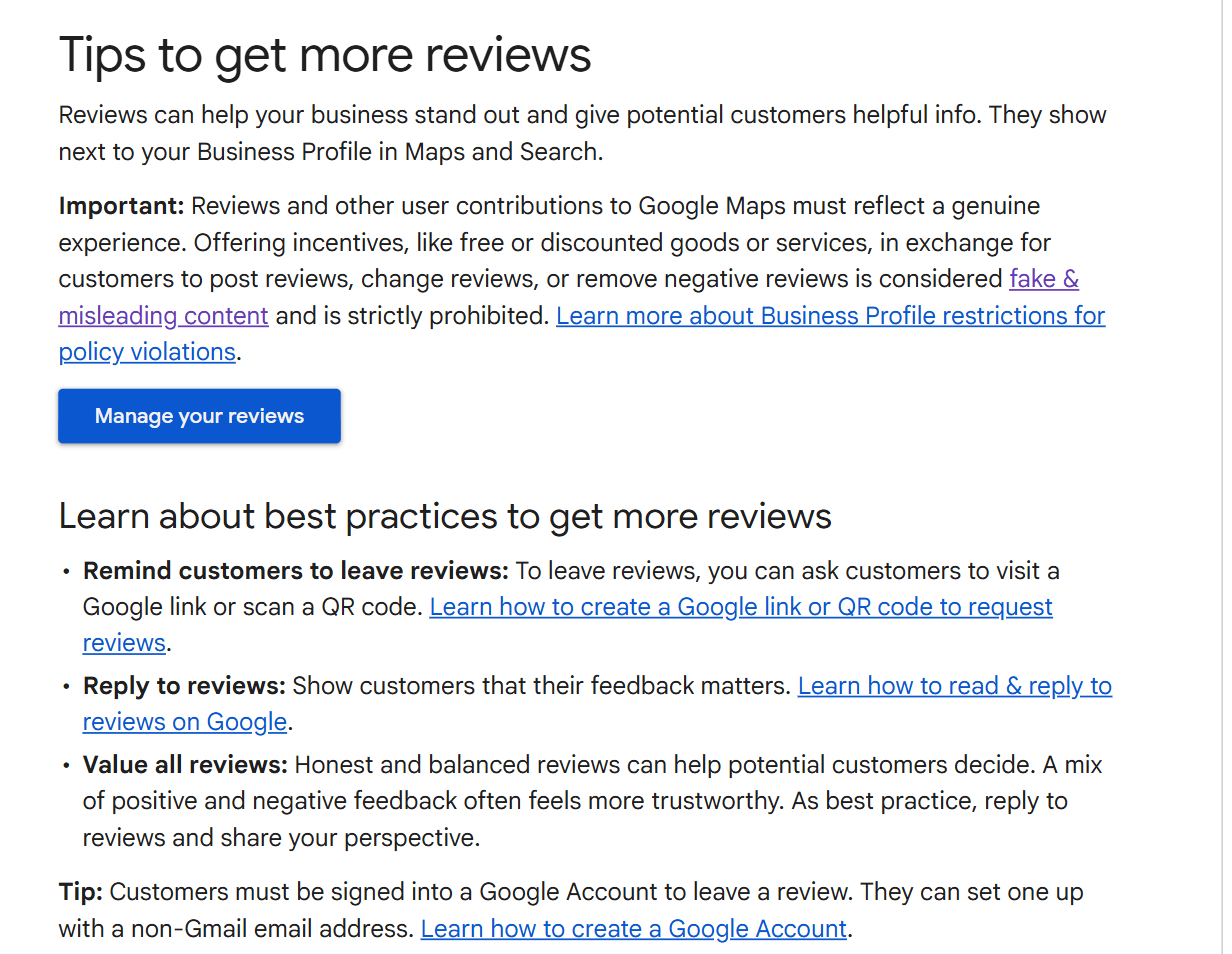
Start with who is allowed to post. Most platform roundups skip this, even though the rules vary widely. On Google, anyone with an account can review you. Google says customers "must be signed into a Google Account to leave a review", and it does not have to be a Gmail address. That is all Google requires. Meta is blunter: turning Recommendations on "lets anyone logged into Facebook publish a Recommendation on your Page", and "we do not verify that users purchased the product or used the service".
The closed-loop sites work the other way. On Booking.com, "only guests who have booked stays through our platform ... and/or have stayed at your property can leave a review". Salon platforms like Fresha invite the client after a completed appointment and nobody else.
A 4.8 built out of verified appointments is not the same evidence as a 4.8 anyone can post to. Both look identical to your customer, which is why the closed-loop sites are the ones worth defending.
Can you reply, and can you fix the reply?
Google publishes your reply under the review and lets you edit or delete it later, though it screens replies first: "replies usually take up to 10 minutes to review, but sometimes a review can take up to 30 days". Yelp works the same way once your page is claimed, and says so plainly: "responses are public and appear below the review."
The rules diverge after that. Tripadvisor gives you one response per review and no edit button. Zomato tells restaurants that "your response can't be edited after posting, so choose your words well." Booking.com lets you edit, but only in one of its two apps. Read the detail for your site before you write anything in anger.
Facebook is the odd one out. Meta documents how a customer leaves a Recommendation, how the rating is worked out and how to switch the feature on. It publishes nothing at all on how a Page replies to one.
Are you allowed to ask?
Google encourages it, and suggests asking customers to open a review link or scan a QR code.
Yelp forbids it. The line sits inside the conflicts-of-interest bullet of its content guidelines, which is why most people have never seen it.

If you use Yelp, do not ask customers to review you there. Zomato has its own version for restaurants, "selective solicitation is a strict NO", and punishes it with a public disclaimer on your page telling diners your reviews are suspicious.
Incentives are a separate question, and the platform rules are stricter than the law. The US FTC rule on consumer reviews, in force since 21 October 2024, "does not prohibit giving incentives for reviews, as long as there isn't an express or implied requirement that the reviews have to express a particular sentiment". Google bans them outright: free or discounted goods in exchange for a review is fake and misleading content under its policy, whichever way the ask is worded.
No site on this list lets you filter who reaches the review page, though a lot of software in this category was built to do it. Google's prohibited content policy tells merchants not to "discourage or prohibit negative reviews, or selectively solicit positive reviews from customers", whatever the vendor calls the step. Ask everyone, in the same words, at the same point after the job.
Does it feed Google and AI answers?
If a review never appears outside its own platform, fewer people will see it. Google's own AI optimisation guide says "Google Business Profiles can help your products and services to be visible in both AI responses and other Google Search results". No other review platform has that relationship with the answer box, which is why Google comes first in every section below.
Review sites for businesses, by industry
| Industry | Start here | Then | Also worth watching |
|---|---|---|---|
| Salons and beauty | Your booking platform | Facebook, Yelp in the US | |
| Healthcare | Whatever your patients actually name | ||
| Home services and trades | Houzz, Angi in the US | BBB in the US, Word of Mouth in Australia | |
| Hospitality | Tripadvisor | Booking.com, Zomato | |
| Professional services and finance | BBB in the US | ProductReview in Australia, Zillow for US property | |
| Multi-location networks | Google, per location | Facebook, per Page | Whichever one your vertical adds |
Most service businesses need two or three sites, not thirty. Keep everything past the third column accurate, but do not treat it as another inbox to work.
Review sites for salons and beauty businesses
Google carries the whole search. Someone looking for a colourist near them is on a map, not in a directory.
Your booking platform is the second one, and salons routinely miss it because the reviews are not on the open web. Fresha is the clearest published example: a client is invited after each completed appointment, and "if an appointment is cancelled or not checked out, no invitation is sent", so the reviews are locked to people who actually sat in the chair. The client can edit theirs for 30 days. You reply under Clients, then Online reputation, then All reviews, and a team member with the right permission can answer on the services they performed. Set that up. The client is answering the stylist, not the salon.
Facebook, because a salon's audience genuinely lives there. Check one setting before anything else. Under Settings and privacy, then Settings, then Page and tagging, there is a single toggle: "Allow others to view and leave reviews on your Page?" Switching it off "will disable Recommendations and remove the rating and reviews from your Page", so it is not a display preference. Two more rules decide whether the number on your Page moves at all: Meta says "a Page may not have a rating if it hasn't received at least 5 reviews", and "only recommendations that are shared publicly are included in a Page's overall rating". A customer who posts to friends only has helped nobody.
Yelp, in US markets, with the asking rule above firmly in mind. Yelp's recommendation software also decides which reviews count, and the ones it does not recommend "don't factor into the business's overall star rating or review count". No employee at Yelp can override it. So a Yelp review can genuinely exist and change nothing, which is also why removal is harder than most guides admit: what actually works on a Yelp review covers the grounds that succeed.
The rest of the beauty directories are not worth the login. If you need the full programme rather than a list of sites, read salon reputation management.
Review sites for healthcare practices
Google first, again, and by a wider margin than in any other vertical, because a patient choosing a clinic searches a suburb and reads what comes back. Facebook second, with the same toggle to check.
After that, be sceptical of anyone who hands you a confident list. The US patient-review directories that every roundup names, Healthgrades among them, publish very little a business can actually read. Healthgrades would not open at all from Australia on 6 September 2026: every path returns "this content is not available in your current region". So this article does not tell you whether a provider can post a public response there. If your practice has a profile on one, log in and look at what your own dashboard offers rather than planning a workflow around a blog post.
For healthcare, what you write back matters more than which site you are on. Confirming that someone was a patient is itself a disclosure. What a practice can say in a public reply covers the wording, and it applies identically on Google, on Facebook and on anything you add later. Home care is a variant, because the review comes from the family: reviews for home care agencies.
Review sites for home services and trades
Google is where the job starts. Someone with a burst pipe is searching a map. The ask is in how to get reviews for home services.
Houzz is the specialist site with real weight here, and its rules are tighter than most people assume. Its review policy requires the review to come from "your first-hand experience as a client", and explicitly not from "correspondence or interactions as a potential client", so a prospect who took a quote and went elsewhere cannot review you. Employees and relatives are barred, and only one person per household may review a project. Houzz moderates before publishing, five to seven business days by its own pro help. You reply in the Review tab, where you can also feature one review, and Houzz will send review requests for you from the Get Reviews button, 50 email addresses at a time.
Angi, in the US, which is the old Angie's List. Its ratings come from homeowners who hired the pro through the platform: the category pages state the rating is "based on verified reviews from our community of homeowners who have used these pros". Angi publishes no reachable owner help on reply limits, so treat what your own dashboard offers as the answer.
BBB, also US. Most trades treat the Better Business Bureau as a badge you buy, and that is wrong twice over. BBB "publishes profiles for Accredited and non-accredited businesses alike", and "accreditation dues do not buy a rating, and they do not remove a complaint". The part worth knowing is that it runs two tracks. A complaint comes from someone who wants a resolution, stays on your profile for 36 months and can move your letter grade. A customer review is a star rating with no resolution requested, and it does not touch the grade. Both sides can comment in public, and BBB takes no anonymous reviews.
Word of Mouth, if you work in Australia. Its business FAQ is direct about both sides of the deal: on replying, "absolutely, we believe that you deserve the right of reply", and on removal, reviews "cannot be changed", with no way to pay one off or opt out. Claim the listing, because the site notes most business information was "entered by the first customer to review your business".
Lead-generation directories are a different case. Angi is one of them, and the profile is a by-product of buying leads. If you are paying for leads anyway, keep it answered. If you are not, a five-star rating behind a match-me form does nothing for the search result your next customer sees.
Review sites for hospitality
Hospitality is different. Google still leads for a cafe, a pub or a suburban restaurant, but bookings are also decided elsewhere. Running it across venues is restaurant reputation management.
Tripadvisor matters wherever a traveller is choosing between options. It checks who you are before it lets you speak: a representative claims a listing by uploading a government-issued photo ID with a face-verification photo, or by taking a phone call to the business. After that you get one response per review, up to two days of moderation, and no edit button.
Every response has to clear the management response guidelines under five headings.
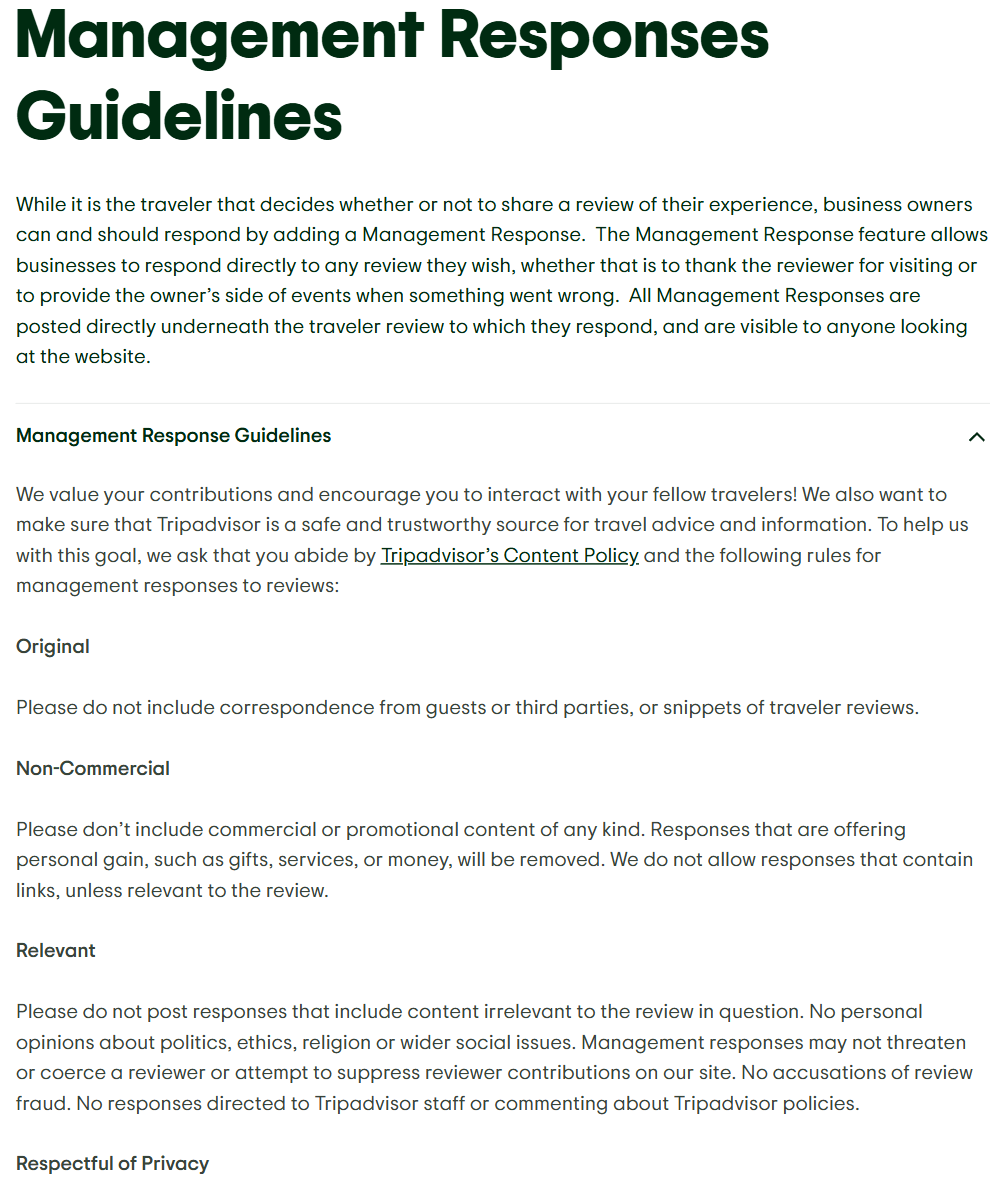
Two of those bite in practice. Non-commercial rules out links unless they are relevant to the review. Relevant rules out threatening or coercing a reviewer, accusing anyone of review fraud, and arguing with Tripadvisor's policies in public. Tripadvisor also bans AI-written reviews outright, and though that rule is aimed at travellers rather than owners, the response guidelines ask for original writing anyway. The long version is in how to respond to Tripadvisor reviews, and our restaurant and hotel lists go deeper on each.
Booking.com, for accommodation, and the hardest site here to get a review onto. Only a guest who booked or stayed can review, the invitation goes out about 48 hours after check-out, the guest has three months to write it, anonymous reviews are no longer accepted, and a review stays public for 36 months. You reply from the extranet or the Pulse app, but only the extranet lets you edit or remove a reply, and moderation takes up to 72 hours. One quirk: you can only respond to a review carrying a title or a comment, so a bare score cannot be answered at all.
Zomato, in the markets where it operates. Reviews are not tied to a verified order. The rule is a stated first-hand experience, enforced after the fact, and Zomato removes content that "indicates that the author hasn't even visited or availed any services from the restaurant". Owners, staff and anyone with a business interest are barred from reviewing. The management response is permanent, and reviews describing experiences more than six months old may be deleted.
Review sites for professional services and finance
An accountant, a broker, a law firm and a mortgage adviser are in the same position: a small number of high-value clients making a long decision, and very little volume on any specialist directory.
Google carries almost the whole weight. A firm with 40 Google reviews reads as established next to one with four, and the searcher rarely goes further.
BBB, in the US, for the reason above. The complaint track is visible for three years and moves the letter grade, and a prospect deciding whether you are safe to hand money to will look at it. Answer complaints whether or not you are accredited, because accreditation is not what puts the profile there.
ProductReview.com.au, in Australia, where insurers, lenders and brokers get compared. Claiming the listing sets up a dashboard so you can reply; the free plan exists but still asks for a card. Understand the verified badge before you argue with a review. ProductReview asks for proof of purchase on submission but says it "is not mandatory outside of select categories", never shares that documentation with the business "even when asked", and will publish a review from someone who never became a customer at all.
Zillow, if you sell or finance US property, where agent and lender reviews sit beside the listing the buyer is already reading. Brokers have their own limits on repeating a review, in Google reviews for mortgage brokers.
Beyond those, most specialist directories are too quiet to justify regular work. Put that effort into a steady flow of Google reviews and answer each one, rather than spreading it over six profiles nobody visits. Prospects read the replies closely, and review response examples has the wording.
Review sites for multi-location networks
A network with 40 sites still uses the same list, but every profile and response workflow multiplies. Nothing on any of these platforms lets you answer once for the group. Each Google Business Profile has its own reply box. Each Facebook Page has the toggle set separately, and each needs five reviews of its own before it shows a rating. Each Tripadvisor property is claimed on its own, with its own identity check. Each Booking.com property has its own extranet login.
The failures show up in two places. A few locations are unclaimed, or claimed by a manager who left, so the reviews land where nobody is reading them. Elsewhere, the hours, phone number and address stop matching what you would tell a customer, and the next batch of reviews is about a locked door rather than the service. Fix both before you widen the list of sites. Listings management and the multi-location playbook both start there.
Claim your Apple Maps place card at the same time. It is a listing you claim rather than an inbox you work, and it moved this year: Apple Business Connect is now Apple Business, and most guides still send you to a URL that redirects. The current steps are in how to add your business to Apple Maps.
The review sites that no longer matter
Foursquare. Foursquare has closed its consumer city guide. Its support site records that the app ran "until December 15, 2024", the web version until "early in the 2025 New Year", and after that "City Guide in its entirety will no longer be available". Your listing survives in Swarm and goes out to Foursquare's data partners, so keep the details right, but there is nothing there to work.
Citysearch. Once the default US city guide. Today citysearch.com is a working shell around an empty product. Search plumbing contractors in Los Angeles and you get business names and street addresses, no phone numbers, no links, no ratings, no reviews, and half the results are in San Francisco, Fresno and Santa Cruz. Click a category profile and it answers "we're sorry, but the business information is not available at this time". Nothing to claim, nothing to reply to. Read on 6 September 2026.
Yellow Pages-style directories. The brand survives on both sides of the Pacific and the product underneath it has changed. An Australian Yellow Pages profile carries a phone number, a website link, directions and a gallery, and no reviews at all. In the US, yellowpages.com category pages do still show star ratings and review counts, next to a panel pushing you to claim the listing. Treat both as citations. A correct name, address and phone number helps your Google listing a little. They offer little else.
Anything you cannot name a customer who used. For the rest of the thirty, ask whether you can think of one person who found you through the site. If you cannot, the profile is a record to keep accurate, not an inbox to work.
Which of these Cloutly reads
Cloutly reads 39 review sites, Google, Facebook, Yelp, Tripadvisor, Booking.com, Zomato, Houzz, BBB, Zillow, ProductReview and Word of Mouth among them, and brings what they say into one inbox.
Healthgrades is not one of those 39, so a US practice that relies on it still has to check the site directly.
Yelp is one of the 39, but that does not change its rule against asking customers for reviews. Use the inbox to read and reply to Yelp reviews. If a vendor promises to generate them for you, it is asking you to break Yelp's policy.
Where to start
Start with Google and Facebook, then add the specialist site for your trade.
- Your Google Business Profile. Everything else is a distant second.
- Your Facebook Page, with the review toggle checked. It is one switch and plenty of Pages have it off.
- The one specialist site your trade is judged on, from the table above.
Then work on volume, because the number of reviews is what a searcher compares first. How to get more Google reviews covers the ask and the timing.