
How to get reviews for home services: the ask, the timing and who sends it
Nobody who hires a trade can judge the work itself. They judge the arrival window, the tidy-up, the invoice against the quote, and what other people wrote about all three.
Lachlan Fea 9 min read
In this article7 sections

To get reviews for home services, ask every customer once, on the day the job is finished and the invoice is paid, from the person who did the work, with a link that opens the review box. That is the whole method.
What makes it hard for a trade is not the wording of the ask. It is that the ask has to go out while the van is still on the street, and the office usually finds out the job is done a day later, when the paperwork lands.
Why reviews decide more for a trade than for almost any other business
Nobody can see the work. A customer can taste a meal and look at a haircut. They cannot inspect a soldered joint behind a wall or a refrigerant charge, and they know it. So they judge what they can see: whether you turned up inside the window, whether the invoice matched the quote, whether the hallway looked the same afterwards, and what other people said about all three.
That leaves you with two problems that generic review advice tends to miss.
You get one shot per customer. Most home services do not see the same customer again next month. A hot water system or a switchboard upgrade is a once-a-decade job for that household. If the ask does not go out while the work is still fresh, it probably will not go out at all.
Your reviews go stale in public. A homeowner reading five-star reviews from 2023 reads them as a business that used to be good. Seasonal trades feel this hardest. An HVAC company that collects a year of reviews in two summer weeks looks dormant every autumn.
Neither is fixed by asking harder. Both are fixed by asking on every job, in the week the job happened.
How to get reviews for home services: time the ask to the job
The moment to ask is the moment the job closes, and every trade already records it: the invoice being paid, the payment going through on the card reader in the van, the job marked complete in whatever software the office runs. That event is the trigger. A Friday list of everyone you saw this week is not, because by Friday the customer has to work out which visit you mean.
The systems already know this. Here is the event each one publishes:
| The system | The event that means "job done" |
|---|---|
| Xero | Webhook - Invoice Paid. It is gated on paid, so there is no moment for you to define |
| Square | Payment received, or order completed and payment received |
| Clover | Payment Completed. It syncs hourly, so allow up to an hour |
| Zapier | Whatever your own job-management or scheduling software fires, carried across |
| A CSV | The fallback for a business that still closes its jobs on paper |
If the software your jobs live in is not on that list, Zapier is the door.
The gap between the event and the ask is yours to set. Same afternoon, while the customer can still name the person who came, or the next morning if your jobs finish at eight at night. There is no right number, but there is a wrong one: "whenever someone gets around to it".
Two things to get right once. Ask once and follow up once, because a second nudge a few days later collects a good share of the people who meant to and forgot, while a third makes you the business that texts too much. And do not ask the same household twice in a year. Trades carry more repeat customers than they think, between the annual service and the landlord with six properties, and asking someone who has already written about you is the fastest way to look automated.
Cloutly is reputation management for home services. The paid invoice fires the ask, the follow-ups run on the day spacing you set, and they stop the moment the review lands. A repeat customer is one contact, asked once, and anyone who reviewed you in the last 90 days is skipped.
How to get more Google reviews has the eight ways to ask and what to send. SMS or email covers which one gets answered.
Who should ask: the tech on the job, with their own link
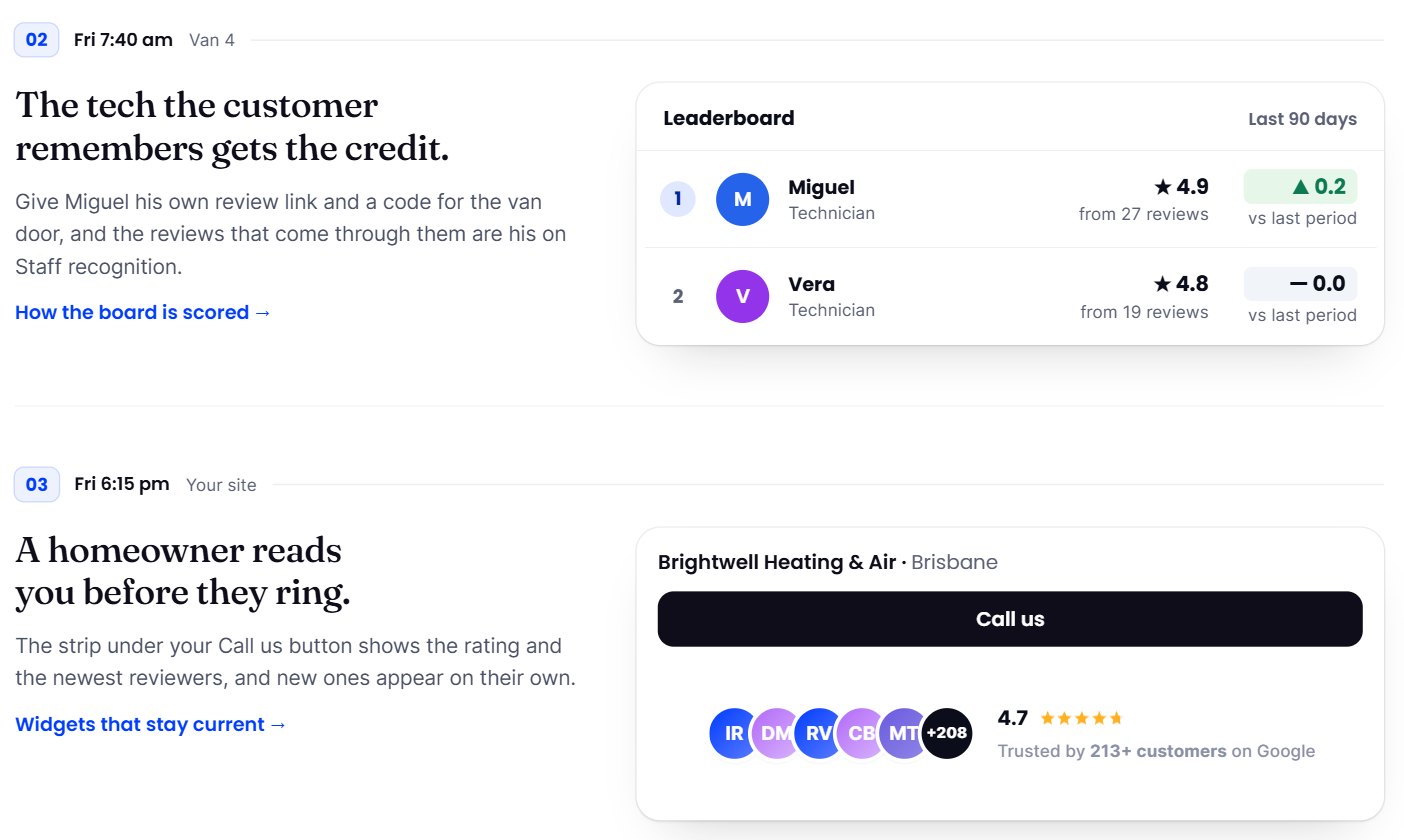
The customer remembers the person, not the company. They will tell a neighbour that the bloke who came out was great long before they remember what it said on the van. So the ask should come from that person, and the review should be credited to them.
The mechanism is a review link per technician, not a name in the message. Give everyone on the tools their own link and QR code, and put them where the job ends: on the invoice, on a card left on the bench, on the van door, and in the tech's phone so they can text it from the driveway. A review that arrives through Marcus's link is credited to Marcus.
Without personal links, the only way to work out who earned a review is to match a name in the review text, and plenty of reviews name nobody, name two people, or name the office. Name matching fills the gaps, and it can credit the wrong person. Give everyone their own link and the crediting runs on links alone.
Anyone adding a second van should know one thing: reviews land on the location, not on the van. Run everything from one address and every job in every van feeds one Google Business Profile, so both sides of town share a rating. Depots with their own address and phone are separate profiles with separate ratings. The multi-location review programme covers running one programme across sites rather than setting it up site by site.
What you are not allowed to ask for
You can ask for a review. You cannot ask for the contents of one. Google's user-generated content policy says merchants soliciting reviews should not "request that specific content be included", and it names the case exactly: "Merchants requesting that staff solicit reviews that include specific content, including content that identifies a staff member." So "mention Marcus in the review and we both win" is out, whatever the vendor selling you a staff leaderboard implies. The link does the crediting. The message asks for an honest review and nothing else.
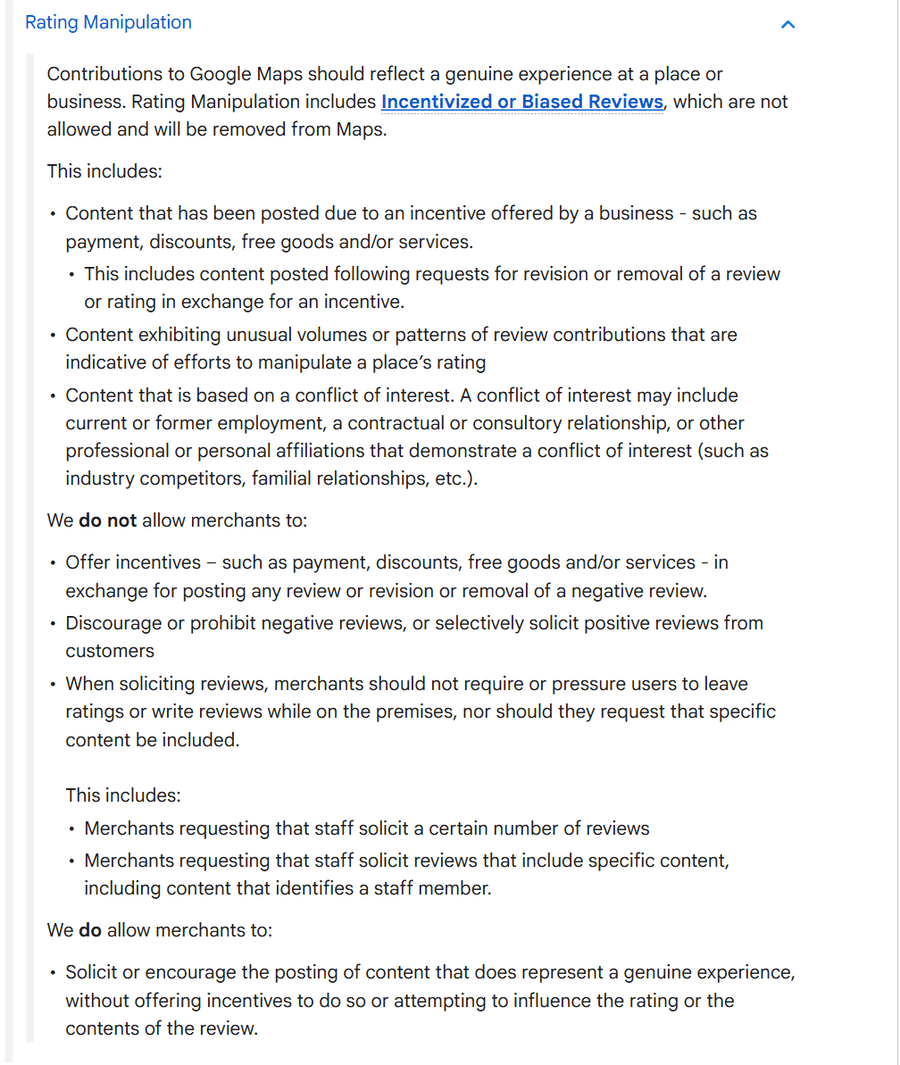
The same page has three more rules that trades break by accident.
No incentives. Merchants may not "offer incentives ... in exchange for posting any review or revision or removal of a negative review", and the policy spells out what it means by incentives: payment, discounts, free goods and services. That covers the money off the next service call that half the trade forums recommend.
No filtering who gets asked. Merchants may not "discourage or prohibit negative reviews, or selectively solicit positive reviews from customers". Asking how it went and sending the link only to the happy ones is the practice that rule describes, whatever the software calls it. Review gating has the rule and the penalty.
No standing over them on the doorstep. Merchants "should not require or pressure users to leave ratings or write reviews while on the premises". Handing the customer your phone before you pack the van is exactly that. Send the link and leave.
Ask everyone, in the same words, at the same point after the job.
Contractor review sites: where you can ask, and where you can only reply
Google first, and it is not close. A homeowner with a burst pipe opens a map, and the map result carries your rating, your review count and your recent reviews in the same card as your phone number.
After Google, the question about any contractor review site is not how big it is. It is whether you can send your own customers there, and whether you can reply in public. Those two answers vary more than anyone expects.
Yelp is a reply site, not an ask site. Its content guidelines say, under conflicts of interest, "businesses should never ask customers to write reviews". That one sentence rules out every review-request tactic on Yelp, and almost nobody selling review software mentions it. Claim the page, answer what lands, ask nowhere near it.
Houzz says yes to both, and no to deletion. Its pro help tells you to respond promptly to a negative review, acknowledge the client and invite them to continue offline. It is equally direct about the other half: "Houzz does not remove reviews that comply with our Review Policy left by genuine past clients."
Angi, in the US, is a closed loop. Its FAQ describes the review as something Angi asks for after a hire on Angi: "When you hire a pro on Angi, we ask you to detail your experience to let your neighbors know about their work." The customer who rang you off a sticker on the van is not in that loop.
That is how lead-generation directories generally work. A review exists there only if the job came through the platform, so the rating is a by-product of buying leads rather than something you build. If you are paying for leads anyway, keep the profile answered. If you are not, stars behind a match-me form do nothing for the map result your next customer is looking at.
The site-by-site breakdown, including the specialist directories for trades and who each one lets post and reply, is in review sites for businesses, by industry. Pick two, maybe three. The rest are listings you keep accurate, not inboxes you work.
Three replies to the complaints every trade gets
Write every reply for the next reader. The person who left it has had their experience. People reading your profile next week want to know what you do when something goes wrong.
The price. Never apologise for your rate and never argue the total. Work out first whether the customer was surprised or overcharged. Here is the surprise, which is the common one in trades: the quote covered one thing and the job turned into another.
Thanks Warrick. The quote covered replacing the mixer, and the extra was the corroded stop tap behind it. We should have rung you before we touched it rather than putting it on the invoice, and that part is on us. The itemised version is in your email, and if you ring the office I will go through it line by line.
Dan, Ridgeway Plumbing
The disclosure failed, not the pricing. Say so, and name the part. "Our prices reflect our quality" reads as a business that has this argument often.
The window that came and went. The most common one-star review in home services has nothing to do with the work.
Thanks Suri. We booked you an eight to twelve window and Jed got there at ten past four. A morning spent waiting is not something an apology covers. The job before yours turned into a full rewire, and we should have rung you at nine to move you rather than letting it run into your day. If you still want us, you are first on the board Tuesday.
Mira, Oakline Electrical
Name the real failure, which is almost always the phone call nobody made rather than the delay itself. Then offer a specific slot, not "please get in touch".
The mess. Dust, boot prints, offcuts left in the garden. Small next to the work, and enormous to the person who lives there.
Thanks Denise. Cutting the ceiling for the return air makes dust, and clearing it up is our job, not something you should be finding the next morning. Rafe is coming back Thursday with the vacuum and drop sheets to do the hallway and the stairs properly, at no charge.
Bree, Wexford Air
Do not explain that some mess is unavoidable. Everyone knows. Book the return visit inside the reply, where the next reader can see it.
Thirty more replies, grouped by what the customer said rather than by star rating, are in review response examples.
"We fixed it. Can they take the review down?"
You cannot remove it, and Google will not remove it on your say-so: "Google doesn't get involved in conflict between businesses and customers. Negative reviews can highlight areas for improvement and aren't always a sign of poor service." Reporting a review works only where it breaks a content policy, evaluation "typically takes several days", and a no-violation decision can be appealed once. An accurate, unflattering review is not a policy violation.
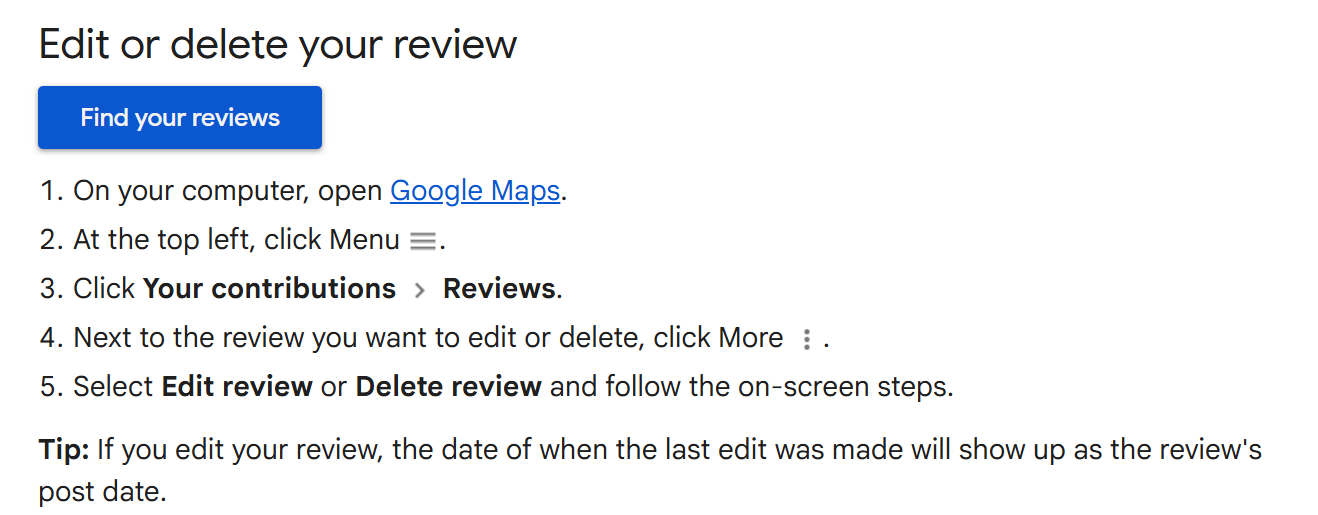
The only person who can take it down is the customer who wrote it, from Your contributions in Google Maps. There is a detail on that help page worth knowing: when a review is edited, "the date of when the last edit was made will show up as the review's post date". An updated review does not only change the words. It resurfaces as a recent review, which is usually better for you than a deletion.
So the order is: fix it, tell them plainly what you did, then ask once.
Hi Denise, Rafe went back Thursday and the hallway and the stairs are done. I am not going to ask you to change what you wrote, because it was accurate on the day. If you think the way we sorted it is worth adding, Google lets you update your own review from Your contributions in Maps. Either way, thanks for telling us.
Bree, Wexford Air
Do not offer anything in exchange. A discount for changing a review is the incentive Google prohibits, and a customer who mentions the offer in their edit does you more damage than the original review did. Do not ask twice. And do not delete your public reply once the review is updated, because the reply is the part the next reader uses to decide.
A genuinely fake review, from someone who was never a customer, is a different process. How to remove a negative Google review covers what evidence gets a report actioned.
Frequently asked questions
How do I get more Google reviews as a plumber?
Ask every customer once, on the day the invoice is paid, from the plumber who did the job. A review link and QR code on the invoice and in the tech's phone removes the step where the customer has to find your listing among the near misses, which is where most plumber Google reviews are lost.
Can I ask a customer to mention the technician by name?
No. Google's user-generated content policy names "Merchants requesting that staff solicit reviews that include specific content, including content that identifies a staff member" as something it does not allow. Give each technician their own review link instead, and the credit follows the link.
How does an HVAC business collect reviews outside the busy season?
By asking on every maintenance visit, not only on installations. HVAC reviews cluster into two summer weeks when the ask is tied to big jobs, and a profile whose newest review is four months old reads as a business winding down.
Do electricians need to be on the trade directories?
Only where you can send your own customers, or where you are already buying leads. Ask two questions of any electrician review site: can you ask your own customers for a review there, and can you reply in public? Google says yes to both. Several directories say no to the first.