
SMS vs email review requests: what actually gets a review written
The answer is both, in an order, and which one leads is decided by what contact detail the customer handed over when they booked.
Lachlan Fea 9 min read
In this article12 sections

Send both, in an order. Text first if you hold a mobile number, because the review gets written on the phone the message arrived on, then email three to five days later for the people who did not act. Which one leads is decided by how the customer booked: a salon that takes a mobile at the counter should text, and an accountant whose relationship with a client runs through an inbox should email.
Open rates do not settle whether SMS or email is better for a review request. Look at what the message does, what it costs and whether you are allowed to send it. The wording lives in our review request templates, which carry the SMS version of every email.
Which channel should you use for review requests?
Start with the contact detail you hold.
- You took a mobile number at booking or on the docket. Text.
- The relationship runs by email already. Quotes, invoices and confirmations arrive in an inbox, so the review request should too. It will not look out of place, which matters more than any channel's average performance.
- You hold both. Text first, email as the single follow-up. That order is the point of this page.
- You hold neither, because it was a walk-in. Neither channel can help. That customer is reachable by a QR code on the counter or the docket, and by nothing else.
That last case is bigger than owners expect: in hospitality and retail, most of the people who came in today left no contact detail.
What a text does well
It lands on the device the review will be written on. That is the whole argument, and it is mechanical rather than statistical. A Google review gets written in a phone browser, signed into an account already signed in on that phone. A text puts the link one tap away. An email opened on a laptop puts a sign-in or a device switch in the way.
A text is also short enough that it cannot do anything except ask. No header image, no footer, no second call to action. Much of the advice about keeping a review request short is really advice to make an email behave like a text.
What a text is bad at: it costs money per message, and the consent rules are stricter than most people expect.
What an email does well
It has room for the context that makes the ask specific. The date, the job, the person who did the work, the invoice number. "Your appointment on Tuesday with Priya" gets a more useful review than "your recent visit", and there is only so much of that a text holds before it splits in two.
It also behaves like a receipt. It sits in a searchable inbox and survives the week, so the customer who meant to review you and got interrupted can find it again on Sunday. A text is below the fold of a message list by lunchtime.
What an email is bad at: filters and tabs decide whether it is seen.
The open rates you have seen are not a comparison
Almost every page on this topic sets "98% of texts are read" beside "20% of emails are opened" and calls that a result. The two figures do not measure the same thing, and one of them is not a measurement at all.
SMS has no open event. There is no pixel in a text message, no read receipt available to the sender, and nothing in the protocol that reports a human looked at it. Whatever a page tells you about text open rates, nobody observed your messages being opened.
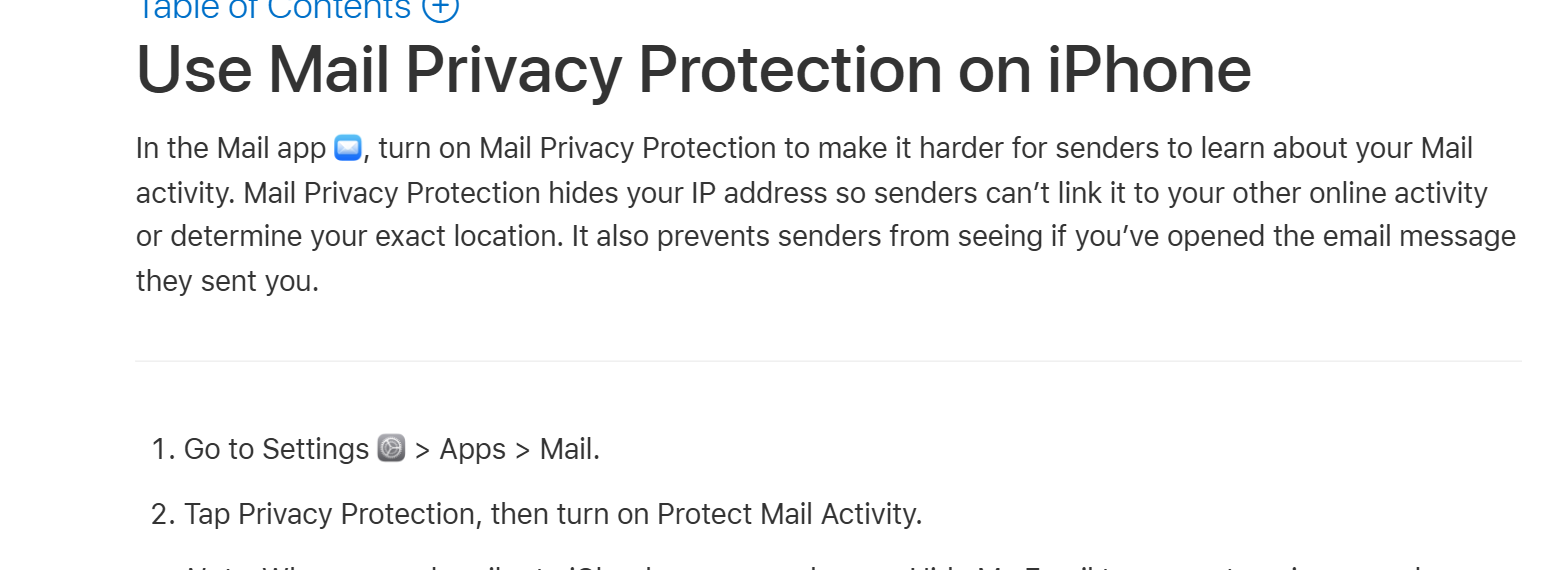
Email opens are measured with a tracking pixel, and Apple has broken that pixel for a large part of your list. Mail Privacy Protection, in Apple's own words, "hides your IP address" and "prevents senders from seeing if you've opened the email message they sent you". Whatever number your sending tool reports, it is no longer a count of people who read the email.
Compare what both channels genuinely report: clicks on the review link, and reviews that arrive. If a vendor quotes you a channel open rate, ask what measured it.
What each channel costs
Email costs effectively nothing per send. The real cost is your sending domain's reputation, which you spend by mailing people who did not want to hear from you.
SMS is billed per segment, not per send. A message that runs past the segment boundary is two messages on your bill even though the customer sees one, and a single curly apostrophe pasted out of a word processor drops the ceiling from 160 characters to 70. The character counts are in the review request templates post. So the honest budget is your provider's per-segment rate, times segments, times the customers you will actually ask. Check what sender registration that provider requires in each market before you commit to a number.
The rules, per channel
The compliance gap between these two channels is what the comparison posts leave out, and it is the part that can cost you money. What follows is what the regulators publish, not legal advice.
Texting customers in the United States
The Telephone Consumer Protection Act governs this, and the FCC's guidance on robocalls and robotexts is direct. FCC rules "ban text messages sent to a mobile phone using an autodialer unless the phone owner previously gave consent to receive the message or the message is sent for emergency purposes", and "commercial texts require written consent; for informational texts, your consent may be oral".
The opt-out rule is the one that catches software. In the FCC's words, a person "may opt out of any robocall or robotext at any time and in any reasonable manner, even if you previously gave consent for such calls". Any reasonable manner. Somebody who replies "stop texting me" has opted out as surely as somebody who replies STOP, and a system that only recognises the keyword keeps messaging a person who has told it to stop.
Texting and emailing customers in Australia
The Spam Act 2003 covers email and SMS together, which is tidier. The ACMA's guidance sets three obligations: get consent, identify yourself as the sender, and make it easy to unsubscribe.
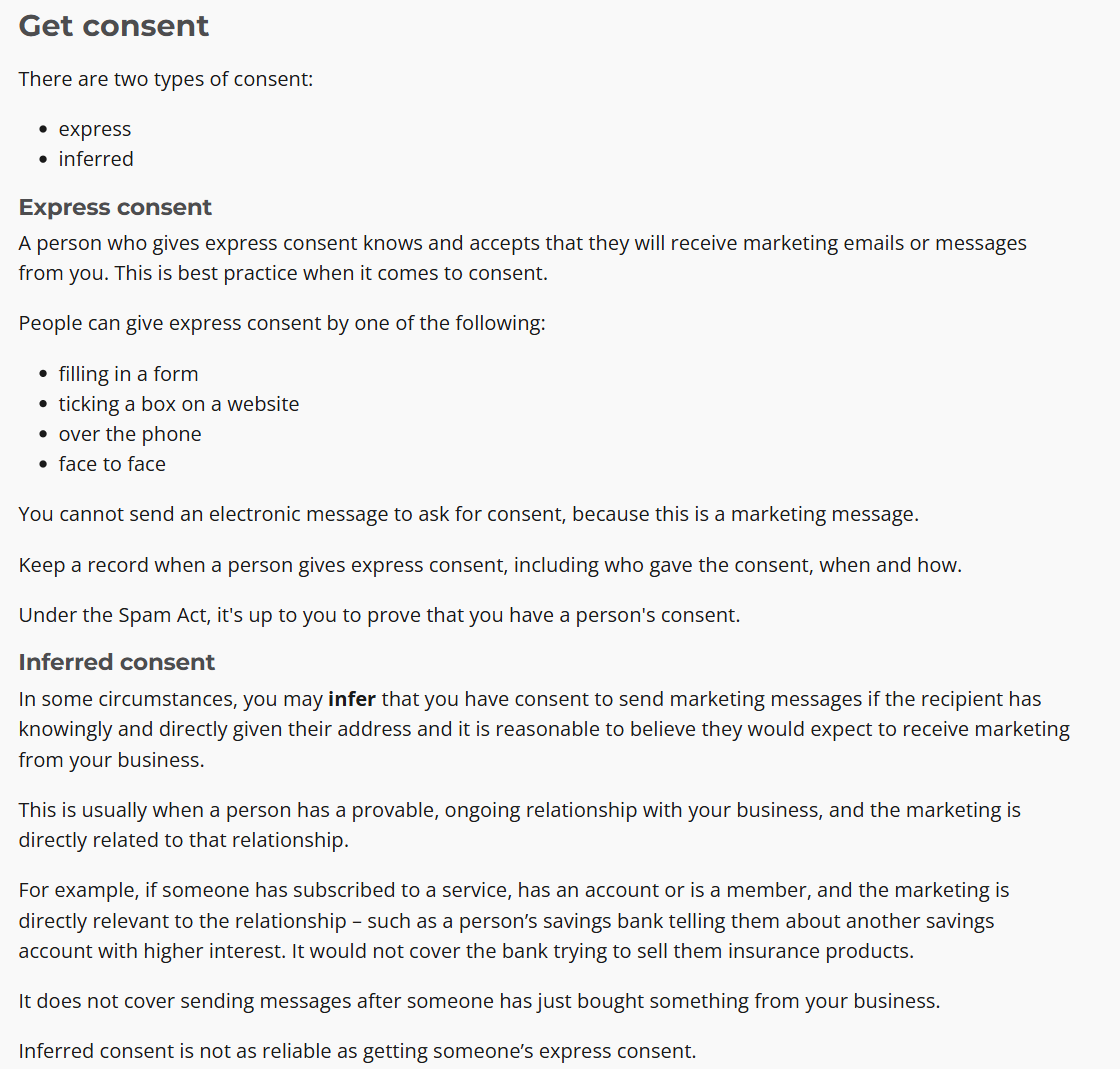
Consent is where service businesses get caught. ACMA separates express consent, given by "filling in a form, ticking a box on a website, over the phone, face to face", from inferred consent, which needs "a provable, ongoing relationship with your business". Then comes the line worth reading twice: inferred consent "does not cover sending messages after someone has just bought something from your business". One transaction is not consent to market to somebody in Australia. Your unsubscribe option must also honour "a request to unsubscribe within 5 working days" and must not require the person to "log in to, or create, an account".
Emailing customers in the United States
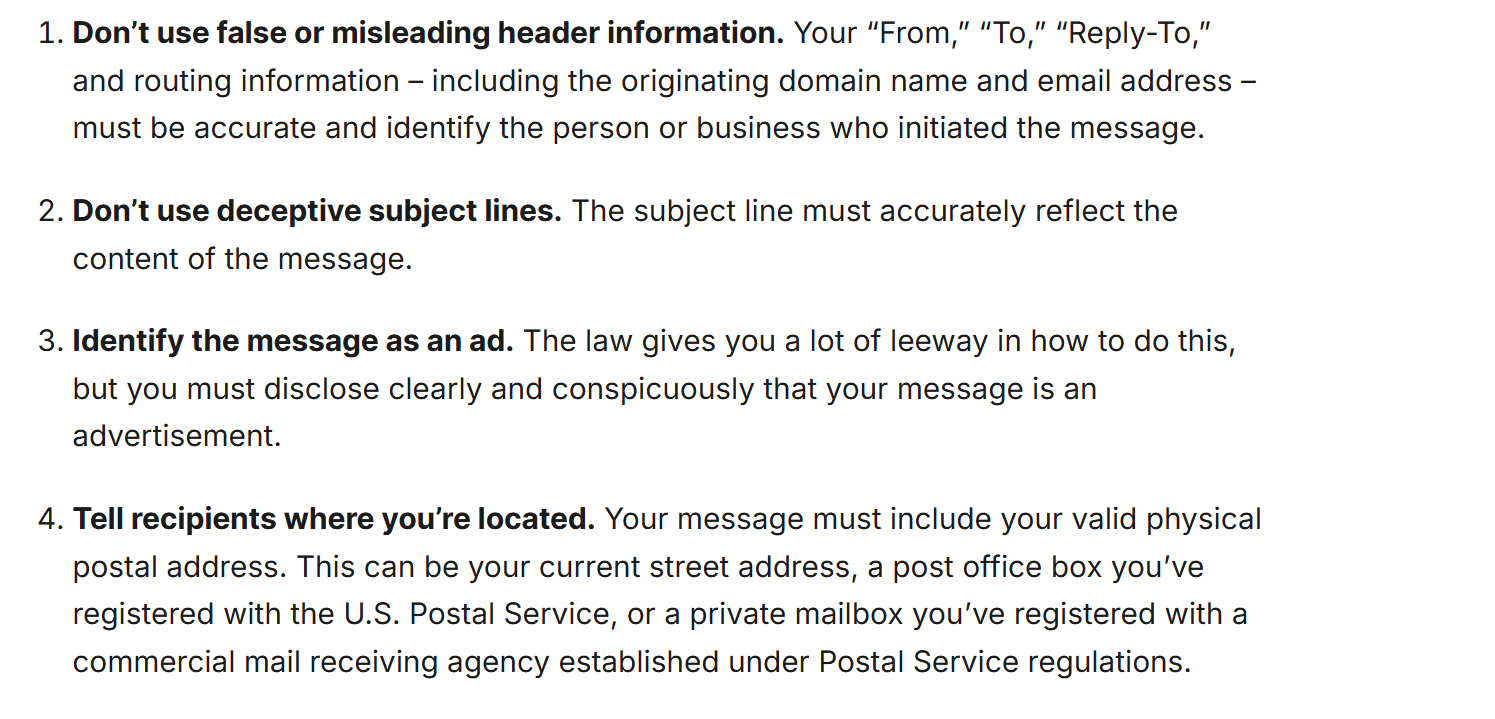
CAN-SPAM applies, and the FTC's compliance guide is short enough to read in full. Do not assume a review request is exempt because the person already bought from you: the FTC reads the transactional categories narrowly and says "you shouldn't assume that any message you send to recipients who have an ongoing commercial relationship with you ... are transactional or relationship messages".
The parts that shape a review request: your "From", "To", "Reply-To" and routing information "must be accurate", "the subject line must accurately reflect the content of the message", "your message must include your valid physical postal address", and you "must honor a recipient's opt-out request within 10 business days". Penalties are assessed against "each separate email in violation", not per campaign, which is what makes a careless send expensive.
When to send each one
Both channels share a trigger and differ on the clock. The trigger is the job being finished, not the payment being taken.
A text should land the day after the job, mid-morning or early evening, inside waking hours in the customer's timezone. The FCC's guidance says telemarketing calls to a home are prohibited before 8 a.m. and after 9 p.m. That is written for calls, not texts, but it is a sensible fence around your sending hours. Email is looser, because it waits: the day after the job, mid-week rather than Monday. There is a fuller timing table by business type in how to get more Google reviews, and the trade where the order matters most is covered in reviews for home services.
Text first, email second, then stop
- Text the day after the job. One sentence, your business name in the first few words, one link.
- Wait three to five days. Not one. A customer who is going to act often acts on day two or three, and a chase on day one spends the second message for nothing.
- Email once, shorter than the text was long. Refer back to the ask rather than repeating it, give the link again, and say that it is fine to ignore.
- Stop. Two messages is the whole programme for this job. Ask again after their next visit.
In practice that means Harbourline Dental marks an appointment complete at 4 p.m. on Tuesday, texts at 10 a.m. on Wednesday, and emails on Monday morning if nothing has happened by Saturday.
Changing channel makes the second message read as a reminder rather than a chase. If the text failed because the number was wrong, the email is a real second attempt rather than a repeat.
Flip the order when the email relationship came first. A client of a firm like Standen & Co, who has only ever had emails from them, gets the email first and a text second, if a text goes at all.
What a repeat customer should experience
Somebody who comes to you four times a year is one customer, not four review requests. Ask once, and if they book again before replying, move the ask rather than adding one. Skip anyone who has just reviewed you, because asking for a thing somebody has already done reads as though nobody was paying attention. Anyone who opted out never reappears on either channel, and when the review lands the follow-up stops.
Keeping one contact history across both channels is where the admin gets messy. Cloutly's review campaigns treat a repeat customer as one contact asked once rather than one ask per transaction, so a second booking moves the ask instead of adding one. They skip anyone who reviewed you in the last 90 days, never re-enrol a contact who has opted out, and stop the follow-up the moment the review lands.
What not to do, on either channel
No incentive, in the text or the email. Google's prohibited and restricted content policy bars merchants from offering incentives "in exchange for posting any review or revision or removal of a negative review", and names payment, discounts and free goods or services as the examples. A prize draw entry counts, and so does a free coffee.
No rating question before the review link. Asking a customer to rate you privately and showing only the happy ones the review link is review gating. The same policy bars merchants from "discourag[ing] or prohibit[ing] negative reviews, or selectively solicit[ing] positive reviews". There is more in review gating. Cloutly has not gated since 2021.
No asking for particular words. Google says merchants should not "request that specific content be included", and names a review that identifies a staff member as its example. Give each person their own review link so the credit follows the link, rather than scripting the customer.
No suggesting a number of stars, in a subject line, a text or a counter card. More on what a request may say is in five-star Google review requests.
No sending to a list you did not collect. The consent obligations above follow every address and number you use, including the ones that came with the business.
SMS vs email review requests, side by side
| Text message | ||
|---|---|---|
| Read on | The phone the review will be written on | Whatever device is open, often not the phone |
| Carries context | A sentence | The job, the date, the person, the invoice |
| Cost | Per segment, so a long message costs double | Effectively nothing per send |
| US rules | TCPA: consent first, opt-out honoured in any reasonable manner | CAN-SPAM: accurate headers, postal address, opt-out within 10 business days |
| AU rules | Spam Act: consent, sender identification, unsubscribe within 5 working days | The same. The Spam Act covers both |
Frequently asked questions
Is SMS or email better for review requests?
Text, where you hold a mobile number and consent, because it reaches the customer on the device the review gets written on and removes a sign-in step email cannot. Email is the better first channel where the relationship already runs by email.
Should I send both a text and an email?
Yes, but not at the same time and not more than twice in total. Text the day after the job, then email once, three to five days later. A third message reads as pressure.
Is it legal to text customers asking for a review?
It depends on consent. In the United States, FCC rules ban autodialled texts to a mobile without the owner's prior consent, and commercial texts require written consent. In Australia, ACMA states that inferred consent does not cover messaging somebody just because they bought something from you.
Do texts really have a 98% open rate?
Nobody can measure the open rate of a text message. There is no read receipt available to the sender and no pixel to fire, so a figure of that kind is not an observation of your messages. Measure link clicks and reviews instead.
What if I only have an email address?
Send the email, write it like a text, and put a QR code where those customers physically are. Collecting a mobile number at booking is worth doing, but it fixes next quarter rather than this one. Meanwhile the subject line does most of the work, and there are ones that hold up in email subject lines for review requests.