
Restaurant review sites: the 9 that matter in 2026
Every list of restaurant review sites names the same platforms, and almost none says which ones a restaurant is actually allowed to ask on.
Lachlan Fea 9 min read
In this article12 sections
Google is the restaurant review site that decides. It is where the search ends for most diners, and its rating is the one they compare. The other eight restaurant review sites worth knowing in 2026 matter for narrower reasons, and one of them will put a public warning on your page if you collect reviews the wrong way.
What separates these platforms is not audience size. It is who may post, and whether you are allowed to ask. Yelp tells businesses never to ask. Zomato answers selective asking with a public disclaimer on your page telling diners your reviews look suspicious. OpenTable does the asking for you and will not accept a review from anyone who did not book through OpenTable and turn up. Most lists of restaurant review sites name the same platforms and skip all of that.
This is the hospitality version of our guide to review sites for businesses. Every rule below was read off the platform's own help or policy pages on 6 September 2026.
The 9 restaurant review sites, and who you may ask
| Site | Who can post | May you ask for reviews | How you reply |
|---|---|---|---|
| Google Business Profile | Anyone with a Google Account | Yes, and Google tells you how | Publicly, editable later |
| Tripadvisor | Anyone with an account | Yes | A public Management Response under the review |
| Yelp | Anyone with an account | No, never | Publicly or by direct message, once claimed |
| Anyone logged into Facebook | Meta publishes no rule | Meta publishes nothing on Page replies | |
| OpenTable | Only diners who booked through OpenTable and turned up | No need, OpenTable asks the day after | One public response, then private only, no edits |
| Zomato | Anyone with an account | No, and it is punished in public | One management response, no edits |
| Uber Eats | Customers, inside the app | No published rule | Merchant articles sit behind a store login |
| DoorDash | Customers with an order, in selected US, Canada and Australia markets | No published rule | Privately, within 7 days |
| The Infatuation | Its own writers | No | No |
The sites anyone can post to are mostly the ones you may ask on, and the sites that check a real visit ask on your behalf. So the list of places a restaurant should chase reviews is much shorter than the list of places it should be listed.
Google restaurant reviews
Google is barely a restaurant review site. It is the layer above them, and anyone can post. The only gate is that customers "must be signed into a Google Account to leave a review", and one can be set up with a non-Gmail address.
Google also wants you to ask. Its tips to get more reviews say that "to leave reviews, you can ask customers to visit a Google link or scan a QR code". What it bans is paying for the answer: "offering incentives, like free or discounted goods or services, in exchange for customers to post reviews ... is considered fake & misleading content and is strictly prohibited". A free dessert for five stars breaches that, whatever the sign on the counter calls it.
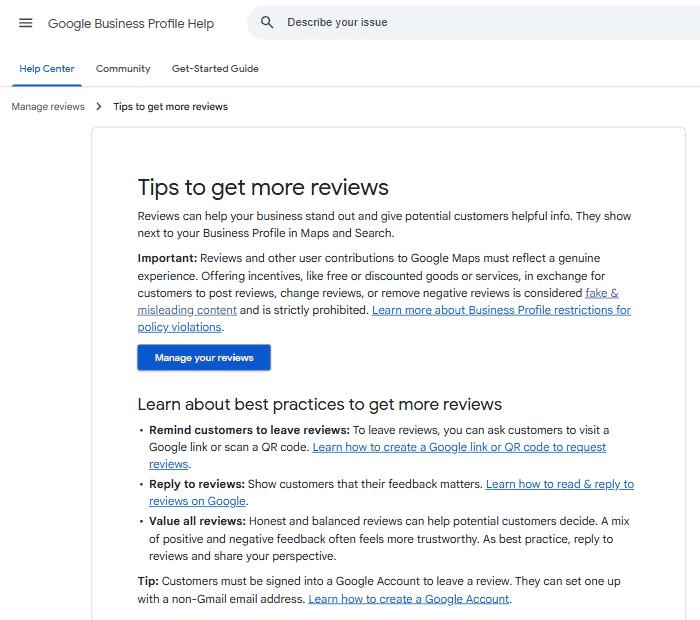
Google also lets you edit or delete a reply after it publishes. Zomato and OpenTable never do, so Google is the one site here where a reply written at eleven on a Saturday night can be fixed on Sunday.
Tripadvisor restaurant reviews
Tripadvisor is where the traveller decides. If a real share of your covers are people who do not live within ten minutes of your door, it is your second site and it is not close.
You may ask, and Tripadvisor would rather you answered. Its management response guidelines say owners "can and should respond by adding a Management Response", posted "directly underneath the traveler review" and "visible to anyone looking at the website".
What gets a response rejected, and replies worth copying, are in how to respond to Tripadvisor reviews; how to ask for one is in how to get more Tripadvisor reviews.
Yelp restaurant reviews and ratings
Yelp carries real weight for restaurants in US markets and close to none elsewhere, so whether it belongs on your list is a geography question. The costly mistake is asking, and Yelp buries the rule in the conflicts-of-interest bullet of its content guidelines.

So Yelp is a site you read and answer, never one you feed.
Answering is simple once the page is claimed. Yelp says that "if you've claimed your business page, you can reply to your reviews by clicking Respond, Direct message, or both", and that "responses are public and appear below the review". When one needs to come down instead, what actually works on a Yelp review covers the grounds that succeed.
Facebook restaurant reviews
Facebook still earns its place for a suburban venue, where the local audience genuinely lives and the Page often does more work than the website.
The rating is a Recommendation percentage rather than stars, and anyone logged in can leave one. Meta does "not verify that users purchased the product or used the service that they are reviewing".
Two rules decide whether the number on your Page moves at all. Meta says "a Page may not have a rating if it hasn't received at least five reviews", and that "only recommendations that are shared publicly are included in a Page's overall rating". So a regular who writes something lovely and posts it to friends only has changed nothing.
Meta publishes no rule on asking, and nothing at all on how a Page replies. The settings path is in Facebook reviews for business.
OpenTable reviews
OpenTable is the closed loop, and it behaves differently from everything above it.
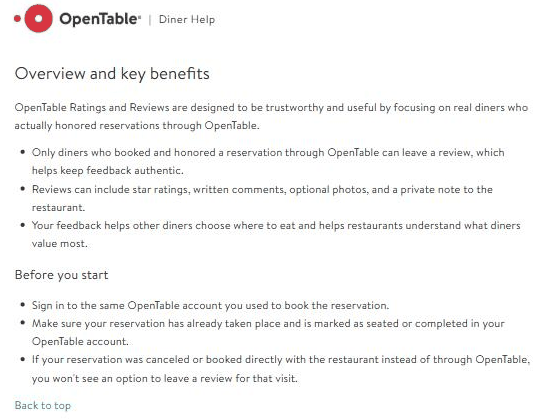
Only a diner who ate can review you. OpenTable's help centre is explicit: "only diners who booked and honored a reservation through OpenTable can leave a review", tied to that reservation in the account that booked it. The diner signs into that account, opens their past reservations, picks the one they want to review and leaves star ratings, written comments, optional photos and an optional private note to you. Moderation can take up to 72 business hours. Diners can edit or delete their own review afterwards, but a deleted one cannot be replaced.
A cancelled booking gets no review option. Neither does a guest who came along on somebody else's reservation, or anyone who rang you directly or walked in.
That is why your OpenTable review count looks thin beside your covers. On a 120-cover Saturday where thirty tables came through OpenTable, thirty diners get asked and ninety do not. Star-only ratings count towards your score but never appear on the public profile. And the Ratings and Reviews section does not show at all until you have been listed 30 days or collected ten reviews with comments, whichever lands first.
You do not send the request. OpenTable sends it the day after the reservation is marked seated, or automatically updated to assumed seated, by email and push notification. The operator's lever is not the ask. It is making sure bookings actually run through OpenTable and get marked seated on the night. Correct a no-show to seated after the fact and the guest can still review from their account, they just never get prompted.
The reply rules are the strictest of the nine.
- One public response per review. Everything after that goes privately to the guest.
- No editing, ever. Responses "won't be removed regardless of mistakes, including typos or posting the response to the wrong review".
- Public responses show on your OpenTable profile on the desktop site only, not in the app.
- You can reply privately to a star-only rating that carries no comment, and that reply is not published.
- Links and email addresses are allowed in private responses and not in public ones.
The rating window catches people out too. In the United States, Canada and Mexico the score runs on a rolling 120 days, and outside North America on 365, counted from the reservation date rather than the date the guest wrote.
Report a review that breaks the rules to reviews@opentable.com, with the text, the dining date and your reason. What OpenTable will not have is you going round the outside: "never directly contact a guest to ask them to remove or alter a review."
Zomato reviews
Check the market before you spend a minute here. Zomato's home page on 6 September 2026 calls it "India's #1 food delivery app", covering 800-plus cities. If your venue is not in India, Zomato is not your list, whatever a 2022 article told you.
Where it does operate, anyone with an account can review and Zomato polices it after the fact. Its guidelines for restaurants are the bluntest of the nine. "Selective solicitation is a strict NO." So is offering freebies, asking staff to compete with each other to collect reviews, and hiring anyone who offers to fix your ratings.
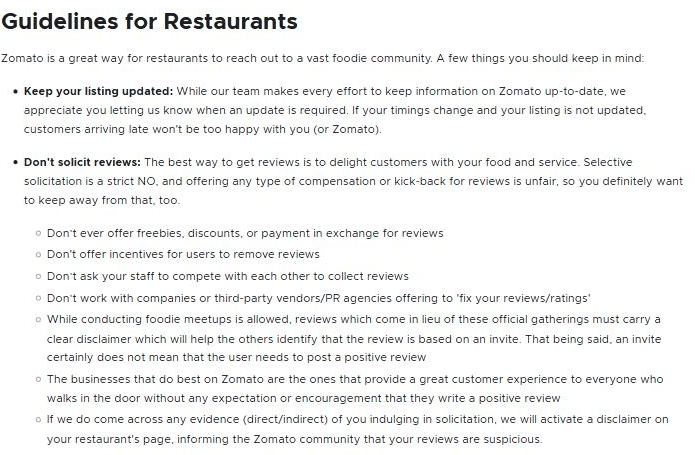
The penalty is the part nobody quotes: "we will activate a disclaimer on your restaurant's page, informing the Zomato community that your reviews are suspicious." No other platform on this list punishes asking in public, on your own page, where your next customer will read it.
You get one management response, and Zomato's warning about it is worth taking literally: "your response can't be edited after posting, so choose your words well."
Uber Eats, DoorDash and delivery ratings
A delivery rating is not a restaurant review, and treating it as one is how kitchens end up chasing a number they cannot move.
DoorDash publishes the most detail. A public review tied to an order carries a "Verified Order" label, and only customers in selected US, Canada and Australia markets can leave one. The scale is not stars: it is Loved, Liked or Didn't Like, with tags for parts of the experience. You reply privately, from the Merchant Portal, within seven days. There is no public reply and no opt-out, and reviews that "focus primarily on delivery issues (such as delivery time or food temperature), which are outside a merchant's control" may be rejected in moderation.
Uber Eats cannot be described honestly from the outside. Uber's merchant help centre demands a "log in with your store's account" before it will show its articles on customer feedback, so this piece will not tell you what that dashboard offers. Open Uber Eats Manager and look.
The Infatuation, and the sites you cannot work
The Infatuation is on this list for a different reason: it is real, and there is nothing you can do about it. Its reviews are staff-written and scored out of ten across a handful of cities including New York, Los Angeles, Chicago, London and San Francisco. There is nothing to claim and nowhere to reply.
Other directories older guides still name have quietly closed, Foursquare's city guide among them; the dead ones are listed here. For whatever survives, the test is whether a diner has ever mentioned it. If not, keep the listing accurate and stop.
Where to send the ask
Concentrating the ask beats spreading it. A venue with 300 Google reviews and 8 on Tripadvisor reads as busy. The same venue with 40 spread over six platforms reads as quiet everywhere.
Google takes the ask at every venue, on every service. Tripadvisor takes it second, but only if travellers are a real share of your covers: a harbourside bistro like Bramble & Rye sends the ask there, a suburban pizzeria three streets from the station does not. Nowhere else, by design. OpenTable has already asked, Yelp forbids it, and Zomato will label your page for it.
Ask every diner the same way at the same point after the meal. Never build a step that routes happy diners to the review link and unhappy ones to a private form: that is review gating, and Google's prohibited content policy tells merchants not to "selectively solicit positive reviews from customers". The timing that works is in how to get more Google reviews.
Running this across several venues
Nothing here lets you answer once for a group. Each venue has its own Google Business Profile, its own Facebook Page needing five reviews before a rating appears, its own Tripadvisor listing and its own OpenTable profile, so a four-venue group is four logins per platform.
Sort the queue by how permanent the reply is rather than by how bad the review is. Google is editable; Zomato and OpenTable are not, and OpenTable will not take a response down even when you post it under the wrong review. Answer the one-shot sites when you are calm and Google whenever you have ten minutes.
Then fix the listings before you widen the list of sites. Most one-star reviews at multi-venue groups are about a locked door, a wrong number, or hours that changed at Easter and never changed back. Our worked examples of bad reviews show what those replies look like, and the whole programme across venues is in restaurant reputation management.
If reading them all is the bottleneck, that is what software is for. Cloutly reads 39 review sites, Google, Facebook, Yelp, Tripadvisor, Booking.com and Zomato among them, brings every venue's reviews into one inbox you can filter by location, and publishes hours, phone and address to Google Business Profile and Facebook while watching Yelp, Tripadvisor and Google's public view for drift. OpenTable and the delivery apps are not among the 39, so you still open those yourself. More for venues is on our hospitality page.
Frequently asked questions
What is the best restaurant review site?
Google, for almost every restaurant in almost every market. It is the only one here that both encourages you to ask customers and lets you edit your reply afterwards.
Can a restaurant ask customers for reviews?
That depends on the site. Google encourages it and suggests a link or a QR code. Yelp tells businesses never to ask. Zomato answers selective asking with a public disclaimer on your page. OpenTable sends the request itself the day after a seated reservation. Offering a discount or a free item in exchange is banned by Google outright.
How do I leave a review on OpenTable?
Sign into the OpenTable account that made the booking, open your past reservations, choose the meal and follow the prompts on the site or in the app. You can only review a reservation you booked through OpenTable and turned up to, so a cancelled booking or a table someone else reserved gives you no option.
Do Uber Eats and DoorDash ratings affect my Google rating?
No. They are separate scores on storefronts those platforms own, tied to a delivery order rather than to a profile you control, and they never appear in the Google result a diner sees when they search your restaurant by name.