
How to get more Tripadvisor reviews: what owners can and cannot do
Tripadvisor's rules decide how you are allowed to ask. Its tools decide how well the ask works.
Lachlan Fea 10 min read
In this article10 sections

To get more Tripadvisor reviews, claim the listing, then ask every guest once, soon after they leave, using the free tools in the Management Center: the window sticker with its QR code, the Write-A-Review widget on your site, Review Express, and your own email or text. Two things are off the table anywhere in that list. You cannot offer a guest anything for a review, and you cannot ask only the guests you expect to be happy.
The second rule is the one that catches good operators out, because it rules out the survey-first pattern several review tools still sell. The rest of this page covers what Tripadvisor documents you may do, what its own tools actually give you, and what its ranking does with the reviews once they land.
Verified 6 September 2026 against Tripadvisor's review posting guidelines, its Hospitality Master Terms, the owner help centre articles linked below, and Tripadvisor's own resources for hotels.
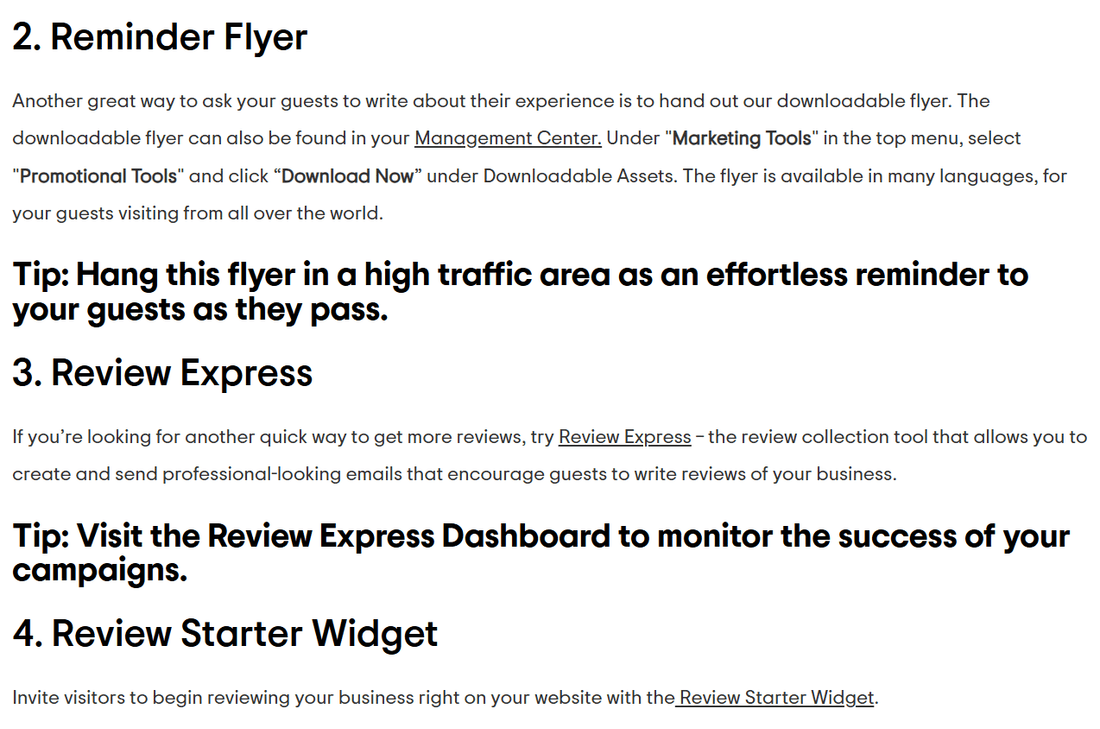
What Tripadvisor gives you to ask with
Claiming the listing comes first, it is free, and it happens at tripadvisor.com/Owners. Everything below sits behind that login.
The owner help centre puts the free marketing tools under Promo Tools & Awards in the Management Center navigation, in four subsections: Window stickers, Website widgets, Printed branding and Digital branding. The window stickers page offers two, and the useful one is the "Review us on Tripadvisor" sticker, which Tripadvisor says "even has a QR code that will lead customers right to your listing page".
Be ready for a half-finished screen. The same article says the Website widgets, Printed branding and Digital branding pages "are still being developed in the new Management Center", and that each carries a button through to the old one. Tripadvisor's older resource on free review tools describes that old path, Marketing Tools then Promotional Tools, and that is where the printed material lives: business card sized reminder cards, first 100 free with shipping "typically $6 - $10", and a downloadable flyer.
The widgets sit in the Widget Center. Alongside the rating badges, the free widget list includes Write-A-Review widgets, which "invite visitors to begin reviewing your business right on your website". Put one on a thank-you page or the landing page of your post-stay email, not on your home page, where it asks people who have not been yet.
Tripadvisor Review Express, and what it does not do
Review Express is Tripadvisor's own review request tool, described as "the review collection tool that allows you to create and send professional-looking emails that encourage guests to write reviews of your business", with a Review Express Dashboard for watching how a campaign performed.
Use it, and be realistic about it. Checked today, Tripadvisor publishes no help centre article for Review Express in any of the three owner categories, and its old tripadvisor.com/ReviewExpress address lands on the Tripadvisor for Business home page. Nothing current is published about upload limits, reminder scheduling, or how long a contact stays in a campaign. You can send from it. You cannot plan a programme around numbers Tripadvisor has not put in writing.
Two limits matter more than the missing documentation. It is email only, so a venue whose guests answer texts is asking through the slower channel, and it asks for one thing, which suits a hotel and often leaves a restaurant short on Google. It also runs off a list somebody keeps exporting out of your booking system. Tripadvisor sells the automated version: with Reputation Pro, its hotel resource says, "we will send review requests on your behalf". Pricing for that is not published.
The Tripadvisor review link, and what the guest actually sees
The QR code on the sticker goes to your listing page, not the review form, so the guest still has to find the review button once they arrive. For the shorter path, Tripadvisor's write-a-review page has a stable address you can build from your own listing URL: keep the -g and -d numbers and swap Hotel_Review or Restaurant_Review for UserReviewEdit. Opened in a phone browser on 6 September 2026, that loaded the review form directly, with no app involved. Tripadvisor does not document the pattern for owners, so treat it as a convenience rather than a supported feature and check it before you print it on anything.
The form is longer than a Google review, and knowing that changes how you ask. The guest gives a bubble rating, says when they went and who with, rates up to eight things separately for a hotel, and has to write at least 25 characters. Then they tick this:
I certify that this review is based on my own experience and is my genuine opinion of this hotel, and that I have no personal or business relationship with this establishment, and have not been offered any incentive or payment originating from the establishment to write this review. I understand that Tripadvisor has a zero-tolerance policy on fake reviews.
A guest who was handed a free drink for the review has to lie to a checkbox to post it. Worth remembering before anyone at your venue suggests it.
When to ask
Tripadvisor's own answer for hotels is a follow-up email a few days after the stay, sent "within 72 hours of check-out, so their stay is still fresh in their minds", or a few extra lines on the check-out email you already send. For a restaurant that window is the same evening or the next morning. For a tour it is the trip home.
There is an outer limit too. Under the review guidelines, "all reviews must be submitted within one year of your experience", so last summer's guest list is one you can still work through. A list from two years ago is not.
Do not move the ask onto the premises to make it faster. Tripadvisor's script for front desk staff is deliberately written for later: "We hope you enjoyed your stay with us. If you have a moment when you get home, please leave us a [r]eview on Tripadvisor. With so many options in [city] today, it truly helps our business stand out." Asking at the counter and watching them type breaks two rules at once, as the next section explains.
The rules on incentives and on asking selectively
Both sit in the review posting guidelines under Bias and Attempts to Manipulate Tripadvisor Rankings, and the penalty lands on the listing rather than on the guest: "ranking penalties, red badges, and/or exclusion from awards".
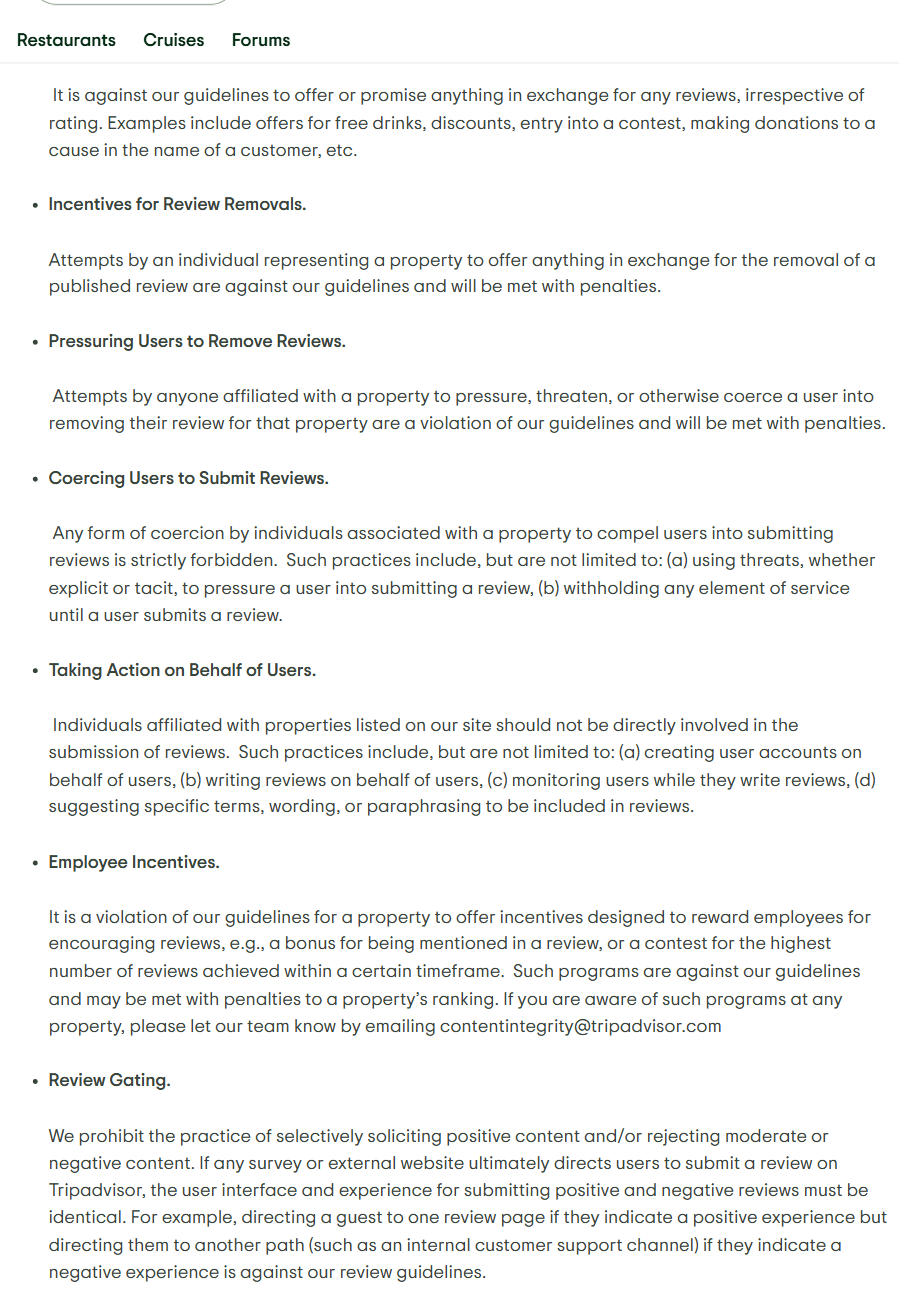
The incentives rule sits at the top of this section and the gating rule at the bottom. Read on 6 September 2026.
On incentives the wording leaves no room: "It is against our guidelines to offer or promise anything in exchange for any reviews, irrespective of rating. Examples include offers for free drinks, discounts, entry into a contest, making donations to a cause in the name of a customer, etc." The prize draw counts. The free coffee counts. Making the donation in the guest's name counts.
Asking only the happy ones has its own heading, Review Gating: "We prohibit the practice of selectively soliciting positive content and/or rejecting moderate or negative content. If any survey or external website ultimately directs users to submit a review on Tripadvisor, the user interface and experience for submitting positive and negative reviews must be identical." The Premium Schedule of its Hospitality Master Terms says the same to any customer using its review collection or review management tools: "Customer shall not be selective about which End Users to contact to solicit reviews and shall not incentivize the review collection in any way." If you are shopping for software, that sentence is the test to apply to it, and there is more on the pattern in what review gating is.
Three more rules in the same section catch hospitality operators in particular.
| The rule | What it catches |
|---|---|
| Taking Action on Behalf of Users | "creating user accounts on behalf of users", "writing reviews on behalf of users", "monitoring users while they write reviews" and "suggesting specific terms, wording, or paraphrasing to be included in reviews". The tablet at the desk with the review form open is the version that gets built by accident |
| Employee Incentives | "a bonus for being mentioned in a review, or a contest for the highest number of reviews achieved within a certain timeframe". Recognising the people who get mentioned is fine. Paying for the mention is not |
| Coercing Users to Submit Reviews | Threats "whether explicit or tacit", and "withholding any element of service until a user submits a review" |
The far end of all this is worth knowing before anyone suggests a shortcut. Tripadvisor's review fraud consequences are a drop in the popularity index, the loss of Travelers' Choice eligibility, and "a large red penalty notice, explaining that the property's reviews are suspicious" sitting above every genuine review you have earned. The US Federal Trade Commission's Rule on the Use of Consumer Reviews and Testimonials, in effect since 21 October 2024, "authorizes courts to impose civil penalties for knowing violations" on top of that. The arithmetic is in can you buy Google reviews, and the signs a rival has been at it are in how to spot a fake review.
How Tripadvisor's ranking uses quantity, recency and quality
Tripadvisor publishes the three factors behind its popularity ranking, and they are the reason a steady ask beats a burst.
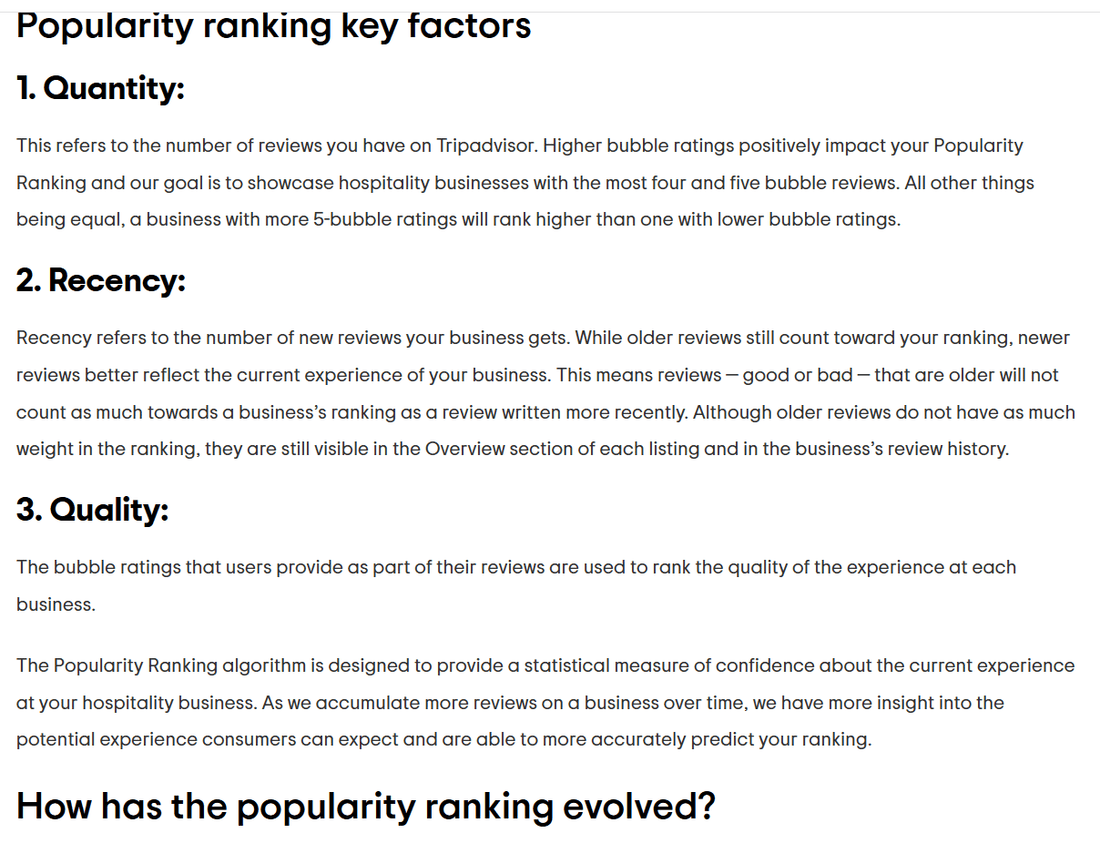
| Factor | What Tripadvisor says it means |
|---|---|
| Quantity | The number of reviews you have. "All other things being equal, a business with more 5-bubble ratings will rank higher than one with lower bubble ratings" |
| Recency | The number of new reviews you get. Reviews "good or bad" that are older "will not count as much towards a business's ranking as a review written more recently" |
| Quality | The bubble ratings themselves, "used to rank the quality of the experience at each business" |
Recency is what makes this a habit rather than a project. A property that collected 200 reviews two years ago and none since is losing ground to a competitor collecting four a month, even though it still shows the bigger number. Tripadvisor is also explicit that the ranking "is based solely on user feedback", and that a listing's "commercial relationship with Tripadvisor has absolutely no impact on their popularity ranking", so no advertising spend fixes a thin recent column. How the visible score itself is worked out is a separate question, covered in our post on how Tripadvisor ratings are calculated.
Asking for Google and Tripadvisor reviews without breaching either policy
Most hospitality businesses need both, and the two rulebooks agree more than they differ. Google's tips for owners say "offering incentives, like free or discounted goods or services, in exchange for customers to post reviews, change reviews, or remove negative reviews is considered fake & misleading content and is strictly prohibited". Its content policy tells merchants not to "discourage or prohibit negative reviews, or selectively solicit positive reviews from customers", and adds a line Tripadvisor leaves implicit: merchants "should not require or pressure users to leave ratings or write reviews while on the premises".
What differs is where each site earns its keep. Google is where someone searching your town finds you at all. Tripadvisor is where a traveller comparing four properties decides between them. So send one ask per guest, pointed at one site, chosen by whichever gap is bigger at that venue this quarter. Two links in one message gets half the clicks and none of the reviews. If Google is the gap, the long version is in how to get more Google reviews; the choice between text and email is in SMS or email for review requests.
What a guest can and cannot edit
A guest cannot edit a published Tripadvisor review. The help centre is direct: "reviews cannot be edited. The only way to update your review is to delete it and submit an updated version." Deleting is their own job, from their profile, and the review "will immediately disappear from the website".
Four consequences for the operator.
- A one-star that vanishes has usually been deleted by the guest, not removed by Tripadvisor, and it may reappear rewritten within a day. Most reviews publish in 24 to 48 hours, though one another user flags "can take several weeks to process".
- A guest who says they have updated their review has deleted and rewritten it, and "you can only submit an updated review once for the same experience".
- A repeat guest cannot review you again straight away. Tripadvisor accepts another review three months after the last one published for a hotel or attraction, one month for a restaurant.
- You cannot ask for any of it. Pressuring a guest to remove or change a review is a guidelines violation with penalties attached, covered in how to remove a Tripadvisor review.
How to get more Tripadvisor reviews across several venues
A group's Tripadvisor position is usually set by two or three venues. Wherever the general manager cares about it, reviews arrive every week. Everywhere else they arrive when a guest feels strongly enough to go looking for the site, which is not often and rarely for a good reason.
Two things close that gap, and neither is a bigger campaign. Pick one channel per venue and leave it alone, so a guest is asked once by a method that venue can actually run. Then report the ask rather than the score: how many guests each venue asked this month, and how many reviews came back. That is the number that moves next quarter's ranking. The score only records last quarter's.
Cloutly is one way to run it. It asks by text and email on the spacing you set, treats a repeat guest as one contact asked once, skips anyone who has reviewed you in the last 90 days, and brings the Tripadvisor reviews that come back into the same inbox as every other site it reads. More on the review campaigns page and our hospitality solutions page.
Collecting them is only worth so much if nobody answers. On Tripadvisor you get one attempt at each reply, and ten worked examples are in how to respond to Tripadvisor reviews. Hotels and restaurants each have a wider site list, in hotel review sites and restaurant review sites, and Tripadvisor ratings covers how the bubble score is built.
Frequently asked questions
How do I get more Tripadvisor reviews for a hotel? Claim the listing, put the "Review us on Tripadvisor" sticker with its QR code where guests pass it, add the Write-A-Review widget to your site, and send one ask within 72 hours of check-out. Ask every departing guest, not the ones you expect to be pleased.
Can I offer a discount or a free drink for a Tripadvisor review? No. Tripadvisor bans offering or promising anything in exchange for a review "irrespective of rating", and names free drinks, discounts and contest entries as examples. The guest also has to certify they were offered no incentive before the review posts.
Does Tripadvisor Review Express still exist?
Yes, as a free tool in the Management Center, and Tripadvisor still names it in its own guide to free review tools. There is no current help centre article for it, and the old tripadvisor.com/ReviewExpress address now redirects to the Tripadvisor for Business home page, so nothing is published today about sending limits or reminder timing.
Can a guest edit their Tripadvisor review? No. The only way to update one is to delete it from their own profile and submit a new version. The original disappears immediately and the replacement goes through moderation like any other review.
How many Tripadvisor reviews do I need? Enough recent ones that a traveller comparing you to three neighbours sees this year rather than 2023. Recency is one of Tripadvisor's three ranking factors, so the running rate matters more than the total, and the arithmetic behind that is in how many reviews you need.