
Google reviews for home care agencies: who to ask, and what you can say back
The person who writes your review has usually never had an hour of care from you. Almost everything else follows from that.
Lachlan Fea 8 min read
In this article8 sections

Google reviews for home care agencies almost always come from the family. The person who compared three providers, signed the agreement, holds the roster and rings when a carer is late is usually a son or a daughter, and they are the one who writes. So the ask goes to the contact your office already emails, it goes after the first month rather than the first visit, and the reply you write underneath never confirms who the client is or what care they receive.
That is where providers slip. Set one thing aside first: a review is not a complaint, and answering a review does not answer one. Whatever your provider does when a family raises something formally is unaffected by anything here.
Who writes a home care review, and why it is rarely the client
Some clients write their own, and those are the best reviews you will ever get. Most do not. The client may be 88 and off email, or living with dementia, or three weeks home from hospital and uninterested in rating anybody. The relationship with your office belongs to the adult child.
That makes your contact list easier than it looks. You already have a family contact on the account: the person you send the schedule to and who queries the invoice. That person is the reviewer.
Two rules follow. Ask the family contact rather than the client, unless the client has said they want to write one. And do not ask both about the same person, because two requests about one set of visits reads as pressure on a family that is already stretched.
It changes what comes back, too. A family reviews reliability and communication: whether the same face turns up, whether the office answers at 7am when a carer is stuck in traffic. They rarely review the care itself, because they were not in the room.
The mechanics of asking are the same as in any service business, and they are in how to get more Google reviews. What is different here is the timing and the recipient.
How to get Google reviews for home care agencies: ask after the first month, not the first visit
Ask after roughly a month of visits. The first visit is much too early: the family is anxious, a parent has just come out of hospital, the roster has not settled and the carer may change twice in the first fortnight. There is nothing to review yet, and asking looks like you are collecting the review before you have done the work. By week four they know whether it is working, and you get a review with something in it.
The other reason to hold the ask is sadder. Care ends. A client dies, or moves into residential care after a fall, and an automated request lands in a daughter's inbox four days later. Nothing does more damage to a home care brand than that message. Whatever you use to send the ask has to let you take a contact out and keep them out.
Then ask once. Providers who over-ask do it by accident, because a repeat booking triggers a repeat request and one family gets four messages about one parent. Cloutly treats each family contact as one contact asked once, so a second booking moves the ask rather than adding one; it skips anyone who reviewed you in the last 90 days, stops the follow-ups the moment the review lands, and never enrols a contact who has opted out. There is more on how providers run it on our home care page.
One thing never to build in. Do not put a rating question in front of the review link so that only the happy families reach Google. That is review gating, it breaches Google's policies, and in care it reads as suppression to anyone who works out what you did.
What you can say in a reply to a home care review
Reply as the provider, in general terms, and never confirm who the client is or what care they receive. Thank the person for writing rather than for the care, put one named person on a real phone number, and stop at about sixty words.
Most advice tells you the opposite: thank the reviewer by name and mention the carer they praised. In home care that is the one thing not to do, and the reason is not a legal one. The daughter who wrote the review chose to make her situation public. Her mother did not. "Thank you for having us with your mother three mornings a week since March" publishes facts about a person who never agreed to any of it, in front of her neighbours and anyone else who searches you. The reviewer waived her own privacy, not the client's.
The test is easy. Read the reply back and ask whether it would still be true and sensible if the person who wrote it had never been a client of yours.
Three replies, from three invented providers.
A five-star review that names a carer. At Ashfern Home Care, the review reads: "Nell has been coming three mornings a week since April and she has been wonderful. Mum actually looks forward to seeing her."
Thank you for writing this down. We do not discuss anyone's care arrangements here, so all we will say is that your message has gone to the person you named and to her coordinator, and it will mean a great deal to both of them. We are on [phone] if there is ever anything you need.
It gives back nothing: not the client, not the days, not the start date, not even confirmation that the carer named works those visits.
A complaint about continuity. At Kelvedge Care at Home: "Four different carers in three weeks and nobody tells us who is coming."
Four faces in three weeks is not the continuity we aim for, and not knowing who is at the door is worse than the changes themselves. We are not able to go through an individual schedule in public. Our client services manager, [name], is on [phone] on weekdays and will go through it properly.
A review you cannot match to anyone. At Sedgeholm Home Care: "Absolutely hopeless. Two missed visits in a fortnight and not one apology."
This one is more common in home care than anywhere else, because your bookings sit under the client's name and the reviewer is a daughter with a different surname. You often cannot tell whether it is yours. Do not write "we have no record of you", which is a statement about a named person, and do not write "we have no client by that name", which confirms who is and is not a client.
A missed visit with no call afterwards is not something we would leave, and I would like to find this one. We are not able to match a public review to an account, and we would not go through an account here in any case. Ring [phone] and ask for [name] and she will look today.
The same constraint applies in how to respond to negative patient reviews, and its wider version is in online reputation management for doctors.
When a review names one of your carers
Most of the time, do nothing except tell the carer. Usually the naming is praise, and the person named never hears about it unless somebody in the office bothers to say so.
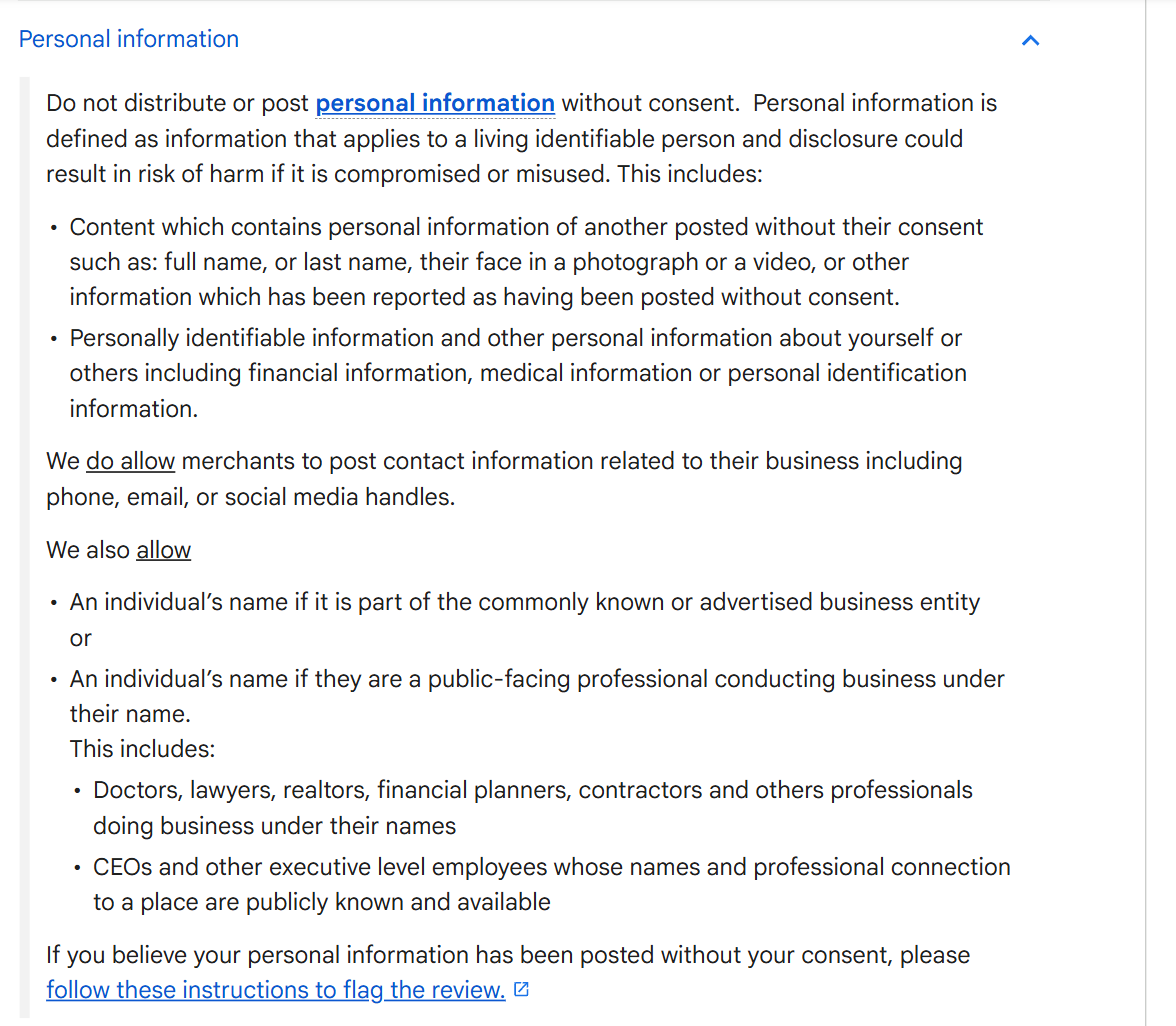
When the naming comes with an accusation, it is worth reporting, and the grounds are better than most providers assume. Google's policy on personal information says "Do not distribute or post personal information without consent", and lists medical information among what is not allowed. It then names two exceptions: a name that is part of the commonly known or advertised business entity, and "An individual's name if they are a public-facing professional conducting business under their name", the examples being doctors, lawyers, realtors, financial planners and contractors (Google).
A support worker employed by your agency is neither. She is not the business entity, and she is not conducting business under her own name, so the exception written for a named GP is a poor fit for her. Where a review names a carer and also sets out somebody's care needs, the personal information clause is the ground to point at, and the health detail is the part of the report most likely to land. What a report needs, and what to do when it is refused, is in how to get a negative Google review removed.
Two things not to do. Never publish a verdict on a named carer in the reply, however sure you are of your own person, because that reply is read by every family you have. And never set up a Google Business Profile for a carer. Google reserves those for "a public-facing professional, typically with their own customer base" contactable at the verified location during stated hours, and says plainly that "support staff should not create their own Business Profiles" (Google). A carer working in a client's living room is neither.
Credit the carer the family named
A home care review usually names somebody. The carer is the only part of your service the family sees, so she is the part they write about.
There are two ways to capture that and only one is exact. Give each carer her own review link, on a card or a QR code she can leave behind, and the review arrives already attached to her. Name matching in the review text fills the gaps, but it can credit the wrong person when two carers share a first name, and it misses every review that names nobody. Personal links first, name matching as the backstop.
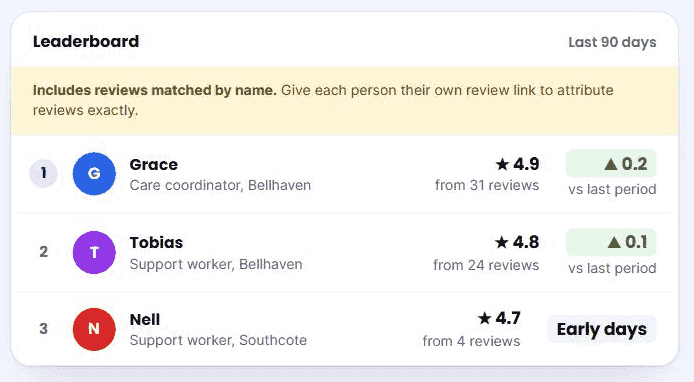
The credit is not a scoreboard for its own sake. It is a name read out at a Monday handover, and a coordinator who can see which of her people has not been named in three months and might be on the wrong runs.
"Cloutly has helped us shine a light on the incredible work our care team does every day. It's made recognising and celebrating our top performers simple and meaningful."
Rochelle Morrison, Head of Marketing at Dovida
Where aged care provider reviews get read
Google first, and it is not close. In BrightLocal's Local Consumer Review Survey 2026 (published 11 February 2026, 1,002 US consumers), 71% said they used Google for local business reviews, down from 83% the year before. It is the rating sitting beside your name when a family searches home care in their suburb at the end of a bad week.
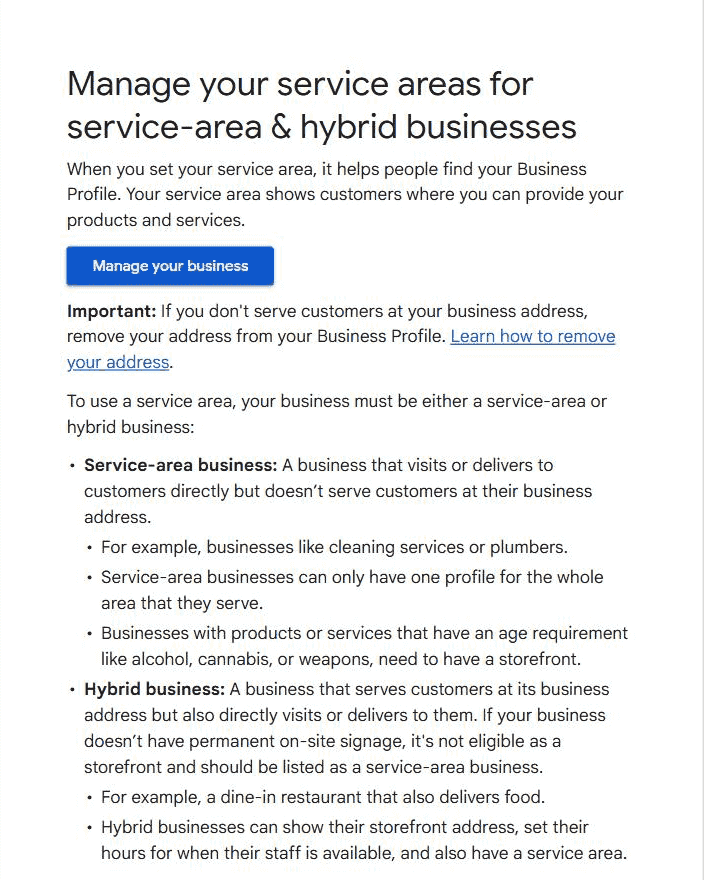
Home care providers have one Google setting other businesses never think about. You visit clients; they do not visit you. Google calls that a service-area business, "a business that visits or delivers to customers directly but doesn't serve customers at their business address", and its instruction is blunt: take the address off the profile. Declare the areas you cover instead, up to 20 of them, set by city or postal code rather than a radius, and all inside about two hours' driving of where the business is based (Google). Get it wrong and your office address sits in front of families who will never go there, while the suburbs you cover go undeclared.
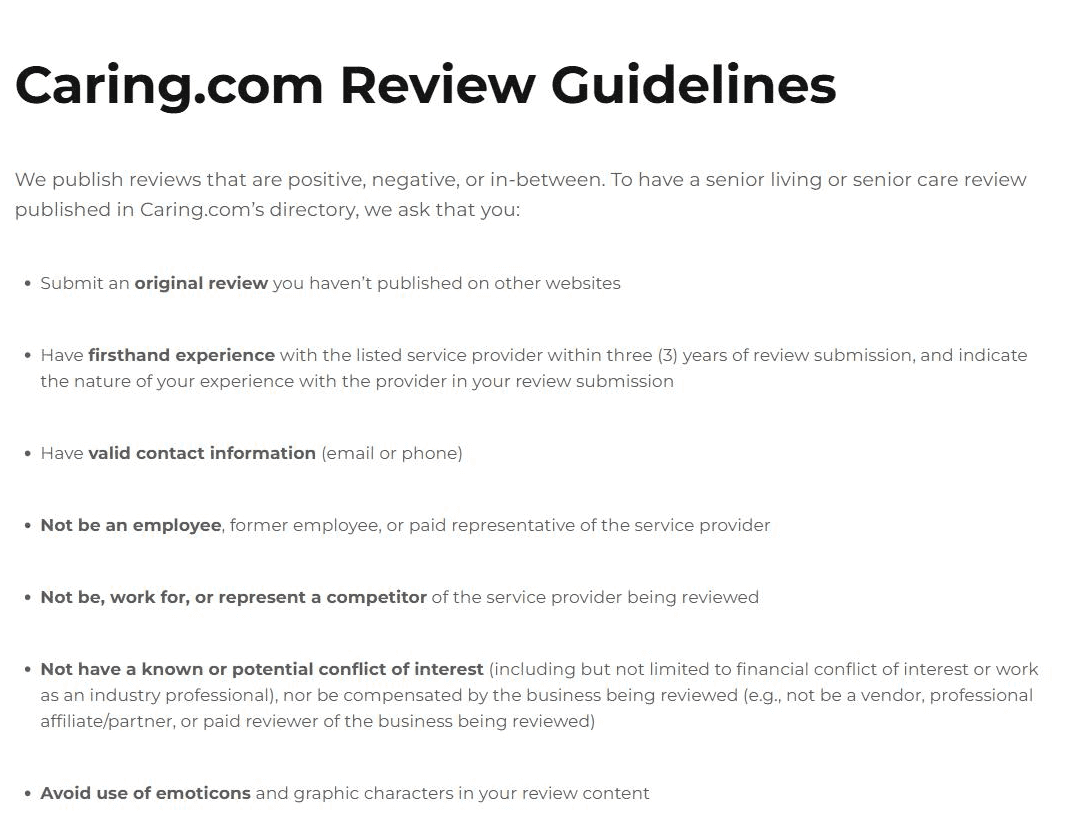
Caring.com is the other directory worth naming here because its rules are published and readable. It requires a reviewer to have "firsthand experience with the listed service provider within three (3) years" and not to be "an employee, former employee, or paid representative" or a competitor. Its reply process is unlike Google's: you send the response with your name, job title and a contact number, none of which is published, and it appears under the review only once Caring's reviews team approves it (Caring.com).
Read the rules of any other care directory before you point a family at it. They differ more than you would expect.
Reviews for care agencies across a network of franchise territories
A network has no shared rating. Every territory carries its own Google profile, so a family searching one suburb sees that office's 4.2 and never learns that the eleven around it average 4.8.
Two things go wrong at that scale, and neither is the wording of a reply. If only the busy offices ask, the network average head office reads is one franchisee's habit. And franchisees feel their reviews are theirs, which they are, so settle who replies before the rollout rather than after the first one-star. Both are worked through in multi-location review management.
Frequently asked questions
Can a family member leave a Google review for a home care client? Yes, and in home care it is the normal case rather than the exception. Google's contribution policies govern what a review contains, not which member of a household writes it. The clause to know is the one on personal information, which restricts posting medical and other personal information about other people without their consent.
Should each carer have their own Google Business Profile? No. Google reserves an individual profile for "a public-facing professional, typically with their own customer base" contactable at the verified location during stated hours, and states that "support staff should not create their own Business Profiles" (Google). Give the carer her own review link instead, so she gets the credit without a profile nobody can maintain.
Should our office address show on our Google Business Profile? Only if families genuinely come to the office. If your carers travel to clients, you are a service-area business: the address comes off, and you list up to 20 service areas by city or postal code instead (Google).