
Restaurant reputation management: how to run it across every venue
Most venues do not have a review problem. They have a no-system problem, where the ask happens when someone remembers and the replies happen when someone is angry.
Lachlan Fea 10 min read
In this article9 sections

Restaurant reputation management is three habits rather than a project. Ask every guest the same way after the visit, answer what comes back, and read the reviews across your venues for the complaints that repeat. It matters more for a restaurant than for most businesses because the rating sits between the search and the booking. Someone standing on the street at seven o'clock deciding where to eat never opens your website.
What follows is the venue version of that job: where the ask belongs in a service, what Google forbids at the table, which sites are worth the effort, what to write back, and how any of it survives a second and a fourth venue. Most advice on reputation management for restaurants stops at reply politely and ask for reviews, which is true and useless.
What reviews do for a restaurant
Start with the map result. Google's guidance on local ranking lists relevance, distance and prominence, and puts reviews inside prominence: "More reviews and positive ratings can help your business's local ranking." Prominence itself is "based on info like how many websites link to your business and how many reviews you have". For a restaurant that covers most of the searching that happens near you.
Then the walk-in. Someone two hundred metres from your door is comparing you with two other places on the same street, and what they see is a rating, a count and the two most recent reviews. A venue with 480 reviews at 4.5 reads as busy. The same venue with 46 reads as untested, whatever the food is like.
Managing restaurant online reviews gets simpler once you accept that both of those happen on Google. Everything after them is a decision about who eats with you.
When to ask a guest for a review, and why never at the table
Ask after the visit is over. Two moments work: shortly after the bill closes, while the guest is in the taxi or walking home, and the next morning, which suits a long dinner and not a lunch. Either beats a week later, when the meal has blurred into every other meal.
The table itself is out, and not because it is awkward. Google's prohibited and restricted content policy, read on 6 September 2026, says under rating manipulation: "When soliciting reviews, merchants should not require or pressure users to leave ratings or write reviews while on the premises, nor should they request that specific content be included."
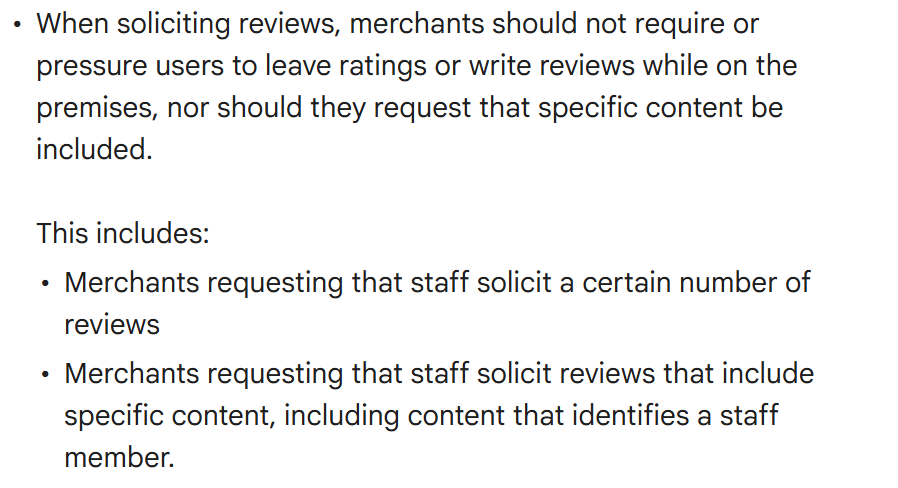
Read that closely, because most articles get it wrong in one direction or the other. It is not a ban on a review link existing inside your building. A QR code on the bill folder is fine, and Google's own tips page says that "to leave reviews, you can ask customers to visit a Google link or scan a QR code". What is banned is a person standing there while the guest types. A tablet on the pass, a server waiting for the phone to come out: that is pressure on the premises, and it is how you end up with a page of five-word reviews that read like they were written under supervision.
The same policy bans the other shortcut. Merchants may not "offer incentives ... in exchange for posting any review or revision or removal of a negative review", so a free dessert for a five-star breaches it however friendly the sign is. Nor may you sort your guests: sending happy diners to Google and unhappy ones to a private form is review gating, which the policy covers under "Discourage or prohibit negative reviews, or selectively solicit positive reviews from customers". Ask everyone the same way at the same point.
Let the till or the booking system decide the moment
An ask that depends on somebody remembering stops on a busy Saturday, which is the night you most want reviewed. Hang it off something that already happens.
The till is the obvious trigger, because payment is the one event every seated guest generates. Cloutly connects to Square and Clover for this: Square can fire on "Payment received" or on "Order completed and payment received", Clover on "Payment Completed", and you choose how long after that the message goes out. A booking system reaches the same place through Zapier, so a completed reservation can be the trigger instead if that suits your floor better.
What matters more than the trigger is what the ask does with a regular. Someone who eats with you fortnightly should be one contact asked once, not one ask per visit, and a guest who reviewed you two months ago should not be asked again on their next booking. Cloutly holds one contact per person, moves the send time when they book again rather than adding a second ask, skips anyone who has reviewed you in the last 90 days, and stops the follow-ups the moment a review lands.
No till reaches the walk-in who paid cash. That is what a QR on the bill folder is for, and it is the honest limit of automation in a dining room. More of this is on our hospitality page.
Which sites to send guests to
Two, for almost every venue. Google takes the ask at every venue, on every service. Tripadvisor takes the second ask if travellers are a real share of your covers, and nothing at all if your room is mostly regulars from three suburbs. Check your bookings before you decide which you are.
Then stop, because the rules stop you. OpenTable asks the diner itself the day after a seated booking. Yelp tells businesses never to ask. Zomato answers selective asking with a public disclaimer on your own page telling diners your reviews look suspicious. Which sites allow the ask, which punish it and what each lets you say back are in restaurant review sites: the 9 that matter. The wording of the ask itself is in how to get more Google reviews.
The complaints every venue gets, and what a reply has to do
The negatives repeat. The wait, cold food, noise, price, a member of staff, and a booking that went wrong: after a few hundred reviews you can name the complaint before you have finished reading it. The star ratings vary. The complaints do not.
A reply that works takes about ninety seconds. It uses the guest's name, says plainly which part of their account is true, names the change in one sentence if there is one, and offers a way back that is a person rather than a form. Google's reply guidance adds a rule that catches restaurants: be "conversational, not promotional", because "your reviewers are already customers". Putting right one bad night is not a promotion. Closing every reply with a discount code is.
Two rules are specific to hospitality.
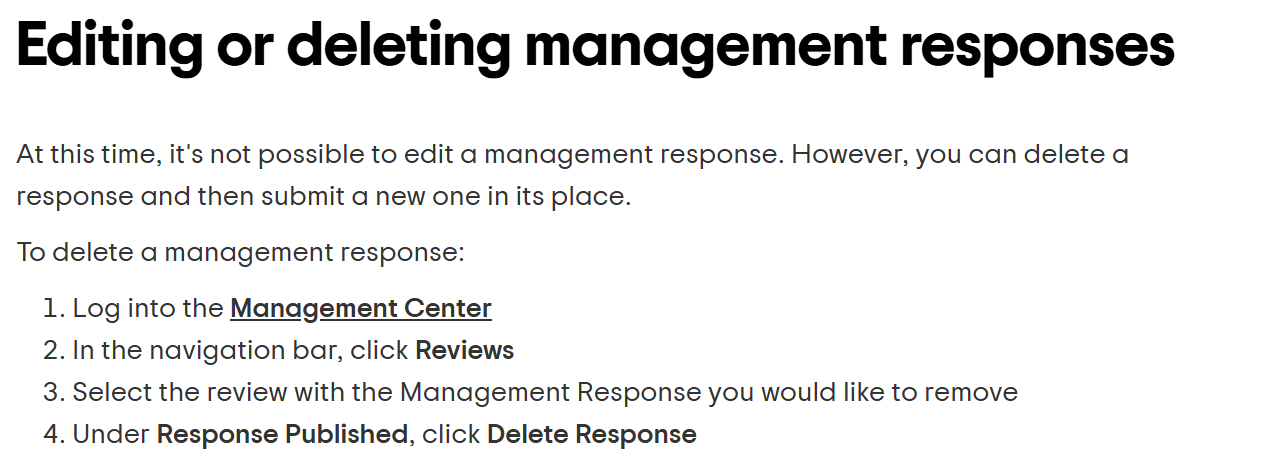
Answer the one-shot sites when you are calm. Google lets you edit a reply after it publishes. Tripadvisor does not: "At this time, it's not possible to edit a management response. However, you can delete a response and then submit a new one in its place." Deleting pulls your answer off the review straight away, so the reply you type at eleven at night either stays or leaves the review bare while you write another.
Never trade a comp for a review coming down. Making good on a bad night is fine and expected. Offering a meal in exchange for a revision is the same breach as buying the review outright, and Google's policy names both in one sentence.
Here are three templates for complaints venue-specific enough that generic advice fails on them. The wait, the price and a complaint about a person already have worked examples in review response examples, and ten written for the Tripadvisor format are in how to respond to a bad Tripadvisor review. Every business below is invented.
Noise: "we could not hear each other"
Thanks for the review, Marianne. The room is brick and glass and it gets loud the moment it fills, which is a fair thing to be annoyed about and not something you should have to shout through. The two booths along the back wall are the quietest tables we have and they are yours if you ring and ask for them. We have also brought the music down after seven, which will not change the room but it takes the edge off. Rosa, Owner, Bramble & Rye
Noise is the complaint owners answer worst, because the honest answer is that the room is the room. Do not promise an acoustic rebuild. Offer the quiet table, name the one thing you changed, stop.
Cold food, when the guest said nothing at the time
Thanks for writing this, Owen. The pork should not have reached you cold, and it is not on you to have flagged it at the time, so I am not going to ask why you didn't. That plate sat on the pass while a table of twelve went out, which is a service problem and not a kitchen one. The pass is split between the two sections from this week. Ring the restaurant and ask for me and dinner is on us next time. Callum, General Manager, Bramble & Rye
The instinct to write "we wish you had told us at the time" is strong and always wrong in public. It reads as blame. Take the point, name where the failure sat, and leave the invitation unattached to the review.
A booking or a function that went wrong
Thanks for writing, Ellery. Fourteen people booked six weeks out and then split across two rooms on the night is not a mix-up, it is us not reading our own diary. The function sheet now goes to the floor manager on the Monday of that week instead of the morning of, so a room can be held properly. Your deposit went back to the card that paid it on Tuesday. If you will let us have the birthday next year, ask for me and I will run it myself. Tam, Floor Manager, Bramble & Rye
Booking failures produce the angriest reviews a venue gets, because the guest planned around you and told other people to come. The refund goes before the apology, and the process change is what stops the next one. More of what a reply should never say is in examples of bad reviews.
Give the floor the credit, inside the rule you just read
Guests name people. "Marianne looked after us all night" is the most common shape a five-star restaurant review takes, and it is worth more to the person named than any roster note.
There is a rule sitting under the on-premises one that almost nobody in hospitality has read. In the screenshot above, Google lists among the things merchants may not do "requesting that staff solicit a certain number of reviews" and "requesting that staff solicit reviews that include specific content, including content that identifies a staff member". A target of ten reviews a shift is out. So is asking guests to mention Marianne by name.
What is left is arithmetic you do afterwards. Give each person their own review link or QR code and the reviews arriving through it are counted to them, with nothing asked of the guest. Cloutly reads it that way on its staff recognition board, and where there is no personal link it falls back to matching names in the review text and says so in the product: name matching fills the gaps, it can credit the wrong person, and it can miss a review that names nobody.
That caveat is the useful part. Two Georges on the floor and no review text will tell them apart. Personal links fix that, and a board read out at a Monday briefing beats one nobody opens.
Read every venue's reviews for the theme, not the score
A rating tells you something is wrong. It never tells you what. Hospitality reputation management at more than one venue is mostly the work of turning a few thousand reviews into the two or three things worth fixing this month.
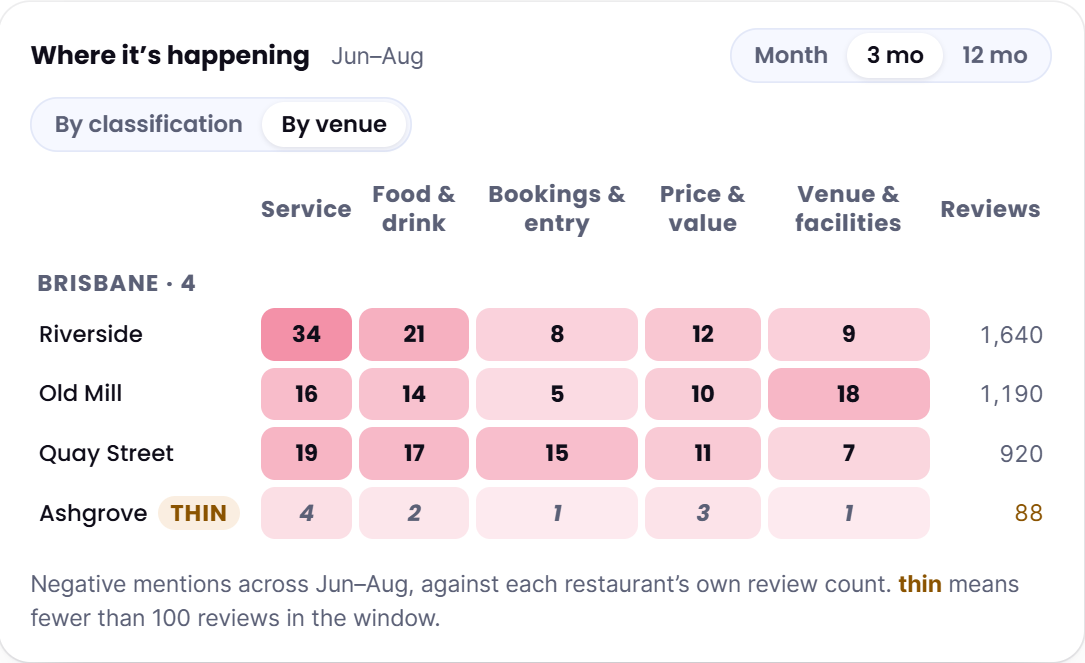
Do it by counting rather than by feel. Take a quarter of reviews per venue, count how many mention each recurring complaint, and put those counts beside each venue's total review count so a busy site is not punished for volume. Look for a theme heavy at one venue and light at the others: that is an operational difference you can go and stand in, rather than a fact about your food.
Cloutly does this as Signals, against ten hospitality themes: Food & drink, Service, Bookings & entry, Price & value, Cleanliness, Venue & facilities, Safety, Events & functions, Digital & contact, and Other. It reads by venue as well as by theme, carries the denominator on every number and a verbatim quote under every signal, and marks a venue with too few reviews in the window as thin instead of pretending the number means something. Our team switches it on for an account rather than you enabling it yourself, so ask us.
Restaurant reputation management across a group
Nothing above gets harder at four venues. It gets repetitive, which is a different problem with a different fix.
Each venue has its own Google Business Profile, its own Facebook Page and its own Tripadvisor listing with its own identity check. No single reply box answers for a group, and a tool claiming otherwise is describing an inbox rather than a shortcut. What you can standardise is the ask: same trigger, same delay, same wording, so a guest at your newest site gets the same message at the same point as a guest at your first. Merivale is one of the restaurant groups that manages its reviews in Cloutly.
Decide who replies before you roll anything out. Head office replying to everything is consistent and reads like a call centre. The venue replying to everything is warm and stops dead in a busy December. What survives is the venue manager replying, with head office writing the four or five answers to the complaints that repeat and checking they go out. The argument in full, league table included, is in multi-location review management.
Frequently asked questions
How do restaurants get more Google reviews?
By asking every guest the same way, shortly after the bill or the next morning, with the ask hung off something automatic like the till rather than a person remembering. Google encourages asking and suggests a link or a QR code. It bans incentives, and it bans sorting guests by how happy they are.
Can a restaurant ask for a review at the table?
Not by standing over the guest. Google's policy says merchants should not require or pressure users to leave reviews while on the premises, or ask for specific content. A QR code on the bill folder that the guest uses later is fine. A server waiting while they type is not.
Should a restaurant reply to every review?
Reply to every negative one, and to positive reviews that name a person or a dish. Answering everything is a nice ambition and the first thing to lapse in December. Write your Tripadvisor responses when you are calm, because you cannot edit one after it publishes, only delete it and start again.
Who should reply to reviews in a restaurant group?
The venue manager, with head office writing the standard answers to the complaints that repeat and checking the replies go out. Head office replying to everything reads like a call centre, and the venue replying alone stops during service peaks. Splitting it survives both.