
How to delete a Yelp review: what works and what it costs
Most reports to Yelp fail, and the two things that really change what a customer sees are the recommendation filter and your reply.
Lachlan Fea 12 min read
In this article11 sections

You cannot delete a Yelp review unless you wrote it yourself. A business owner can report it, and Yelp removes a review only when it breaks one of its content guidelines. Human moderators decide, the answer arrives by email in a few days, and plenty of reports come back declined.
Most guides stop there, which leaves out the two things owners on Yelp actually hit: a review that vanishes with nobody reporting it, because Yelp's software stopped recommending it, and a warning banner Yelp can hang over your reviews that does more damage than any one-star. Removed, filtered and flagged are three different problems. This guide keeps them apart, answers the cost question, and covers why Yelp tells businesses never to ask for reviews.
Can you delete a Yelp review?
Not if someone else wrote it. Yelp gives owners one route: report the review and ask moderators to take it down under the content guidelines. Yelp says removing user content "is not something we take lightly" and that it "doesn't take sides in factual disputes". Evaluation may take several days, and reporting guarantees nothing.
The only person who can delete a Yelp review outright is the person who wrote it, from their own account, using the steps in Yelp's Support Center. You cannot do it for them, and you must not pay them to do it.
What Yelp actually removes
Yelp publishes the criteria its moderators apply. When should I report a review? names three reasons it will take a review down. If yours does not fit one of them, a report is wasted effort.
| What Yelp removes | Examples Yelp gives | What decides the outcome |
|---|---|---|
| A conflict of interest | A competitor, a current or former employee, a friend or relative, someone paid or incentivised | Evidence. Yelp says outright that "it usually isn't enough to say that you're suspicious of a bias" |
| The review isn't the writer's own consumer experience | Someone else's visit, hearsay from a friend or the news, a review of a different business, plagiarised text, a post that only comments on your hours or policies | Usually visible in the text itself, which makes this the most winnable category |
| Inappropriate material | Threats, hate speech, lewd commentary, private information about employees or patrons | Yelp reads each term narrowly and says colourful language on its own is fine |
Yelp's own numbers point the same way. Of the 193,700-plus reported reviews its User Operations team removed in the US in 2025, 25% went for not being a firsthand experience and 15% for a conflict of interest, against 11% for inappropriate content (Yelp Trust & Safety Report 2025). The category owners underuse is the one that wins most often.
Two complaints Yelp will not act on: a review you believe is factually wrong, and a review that is simply harsh. It does not adjudicate whose account of the night is correct. If you suspect the review was fabricated rather than just brutal, our guide to identifying fake reviews covers the signals worth checking first.
How to report a Yelp review, step by step
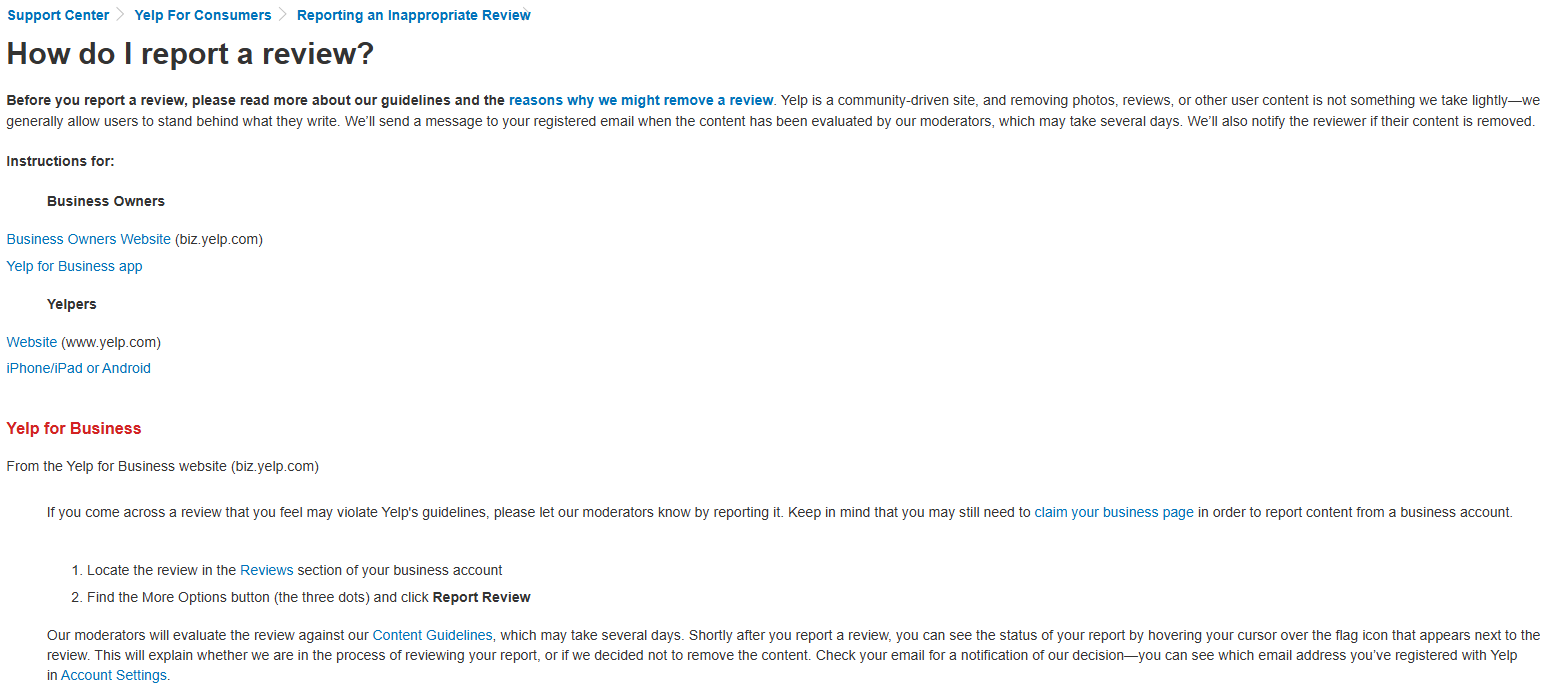
These steps are Yelp's own, from How do I report a review?, read in September 2026.
- Claim your Yelp Page. Yelp notes you may still need to claim it before you can report content from a business account. Claiming is free at biz.yelp.com.
- Decide which guideline it breaks, using the three categories above. If you cannot name one, do not file. Check the firsthand-experience angle first, because that is what moderators remove most.
- Gather your evidence. Booking records, a receipt, a staff roster, the reviewer's other reviews, a screenshot of the same text elsewhere. Conflict-of-interest claims live or die on this.
- Find the review in the Reviews section of your Yelp for Business account, on the left-hand menu. Managing several pages? Switch to the right one from the See all locations dropdown first.
- Open More Options (the three dots) and choose Report Review. The app works the same way: the three dots on iPhone, the overflow menu on Android.
- Check the status. Hovering over the flag icon beside the review shows whether it is still being assessed or has been declined. Yelp emails the decision to your registered address, and if it removes the review it usually tells the reviewer too.
One report per review. Filing again does not escalate it.
How much does it cost to remove a Yelp review?
Nothing. Claiming your page, reporting a review and replying are all free. Yelp sells no removal product and no paid appeal, and it says that other than giving advertisers ads, "advertisers don't get any preferential treatment" (Does Yelp treat advertisers any differently?). On the filter side, no employee can override the recommendation software, which Yelp calls a deliberate choice to avoid conflicts of interest.
Every paid route buys something other than removal. A removal service charges you for the report you could file yourself, and Yelp's moderators still decide, so a guarantee of removal is a guarantee nobody is in a position to make. A lawyer buys a legal process, not a takedown button. Paying the reviewer costs the most of all: Yelp issued 527 warnings to businesses over suspected compensated or incentivised review behaviour in 2025, and the step up from a warning is a public alert on your page.
Why your Yelp review disappeared without you doing anything
Plenty of owners searching for how to delete a Yelp review are describing something else: a review that is no longer visible, that neither they nor Yelp's moderators touched. That is the recommendation software, and it is the most misunderstood thing about the platform.
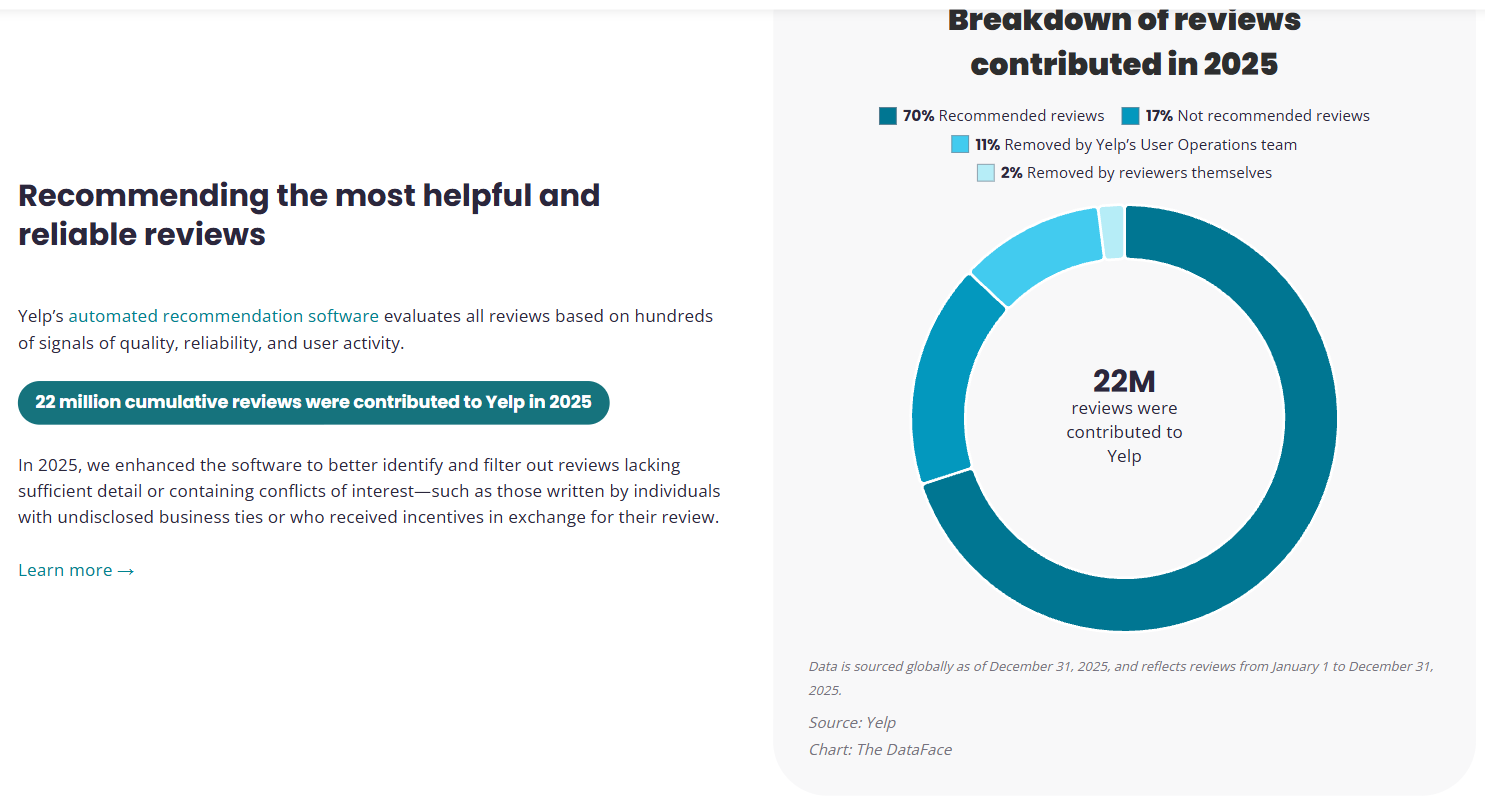
Every review goes through an automated system that decides which ones to recommend, based on what Yelp calls "hundreds of signals of quality, reliability, and user activity on Yelp". Yelp publishes what it looks for: conflicts of interest, solicited reviews it suspects a business or an employee asked for, reviewers it does not know enough about to rely on, and reviews it reads as unhelpful rants or raves.
This is not rare. Of the 22 million reviews contributed to Yelp worldwide in 2025, 17% were not recommended, against 70% recommended and 11% removed by Yelp's own team. One review in six never counts.
The decision can move both ways. Yelp says the software runs and learns regularly, so a filtered review can reappear months later with no explanation. It also got stricter in 2025, when Yelp filtered out nearly 500,000 reviews carrying the characteristics of AI-generated content.
Keep the three states apart, because acting on the wrong one wastes weeks.
| Removed | Not recommended | Consumer Alert | |
|---|---|---|---|
| Who decides | A human moderator, after a report | Automated software, on its own | Yelp, after an investigation |
| What triggers it | A content guideline breach | Signals of quality, reliability and reviewer activity | Evidence of paid reviews, coordinated activity, legal intimidation or a media-driven spike |
| Still visible? | No | Yes, behind a link at the bottom of the page | The alert sits over your reviews |
| Counts towards your rating? | No | No | Reviews still count; the banner sits above them |
| Can you appeal? | Report once; a court order is the only escalation | No, and nobody at Yelp can override the software | Alerts come down when the activity stops |
Yelp's platform numbers change every year. Ours are in the Yelp fact sheet.
The Consumer Alert badge, and what triggers it
The worst thing that can happen to a Yelp page is not a one-star review. It is a Consumer Alert: a warning message Yelp displays over your reviews after what it calls a thorough investigation, with the evidence attached wherever possible.
Three of the five types are ones a business brings on itself. A Compensated Activity Alert goes up when Yelp has evidence someone offered cash or other incentives in exchange for a review. A Suspicious Review Activity Alert covers patterns like a run of reviews from one IP address, or reviewers connected to a group that trades incentivised fake reviews. A Questionable Legal Threats Alert appears when Yelp has evidence a business may be abusing the legal system to intimidate a reviewer.
The other two follow attention you did not ask for: an Unusual Activity Alert after a media-driven spike in reviews that are not firsthand, during which posting on the page is disabled, and a Public Attention Alert when someone associated with the business is accused of, or targeted by, racist or discriminatory behaviour.
Yelp placed 491 Compensated Activity and Suspicious Review Activity alerts worldwide in 2025, 6 Questionable Legal Threats alerts, and more than 1,450 media attention alerts on US pages. Suspicious Review Activity alerts can appear anywhere in the world; the other two self-inflicted types are US-only, and the media-driven pair runs in the US and Canada.
Yelp asks businesses not to request reviews at all
This is the part a review software company has every incentive to leave out, so here it is plainly. Yelp's content guidelines say, in one sentence: "Businesses should never ask customers to write reviews."
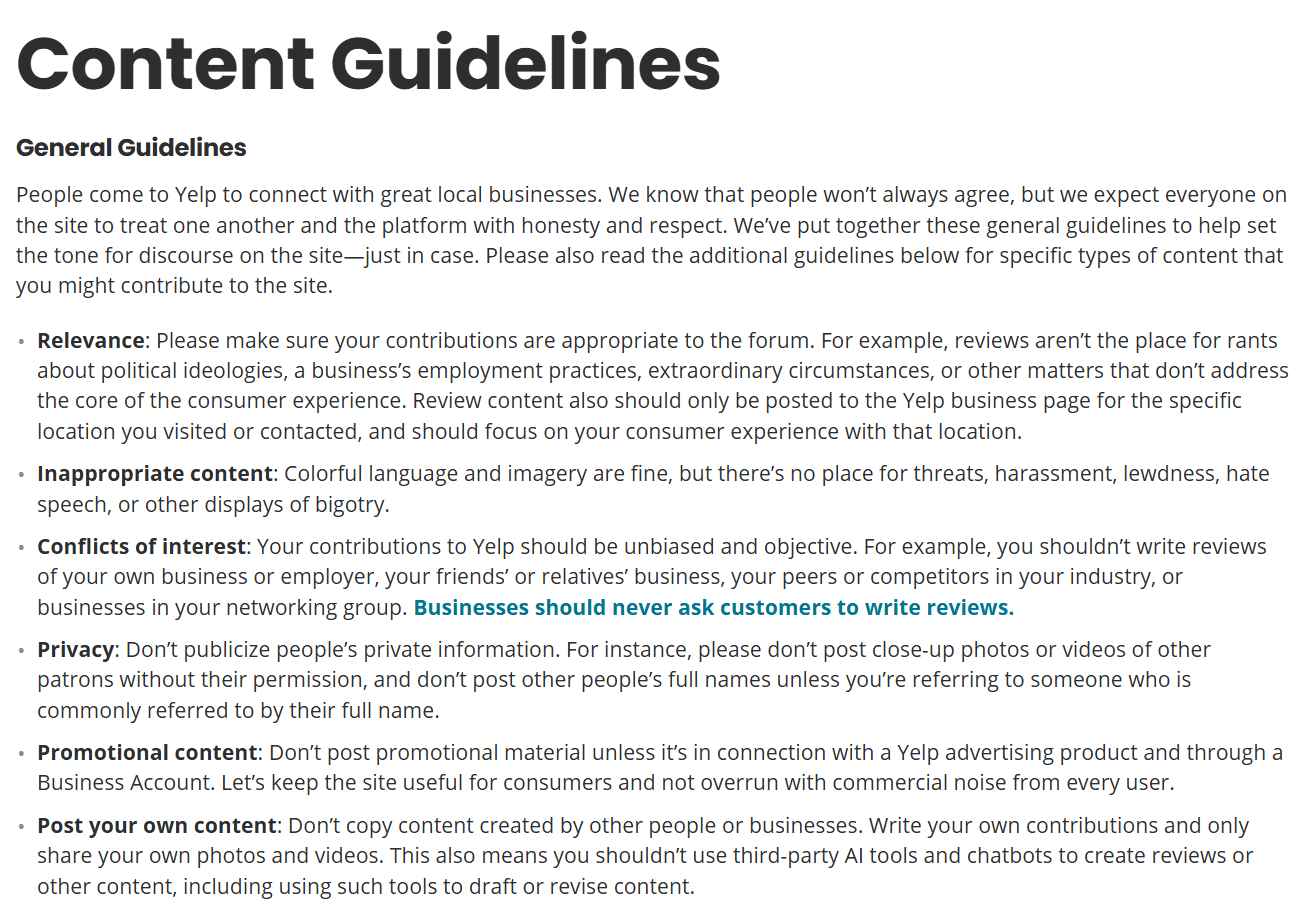
Yelp's support article Don't Ask for Reviews spells out the scope. Do not ask anyone, including customers, mailing list subscribers, friends or family. Do not let staff compete to collect reviews. Do not ask after a survey or a contact form. Do not offer freebies, discounts or payment for reviews, which Yelp notes "may also be illegal". And you cannot offer incentives to remove reviews either. Owners who conclude from that they would rather not be on Yelp should read deleting a Yelp account first.
Yelp's stated reason is that its software is built to spot prompted reviews and not recommend them, and that many businesses only ask happy customers, "which leads to biased ratings". Asking, on Yelp, can quietly cost you the reviews you generate.
Yelp is the exception, not the rule. Google, Facebook and most other review sites expect businesses to ask, as long as the ask goes to every customer and carries no incentive. So exclude Yelp from your review requests and let it fill up on its own. Cloutly reads Yelp as one of the 39 review sites it watches, so Yelp reviews land in the same inbox as everything else, and it never asks a customer for a Yelp review, because Yelp does not allow it. What Yelp wants instead: claim and complete the page, reply to the reviews you get, add photos, and give people an experience worth writing about unprompted.
The mistake in the other direction costs just as much. Never sort customers by how happy they are before deciding who gets asked, on any platform. The US Federal Trade Commission says its review rule carries no specific ban on asking only the customers you think are happy, but that the practice "could violate the FTC Act". Ask everyone or ask nobody.
How to respond to a bad Yelp review
Future customers read your reply when they scroll past the review. That often matters more than a removal you probably will not get. Yelp says its own data shows businesses with some critical reviews get more page views than businesses with none.
In the Reviews section of your Yelp for Business account, each review carries Respond and Direct Message. Yelp recommends starting with the public one, and it wants an approved profile photo and business account name before you can reply at all. Save the direct message for when you need something personal to fix the problem, like a booking reference. It will not keep the complaint off the page either way.
Two constraints on what you write. Yelp's guidelines say contributors must not use third-party AI tools or chatbots to create content, "including using such tools to draft or revise content", so the words have to be yours. And the FTC's review rule treats a knowingly false public accusation about a reviewer as review suppression, so "this person has never been a customer" is a claim you need to be sure of.
Three worked replies. The businesses are invented.
1. The service genuinely went wrong (public)
Hi Marcus. You booked a 40-minute appointment and got 25, and you were right to be annoyed. We double-booked the 4pm slot on Thursday and you paid for it. I have refunded the session today and taken same-hour double bookings out of our system so it cannot repeat. If you come back, ask for me and I will take the session myself. Sam, owner, Coastline Physio.
Name the fault, say what you changed, make the offer once.
2. An account you believe is not accurate (public)
Hi Jordan. That is not how the appointment looks in our records, and I would rather work it out with you than argue about it here. Our notes show two calls to the mobile on file before we closed the job, and if those did not reach you then something went wrong on our side. I have sent you a direct message with my number. Alex, Northgate Auto.
Say your version once, then move it off the page. Do not litigate line by line in public, and do not post anyone's private details, which Yelp's privacy guideline covers.
3. When you need details, by direct message
Hi Rachel, this is Sam from Coastline Physio. I would like to refund your session and sort out the follow-up appointment you were owed. Could you send me the date you came in and the name the booking is under? I will handle it today, and there is nothing you need to do afterwards.
Notice what the message does not do. It never raises the review, and it asks for nothing in return.
There is more on structure and tone in our Yelp review response guide, and the version for reviews that are not complaints is in our positive review response examples.
"They said they'll remove it if I refund them"
Fix the problem. Tell the customer what you did. Then leave the review alone. Do not ask them to delete it, do not ask them to change it, and do not let the refund read as a trade. Yelp's policy says you cannot offer incentives for users to remove reviews, and a Compensated Activity Alert is far more visible than the review you were trying to lose.
The US legal position is finer than most articles claim. The FTC's Rule on the Use of Consumer Reviews and Testimonials (16 CFR Part 465), in effect since 21 October 2024, does not itself ban paying a customer to take a review down. FTC staff guidance says so in terms, then says paying consumers to change or remove truthful negative reviews "may violate the FTC Act as an unfair or deceptive act or practice". What the rule bans outright is compensation conditioned on a review expressing a particular sentiment, and unfounded legal threats or intimidation used to get a review removed. Knowing violations can carry civil penalties.
The same guidance sets out the permitted version: nothing in the rule stops you contacting a customer who posted a negative review in order to resolve the problem they reported. Resolve it, say what you did, and stop there. If they update what they wrote, that is their call and yours to stay out of. Many will not, and you have to be able to live with that before you pick up the phone.
When a Yelp review is defamation, and when the legal route is a mistake
Opinions are not defamation, however unfair they feel. A false statement of fact, presented as fact and causing real harm, may be. That line is narrower than most owners assume, and Yelp will not draw it for you, because it does not take sides in factual disputes.
Its escalation path, from Will Yelp remove a false or defamatory review?, is specific. If your report is declined and you then obtain "a final order from a court of competent jurisdiction explaining why a review is defamatory", you contact Yelp's support team with it. A court order first, then removal. Not a solicitor's letter, and not a threat.
Yelp defends reviewers in public. Of 4,267 user accounts subject to legal demands in the US in 2025, it says it avoided producing account information in 99% of cases, so unmasking an anonymous reviewer is a fight on its own. It flags businesses it believes are misusing the legal system, and the FTC rule names unfounded legal threats as review suppression, while confirming that a threat with a legitimate basis is fine.
Then there is the cost, the months, and the way a lawsuit draws far more attention to a review than the review would ever have earned alone. For a genuinely defamatory statement causing measurable damage, take legal advice in your own jurisdiction. For a one-star that stung, the reply above is the better investment. Our guide to removing negative reviews from Google sets out the same report-then-legal framework in more detail, and it applies here.
This is general information, not legal advice.
Frequently asked questions
Can a business remove a Yelp review?
No. A business can report a review and ask Yelp's moderators to remove it under the content guidelines, but the decision is Yelp's. Businesses cannot delete reviews themselves, cannot pay to have them removed, and cannot influence which reviews the recommendation software shows.
How long does Yelp take to remove a review?
Yelp says a reported review is evaluated by its moderators and that this may take several days. The decision arrives by email at the address registered to your account. Meanwhile, hovering over the flag icon beside the review shows whether it is still being assessed or has been declined.
How much does it cost to remove a Yelp review?
Nothing. Claiming your page, reporting a review and replying are all free, and Yelp sells no removal or appeal product. Agencies charge for filing the same report you can file yourself, and none of them decides the outcome. Paying a reviewer to delete a review breaches Yelp's policy.
Can you pay to have a bad Yelp review removed?
No. Yelp says advertisers get no preferential treatment beyond the ads they buy, and that no employee can override the recommendation software. Paying a reviewer is worse than useless: it breaches Yelp's guidelines and can earn your page a public Compensated Activity Alert that every visitor sees.
Why did my Yelp review disappear?
Almost always because Yelp's automated recommendation software stopped recommending it, not because anyone removed it. In 2025, 17% of the 22 million reviews contributed to Yelp were not recommended. They stay readable behind a link at the foot of the page but do not count towards the rating.
Can you sue over a Yelp review?
You can sue over a false statement of fact that causes real harm, though not over an opinion. Yelp acts on a final court order, not on a threat, and it flags businesses it believes are using legal threats to intimidate reviewers. The FTC rule in effect since 21 October 2024 prohibits unfounded legal threats used to suppress a review.