
White label reputation management: how agencies resell reviews under their own brand
Reselling reviews is one of the easier recurring lines an agency can add, and almost everything written about it is a sales page.
Lachlan Fea 11 min read
In this article9 sections

White label reputation management is review management an agency sells to its clients under its own brand, using a platform somebody else built and runs. It is also sold as white label review management, which means the same thing. The agency owns the client relationship, sets the price and answers the phone. The vendor supplies the software and sending infrastructure, and stays in the background.
It is a good line for an agency. Reviews arrive every month whether anyone works on them or not. That gives you recurring revenue without another renewal conversation, and clients can see the result on their own Google profile without needing a report to explain it.
Almost every page about this is written by someone selling it. This one is too. Cloutly sells a white label tier, and it gets one paragraph and a partner quote a long way down. That is the only place we come up. The rest is what an agency principal needs to decide before signing anything.
What is white label reputation management?
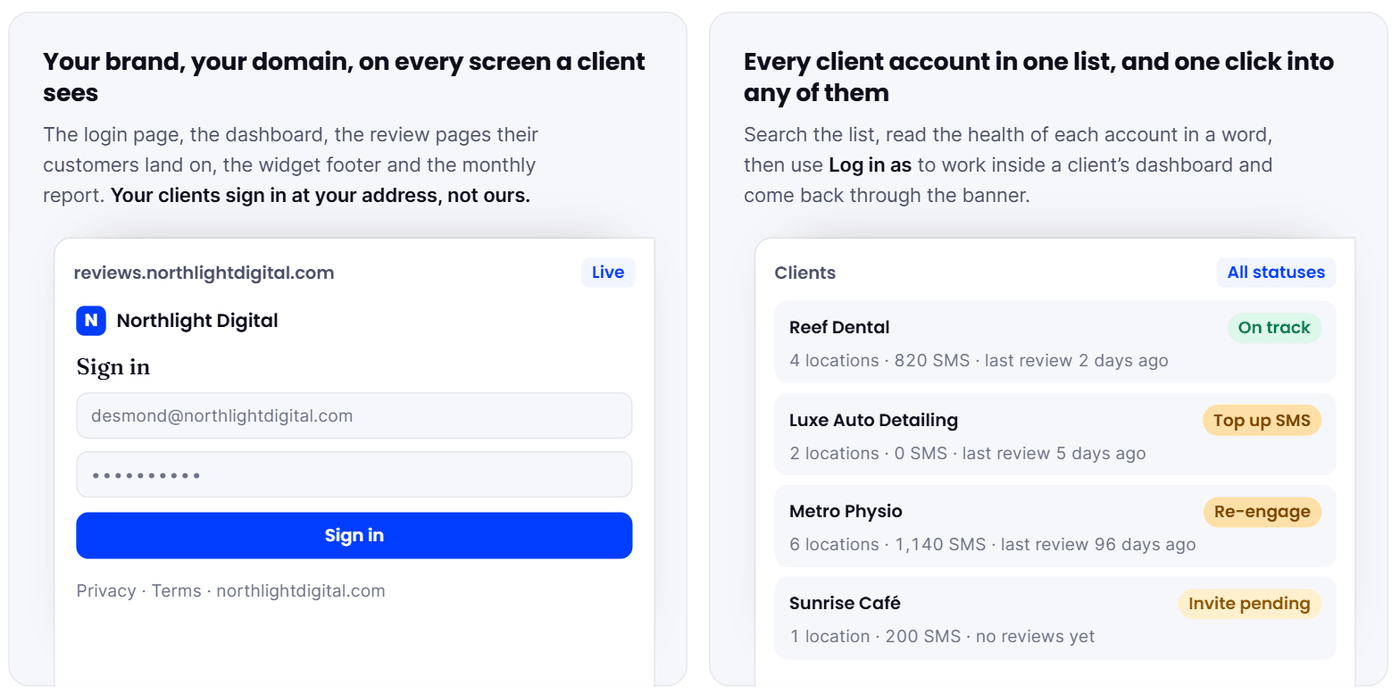
White label reputation management is a review platform an agency resells under its own brand and domain. The agency owns the client contract, the price and the support. The vendor supplies the software and stays in the background.
You sign the client, invoice them and set the number. Your clients log in at your address, see your logo, and get their reviews collected, answered and displayed. The vendor bills you, not them. The confusion starts because two quite different products are sold under the same name.
Software, or a team
| White label software | White label managed service | |
|---|---|---|
| What you are buying | A platform under your brand | A team doing the work |
| Who writes the review replies | You, or your client | The vendor's writers |
| Who your client talks to | You | You |
| Cost shape | A platform fee, flat or per location | A fee per client, per month |
| Grows by | Adding accounts | Adding spend |
| Fails when | Nobody logs in | The output reads generic |
Do not start by asking which is cheaper. Decide whether reviews are a service you intend to deliver or a product you intend to hand over. If you are handing it over, the platform has to work for a salon manager on a Tuesday afternoon with no training. If you are delivering it, one of your people needs to move through forty accounts in a morning. Those are different products, and most vendors are good at only one of them.
How the commercial model works
Your agency deals with the client and runs the account. The vendor provides the platform underneath it.
The contract and the price are yours. The client signs with your agency, so there is no vendor agreement for them to accept and no second relationship to manage. What the vendor charges you is a cost, not a price list. Agencies routinely buy per location and sell per client, or the reverse.
You also handle support. Every question about why a review has not appeared, why a text did not send, or how to change a template comes to you first. That is the correct arrangement on a properly white-labelled platform, but it is still a real load.
Onboarding happens on your timeline, not the vendor's. That includes connecting profiles, importing customers and setting up campaigns. If a client leaves, your margin goes with them and you keep paying the platform until you remove the account.
The vendor is responsible for uptime, deliverability, review ingestion from the sites, the app itself and the roadmap. If any of it fails, it is not yours to fix, but your client will still call you. That is why you need to inspect the platform before you sell it.
What to look for in a white label platform
Before you sell a platform under your name, inspect these six parts of it. They tell you whether it is white label reputation management software you can build a service line on, or just a logo swap.
1. Your own domain, and who provisions the certificate. A subdomain of the vendor's site is not white label. Ask what the DNS change is, and who provisions and renews the TLS certificate. If the answer involves you running a proxy or adding ACME records every ninety days, you have just bought an ops job.
2. Per-client accounts with real separation. One login per client, their own locations, users and data. Ask whether you can cap a client's locations, whether adding one is self-serve for them, and what happens to the account when they stop paying you.
3. An agency-level view, and be precise about what it does. Most partner portals are a client list with a way into each account. That is genuinely useful, and it is usually where the usefulness stops. A cross-client roll-up of ratings and review counts, or a report you can send straight to a client, is rarer than the marketing implies. Ask to see the portal before you assume it is in there.
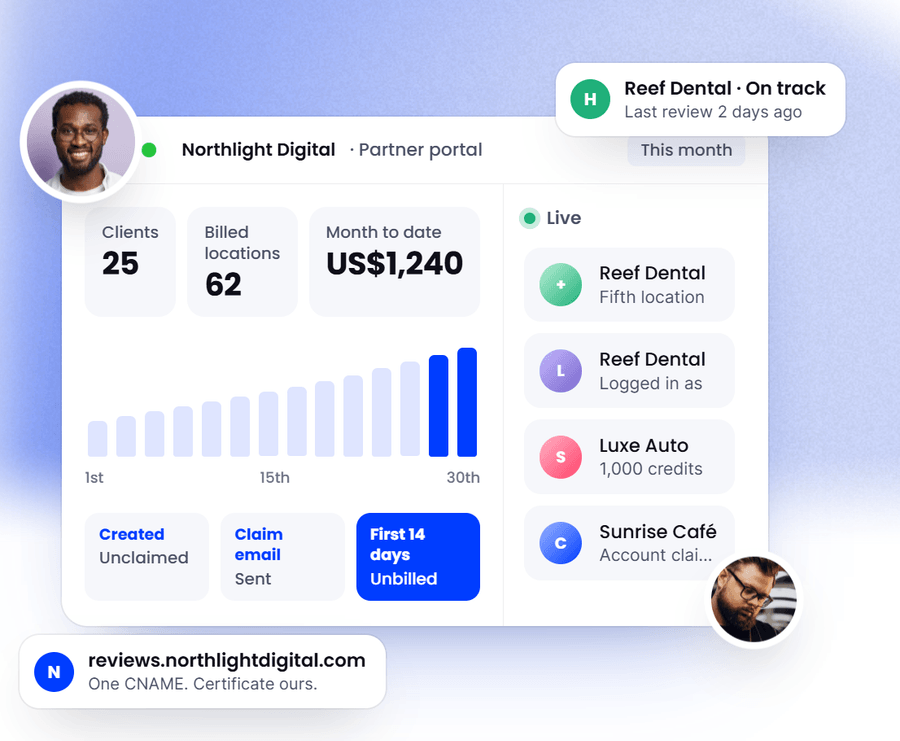
Check whether the portal gives you the number of accounts, the locations you are billed for, what changed today, and one click into any of them. Then compare that with what your monthly report needs. Anything it cannot give you is something somebody in your office types out by hand. (Cloutly's own white label page, 6 September 2026. The agency and clients in it are invented.)
4. The billing model, in the shape you sell. Per location, per client, or flat. Per location tracks your cost to the value you deliver but punishes you the month a client opens three sites. Flat is easier to forecast and worse at the small end. Whichever it is, ask when a new client's location starts being billed, and whether the count syncs on its own or someone has to remember.
5. Who talks to the end client. Check whether the vendor's support widget loads on your domain, whether their help centre is linked from anywhere inside the app, and whether their name appears in any system email. Each one is a support conversation you did not get to have.
6. What stays vendor-branded, honestly. Every platform in this category has residue: the domain review-request emails send from until the client verifies their own, help links inside the dashboard, widget footers, terms and privacy links, any hosted page the platform generates. Ask for that list in writing. A vendor who says "nothing" has not looked.
Our buyer's checklist for white label reputation management software takes those checks further, covering all fifteen and showing what a good answer and a bad answer sound like for each.
Cloutly's own white label tier answers those six this way. You point one CNAME at us and the certificate is ours to manage. Your name, colour, font, logo and icon go in under Settings. You get one partner bill a month, tiered by your clients' total locations, and what you charge those clients is yours to set.
Word of Mouth Online runs Cloutly as a partner. Its director, Anthony Barry:
"The Cloutly team has been instrumental in helping us move faster on growth goals. Their tech is robust, the rollout was seamless, and their support has been first-class."
How agencies price white label reputation management
Nobody can hand you a number. It depends on your market, your delivery cost and what else the client buys. But there are only a handful of structures, and the wrong one quietly kills the margin.
| Structure | How it bills | What to watch |
|---|---|---|
| Flat monthly per client | One price per client, whatever their size | The day a good client opens a second and third site. Your cost moves and your price does not |
| Per location | Per site, the way most platforms bill you | Harder to sell to a single-site business, who reads it as a per-seat tax |
| Folded into the retainer | No separate line at all | Nothing to cut when the client tightens spend, and nothing to point at when you want to raise it |
| Tiered on volume | Bands by review volume, locations or replies written | The honest one if you write the replies, because it ties the price to your people's time |
| Setup fee, then monthly | Onboarding priced once, then the ongoing line | Onboarding is real work and the fee prices it. It also filters out the client who will never send you a customer list |
Four inputs decide the actual figure: your platform cost per client, the hours you will spend per client per month, how long you expect the account to live, and what the client's alternative is. That last one is usually nothing, which is why pricing off the vendor's rate card undersells the service.
The operational reality of forty clients
Selling forty accounts is a sales problem. Keeping them running is a different job, and it is mostly not the software.
Onboarding is the bottleneck. Every account needs a Google Business Profile connected, locations added, a customer source wired up, message templates written, and one person at the client who owns it. That is an hour on a good day and an afternoon on a bad one. Sign fifteen in a month and delivery slips on the thirty you already have.
The customer source decides whether the account lasts. A client who has to upload a CSV stops around month three, the reviews stop, and the cancellation arrives in month five. A client whose booking or point-of-sale system fires the ask keeps going without thinking about it. Get every account onto an integration during onboarding, because nobody goes back and does it in month four. The mechanics of the ask do not change because an agency is running it: when you ask still decides how many reviews you get.
Listings drift on their own. Hours change for a public holiday, someone edits an address, a duplicate profile appears. Nobody at the client will tell you. If listing accuracy is part of your offer it needs a monthly sweep, not an alert you hope arrives.
Decide who writes the replies before you sell it. AI drafts have made the first pass much faster, but a person still reads and sends. Across forty accounts, that needs a real weekly slot in someone's calendar. Our review response examples are written for that job: replies aimed at the next customer reading them rather than at the one who left the review.
With no cross-client view, someone spends the first week of every month copying numbers into slides. That is time your agency has to price, absorb or explain to the client. Ask about it before you sign, not in February.
Set the escalation rule early. A one-star review lands on a Saturday. Who sees it, how fast, and what do you promise? Put it in the proposal, because the client will assume an answer if you do not give them one.
Clients with several sites are where this model earns properly. They also expose a thin platform fastest. Our guide to running reviews across a network of locations covers who asks, who replies and who gets measured.
For the week-to-week work, including scope, pricing and the monthly report, see the agency work itself.
You are an agent, and the FTC says so
The legal position matters when you put your own name on the service.
The US Federal Trade Commission's Rule on the Use of Consumer Reviews and Testimonials went into effect on 21 October 2024. The FTC's own staff Q&A asks whether advertising agencies, public relations firms, review brokers and reputation management companies can be liable under it. The answer runs to four sentences. The first one is a single word.
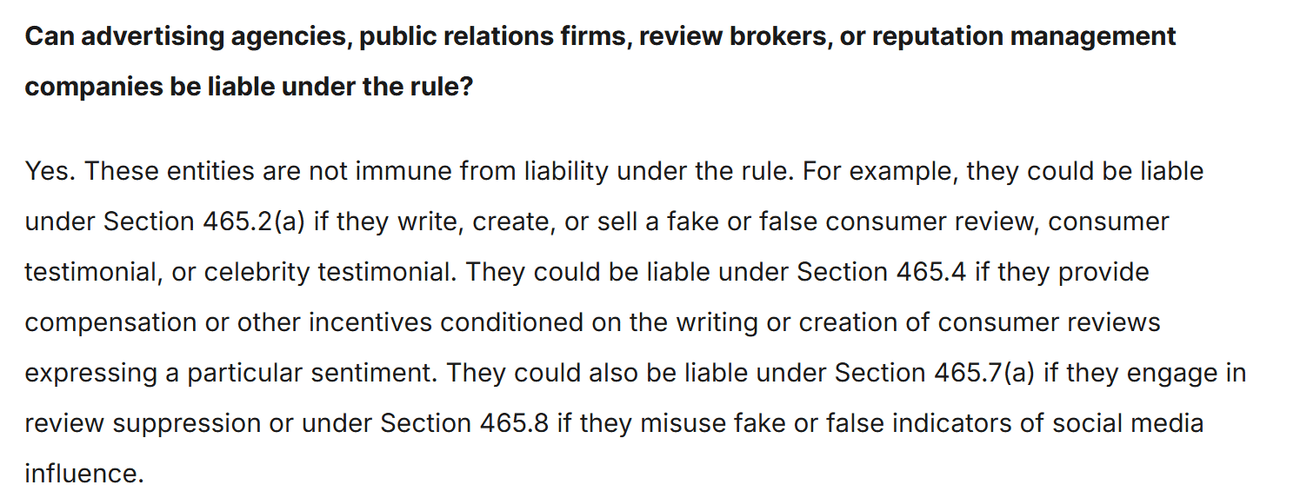
The same guidance says the rule's reference to a business's agents is "meant to apply to people like representatives of advertising agencies, public relations firms, and review management firms".
Read that as an agency principal. When you resell reputation management you are the agent, your brand is on the invoice, and the fact that a vendor performed the work is not a defence. The rule is American, so if your clients are elsewhere your own consumer regulator is the one to check. The platform policies below apply everywhere.
Rule out these three practices before you put your logo on a platform.
Incentives tied to sentiment
The rule does not ban incentives outright. It bans conditioning one on a particular sentiment, expressly or by implication, and the FTC's own example of an implied condition is a line most marketers would write without blinking: "Tell us how much you loved your visit to John's Steakhouse and get a $5 coupon."
Google is stricter than the rule. Its tips for getting more reviews call offering incentives in exchange for customers posting, changing or removing reviews "fake & misleading content", and say it is "strictly prohibited".
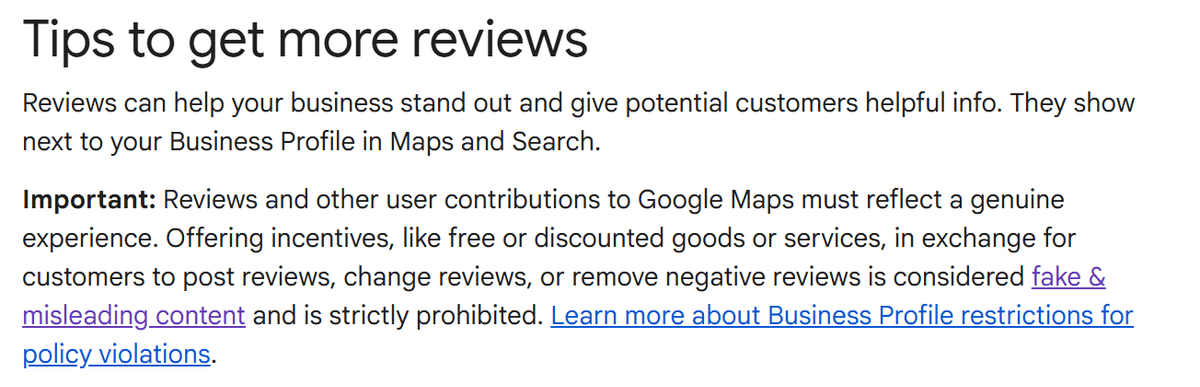
That is a platform policy, not a law, and the sanction is not a fine. It is your client's profile.
Review gating
A rating step in front of the review sites, where four and five stars go to Google and one and two go to a private feedback form, is the oldest feature in this category and it is still sold to agencies as a benefit. The FTC's position is that asking only the customers you believe are happy is not specifically prohibited by the rule, but the practice could violate the FTC Act.
Do not resell it. It is the feature most likely to be sitting behind your brand when somebody looks, and the rating it produces is worthless as evidence anyway. What review gating is, and what Google and the FTC say about it has the detail.
Promised removals
Nobody can delete an honest negative review. A partner can flag reviews that break a platform's content policy, which is a different and much smaller claim, and what Google will and will not take down is the honest version of that promise. Any vendor pitching removals is selling you an exposure with your name on it.
Is this you?
Reselling review management suits a specific kind of agency. The vendors selling it are not the people who will tell you whether yours is one.
Resell it if
- You already bill local service businesses every month, and reviews come up unprompted on client calls.
- You have, or will hire, one person who owns delivery. Not a shared responsibility, a person.
- You have enough clients to spread a platform fee across, and a pipeline that keeps adding them.
- Your clients have several locations, or you want the kind that do.
- You are willing to be first-line support, including on the Saturday a one-star lands.
Do not resell it if
- You have three clients and want a new revenue line. You will pay a platform fee to run three accounts. Put them on ordinary business accounts and sell them your time instead.
- You want passive income. This is a service business with a login attached.
- You cannot currently answer a client asking why their review has not shown up on Google yet.
- The pitch that sold you was the margin, and you have not worked out who does the onboarding.
- You need to promise a star rating. You cannot, and a provider who says you can is a problem you are buying.
If reviews are a service you have never delivered, do not start with a partner contract. Run it for two or three clients on ordinary accounts, learn where the hours go, and read what review management involves end to end. The partner tier will still be there in ninety days, and you will negotiate it a great deal better.
Common questions
How much does white label reputation management cost? There are two costs, and vendors quote one. The platform cost to you is flat, per client or per location, and most vendors publish an entry price you can find without a sales call. The other cost is delivery: onboarding hours, reply writing and reporting. Ask for the entry price, then ask for the exact rule that moves you off it.
Will my clients know which platform I am using? Mostly not, if the platform is properly white-labelled. A determined client can still work it out from an email header or a support link. Do not build the offer on secrecy. They are buying your judgement either way.
Can a white label partner get bad reviews removed? No. Reviews that break a platform's content policy can be flagged, and some of those come down. Honest negative reviews do not, and paying a customer to change or remove one is a practice the FTC has warned about separately from the rule.
Before you sign
Reputation management for agencies is not a product you switch on. Choose the shape honestly, service or software, because the wrong one leaves you with an unused login or a team you cannot afford. Before you sell the first account, name the person who will connect profiles, chase customer lists and answer the first support questions. Those jobs do not disappear because the platform carries your logo.
Everything else is comparable. If you are still narrowing the field, our guide to choosing review management software covers the six questions worth asking any vendor, white label or not.