
Reputation management for agencies: what the work is and what to charge for it
Clients ask for it because reviews are the one part of local marketing they can see for themselves, and it costs more to run than most agencies quote.
Lachlan Fea 9 min read
In this article7 sections

Reputation management for agencies is a productised service: you run a client's review programme for a monthly fee. The ask that goes to their customers, an inbox that catches every review, the replies, the profile data behind them, a report at the end of the month. It sells easily and loses money easily, because agencies price it per client while the cost sits in replies, and replies scale per location.
Verified 6 September 2026 against Google's help pages on local ranking, replying to reviews and profile owners and managers, the Maps content policy, and the FTC's Consumer Reviews and Testimonials Rule questions and answers. None of it is legal advice.
Written for the agency principal deciding whether to put this on the service list. If that is settled and the open question is whose brand the client sees, white-label review management is the piece on that.
Why clients ask agencies for reputation management
Reviews are the part of local marketing a client can see without you. They cannot read a rank tracker and they do not really believe an impressions chart, but they can read a 4.1 sitting next to a competitor's 4.7 in the map pack. So can their franchisor. So can the person on the front desk who keeps getting asked about it. That is why the request usually arrives unprompted, attached to a complaint about something else.
It is not vanity. Google names relevance, distance and prominence behind local results, says prominence is based partly on "how many reviews you have", and adds that "more reviews and positive ratings can help your business's local ranking".
There is a reason on your side too. A reputation retainer moves a number inside the first month, in a category where most of what you sell takes a quarter to show anything, and clients rarely cancel a service whose result they can watch. The visibility runs both ways. If nothing has moved by month three, everyone can see that too.
What reputation management for agencies actually involves
The jobs are the ones any business does for itself, and the four jobs of review management covers them from the client's side. What changes for an agency is that you do them across every client at once, and your real constraint is not effort. It is approval.
| Job | Cadence | What happens if you skip it |
|---|---|---|
| The ask | Automatic, fired by the client's booking, point-of-sale or CRM system | Review count stays flat and the retainer has nothing to show |
| The inbox | Daily | A one-star review sits for nine days and the client finds it before you do |
| Replies | Twice a week, drafted by you and approved by the client | The profile reads as an absent owner |
| Profile data | Monthly | Wrong hours on Google in December, the complaint that reaches the owner |
| The report | Monthly, on the same date every time | Judged on feel, and feel is not on your side in a flat month |
Only the ask scales for free. For one client or thirty it is a template, a trigger and a decision about timing, and the trigger should come from a system that already knows the job is finished, not from a person remembering.
The inbox is where agencies underquote. Watching one profile is a notification setting. Watching four profiles across six locations for eleven clients is a list somebody opens every morning, and what you sell is that it gets opened.
Replies are the cost centre. Ten clients averaging 25 reviews a month is 250 replies, and at three minutes each that is twelve hours before one goes for approval. Approval turns twelve hours into a week of chasing. Positive review response examples has the templates worth systemising first, because praise is the volume.
How to offer reputation management as an agency: pick the delivery model first
If you intend to sell it under your own brand, read the white label buyer's checklist before you pick, because it decides what you can promise.
Set the delivery model before you quote anybody. It determines the scope and price.
| Model | Works up to about | Where it breaks |
|---|---|---|
| By hand: notifications, a spreadsheet, a calendar reminder | Five clients | The morning check gets skipped and nobody notices for a fortnight |
| A platform, under the vendor's brand | Fifty clients and beyond | The client sees the vendor's name and works out they could buy it themselves |
| White label: the same platform, your brand | Fifty clients and beyond | You are the support desk, because you are the name on the login page |
Those client counts are rules of thumb, not research. The line between the first two rows is less a number than a moment: the first time you cannot answer "how many reviews did that client get last month" without opening four browser tabs.
Most of the platform shortlist looks identical in a demo, and three questions separate them. Does one login reach every client without a password swap? Does the ask fire off the client's own booking or point-of-sale system, or does somebody upload a CSV? And is each client account separate, so one client's reviews can never surface in another's dashboard?
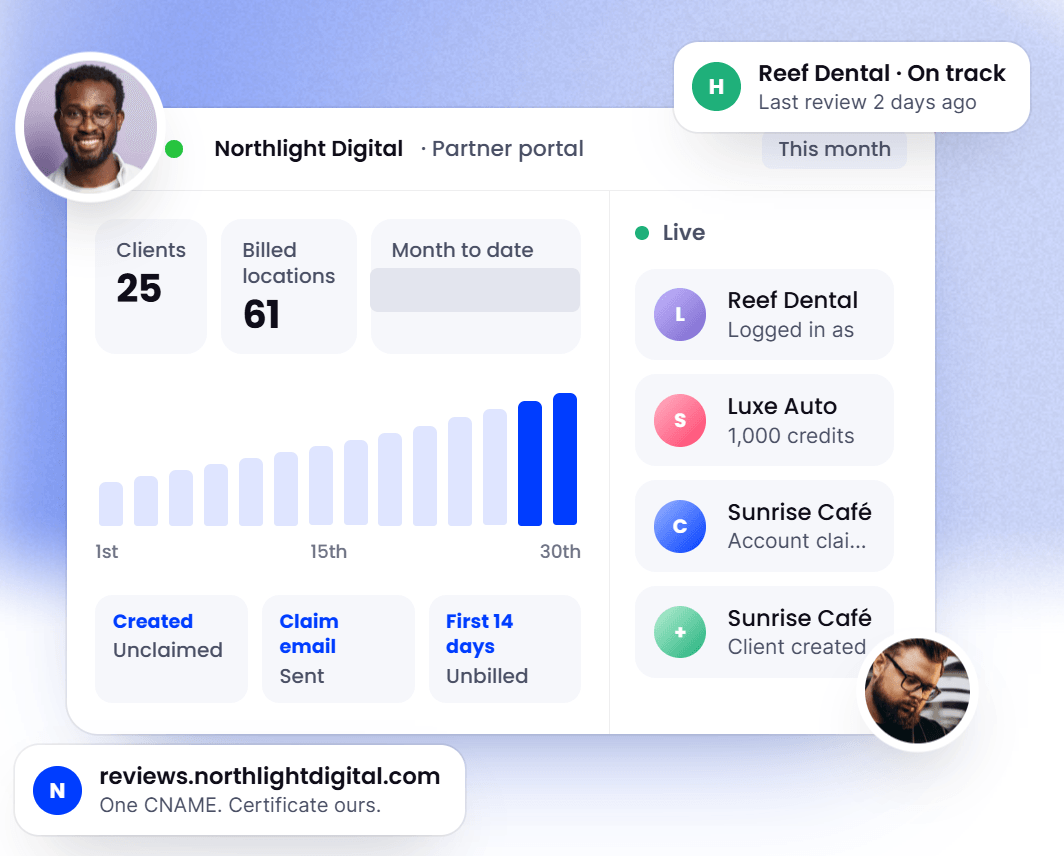
Go white label when the client has to see your brand: when you are the agency of record and a second vendor's name on the login page invites the client to go around you. Cloutly's white-label tier points your own hostname at us with one CNAME and the certificate handled at our end, carries your name, colours, logo and links on every screen a client reaches, and puts every client account in one list you can log in to.
How to scope and price it as a retainer
Charge on locations and expected review volume, not per client, and anchor the fee against what doing the work in-house would cost the client, which is mostly reply time. A retainer quoted per client gets worse every time a good client opens a second site.
Five things the scope has to name, in writing, before the first invoice.
- Which profiles are covered. Google, whichever second profile their customers actually use, and stop. Every extra profile is another surface you have promised to watch.
- A review volume band. Replies are your variable cost, so state the volume the fee assumes and what happens above it. That protects you in the month a client goes viral for the wrong reason.
- Who publishes replies. Either you draft and the client approves inside an agreed window, or you publish under a written policy with named exceptions. Pick one. Hybrids are where retainers quietly stop being profitable.
- Whether profile data is in or out. Hours, phone, address and the monthly check on them are real work. Charge for it or say plainly it is not included.
- The report, and its date. Same date, same numbers, every month. A report that changes shape reads as an argument.
Keep set-up out of the retainer. Access, the trigger, the reply policy and the baseline are a one-off project with a one-off fee, and folding them into month one is how the first quarter of a twelve-month retainer becomes unpaid work. Message costs work the same way: texting carries a per-message cost that varies by country, so it belongs in the contract as a named pass-through or a stated allowance.
Do not price on outcomes you do not control. Rating movement is the trap, because it lags and depends on how many reviews the client already has, so a client with 900 lifetime reviews could pay you almost nothing for excellent work. Price on the work and report on the outcome. And ask for a term: ninety days is the honest minimum, because velocity takes a month to establish and two more before a trend is a trend rather than a good fortnight.
What to report to the client each month
Four numbers, on one page, in the same order every month.
| Metric | How to define it | Why it is the one to show |
|---|---|---|
| Review velocity | New reviews per location this month, against the same month last year | Reviews are seasonal, so year on year beats month on month |
| Response coverage and speed | Percentage answered, and median hours to first reply | Entirely within your control, so lead with it in a flat month |
| Rating movement | The rolling 90-day rating, per location | The lifetime average is arithmetic sludge and hides your work |
| AI visibility, if you sell it | Whether assistants name the client when asked for a business like theirs, sampled monthly | The question clients started asking in 2025 that most agencies cannot answer |
The rating row is worth the arithmetic, because it is where agencies get punished for good work. A client sitting on 400 lifetime reviews at 4.3 who collects thirty new ones at 4.9 moves their lifetime average by about four hundredths of a star. On the report that reads as nothing happened. The rolling 90-day rating moves visibly over the same period, and it is the more honest number anyway, because it describes the business as it runs now rather than as it ran in 2021.
Report AI visibility as a sample, not a rank, and say so on the page: ask an assistant the same question twice and the answer can differ. How to check whether AI recommends your business is the method, and it works better as a paid add-on than folded in for free.
Leave two things out. A sentiment score you cannot explain will cost you the whole meeting the first time a client asks how it is calculated. And never lead with a multi-location client's network average: it hides the two sites dragging the brand down, and those sites are why you were hired. The multi-location playbook covers reading a network properly.
Take the baseline before the first invite goes out. Without it, month three is your word against the client's memory.
The mistakes that end the retainer
Gating, in any form
Asking for a star rating first and showing the review links only to customers who answer four or five is review gating. Google's Maps content policy puts it in the prohibited column: merchants may not "discourage or prohibit negative reviews, or selectively solicit positive reviews". It is self-defeating as a service, because a filtered rating describes your filter rather than the client's business. Review gating covers why vendors still sell it.
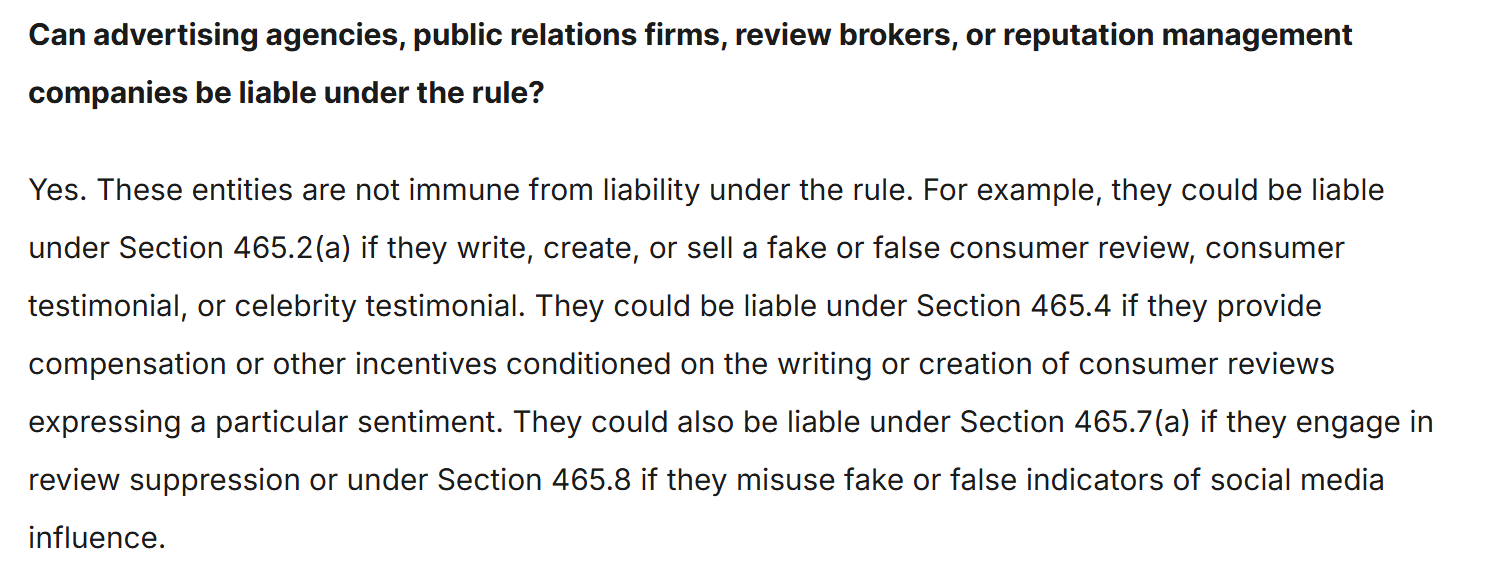
The part agencies miss is who carries the risk. The FTC's rule on consumer reviews and testimonials has been in force since 21 October 2024, and it "authorizes courts to impose civil penalties for knowing violations". Its questions and answers page asks whether advertising agencies, PR firms, review brokers or reputation management companies can be liable under it, and answers: "Yes. These entities are not immune from liability under the rule." Running the programme on a client's behalf does not move the exposure onto the client.
Incentives, and staff quotas
Google prohibits offering "payment, discounts, free goods and/or services" in exchange for a review. The same policy prohibits "merchants requesting that staff solicit a certain number of reviews" and "merchants requesting that staff solicit reviews that include specific content". That second one catches a lot of well-meaning agency work: a reviews-per-week target on a branch manager's scorecard gets written into a rollout plan without anybody checking the policy. What is allowed is soliciting content that represents a genuine experience, without incentives and without influencing the rating or the wording.
Replying without the authority to speak
Google is explicit about how a reply appears. It publishes under the customer's review, and "it will appear like your business replied, and your personal name won't be shown". The client's brand carries whatever you write, with no visible agency byline.
So the reply policy has to name the tone, the topics that always go back to the client first, and the person on the client side who answers within the day when one of those lands. Refunds, anything about a named staff member, anything clinical or legal, anything involving a minor, and anything alleging injury belong in that middle group.
Taking ownership of the client's profile
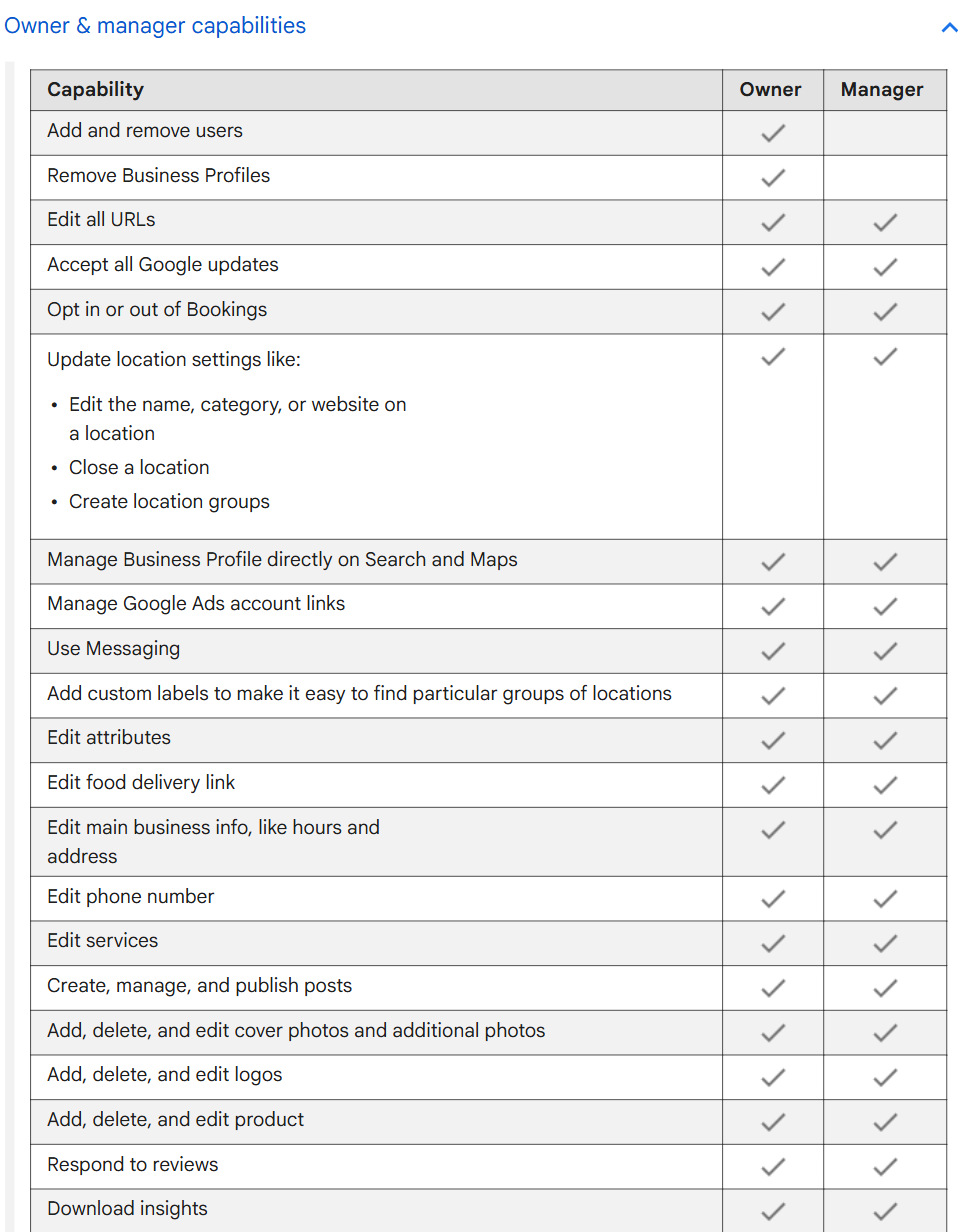
Get added to the client's Google Business Profile as a manager, not an owner. Google's own capability table gives managers the tick on "Respond to reviews" and withholds it on "Add and remove users" and "Remove Business Profiles". That is the right amount of power for a supplier to hold over an asset the client cannot rebuild. Never accept primary ownership, and never work from a login the client also uses. New owners and managers wait seven days before some profile features become available, so access is the first onboarding step, not the last.
The test is simple. If the relationship ended on Friday, would handing everything back be a five-minute administrative task?
Selling removals
You cannot delete a review the client dislikes. You can report one that breaks the platform's rules, and that test is narrower than owners expect, so selling removal as a deliverable means promising an outcome you do not control to somebody who will remember the promise word for word. How to remove negative reviews from Google has what a report can and cannot do.
An onboarding checklist for a new reputation client
Nine steps. The order matters more than the list.
- Get access properly: manager on the Google Business Profile, an admin role on the Facebook page, named logins elsewhere. Your accounts, never the client's.
- Audit what exists, claimed or not, including the duplicate somebody created in 2019 and the page still carrying the old address.
- Take the baseline: reviews per location for twelve months, current rating, response rate, median reply time.
- Find the trigger, and how a mobile number or email comes out of it. This is the step that stalls, so start it in week one.
- Agree the reply policy: tone, approval window, escalation list, and the named person who answers.
- Set the ask timing. A physiotherapist asking the morning after a first appointment and a builder asking after handover are different programmes.
- Tell the frontline staff. A front desk that does not know why customers mention a text message will apologise for it.
- Fix the wrong hours and the wrong phone number in the first fortnight, while it is still scoped as set-up.
- Book the report date and a 30-day review, where you check whether the ask lands at the right moment.