
How many Google reviews do I need? The maths, worked through
Google publishes no minimum, but there is still an answer, and most of it is arithmetic you can do on the back of a docket.
Lachlan Fea 9 min read
In this article8 sections

How many Google reviews do I need? Google publishes no minimum, so there is no official number to hit. The closest thing to an answer is consumer research: BrightLocal's Local Consumer Review Survey 2026 found that 47% of consumers will not use a business with fewer than 20 reviews, and 68% will only use a business rated four stars or higher. Twenty reviews at four stars is the floor. Everything past that is arithmetic: what it costs to move a rating, what one bad review costs, and how many months the climb takes at the rate you can actually collect.
What is a good number of Google reviews?
There is no published minimum, from Google or anyone else. What exists is survey evidence about where consumers stop looking. These figures come from BrightLocal's Local Consumer Review Survey 2026, published 11 February 2026 from a sample of 1,002 US consumers.
- 47% will not use a business with fewer than 20 reviews. That is the closest thing to a floor anyone has measured.
- 68% will only use a business rated four stars or higher, up from 55% a year earlier.
- 31% now require 4.5 stars or higher, up from 17% a year earlier.
Twenty reviews gets you past the first filter. Four stars gets you past the second. The bar that is moving is the third: the group demanding 4.5 nearly doubled in a year.
Two cautions before you write a number on the whiteboard. That sample is US consumers, so read it as a direction rather than a local benchmark. And a count means little on its own. Twenty reviews is plenty in a category where your competitors hold 25, and nowhere near enough in one where they hold 300.
How many 5-star reviews do you need to raise your rating?
One line of algebra.
five-star reviews needed = current count x (target rating - current rating) / (5 - target rating)
Ridgeway Plumbing sits at 4.2 stars from 90 reviews and wants 4.5.
90 x (4.5 - 4.2) / (5 - 4.5)
= 90 x 0.3 / 0.5
= 54 five-star reviews
Check it. Ninety reviews at 4.2 is 378 stars. Add 54 fives and you have 648 stars across 144 reviews, which is 4.5 exactly.
The Google review calculator runs that sum, and the two below it, on your own numbers.
Now Ridgeway wants 4.7, starting from the 4.5 it has just reached, with 144 reviews on the board.
144 x (4.7 - 4.5) / (5 - 4.7)
= 144 x 0.2 / 0.3
= 96 five-star reviews
Fifty-four reviews bought the first three tenths of a star. The next two tenths cost 96. That is the shape of the whole thing: every tenth costs more than the one before it, because the target sits closer to 5.0 and each new review has less room to pull the average up. Going straight from 4.2 to 4.7 takes 150, which is the same answer by a shorter route.
Here is the table at a round 100 reviews, so you can scale it to your own count.
| Your rating now, from 100 reviews | Five-star reviews to reach 4.5 | To reach 4.7 |
|---|---|---|
| 3.8 | 140 | 300 |
| 4.0 | 100 | 234 |
| 4.2 | 60 | 167 |
| 4.4 | 20 | 100 |
| 4.5 | already there | 67 |
| 4.6 | already there | 34 |
The number scales with what you already hold. Double your review count and you double the reviews needed for the same climb, because the existing average has twice the weight to it. A young profile is cheap to move and cheap to wreck. One sitting on 800 reviews barely notices a bad month, and barely notices a good one either.
The catch: not every review you get will be five stars
The formula above assumes every new review is a five. Almost no business runs at a perfect five on new reviews, and planning on it will put you months past your date.
The honest version divides by the average of the reviews you are actually collecting, not by 5.
reviews needed = current count x (target - current) / (new-review average - target)
Ridgeway again, at 4.2 from 90 reviews, aiming for 4.5, but with recent reviews averaging 4.8 rather than 5.0.
90 x 0.3 / (4.8 - 4.5)
= 90 x 0.3 / 0.3
= 90 reviews
Ninety, not fifty-four. Assuming every review is a five made the job look 40% smaller than it is. Work out your own new-review average from the last three months before you use either formula, and note the hard limit inside the arithmetic: if the reviews you collect average below your target, no volume gets you there. A business collecting 4.4s cannot reach 4.5 by collecting more of them.
What one bad review costs, in five-star reviews
To hold an average of T after a one-star review, you need enough fives to cover the gap it opened.
five-star reviews to recover = (T - 1) / (5 - T)
| Your average | Fives to absorb one 1-star review | To absorb one 2-star review |
|---|---|---|
| 4.0 | 3 | 2 |
| 4.5 | 7 | 5 |
| 4.7 | 13 | 9 |
| 4.8 | 19 | 14 |
Look at what is missing from that table: your review count. It is not in the formula at all. One one-star review costs a business with 40 reviews the same 13 fives as a business with 4,000, if both are holding 4.7. The difference is that the business collecting steadily earns those 13 back in a fortnight, and the one that stopped asking in 2023 never earns them back.
That is the real argument for a steady rate. It does not prevent the bad review. It repairs the average without anyone having to do anything special.
How many reviews it takes to get to 5 stars
Once a single review below five lands, a true 5.0 average is gone for good. What you can hold is a displayed 5.0. Google shows a rating to one decimal place, so a true average of 4.95 or higher shows as 5.0 if Google rounds rather than truncates, which is what it appears to do on live profiles. Google documents neither behaviour, so treat the exact cutover as an observation rather than a policy.
Run it. With one one-star review on the profile and every other review a five, you need 79 fives to bring the true average back to 4.95. At 78 you are on 4.949.
That does not make a perfect score a target. Northwestern University's Medill Spiegel Research Center found that purchase likelihood peaks in the 4.0 to 4.7 range and falls above it, because a perfect score reads as unlikely (How Online Reviews Influence Sales, 2017; dated, and still the only published product-level data on the point). A 5.0 from 22 reviews invites a question that a 4.7 from 300 never gets asked.
How many Google reviews do I need to beat the businesses beside me?
There is no absolute number here either, and there cannot be, because the map pack is a comparison and not a test you pass.
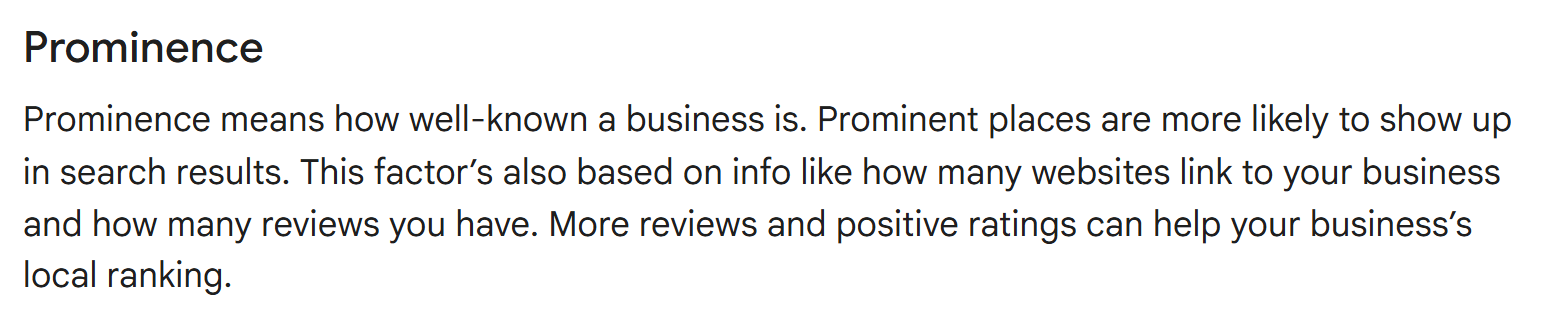
Google's own wording is the place to start. Its help page on local ranking says local results are "mainly based on relevance, distance, and popularity". The third factor is headed Prominence, and under it: "This factor's also based on info like how many websites link to your business and how many reviews you have. More reviews and positive ratings can help your business's local ranking." That is the whole of what Google publishes on the subject.
Reviews are named there, so the count is doing something. But they sit alongside relevance and distance, neither of which a review can touch. You cannot review your way into a pack you are five kilometres too far from.
So the number worth knowing is not a national average. It is the review counts of the three businesses Google is showing today for the search that matters to you. Search your main service and your suburb from a phone that is actually in the area, write down each result's rating and count, and put your own beside them. That tells you whether you are 30 reviews behind or 300, and those are different plans. Whether Google reviews affect your ranking works through what reviews can and cannot move.
Does it matter how recent the reviews are?
Yes, and this is where a large count quietly stops working.
BrightLocal's Local Consumer Review Survey 2026 found that 74% of consumers want reviews written in the last three months, and 44% name "posted within the last month" among the things that make a review count. On the ranking side, recency of reviews was scored 11th out of 187 factors by the local search experts surveyed for Whitespark's 2026 Local Search Ranking Factors, published 6 November 2025 from 47 contributors. That is practitioner opinion rather than anything Google has confirmed, and it sits high enough on the list to act on.
A review count is a stock. Recency is a flow, and only the flow tells a customer what you are like now. Two profiles both showing 4.6 from 200 reviews are not the same profile if one has eight reviews from the last month and the other has nothing since 2023. The second reads as a business that used to be good, and nothing in a total fixes that.
How many reviews a month can you expect?
Your monthly review rate turns a target into a date. It is the part calculators on this topic leave out.
reviews per month = asks sent per month x the share of asks that end in a review
Asks sent per month is capped by customers served. Finish 120 jobs a month, ask every one of them once, and your ceiling is 120 asks. Asking the same customer twice does not raise the ceiling, it just annoys them. Raising it means asking the people you currently miss: the walk-ins whose details nobody took, the second location that never got set up, the jobs that finished on a weekend.
The share that ends in a review is yours to find out, not to borrow. Count the reviews that arrived last month, divide by the asks you sent last month, and repeat for three months before you trust the answer. Do not take a benchmark off a vendor's page, this one included. Any percentage published without your channel and your timing behind it will be wrong for you, usually in the flattering direction.
Multiply the two and you have the number that sets your date, and the fastest gains are almost always on the first half. How to get more Google reviews covers the asks themselves, review request templates has the wording for text and email, and your Google review link decides how many people who meant to review you actually finish.
Consistency across a whole customer list depends on the process. Cloutly's review campaigns handle it this way: a repeat customer is one contact, asked once, rather than one ask per transaction; anyone who reviewed you in the last 90 days is skipped; opted-out contacts are never enrolled; and follow-ups run on the day spacing you set and stop when the review lands.
How long the climb takes
Ridgeway needs 54 five-star reviews to get from 4.2 to 4.5, and 150 to get to 4.7. Divide by the monthly rate.
| Reviews a month | Months to 4.5 (54 needed) | Months to 4.7 (150 needed) |
|---|---|---|
| 5 | 11 | 30 |
| 10 | 6 | 15 |
| 20 | 3 | 8 |
| 40 | 2 | 4 |
The rate matters more than the target. Going from 5 reviews a month to 20 does more for Ridgeway than dropping its ambition from 4.7 to 4.5 does. Every row here is a multi-month project, so a week of hard asking will not get you there, and a burst is worth less than a habit on the ranking side too: the same Whitespark contributors put "sustained influx of reviews over time (rather than bursts)" 14th of the 187.
Use both figures: the count that gets you to the rating and the monthly rate that holds it. A business that hits 4.5 and stops asking drifts back down, because the reviews that arrive unprompted skew towards people with something to complain about.
What you cannot do to get there faster
The arithmetic makes the shortcuts look tempting. The two obvious ones are against the rules.
Asking only the customers you expect to be happy. Google's prohibited and restricted content policy says merchants may not "discourage or prohibit negative reviews, or selectively solicit positive reviews from customers". That covers the survey-first pattern, where a customer rates you privately and only the satisfied ones are shown the review link. It is called review gating, several vendors still sell it, and it is a breach. Cloutly has not gated since 2021 and does not offer it. More on review gating and what to do instead.
Paying for reviews, in money or in kind. Google's page on getting more reviews is blunt: "Offering incentives, like free or discounted goods or services, in exchange for customers to post reviews, change reviews, or remove negative reviews is considered fake & misleading content and is strictly prohibited." In the United States it is also law. The FTC's Rule on the Use of Consumer Reviews and Testimonials went into effect on 21 October 2024 and authorises courts to impose civil penalties for knowing violations. Bought reviews also get removed in volume, so you pay for a number that then disappears.
What is left is asking everyone, once, at the right moment. What a five-star review request may and may not say covers where the line sits in the wording.
Frequently asked questions
How many Google reviews do I need?
Google publishes no minimum. Consumer research puts the practical floor at about 20: BrightLocal's Local Consumer Review Survey 2026, from 1,002 US consumers, found 47% will not use a business with fewer than 20 reviews and 68% will only use one rated four stars or higher. Past that, what matters is how you compare with the businesses shown beside you in the map pack.
How many 5-star reviews do I need to raise my rating?
Multiply your current review count by the gap you want to close, then divide by the distance from your target to 5. From 4.2 with 90 reviews, reaching 4.5 takes 54 five-star reviews and reaching 4.7 takes 150. If the reviews you collect average below 5, divide by the gap from that average to your target instead. On the worked example above, an average of 4.8 rather than 5.0 turns 54 into 90.
How many reviews does it take to recover from a one-star review?
At a 4.5 average it takes 7 five-star reviews, at 4.7 it takes 13, and at 4.8 it takes 19. Your total review count does not change that figure. What it changes is how quickly you collect them.
Is a 5.0 rating the goal?
No. Once one review below five lands, a true 5.0 is gone, and a displayed 5.0 only needs 4.95, which after a single one-star review takes 79 five-star reviews to restore. Northwestern's Medill Spiegel Research Center found purchase likelihood peaks between 4.0 and 4.7 and falls above it, because a perfect score reads as unlikely. Somewhere between 4.5 and 4.8, with recent reviews and replies under them, is the profile that actually converts.