
How to remove a Tripadvisor review: what works and what does not
Reporting works on grounds, not on how unfair the review feels. Here are the grounds Tripadvisor publishes, and the evidence each one needs.
Lachlan Fea 10 min read
In this article11 sections

There is no way to remove a Tripadvisor review yourself. The delete button does not exist, and Tripadvisor's team will not take one down because you ask. What works is reporting the review from the Management Center as a breach of a published guideline, then waiting three to five working days for a decision. Two other routes exist: a documented blackmail report, and a bulk removal after a change of ownership or a major renovation.
Verified 6 September 2026 against Tripadvisor's review posting guidelines, its content and community guidelines, its 2025 Review Transparency Report and the owner help centre articles linked in each section below.
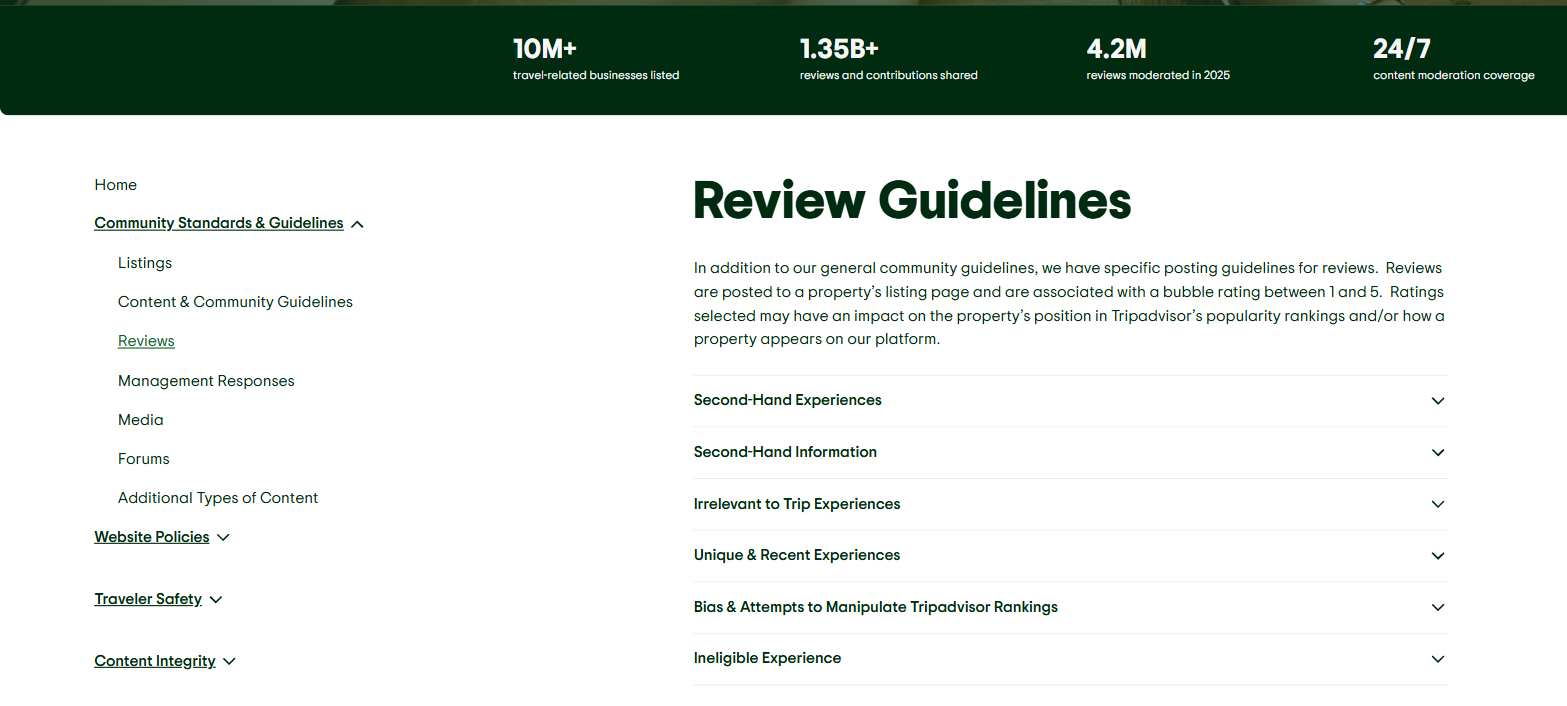
Can a business owner delete a Tripadvisor review?
No. There is no delete button in the Management Center and no paid tier that adds one. The reviewer can take their own review down, and Tripadvisor can take it down. That is the whole list.
It is not as hopeless as it sounds. Tripadvisor's 2025 Review Transparency Report, covering 2024, says it blocked or removed 2.7 million fraudulent reviews out of the 31.1 million posted that year, plus 214,000 more it believed were written by AI. Reviews come down every day, but not because a business makes a convincing case that one feels unfair. Match the review to a published rule and give Tripadvisor the evidence for it.
Which reviews Tripadvisor will remove
Read the review against this table before you open the report form. If nothing matches, no amount of reporting will move it.
| The ground | What the guidelines say | What to attach |
|---|---|---|
| Not a first-hand experience | "If you did not experience the business as a guest or potential guest, we will not post your review." A review driven by news coverage rather than a visit goes the same way | The date, and what your booking system returns for it |
| Second-hand information | Quotes or descriptions from the media, the internet, or a guest outside the writer's own party are removed "no matter how minor of a mention" | The sentence, quoted exactly |
| Wrong business | A review "submitted on a property that does not correlate with a listed business" comes down | The listing it belongs on, if you can find it |
| Older than twelve months | "all reviews must be submitted within one year of your experience" | The stay date in the text, against the posting date |
| Solely about a policy | Tripadvisor removes "reviews that simply describe an interaction that is a disagreement on the stated policies": a cancellation term, a no-dogs rule | Your published policy and the booking confirmation |
| Solely about hours or a closure | Not posted "unless the official information posted by the business created an expectation of service". Unanswered calls and emails do not count either | A screenshot of your hours as they stood that day |
| Excessive commentary | "Excessive commentary on other reviews, business owners or Tripadvisor policies" is sent back to be rewritten around the visit | The passage |
| AI-generated text | "Review content generated by artificial intelligence (AI) is not permitted", and the account can be banned | The review text, plus near-identical reviews on other listings |
| Offensive or private content | The community guidelines cover profane and vulgar language, discriminatory language, private information and plagiarised text | A screenshot showing the rating, screen name and date |
| Competitor vandalism | "Any attempts, made by individuals affiliated with one property, to damage the reputation of a competing property" | Whatever links the account to the competitor |
Second-hand information is a ground owners often miss. It is broad: a guest who quotes a newspaper story about you has breached it, and so has one who pads a review with something a taxi driver told them afterwards. Check the exceptions before you rely on it. Anything a staff member said is fine, as is the experience of anyone in the guest's own party and a passing mention of genuinely well-known news. Blackmail has its own channel and evidence rules, further down this page.
What is not on the list is a real guest who had a bad night and said so. A review can be one-sided, wrong about the facts, and still stay up. Tripadvisor's page on reported reviews that stay published is blunt about it: "simply disagreeing with the content of the review is not sufficient to justify removing the review. Tripadvisor does not arbitrate or referee factual disputes." Sorting the two before you file is the whole skill, and how to spot a fake review sets out the checks that hold up.
How to report a Tripadvisor review, step by step
Claim the property in the Management Center first. Then, per the owner help centre:
- Log into the Management Center.
- Click the Reviews tab in the navigation bar.
- Click the review you want to report.
- Select Report Review on the right side.
- In the form, give the reason for your dispute.
- Leave your comment and click Submit.
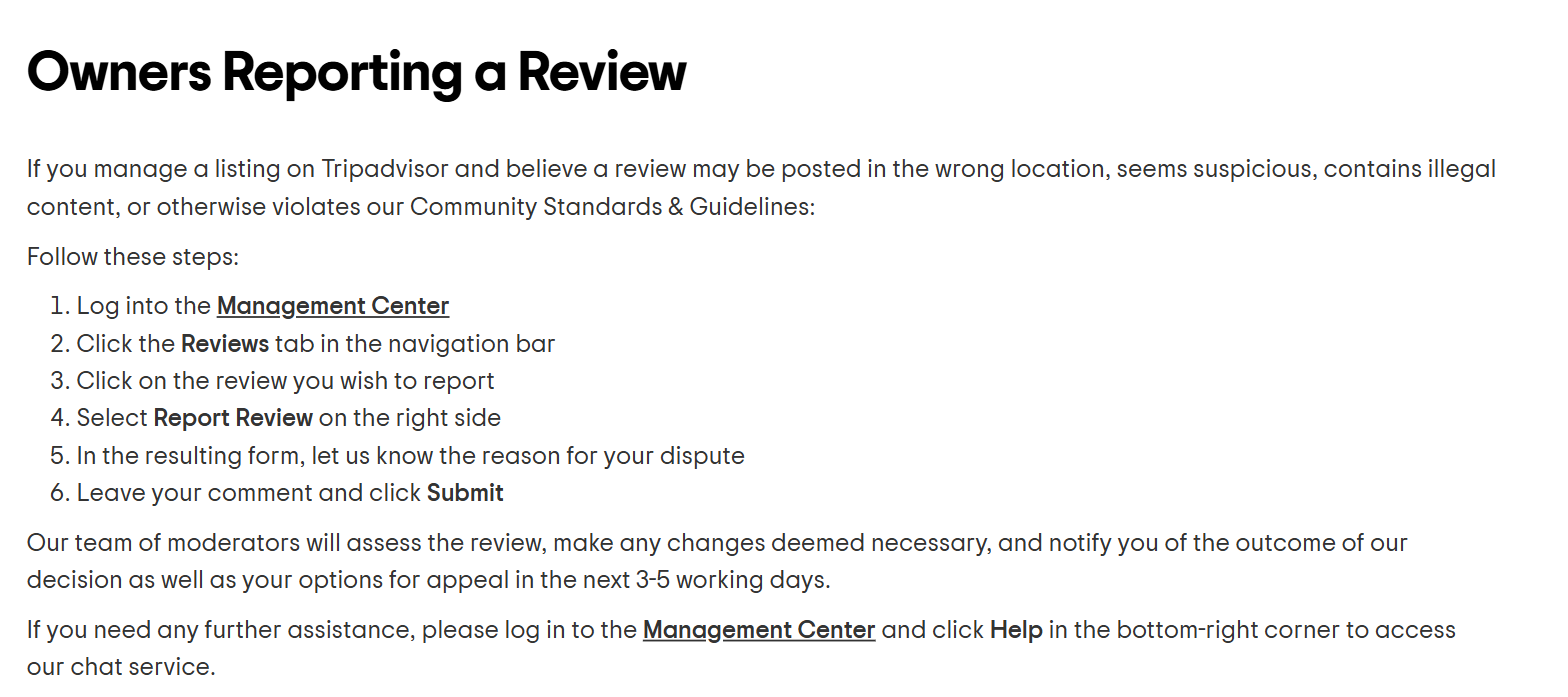
Step 4 is the one owners cannot find, because Report Review sits beside the review rather than under it.
Step 5 is where the report succeeds or fails. Write a claim a moderator can check in a minute. "This review is unfair and it is costing us bookings" is a feeling. "Posted 3 September 2026, describes a stay in March 2024, outside the twelve-month window" is a fact with a rule attached.
Attach what the right-hand column of the table above asks for, quote the guideline in Tripadvisor's own words, and stop there. One review, one report, one ground. A report listing five possible breaches reads as a fishing trip.
How long it takes, and what to do if it is refused
Tripadvisor's moderators "will assess the review, make any changes deemed necessary, and notify you of the outcome of our decision as well as your options for appeal in the next 3-5 working days". There is no status dashboard for owner reports the way there is on Google. Nothing moves on a screen while you wait, and the answer arrives as a notification.
If the answer is no, your options narrow. An EU resident has a formal appeal: six months from the decision, filed through the link in the decision email, and Tripadvisor adds that a business user may also be entitled to redress under the Platform to Business regulation. It names a third-party out-of-court settlement route as well, though those bodies "have not yet been designated". This is the strongest lever a European property has, and it sits in a traveller-facing help article, which is why owners rarely find it.
Outside the EU there is no published appeal form, so what is left is a fresh report naming a different ground, carrying evidence the first one did not. Filing the same argument again in stronger language does nothing.
Blackmail: the separate channel and its evidence rules
If a guest threatens to post a review, or offers to pull one, in return for a refund, an upgrade or cash, that is not an ordinary report. Tripadvisor runs a separate process for it, and removed 814 reviews tied to blackmail reports in 2024.
Its definition needs three parts present at once: bad-faith intent, a demand for something the guest is not owed under their booking, and a threat that explicitly names Tripadvisor or the rating. A guest who says they will write a review because the pipe in their room burst is not blackmailing you, and Tripadvisor uses that exact example to say so.
The evidence rules are stricter than anything else on this page, and they are why most of these reports fail. Tripadvisor wants the whole conversation from its start, unedited, as an .eml or .msg file, a complete screenshot or a PDF, showing the sender's email address and the date sent so the person can be matched to the reviewer. It refuses anything copied and pasted into an email or a document, photos of your property, receipts, booking confirmations, witness statements, third-party and police reports, internal correspondence, video, audio and handwritten notes.
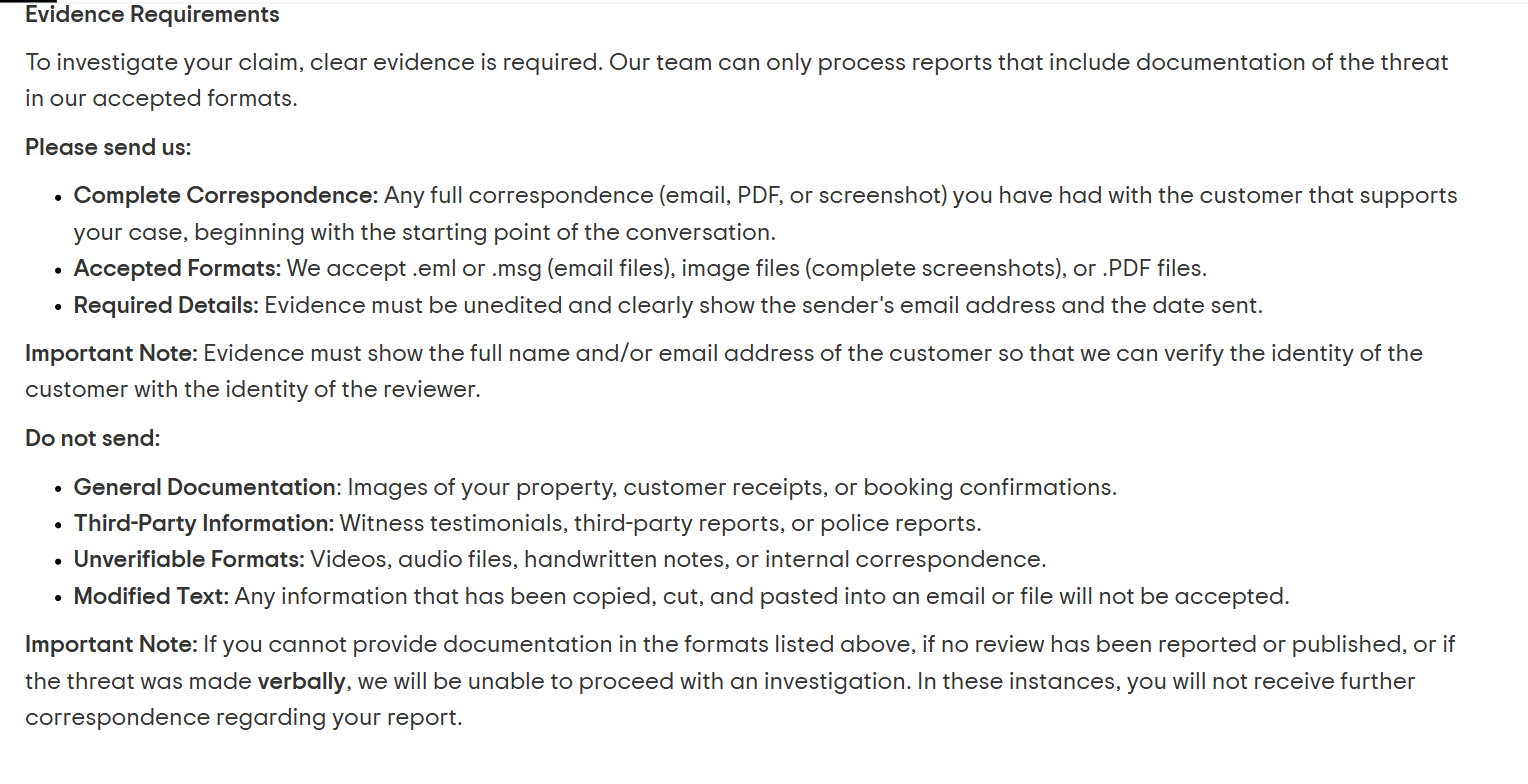
Unedited .eml, .msg, image or PDF only. A pasted transcript is not evidence, and neither is a police report.
Two rules catch owners out. Tripadvisor will not act before the review exists, so a threat with nothing published behind it is dead on arrival. And a threat made only out loud cannot be investigated at all, so if the demand comes at the desk, get it into writing before you promise anything. Reports go through the chat, using the Help button in the bottom-right corner of the Management Center. File with your police or consumer regulator too, even though Tripadvisor will not read that report.
"They said they will take it down if I refund them"
Do not take that deal, and never propose one.
The guidelines have a line for the offer coming from your side: "Attempts by an individual representing a property to offer anything in exchange for the removal of a published review are against our guidelines and will be met with penalties." A second makes it a violation to "pressure, threaten, or otherwise coerce a user into removing their review".
Tripadvisor's page on review fraud consequences says what its penalties look like: a drop in the popularity index, the loss of Travelers' Choice eligibility, and a large red notice on your listing page telling travellers your reviews are suspicious. It is a poor trade: one bad review for a banner above all of them.
So refund the guest if the refund is owed, fix the thing if it is broken, say so in a management response, and leave the review alone. If they change it later, that is their call. A reply that stays on the right side of both rules reads like this.
Hello Priya. I have read your review of the Wharf Rooms and I have been through the file. You were moved out of the room you booked at eleven at night and nobody explained why, which is on us. The two rooms above the loading bay are out of service until the work finishes on 30 September, and the difference has gone back to the card you paid with. If you are in Port Fairy again, ring the desk and ask for Marianne.
No request to change the rating, nothing offered on a condition. Cloutly is built the same way and for the same reason: no rating question sits between a customer and the review site, and nobody is filtered out for being unhappy. Tripadvisor bans that by name, requiring that where a survey or an external site leads a guest to Tripadvisor, "the user interface and experience for submitting positive and negative reviews must be identical".
Bulk removal: change of ownership and major renovation
These are the only two routes that clear history rather than one review. Take over a business and you can ask for every review, photo and management response posted before the handover to go, on the strength of a press release, a deed, a receipt of purchase, a transfer document or a lease of at least three years, showing the date of the change and both owners' signatures. Refurbish the property completely and you can ask for everything posted before the work finished to go, on one of the three documents Tripadvisor lists. Tripadvisor is explicit that "cosmetic updates such as new carpets, paint, or signage do not qualify". Both go through the chat behind the Help button, and an approved removal shows on the listing within five business days.
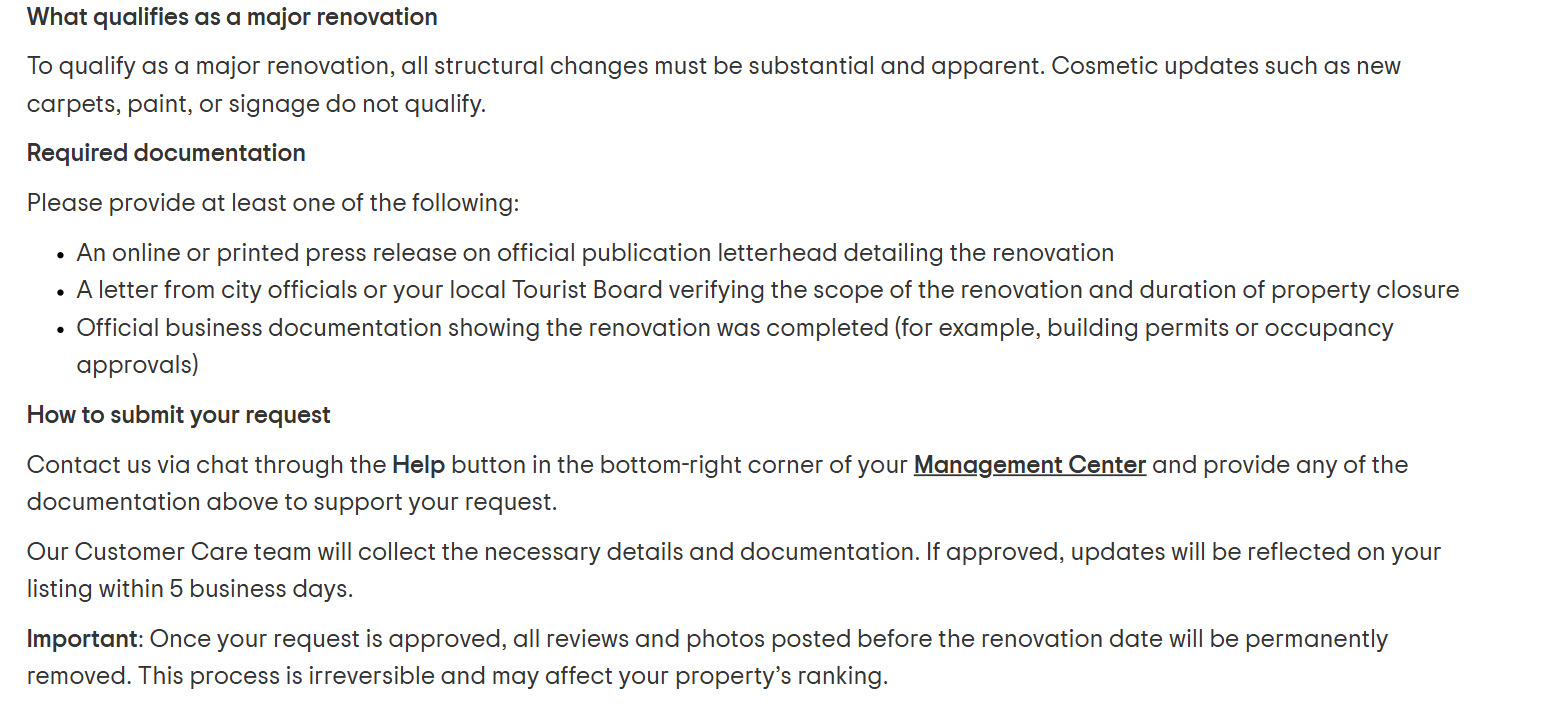
Read the warning on both pages before you ask. The removal is permanent, it is irreversible, and it "may affect your property's ranking". Bramble House, a fictional forty-room country hotel sitting on 900 reviews at 4.1, would restart at zero, and zero on the popularity index is usually worse than 4.1. This route makes sense when the reviews describe a building that no longer exists.
What to do while the review stays up
Report it, then answer it anyway. Tripadvisor recommends exactly that on the page explaining why a reported review stayed published, and a response goes live in up to two days, well before the decision arrives.
Two things stay out of that reply. You cannot accuse anyone of writing a fake review, and you cannot ask them to take it down. Say what you found, say what has changed, and write it for the next traveller rather than for the reviewer. Ten worked replies, including one for a stay you have no record of, are in how to respond to Tripadvisor reviews.
After that it is arithmetic, and the arithmetic is the part you control. One one-star among 40 reviews takes a 4.6 to a 4.5; among 400 it may not move the displayed number at all. The mechanics are in how Tripadvisor ratings are calculated, and the follow-up process is in how to get more Tripadvisor reviews.
Running this across a group of venues
One venue can do this ad hoc. Nineteen cannot, and the failure is always the same. The review that qualified for removal was found five weeks late by a duty manager, who filed a report with no evidence in it.
Put one person per region on reporting rather than one per venue. Matching review text to a published rule is a skill, and a venue manager who files two reports a year never gets good at it. Someone filing forty does.
Give that person a standing evidence pack, taken the day the review lands: the screenshot with rating, screen name and date, the reviewer's other contributions, the booking or POS search and its result including a nil result, and the roster for the shift. Publish your own version of the table above to venue managers too, so nobody burns a week on a review that was always going to stay.
Then log outcomes rather than submissions. Venue, date, ground cited, decision, days taken. Thirty entries in you can see which grounds work for your kind of property, and which ones your people keep reaching for and losing with.
Finding the review late is a tooling problem more than a discipline problem. Cloutly reads 39 review sites and watches Tripadvisor rather than writing to it, so a review that breaks a guideline reaches the person who reports it the day it lands, across every venue in the group. More in listings management and on the hospitality solutions page.
The legal route
A review that is defamatory or otherwise unlawful can be reported to Tripadvisor as illegal content rather than as a guideline breach, through the same form, and that costs nothing. Past that, be clear about what you would be suing. Reviewers are anonymous by design, and Tripadvisor "does not facilitate direct contact between owners and members of our travel community", so the sequence is a lawyer, a court order to unmask an account, then a claim against a private individual over a review that is two years old by the time it is heard. A genuine claim is fine. But under the FTC's Consumer Reviews Rule, in force since 21 October 2024, using an "unfounded or groundless legal threat" to get a review taken down is itself a violation. The trade-off between an appeal and a legal claim is laid out side by side in how to remove negative reviews from Google. None of this is legal advice.
Frequently asked questions
Can owners delete Tripadvisor reviews?
No. Owners can report a review, respond to it, and request a bulk removal after a change of ownership or a major renovation. Only Tripadvisor or the reviewer takes a single review down.
How long does Tripadvisor take to remove a review?
It says moderators assess a reported review and notify you of the outcome and your appeal options within three to five working days. Approved bulk removals appear on the listing within five business days.
Can I ask a guest to delete their review?
No, and the risk is to your listing rather than theirs. Offering anything in exchange for a removal, or pressuring a reviewer into one, breaches the guidelines and is penalised on your profile.
Will Tripadvisor remove a review that is untrue?
Not on that basis. Tripadvisor "does not arbitrate or referee factual disputes". A review that gets your prices or your policy wrong stays up, and the answer is a management response that corrects the fact once.