
How to spot a fake review (and what to do when one lands on your business)
Reading a review and deciding it feels fake is close to a coin toss. Checking it against your own records is not.
Lachlan Fea 10 min read
In this article10 sections
You spot a fake review by checking it against your own records first and the reviewer's account second. No booking, no order and no staff member by the name in the text, then an account with no history whose review landed in the same hour as two others: that is a fake review, and that combination is what a platform acts on. No single sign proves anything on its own.
Verified 6 September 2026 against Google's content policy, its help pages on reporting reviews and extortion scams, its April 2026 Maps announcement, the FTC's Consumer Reviews Rule, the CMA's fake reviews guidance, the ACCC, and Meta's, Yelp's and Tripadvisor's own pages. None of it is legal advice.
This is for the owner or manager looking at a review they think somebody invented. It covers how to identify fake reviews on your own profile, what evidence a report needs, and where the law stands.
What counts as a fake review
A fake review is one that is not based on a real experience of your business. Google's policy calls this fake engagement, and defines it as "content that is not based on a real experience or does not accurately represent the location or product in question". A competitor's invention, an ex-employee's grudge, a bought five-star and a review meant for the shop next door are all covered by it.
What is not covered: a review from a real customer who had a bad time and said so. That one can be unfair, one-sided and wrong about the facts and still stay up, because being wrong is not against any platform's rules. Make that distinction first. It decides what happens next. If it turns out to be genuine, our review response examples are a better use of the next twenty minutes than a report that gets declined.
How to spot fake reviews: nine signs
One finding changes how to read this list. In a 2025 study of AI-generated product reviews, Large Language Models as 'Hidden Persuaders' (Meng et al.), human judges picked the fakes at 50.8% accuracy, and the language models tested did no better. Reading a review and deciding it feels wrong is a coin toss. The signs below work because most of them sit outside the text.
- There is no transaction behind it. Search your booking system, POS or invoices for the name and the date range the review describes. Nothing is the strongest single signal you will find, and it is the one you can document.
- The account has no history. No profile photo, one or two contributions, created recently. Real customers with thin profiles exist, so this counts only alongside something else.
- It arrived in a cluster. Three or four reviews inside an hour or a day, after months of one a fortnight. Genuine reviews arrive at the rate your business generates customers.
- The reviewer's other contributions are somewhere else entirely. An account whose reviews sit in three countries, or 400km away with nothing local, did not walk into your salon on a Tuesday.
- The details are wrong for your business. A treatment you don't offer, a staff member who has never worked there, a car park you don't have.
- The same text sits on other profiles. Paste a full sentence into a search engine in quotation marks. Identical wording on another business is the cleanest proof there is, and it takes a minute.
- It reads like it was written for a purpose. A one-star that names a competitor and tells people to go there instead, or a five-star that repeats a brand name the way a landing page does. Google's policy has a line for the first case: merchants and users may not "post content on a competitor's place or business to undermine that business' or product's reputation".
- Nothing in it could only come from a customer. Genuine reviews are concrete: a name, a wait, a price, a room. Pure superlatives or pure damnation with no detail under them is a flag at either end of the scale, and so is an account that has left nothing but one-stars.
- The language does not fit your customers. This tell used to be reliable and is now the weakest one here, because a language model writes a plausible review in a second. Odd phrasing is a prompt to check signs 1 to 8, never a finding on its own.
How to check a reviewer's profile on Google
Open the review on your Business Profile in Google Maps and click the reviewer's name. That opens their public contributor page, which covers signs 2, 4, 6 and 8 in about ninety seconds.
What you get: their Local Guide level if they have one, tabs for Reviews and Photos, and a counter that splits the two kinds of contribution, in the form "55 reviews · 48 ratings". Every entry names the place, prints its full street address, and shows the rating, the date and any owner reply. Beside the list, Google plots each of those places on a map.
The map is easy to overlook. A believable local account puts pins on a supermarket, a dentist and a pub within a few suburbs. Pins scattered across unrelated cities, or a whole history that landed on one afternoon, mean the account is being used for a job.
Two cautions. A sparse profile is not proof: plenty of genuine customers have never reviewed anything before yours. And the page shows only public contributions, so an account that deleted its history looks new whether it is or not.
The evidence that makes a report succeed
Most guides skip this part, even though it decides the outcome. No platform publishes an evidence checklist, and Google's form asks for a category rather than an essay. The evidence still matters. It forces you to name the right policy, and a person reads your one appeal per review.
Collect the pack before anything changes. Reviewers delete accounts, edit text and disappear. A screenshot taken today beats a description written next month.
- The review itself, screenshotted with the star rating, the reviewer name and the date visible, plus the URL of your profile.
- The reviewer's contributor page, screenshotted, showing the account's history or the absence of one.
- The exact-phrase search, screenshotted, with links to any other business profiles carrying the same text.
- Your own record, which is the piece nobody else can produce: an export from your booking system or POS covering the period, with the search you ran and the result. "No customer, booking or order under that name between 1 and 31 August" is a sentence a moderator can act on.
- Timestamps for the cluster, if there is one, listing each review, its account and the minute it landed.
- Any off-platform message that arrived with the reviews. That one is the subject of the extortion section below, and it is the strongest thing in the file.
Use Google's policy terms rather than your own. "Fake engagement: this account has no transaction with us and the same text appears on two other profiles" travels further than "this review is unfair and it is hurting us". Google's prohibited and restricted content list supplies the vocabulary. Fake engagement, rating manipulation, misrepresentation and off-topic are the four categories most fake reviews sit in.
How to report a fake review, and what happens next
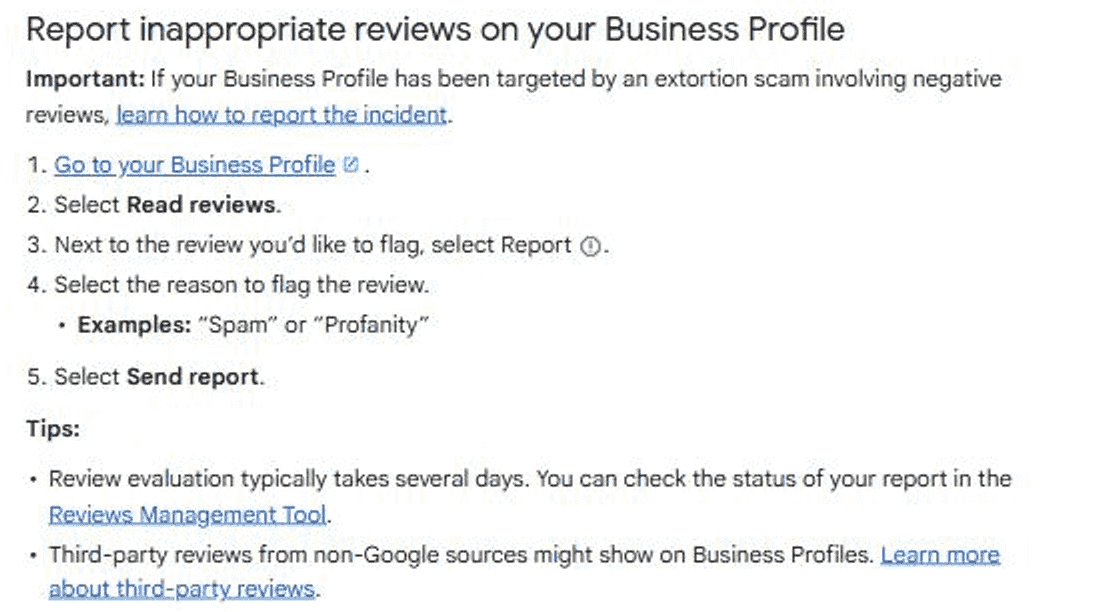
Google. Open your Business Profile, select Read reviews, select Report next to the review, pick a reason, and send. Google says evaluation "typically takes several days", and the status shows in the Reviews Management Tool as Decision pending, Report reviewed (no policy violation), or Escalated. A declined report gets one appeal per review, and that form is where your evidence pack goes. Our guide to removing a negative review from Google walks both routes and sets out what is left when Google says no.
Facebook. Click Reviews under Details below the Page cover photo, tap See all next to Recent reviews, click Options in the top right corner of the post, and select Report post. One limit is worth knowing before you look: Meta says that "Recommendations that only include a star rating can't be reported". If the attack on your Page is a wave of silent one-stars, there is no report button for them, and volume is the only answer.
Tripadvisor. Log into the Management Center, open the Reviews tab, click the review, select Report Review, and give a reason. Tripadvisor says its moderators will notify you of the outcome and your appeal options within three to five working days.
Yelp. The grounds to quote are Yelp's content guidelines, which tell reviewers: "You shouldn't write reviews of your own business or employer, your friends' or relatives' business, your peers or competitors in your industry, or businesses in your networking group." That sentence is where most competitor and ex-employee reviews fall.
"Pay us and the reviews stop": the extortion pattern
This scam follows a pattern worth knowing before it happens to you. A burst of one-star ratings lands overnight, usually with no text, from accounts with no history. A day or two later a message arrives by email, WhatsApp or Instagram DM offering to remove them for a fee, sometimes dressed up as a reputation service.
Do not pay and do not negotiate. Google's advice is the same and blunter: "Do not engage with or pay the malicious individuals. This can encourage further attempts and doesn't guarantee the removal of reviews."
Both Google and Tripadvisor run a separate channel for this, and neither is the ordinary report button. Google has a merchant extortion report form asking for the affected profile, the suspicious reviews, whatever you know about the person demanding money, and screenshots of the demand showing the date, time and sender's contact details. Tripadvisor takes blackmail reports through the Help chat in the Management Center, accepts only unedited .eml, .msg, image or PDF evidence showing the sender's email address, and will not act on a copy-and-paste, a video, a witness statement or a police report. It also refuses pre-emptive reports: a published review has to be reported first.
Report it to your local police or consumer regulator too. Demanding money to stop harm is a criminal matter in most countries. A platform refusing to read a police report is no reason to skip filing one.
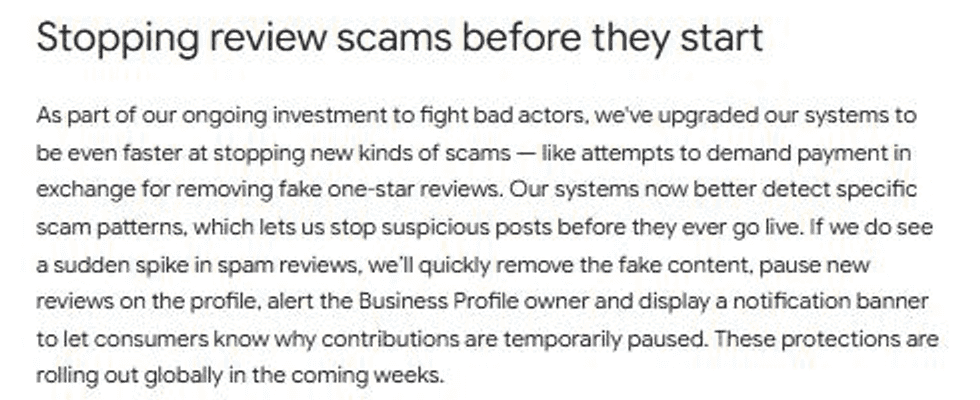
Google's April 2026 announcement also says what now happens on its side during a spike: "we'll quickly remove the fake content, pause new reviews on the profile, alert the Business Profile owner and display a notification banner to let consumers know why contributions are temporarily paused." If your profile stops accepting reviews during an attack, that is the protection working rather than a penalty on you. It also means the genuine reviews you asked for will bounce for a few days, which is worth telling your team. Watch the inbox as well as the profile: a burst like this is usually followed by a fake review notification by email. On a Facebook Page the report path is different again, in removing a review from a Facebook Page.
Are fake reviews illegal?
Yes. In the United States, the United Kingdom and Australia, all three rulebooks are recent enough that plenty of owners have not caught up.
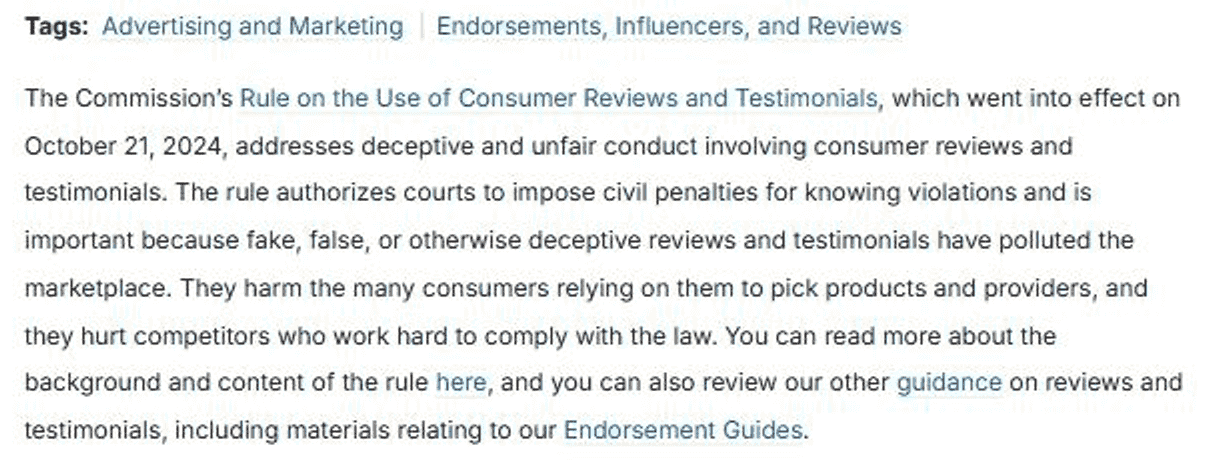
United States. The FTC's Rule on the Use of Consumer Reviews and Testimonials (16 CFR Part 465) has been in force since 21 October 2024 and "authorizes courts to impose civil penalties for knowing violations". It covers reviews "that misrepresent that they are by someone who does not exist, such as AI-generated fake reviews", bans incentives "conditioned on the writing of consumer reviews expressing a particular sentiment, either positive or negative", and bans undisclosed reviews from company insiders. It also bans review suppression: "unfounded or groundless legal threats, physical threats, intimidation, or certain false public accusations" used to prevent or remove a negative review. FTC staff guidance says advertising agencies, PR firms, review brokers and reputation management companies are not immune, so a regulator can reach the agency you hired as well as you.
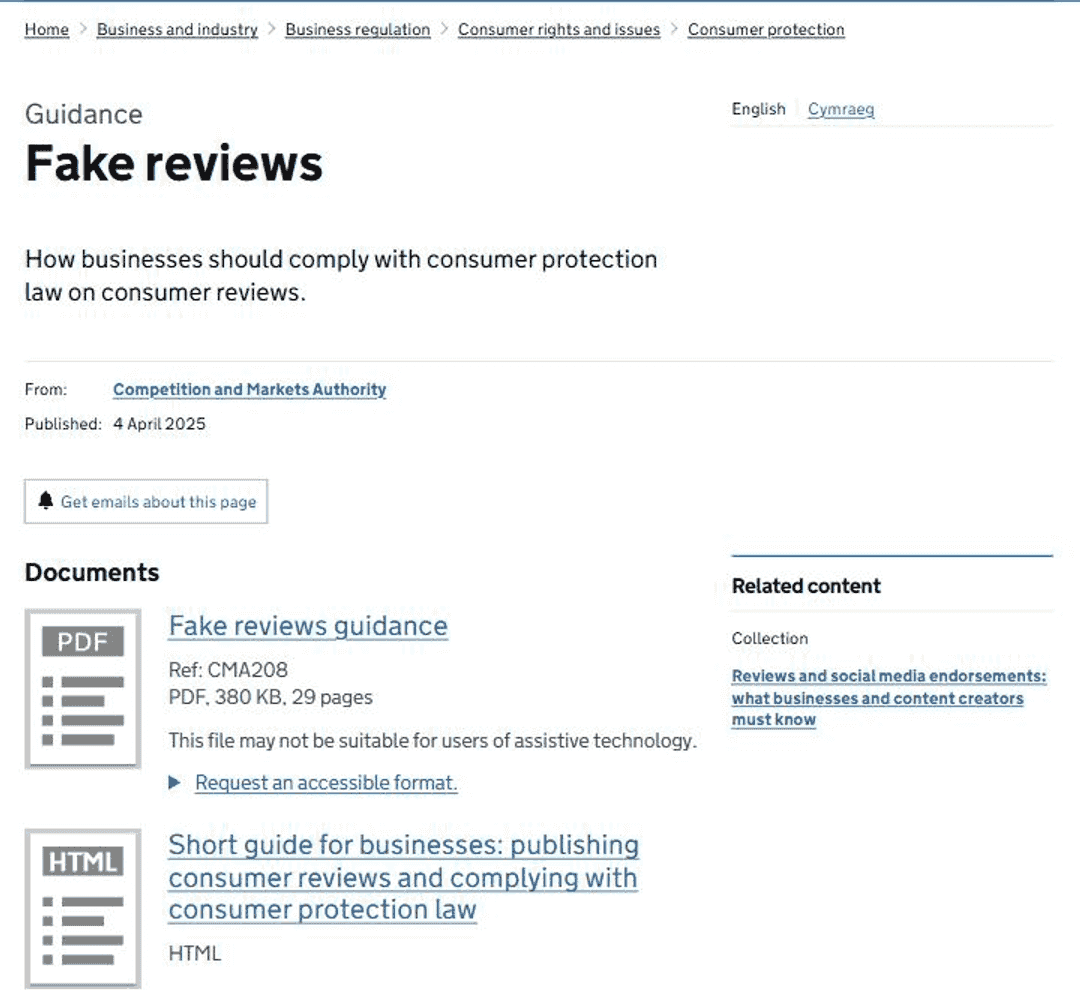
United Kingdom. In April 2025 several review practices became banned practices under the Digital Markets, Competition and Consumers Act 2024, meaning they are automatically unfair and illegal: obtaining and posting fake reviews, paid-for reviews not marked as incentivised, hidden negative reviews, and star ratings that give an inaccurate picture. The CMA's guidance, CMA208, published 4 April 2025, requires any business that publishes reviews to take "reasonable and proportionate steps" to prevent and remove fake ones. The CMA can fine up to 10% of global turnover without going through the courts, and in March 2026 it opened five investigations across the funerals, food delivery and car sales sectors, one into whether a meal-kit company offered discounts in exchange for five-star reviews. This is enforcement, not theory.
Australia. Fake reviews are misleading and deceptive conduct under the Australian Consumer Law. The ACCC puts it plainly: "It's against the law for a business to create fake or misleading reviews or to arrange for others to do so." The same page warns the other way as well, since removing a genuine negative review can itself mislead consumers.
Buying reviews carries a commercial bill before the legal one. Google removed over 13 million fake Business Profiles in 2025, and a purge across a seller's network takes everything that seller ever posted, so a rating you spent months lifting drops back in an afternoon. The full accounting is in can you buy Google reviews; what you may do to get reviews is in the Google review policy guide.
How to reply to a review you believe is fake
Write for the next person reading your profile, not for the reviewer. Nobody scrolling your reviews knows what you know. An owner accusing a customer of lying reads badly even when the owner is right.
So do not write "this is a fake review", do not write "you were never a customer", and do not threaten anything. That last one is a legal point as well as a tonal one, since unfounded legal threats used to get a review removed are a violation of the FTC rule in their own right.
Say instead that you cannot find a record, and open a door:
Thanks for taking the time to write this. We've looked for a booking and an order matching your name around the date you mention and we can't find one, so I think something has gone astray. If we have missed you, email me at [address] and I will make it right. If this was meant for another business, no hard feelings.
Keep it to four lines, post it once, and do not reply again if the reviewer answers. Never name the person and never name the competitor you suspect. Post it whether or not you have reported the review, because a report can take a week and the reply is live immediately.
How to make a fake review matter less
The reliable defence is arithmetic. It is the one thing entirely inside your control. A single one-star among 40 reviews pulls a 4.8 average down to 4.7. The same review among 400 costs you a hundredth of a star. Recency does the rest: the reviews a customer reads are the ones on the first screen, and a fake from March is buried by twelve genuine ones from August.
So the answer to "somebody is attacking my profile" is the answer to "our rating is stuck": ask every customer, on your own timing, after the job is done. Not a selected few, no incentives, no rating question between the customer and the review sites. Cloutly's review campaigns run that ask off the systems the business already uses, treat a repeat customer as one contact asked once, and skip anyone who reviewed you in the last 90 days.
Frequently asked questions
Can Google tell a review is fake?
Often, and increasingly before it publishes. Google says its systems "now better detect specific scam patterns, which lets us stop suspicious posts before they ever go live", and it blocked or removed over 292 million policy-violating reviews in 2025 while publishing more than a billion genuine ones. It still misses individual reviews, which is why reporting exists.
How long does it take to get a fake review removed?
Google says several days, plus an appeal on top. Tripadvisor quotes three to five working days. Plan for a fortnight and be pleasantly surprised.
Are AI-written reviews against the rules?
Yes. The FTC rule names "AI-generated fake reviews" among reviews that misrepresent the existence of the reviewer, and Google's fake engagement policy turns on whether the content is based on a real experience, not on who or what typed it.
What if a competitor is buying five-star reviews?
Report the reviews on the platform as a user. Do not retaliate with fakes of your own: that puts you inside the same rule, with your own profile as the evidence.