
Do Google reviews affect ranking? What Google confirms, and what it doesn't
Reviews move one of the three things Google says decides local results. The other two are your category and your address.
Lachlan Fea 8 min read
In this article10 sections
Do Google reviews affect ranking? Yes, and Google says so in writing. Its help page on local ranking puts reviews inside prominence, one of the three factors behind local results, and states that "More reviews and positive ratings can help your business's local ranking." What Google has never published is how much they help, how many you need, or how fast it happens.
Almost every page on this question asserts the effect and stops there. The useful version separates what Google has published from what experienced local SEOs believe but cannot prove, and then from the thing reviews do after the ranking is settled, which is where most of their value sits.
What is the Google Map Pack?
The Google map pack is the block of three business listings, shown under a small map, that Google puts above the ordinary web results for a local search. Google calls this section the local results. Marketers call it the map pack or the 3-pack. It is ranked separately from the blue links beneath it, on a different set of signals, so a business can own the pack and be nowhere on page one otherwise.
What Google says decides local ranking
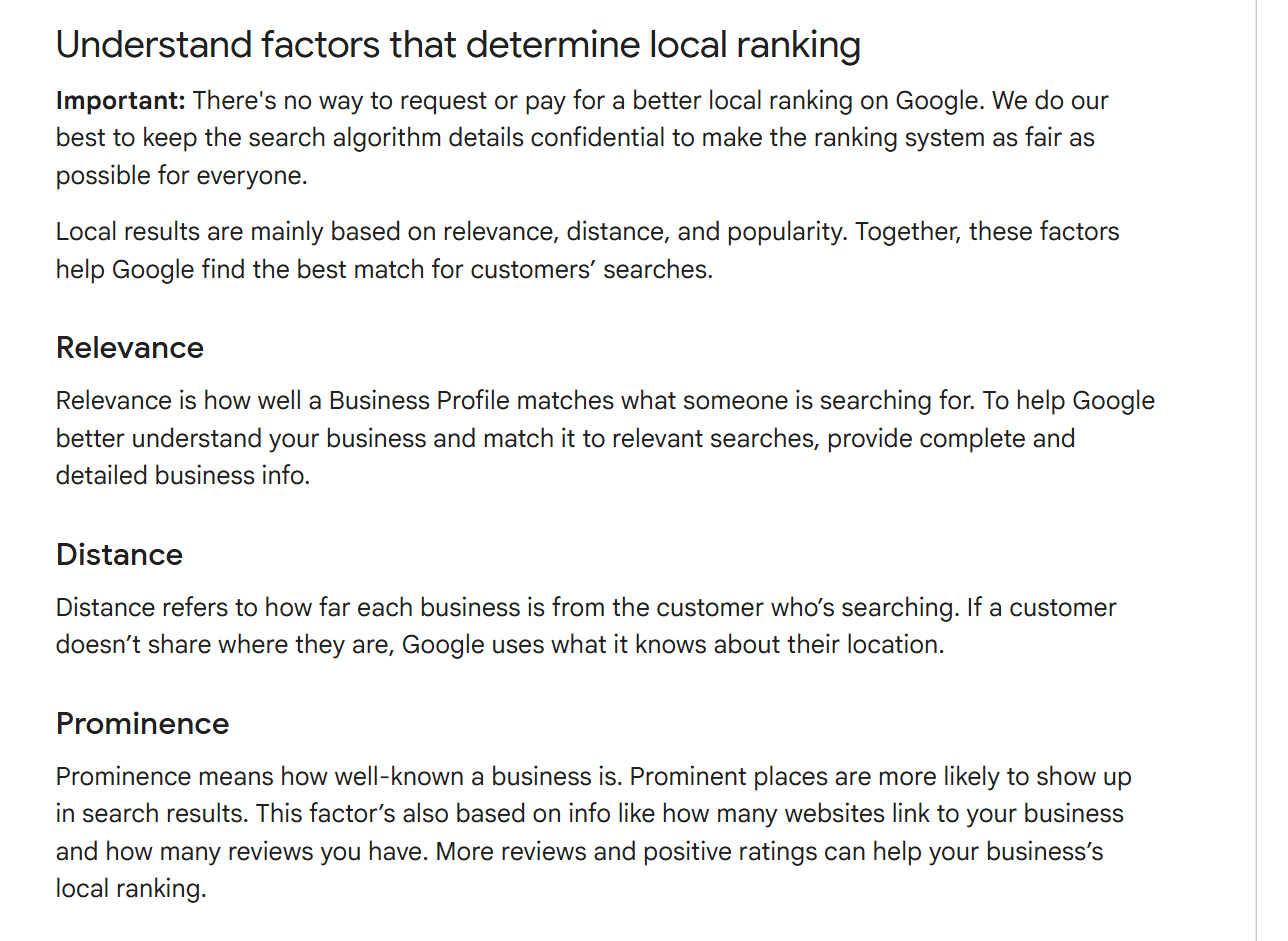
Google publishes one page on this: Tips to improve your local ranking on Google. It names three factors and gives each of them a sentence.
Relevance is how well a Business Profile matches what someone is searching for.
Distance refers to how far each business is from the customer who's searching.
Prominence means how well-known a business is. Prominent places are more likely to show up in search results.
Reviews sit inside the third one. The two sentences that follow are the whole documented basis for the question in the title:
This factor's also based on info like how many websites link to your business and how many reviews you have. More reviews and positive ratings can help your business's local ranking.
That is it. No numbers, no threshold, no timeframe. The same page carries a line worth reading before you buy anything from anyone: "There's no way to request or pay for a better local ranking on Google."
One quirk, because you will see both words quoted around the web. The page's opening line says local results are "mainly based on relevance, distance, and popularity", while the headings underneath it read Relevance, Distance and Prominence. Same idea, two labels, one page, today.
The honest reading is not flattering to review software, mine included. Distance is the factor you cannot move without opening a location. Relevance is mostly your category and what your profile says. Reviews are one input into the third factor, sitting alongside links from other websites. They matter. They are not the lever, and no review tool, Cloutly included, moves a map pack position on its own.
Do Google reviews affect ranking, or the click?
Both, and the second effect is larger and much faster.
Your rating does not put you in the pack. Your category, your address and a complete profile do most of that work. What the rating decides is which of the three listings gets tapped once all three are showing, and that split is wider than owners expect. BrightLocal's Local Consumer Review Survey 2026 (published 11 February 2026, 1,002 US consumers) found 68% of people will only use a business rated four stars or higher, up from 55% the year before, and 31% will only use one rated 4.5 or higher. In the same survey, 97% read reviews for local businesses.
Take Coastline Physio, a fictional clinic. Three physios show in the pack for "physio near me" in the same suburb, all within a kilometre of the searcher, all with the right primary category. Ranking has done its job and stopped. The one showing 4.9 from 180 reviews takes the calls. The one showing 4.2 from 11 does not, and no further ranking work changes that.
So: do Google reviews affect ranking? A little, indirectly, over months. Do they affect whether anyone rings you? Far more than that, and this week.
What local SEO practitioners believe about reviews
The best available read on the parts Google does not document is the Local Search Ranking Factors report, published by Darren Shaw of Whitespark on 6 November 2025. It asks 47 local search practitioners to score 187 factors from 0 to 5 for their impact on local pack and Maps rankings, then ranks them by total score.
Whitespark is direct about what the survey is: "None of the experts have special access to the internal workings of Google's local search algorithm." It is informed opinion from people who move local rankings for a living. It is not a leak.
Here is the top of that list, with every review factor that appears in it.
| Rank | Factor | Score |
|---|---|---|
| 1 | Primary GBP Category | 227 |
| 2 | Proximity of Address to the Point of Search | 225 |
| 3 | Keywords in GBP Business Title | 223 |
| 4 | Physical Address in City of Search | 213 |
| 5 | Business is Open at Time of Search (Business Hours) | 189 |
| 6 | High Numerical Google Ratings (e.g. 4-5) | 181 |
| 9 | Quantity of Native Google Reviews (w/text) | 170 |
| 11 | Recency of Reviews | 164 |
| 14 | Sustained Influx of Reviews Over Time (rather than bursts) | 154 |
| 36 | Keywords in Native Google Reviews | 117 |
Two things stand out. The highest-scoring review factor is sixth, behind two profile settings, a distance factor and your address. And rating outranks review count, which is the reverse of how most businesses treat the problem.
Why review recency beats a bigger total
Recency comes in at 11 and a steady flow of reviews at 14, both inside the top 15 of 187. Neither appears anywhere in Google's documentation. Treat them as observation.
The consumer side of recency is not observation. In the same BrightLocal survey, 74% of people said they look for reviews written in the last three months, and 32% look for reviews from the last two weeks, up from 20% a year earlier. A profile carrying 300 reviews where the newest is from 2024 reads as a business that has stopped, whatever the average says.
That is why a review drive works poorly as a one-off event. Forty reviews in a fortnight and then nothing for a year gives you a good number and a stale page. Asking every customer, from the job, produces the pattern the practitioners and the consumers both respond to. Cloutly's review campaigns are built for that shape: a repeat customer is one contact, asked once, anyone who reviewed you in the last 90 days is skipped, and follow-ups stop the moment the review lands.
If you have not set the asking up yet, start with how to get more Google reviews, which covers the timing and the follow-up in detail.
Keywords in review text, and why not to engineer it
"Keywords in Native Google Reviews" ranks 36th of 187 in Whitespark's list. The effect the industry believes in is real and small. The reason to leave it alone is not that it does nothing. It is that asking for it breaks Google's rules.
Google's prohibited and restricted content policy tells merchants they "should not require or pressure users to leave ratings or write reviews while on the premises, nor should they request that specific content be included". The same policy bars merchants from offering "incentives ... in exchange for posting any review or revision or removal of a negative review", and from any move to "Discourage or prohibit negative reviews, or selectively solicit positive reviews from customers".
So the template that says "please mention emergency plumbing in Newcastle" is not a clever tactic. It is a policy breach on a profile you cannot afford to lose. The same page states what is allowed, in one sentence: "Solicit or encourage the posting of content that does represent a genuine experience, without offering incentives to do so or attempting to influence the rating or the contents of the review." Ask everyone, promptly. A customer asked the same day writes about the job they just had, and the language turns up on its own.
The parts of map pack ranking that are not about reviews
Four of the five factors above reviews are things you set once and then leave alone, and none of them are a review problem.
- Your primary category, the highest-scoring factor in the survey and the field most often wrong on a profile someone set up years ago.
- Complete and accurate information. Google's own words: "Businesses with complete and accurate info are more likely to show up in local search results." Hours are part of that, and "Business is Open at Time of Search" ranks fifth in Whitespark's list, so wrong or missing holiday hours cost you placement at exactly the hours people are searching.
- Photos and videos, which Google asks for on the same page.
- One address, written the same way everywhere. If you run several sites, more than one business on Google with the same name is its own problem and worth fixing before anything else.
The setup and verification steps are in our guide to adding your business to Google Maps. Past that list, local SEO is a specialism, and a review-management company is not the right source for the link building and landing page work sitting under the rest of it.
Do reviews affect AI Overviews and AI Mode?
They feed the same profile, so there is no separate lever to pull. Google's guide to optimizing for generative AI features says "our generative AI features on Google Search are rooted in our core Search ranking and quality systems", that "Where appropriate, generative AI responses can include product listings, product information, and information about local businesses", and that "Using products like Merchant Center ... and Google Business Profiles can help your products and services to be visible in both AI responses and other Google Search results".

The same page is blunt about the industry that has grown up around this: "many suggested 'hacks' aren't effective or supported by how Google Search actually works". The profile you fix for the map pack is the profile AI Overviews and AI Mode read. Whitespark's current edition scores every factor for AI search visibility as well as local pack impact, which tells you how new the question is and how little anyone can prove yet.
ChatGPT and Perplexity are a different matter. They do not run on Google's local index and they do not read your profile the same way. We tested what they name in does ChatGPT recommend businesses like yours. AI search optimization for local businesses covers all five surfaces together, and what each one documents about reviews.
What to do first
Fix your category, your address and your hours before anything else, because those outrank everything a review programme can do. Then ask every customer, every week, because that is what decides who rings you once the ranking has done its part. The numbers behind the second half are in our online review statistics for 2026, which carries a source on every figure.
Frequently asked questions
How many Google reviews do I need to rank in the map pack?
Google has never published a number and there is not one. The useful version of the question is comparative: open the pack for your own search, note the review count and rating on each of the three listings, and you have your target. How to get more Google reviews has a method for working out the gap.
Does replying to reviews improve ranking?
Google does not say so. What it says is narrower: "Positive reviews and helpful replies can help your business stand out." Replies are worth writing for the person reading them. The ranking claim attached to them elsewhere is not something Google has confirmed.
How long after getting reviews does ranking change?
Nobody outside Google can answer this, and anyone quoting a number is guessing. Reviews appear on your profile within a day or two in most cases. Any ranking effect is gradual and mixed in with everything else moving at the same time.
Do reviews on Yelp or Facebook affect my Google ranking?
Google's prominence wording covers "how many websites link to your business and how many reviews you have" and does not name third-party review sites. Practitioners generally treat them as a weaker signal than native Google reviews, which is consistent with Whitespark's list. They matter for the people reading them either way.
Can I pay to rank higher in the map pack?
No. Google states it plainly: "There's no way to request or pay for a better local ranking on Google." Ads are a separate thing, and Google labels them where they appear.
Is the map pack the same as Google Maps?
Not quite. The map pack is the three-result block on the search page. Tapping "More places" opens the local finder, and the Maps app is a third surface. They run on the same signals but show different numbers of results, so your position can differ between them.