
What is a Local Guide on Google reviews? Levels, points and what the badge means
The badge under a reviewer's name says how much that person contributes to Google Maps. It does not say Google checked the review.
Lachlan Fea 8 min read
In this article9 sections

A Local Guide on Google reviews is someone who contributes to Google Maps: reviews, ratings, photos, answers to other people's questions, and edits to business listings. Google pays a point for a rating, ten for a review and five for a photo, then sets a level from 1 to 10 off the running total. At Level 4 the words "Local Guide" start appearing next to their name, and that is the badge you are looking at.
The badge is just a count of how much somebody contributes. It is not a check on the review you are reading, and Google has never said a badged review counts for more when it ranks your business.
What is a Local Guide on Google reviews?
Local Guides is Google's contributor program for Google Maps. Members write reviews, rate places, upload photos and videos, answer questions about somewhere they know, fix wrong hours and addresses, and add places Google has missed. Each of those earns points, and the points set a level that anybody can see.
Two details matter if it is your business being reviewed. The program is for people, not companies: Google's page says "The Local Guides program is for individuals, not businesses", and contributions from a business account do not count towards a level. You cannot enrol your venue in it, and neither can a competitor. It also runs everywhere Google Maps is available, so the same rules apply at every one of your locations.
Most of what has been written about Local Guides dates from when Google still called business listings Google My Business. It is Google Business Profile now, and that is where you will see these reviews and answer them.
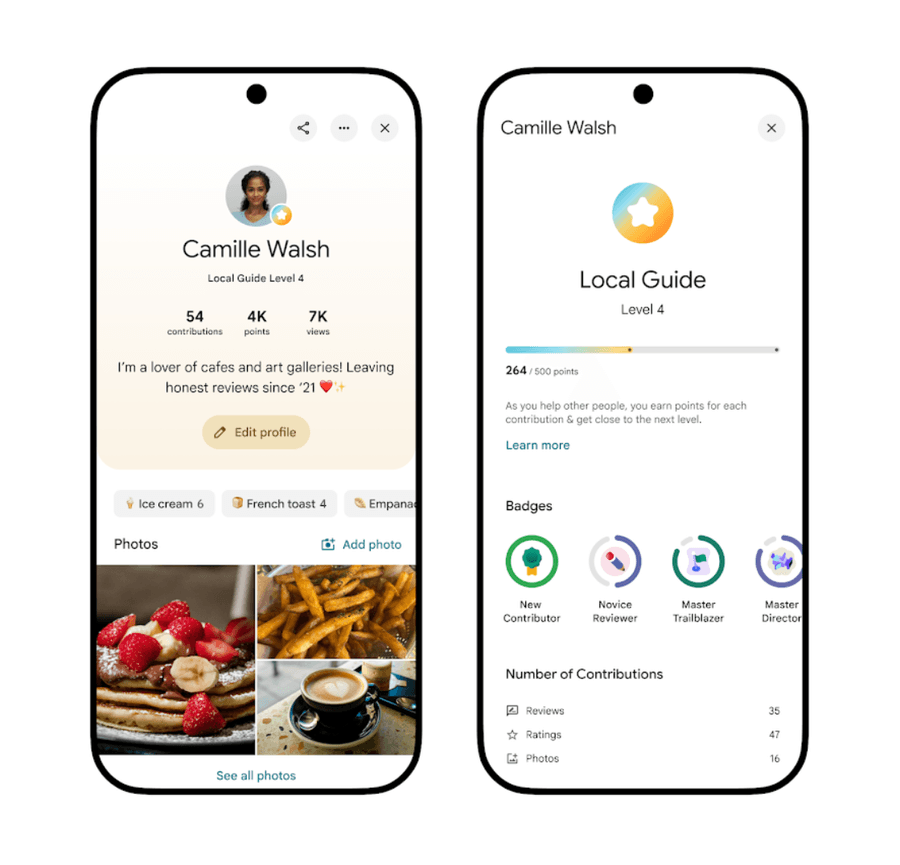
Google's own illustration of a Level 4 profile. The small line under the name is the thing everyone is asking about.
What does Local Guide mean on a Google review?
It means the reviewer has reached Level 4, which takes at least 250 points. Google's help page puts it plainly: "The Local Guides badge shown on a user's contributions indicates they made enough contributions to reach Level 4 with at least 250 points."
Below Level 4 nothing shows at all. Somebody can be in the program, collecting points on every visit, and review you with no badge next to their name.
That is all the badge tells you. It counts contributions, but it does not vouch for any one of them. Google has not confirmed the person came to your business, has not verified who they are beyond a Google account, and does not wave a badged review through on the way in. Levels can go backwards, too: points "do not expire, though they may decrease if content is removed for violating our policies", so a high level is a number Google can take back.
Local Guide points and levels
Google lists these points on its Local Guides points, levels and badging page on 6 September 2026.
| Contribution | Points |
|---|---|
| Review | 10 |
| Review over 200 characters | 10 bonus, on top of the 10 |
| Rating | 1 |
| Photo | 5 |
| Photo tag | 3 |
| Video | 7 |
| Caption on a photo update | 10 |
| Answer | 1 |
| Response to a Q&A | 3 |
| Edit to a place | 5 |
| Place added | 15 |
| Road added | 15 |
| Fact checked | 1 |
| Reported incorrect | 1 |
And the ten levels:
| Level | Points needed |
|---|---|
| 1 | 0 |
| 2 | 15 |
| 3 | 75 |
| 4 | 250 |
| 5 | 500 |
| 6 | 1,500 |
| 7 | 5,000 |
| 8 | 15,000 |
| 9 | 50,000 |
| 10 | 100,000 |
Level 4 is the only threshold that changes what anyone else sees. Everything above it is a bigger number behind the same badge. Points and levels take up to 24 hours to catch up after a contribution, which is why a guide's total sometimes looks stuck.
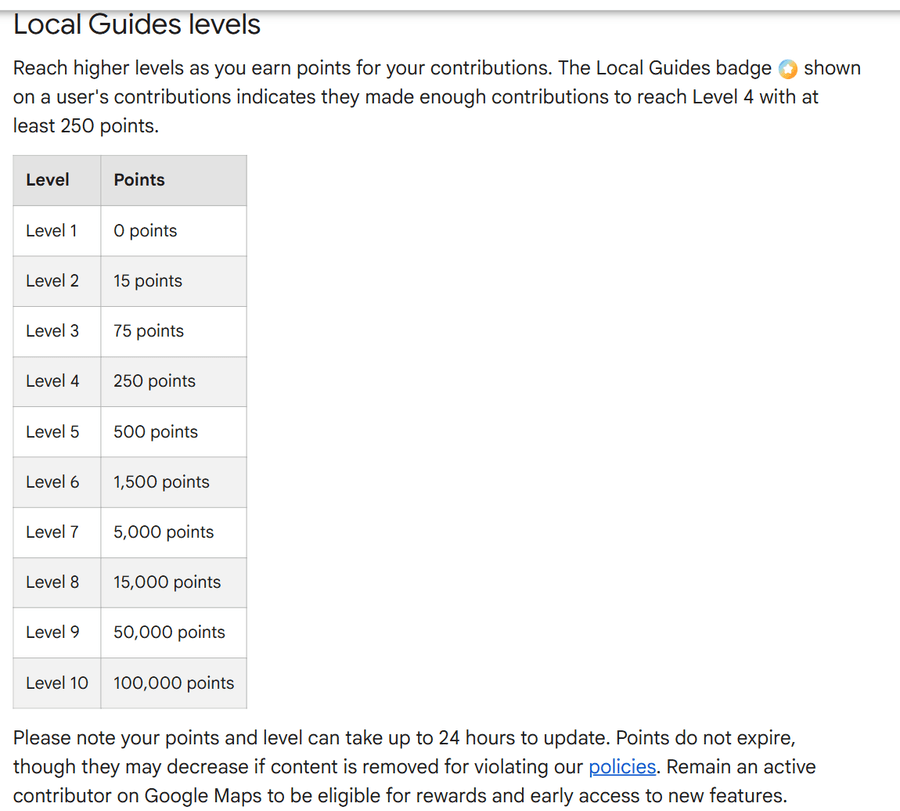
The source, captured 6 September 2026. Numbers you find in older articles are usually a version or two behind.
What are the perks of being a Local Guide?
Google names two: early access to Google features, and invitations to special events. That is the published list. There is no payment, no per-level reward schedule, and nothing to spend the points on.
An earlier version of this page said Local Guides could trade their points with thousands of Google partners. That was wrong. No such scheme exists on any Google page, and where you see it repeated, treat the rest of the article the same way.
How to become a Local Guide
Three steps, and it takes about a minute.
- Sign in to a personal Google account. A business account will not do, because contributions from one do not count towards the program.
- Sign up at maps.google.com/localguides. You have to meet the age requirement for your country. Google notes it can take up to nine weeks after you turn 18 for the account to update.
- Start contributing. Review a place you have actually been to, add a photo, answer a question about somewhere you know. A review over 200 characters is worth 20 points, so thirteen considered reviews gets you to the badge.
If a customer asks whether they should join before reviewing you, joining changes nothing about whether the review publishes. It may change how long the review sits near the top of your listing, and one study has measured that.
Are Local Guide reviews more trustworthy?
Not by design. The badge measures how much somebody contributes, not how carefully. A Level 8 guide with 20,000 points has proved they post a lot. They have not proved they came to your restaurant, ordered anything, or described what happened accurately.
A badged review can be fake in every way an unbadged one can. Google's prohibited and restricted content policy covers fake and misleading reviews, rating manipulation (which is where incentivised reviews and conflicts of interest sit), impersonation, misinformation, misrepresentation, off-topic content, advertising and solicitation, and repetitive content. It applies to a Level 10 account exactly as it applies to one created this morning. There is no separate vetting for badge holders.
What the badge does do is carry weight with the person reading it, which is the real reason business owners care. Somebody scanning your listing sees "Local Guide" beside a one-star review and reads it as a considered opinion. Sometimes that is right.
Before you decide a badged review is genuine, open the reviewer's profile from the review itself. Google lists their other contributions there. Forty reviews in three days across four cities is not forty visits.
Then read it for specifics. A real customer names the thing: the treatment, the technician, the wait, the dish that came out cold. A points-farming review says "good service" and moves on.
And check it against your own records, because that is what you will need if you end up reporting it. A review describing a service you do not offer, on a day you were closed, is worth writing down while you can still prove it.
If you want the full set of signals, we wrote a longer piece on how to spot a fake review.
Do Local Guide reviews carry more weight in Google's ranking?
Google has never said so. Its guide to improving your local ranking names relevance, distance and prominence, and says "More reviews and positive ratings can help your business's local ranking". Local Guides is not mentioned anywhere on that page.
What has been measured is visibility, not ranking. Joy Hawkins of Sterling Sky tracked which reviews held the top ten slots on a listing and published the results in December 2022. Reviews left by Local Guides stayed in those slots noticeably longer than reviews from people without the badge, and reviews from accounts with a profile picture stayed visible for roughly twice as long. That decides which of your reviews a searcher reads first. It does not decide where you sit in the map pack.
So a badged review is more likely to be read, and slower to be pushed down the page, and there is no confirmed ranking multiplier sitting behind it. Plan for the first part and ignore the second.
What you cannot do is try to steer who reviews you. Offering anything in return for a review breaks Google's rating manipulation policy, and in the United States it breaks the FTC's rule on fake reviews and testimonials, announced on 14 August 2024, which bans compensation conditioned on a review expressing a particular sentiment. Nor can you ask for a star rating first and pass only the happy ones on to Google. That is review gating, and it breaks the same rules. Ask every customer the same way and take what comes.
What businesses should do about a bad Local Guide review
Start by finding it in your Business Profile, so you are working from what Google shows rather than a screenshot somebody sent you. From there it is one of two paths, and the badge is irrelevant to both.
If it breaks a Google policy, report it. In your Business Profile, select Read reviews, then the Report icon next to the review, choose the reason and select Send report. Google's Reviews Management Tool is the only place that tells you what happened afterwards: "Decision pending", "Report reviewed - no policy violation", or "Escalated - check your email for updates".
Be realistic about the test. A policy violation means one of the categories above and nothing else. A review that is harsh, unfair, wrong about the facts, or written by somebody having a bad morning is not a violation and will not be removed. What to do when the first report comes back rejected is in the full removal and appeal process.
If it does not break a policy, reply to it. One short public reply is read by everybody who lands on that review afterwards, and it is the only part of this you control. Two or three sentences: acknowledge the specific thing, say what you have changed or offer a way to sort it out, sign it with a name. Do not argue in public about whether they were really a customer. There are worked examples in our review response examples, and the hardest case is in how to respond to a 1-star review.
Then fix the denominator. One 1-star review against 30 costs you a lot of rating. Against 300 it costs you almost nothing, and it stops being the first thing anybody reads. The businesses that stop worrying about individual reviews are the ones that keep asking every customer, every week, without deciding in advance who is likely to say something nice.
That last part is what we build Cloutly for: reviews from 39 sites land in one inbox across every location, with an AI-drafted reply a person edits and approves before it sends.
FAQ
What does Local Guide mean on Google reviews?
It means the person who wrote the review is in Google's Local Guides program and has reached Level 4, which takes at least 250 points earned from reviews, ratings, photos, answers and edits on Google Maps. It is a measure of how much they contribute to Maps. It is not a verification that they visited your business.
Do Local Guides get paid?
No. Google names the benefits as early access to Google features and invitations to special events, and publishes no payment or per-level reward schedule. Anyone offering to pay a Local Guide for a review is breaking Google's rating manipulation policy, and in the United States the FTC's 2024 rule on fake reviews as well.
Can a Local Guide review be removed?
Yes, on exactly the same terms as any other review. It has to break one of Google's content policies: fake or misleading reviews, rating manipulation, impersonation, misinformation, misrepresentation, off-topic content, advertising or repetitive content. Report it from your Business Profile or the Reviews Management Tool. A negative but genuine review will not be removed.
How many points is Level 5?
Level 5 starts at 500 points. The full ladder runs 0, 15, 75, 250, 500, 1,500, 5,000, 15,000, 50,000 and 100,000 points for Levels 1 to 10. Level 4, at 250 points, is where the badge appears.
Are Local Guides Google employees?
No. They are members of the public with a personal Google account, contributing on their own time. Google's page states the program is for individuals rather than businesses, and it runs everywhere Google Maps is available. A Local Guide has no authority over your listing and no line into Google support.
Why can't I see a Local Guide's review on my profile?
The badge has nothing to do with it. New reviews can take a while to appear, and Google's automated systems remove some before anyone sees them. Check the review still exists on the reviewer's profile, then work through the usual causes in our piece on a Google review not showing up.