
Review request email templates: 10 examples, with the SMS version of each
Every template here is plain text you can copy, written for a real service job, with the text-message version beside it and a note on when to send it.
Lachlan Fea 13 min read
In this article10 sections

A review request email should use the customer's first name, name the job you actually did, ask in one sentence, and give one link that opens the review page. Four lines is enough. Anything longer starts competing with itself, and anything sent at the moment you take payment arrives before the customer has an opinion worth writing down.
Here are ten review request templates for service businesses. Each one is plain text you can copy, has the text-message version beside it, and says when to send it. After the templates: how long a text can run before it costs you two messages, when the ask should land, and how to follow up once. The final sections cover who to leave off the list and the rules that can get your reviews deleted.
For the wider programme rather than the wording, start with how to get more Google reviews. This article focuses on the copy.
What a review request email has to do
These are the five things a request needs. Miss the fourth or the fifth, and you get complaints instead of reviews.
- Name the person and the job. "Hi Emma, thanks for coming in on Tuesday" beats "Dear valued customer" by a distance, and it costs you one merge field and one date.
- Ask once, in one sentence. The reader should not have to work out what you want. "Would you leave us a Google review?" is the whole ask.
- Give one link, and make it the only thing to click. No social icons, no newsletter footer, no "while you're here". A review link opens the review box directly. If you do not have yours yet, the Google review link and QR code take about two minutes to set up.
- Come from a person. A first name in the sign-off and a reply-to address a human reads. People answer these emails, often with the feedback they were going to put in the review, and if that lands in a no-reply inbox you have thrown it away.
- Give a way out. An unsubscribe link in the email, "Reply STOP to opt out" in the text. In the US the CAN-SPAM Act requires "a clear and conspicuous explanation of how the recipient can opt out", honoured within ten business days, and most other markets have their own version. It also keeps your list clean, which is the selfish reason to do it properly.
10 review request email templates you can copy
Every template uses [First name], [Business], [Name] for whoever signs it, and [link] for your review link. Replace the square brackets and nothing else. The text versions fit one message. There is a section on that below.
1. After a haircut or a colour
Send this when: the appointment was yesterday and the client left happy.
Subject: How's the colour sitting, [First name]?

Morning [First name],

Thanks for coming in yesterday. I hope it's still sitting the way
you wanted it after you've washed it yourself once.

If you've got a minute, would you leave [Business] a Google review?
It's the main way new clients find us.

Thanks,
[Name]

[link]
Morning [First name], it's [Name] at [Business]. Hope the colour's behaving. If you've got a minute, a Google review would make my week: [link]
2. After a service call at someone's home
Send this when: the job is finished and has held overnight. Not from the van on the way out.
Subject: Your [job type] on [day]

[First name],

[Name] here from [Business]. Thanks for having us out on [day].
Everything should be running properly now. Call us if it isn't.

If you were happy with the job, a Google review would help us out.

[link]

Cheers,
[Name]
[First name], [Name] from [Business]. Glad we got the leak sorted. If the fix is holding, a Google review helps us more than any ad does: [link]
3. After an appointment at a clinic or a practice
Send this when: the day after the appointment. Never at the reception desk while the person is paying.
Subject: One question about yesterday

Hi [First name],

Thanks for coming in to see us yesterday. I hope you're feeling
better for it, and if anything has flared up since, call the clinic
rather than waiting for the next appointment.

If [Business] was helpful, would you write us a short Google review?
People choosing a clinic read them closely, and a few sentences from
a patient are worth more than anything we can say about ourselves.

[link]

Thanks,
[Name]
Hi [First name], thanks for coming in yesterday. If the session helped, would you leave [Business] a review? [link] Reply STOP to opt out.
4. After an invoice is paid
Send this when: the payment clears. For trades and professional work, where the invoice is the end of the job.
Subject: Invoice received, and thank you

Thanks for settling that, [First name], and thanks for the work.

If you were happy with how it went, a Google review would help us
more than you'd think. It's the first thing people look at when
they're deciding who to call.

[link]

Appreciate it,
[Name]
[Business]
Thanks for settling the invoice, [First name]. One ask: a Google review for [Business]? [link] [Name]
5. After a delivery or an install
Send this when: two or three days after, once the thing has actually been used.
Subject: How's the [item] going?

Hi [First name],

Just checking the [item] we put in on [day] is doing what you wanted
it to do. If it isn't, reply to this and I'll come back out.

If it is, would you leave [Business] a Google review? A line about
how the install went is plenty.

[link]

Thanks,
[Name]
[Name] from [Business] here. Is the unit behaving itself, [First name]? If so, a Google review helps us out: [link]. If not, call [phone].
6. A first-time customer
Send this when: someone new has been in once and it went well. They are the ones who notice the things your regulars stopped seeing.
Subject: How did we do, [First name]?

[First name],

You came to [Business] for the first time this week, so I'd like to
know how we did.

If it was good, a Google review helps other people find us. If it
wasn't, reply to this and tell me. I read every one of these.

[link]

Thanks,
[Name]
[First name], you came to [Business] for the first time this week. How did we do? A Google review tells us, and tells everyone else: [link]
7. A long-standing customer
Send this when: someone has been coming for a year or more and has never been asked. Ask once, and say out loud that you know it is overdue.
Subject: A favour, after all this time

Hi [First name],

You've been coming to [Business] for a couple of years now, which I
don't take for granted.

I've never asked you for a review, so I'm asking once. A few
sentences about what keeps you coming back would mean a lot, and I
won't ask again.

[link]

Thanks,
[Name]
[First name], you've been coming to [Business] for years and I've never once asked you for a review. Asking now, just the once: [link] [Name]
8. After you fixed a problem
Send this when: a complaint is closed and the customer has told you they are happy. Never while it is still open.
Subject: Glad we got that sorted

[First name],

Thanks for being patient while we got that sorted, and thanks for
telling us in the first place. We'd rather hear it than not.

No obligation at all, but if you're happy with how it ended up, a
review saying so would help us. Plenty of people are more convinced
by a business that fixed something than by one that never had a
problem.

[link]

Thanks,
[Name]
Glad we got that sorted in the end, [First name]. No obligation at all, but if you'd say so publicly it would help us a lot: [link]
9. The follow-up
Send this when: three to five days after the first ask, and only once. Shorter than the first one, and it has to give the person permission to ignore it.
Subject: Re: How did we do, [First name]?

Hi [First name],

In case my last email got buried, here's the link again:

[link]

If now isn't the time, no problem at all. I won't chase it.

[Name]
[First name], link again in case it got buried: [link] Last message about it, promise. [Name]
10. From the person who did the work
Send this when: the person who did the job can send it themselves. It does not read like a system because it isn't one.
Note what this template does not say. It does not ask the customer to name the sender in the review. Google's policy treats asking for specific content, including content that identifies a staff member, as rating manipulation. Send the ask from the person and give that person their own review link, and the credit follows the link instead of the wording.
Subject: It's [Name] from [Business]

[First name],

It's [Name]. I [did the job] on [day].

If you were happy with how it turned out, would you leave [Business]
a review? It takes a minute and it genuinely helps.

[link]

Thanks,
[Name]
Hi [First name], it's [Name], I did the install at your place on Tuesday. If you were happy with it, would you leave [Business] a review? [link]
Subject lines that get the email opened
Here are six for service businesses, kept short so they do not truncate on a phone. There is a longer list, including the ones to avoid, in the best email subject lines for review requests.
| Subject line | Use it for |
|---|---|
| How did we do, [First name]? | Anything. The safest default. |
| Your [job type] on [day] | Service calls and trades. Reads as admin, not marketing. |
| One question about yesterday | Clinics and appointments. |
| A favour, after all this time | Long-standing customers. |
| Invoice received, and thank you | Invoiced or project work. |
| How's the [item] going? | Deliveries and installs. |
Do not write anything that sounds like a promotion, because it will be filed as one. Do not put the word "review" in every subject line you ever send either, because your regulars will learn to skip it.
How long a text can be before you pay for two
This is where SMS templates from other blogs quietly cost you money. Texts are billed per segment, not per send, and the boundary is not where people expect it.
| What the message contains | Single message | Each part, once it splits |
|---|---|---|
| Standard GSM-7 characters only | 160 characters | 153 characters |
| Any character outside GSM-7 | 70 characters | 67 characters |
Those are properties of the SMS standard rather than of any one provider, and they are set out in Twilio's character limit reference. The second row is the one that catches people. A single emoji, an accented name, or a curly apostrophe pasted out of a word processor drops the whole message to a 70-character limit, so a 150-character text becomes three segments instead of one.
Every text above fits a single segment with a business name of about 16 characters and a shortened link of about 24. Templates 1, 2, 5 and 10 sit within a handful of characters of the line, so a longer business name will tip those into two. Nine of the ten leave the opt-out line off because most sending platforms append it for you; if yours does not, add "Reply STOP to opt out" and budget the 22 characters. Type any template into your sending tool and read the segment counter before you save it, especially if the list you are sending to has ten thousand people on it.
Put the business name in the first few words. On a locked phone, that is all the customer sees before deciding whether to open it.
Segment count is a cost question. Whether you are allowed to send the text at all, and what has to be in it, is a different one: consent, sender ID, the STOP keyword and quiet hours differ by country, and the rules are in SMS compliance for review requests.
When to send it
The most common mistake is sending at the moment of payment. The customer is standing at a counter, or holding a card, or waving the tradesperson off. They have not used the thing yet and they have nothing to say. The ask that works lands the next day, when the haircut has survived a shower and the heater has run a night.
| The job | Send the first ask | Why then |
|---|---|---|
| Haircut, colour, beauty appointment | The next morning | They have styled it themselves once |
| Restaurant or cafe | That evening or the next morning | The meal is still specific in their mind |
| Home service call | The next day | The fix has held overnight |
| Clinic or practice appointment | The next day | Away from the reception desk and the payment |
| Invoiced professional work | The day after the invoice is paid | The job is finished and settled |
| Delivery or install | Two to three days later | It has actually been used |
| Long project or renovation | The week after handover | Everything is unpacked and working |
Send on a day the customer is likely to have a spare minute, which for most service businesses means mid-week rather than Saturday morning. Be consistent. A business that asks every customer once, every week, will out-collect a business that runs a clever push twice a year, and it will not be close.
How to send a review request email
Use this checklist before you send it.
- Send from a person, never from "no-reply". A named sender at your own domain, replying to a mailbox somebody opens.
- Send plain text, or something close to it. A heavily designed HTML template with a header image and a footer looks like a newsletter, and it gets treated like one by the reader and by the spam filter. Text with one link reads like a message from a person, because it is.
- Use the link once. Repeating it three times does not raise the response rate. It makes the email look automated.
- Personalise with the first name and the job. Both are already sitting in your booking or payment system.
- Never send to a list you did not collect. Those people did not buy from you, cannot write a genuine review of you, and can report you.
- Send the text to mobile numbers and the email to inboxes. They are different messages, not one message in two formats, which is why every template above has both.
Read what comes back and reply to it. That follow-through is where most businesses fall short. The templates are in our review response examples.
The follow-up: one, spaced
Send one follow-up, three to five days after the first ask. Keep it shorter than the first, ideally on the other channel, and end by telling the person it is fine to ignore.
Stop there. A second and third chase converts almost nobody and irritates the people who were going to review you anyway, on whatever day they got around to it. If somebody has not acted after two messages, the answer is no. Ask them again after their next job rather than keep pushing this one.
Whatever tool you use, the follow-up has to stop when the review lands. Chasing a customer for a review they have already written is the fastest way to get that review edited.
Who not to ask
This is the part missing from every template list on the internet, and it matters more than the wording does. Before a send goes out, take these people off it.
- Anyone who has opted out. Once, ever. An opt-out is not a preference to revisit next quarter.
- Anyone who reviewed you in the last 90 days. They have already done the thing you are asking for, and asking again reads as though nobody was paying attention.
- Anyone with an open complaint. If there is an unresolved issue sitting in the inbox, a review request is not a request, it is a prompt. Fix it first, then use template 8.
- Anyone whose job is not finished yet. Part-delivered orders, or work waiting on a part.
- Anyone already in a live campaign. A repeat customer should be one contact asked once, not one ask per transaction. Two bookings in a fortnight is not two review requests.
- Anyone whose details you did not collect yourself. Purchased lists, or the spreadsheet that came with the business.
Keeping that list by hand across a customer file is where most review programmes fall over, which is what the software is for. Cloutly's review campaigns treat a repeat customer as one contact asked once rather than one ask per transaction, skip anyone who reviewed you in the last 90 days, never re-enrol a contact who has opted out, and run the follow-up on the day spacing you set.
What not to put in the template
Five things, and they are not stylistic preferences. Google enforces four of them, and two of them carry a civil penalty in the United States.
No incentive. Google is explicit: "Offering incentives, like free or discounted goods or services, in exchange for customers to post reviews, change reviews, or remove negative reviews is considered fake & misleading content and is strictly prohibited" (Google Business Profile help). The US position is narrower and worth knowing precisely, because most articles on this topic get it wrong in one direction or the other.
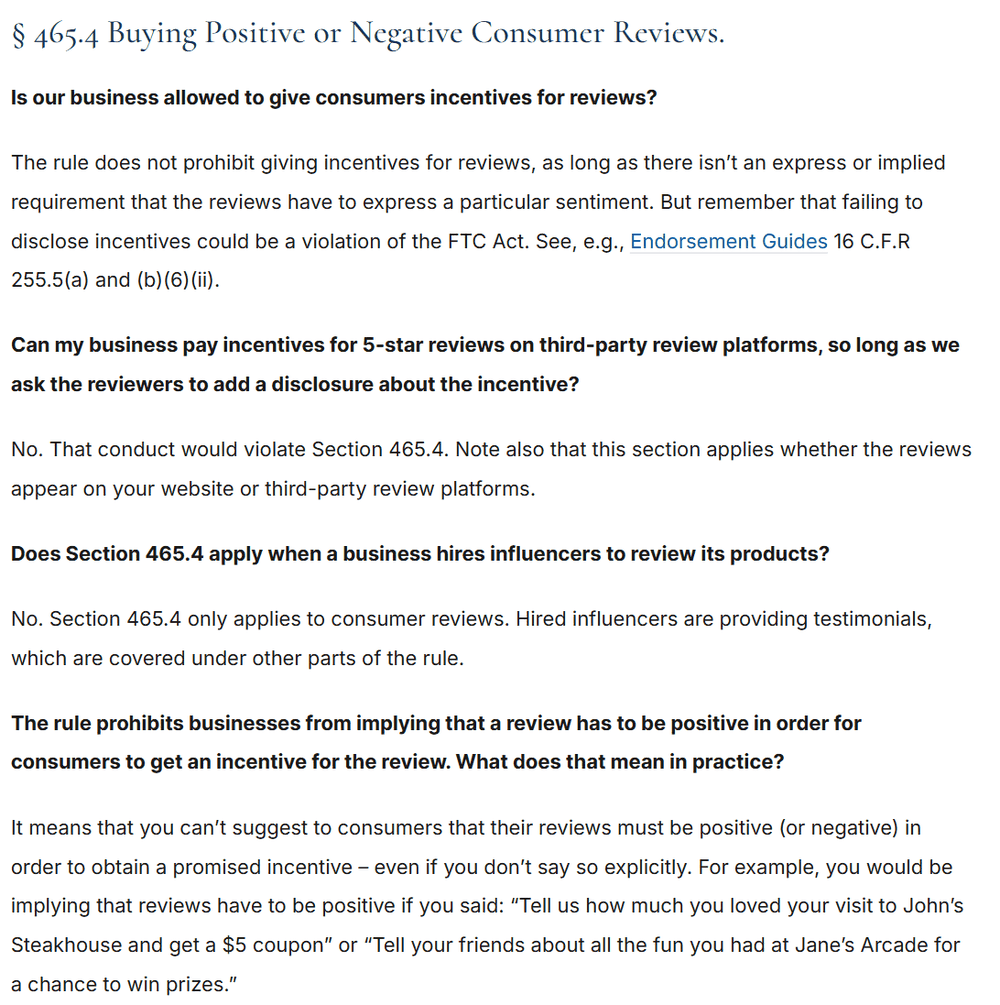
The FTC's Consumer Reviews and Testimonials Rule, 16 CFR Part 465, went into effect on 21 October 2024, and it does not ban incentives outright. In the FTC's own words, "the rule does not prohibit giving incentives for reviews, as long as there isn't an express or implied requirement that the reviews have to express a particular sentiment". Its example of crossing that line is "Tell us how much you loved your visit to John's Steakhouse and get a $5 coupon". So the honest summary: the FTC forbids paying for a sentiment, Google forbids paying at all, and since Google is where you want the reviews, the answer inside a template is no discount and no entry into a draw.
No asking for five stars. Not in the subject line, not on the counter card. Google allows you to solicit reviews "without offering incentives to do so or attempting to influence the rating or the contents of the review", and a request for five stars is an attempt to influence the rating. Ask for a review and let the customer choose the number.
No asking for particular content. This one surprises people, because half the template galleries online suggest it. Google's policy says merchants should not "request that specific content be included", and gives asking for reviews that identify a staff member as an example. Wanting your team recognised is fair. The way to do it is to give each person their own review link so the credit follows the link, not to script the customer.
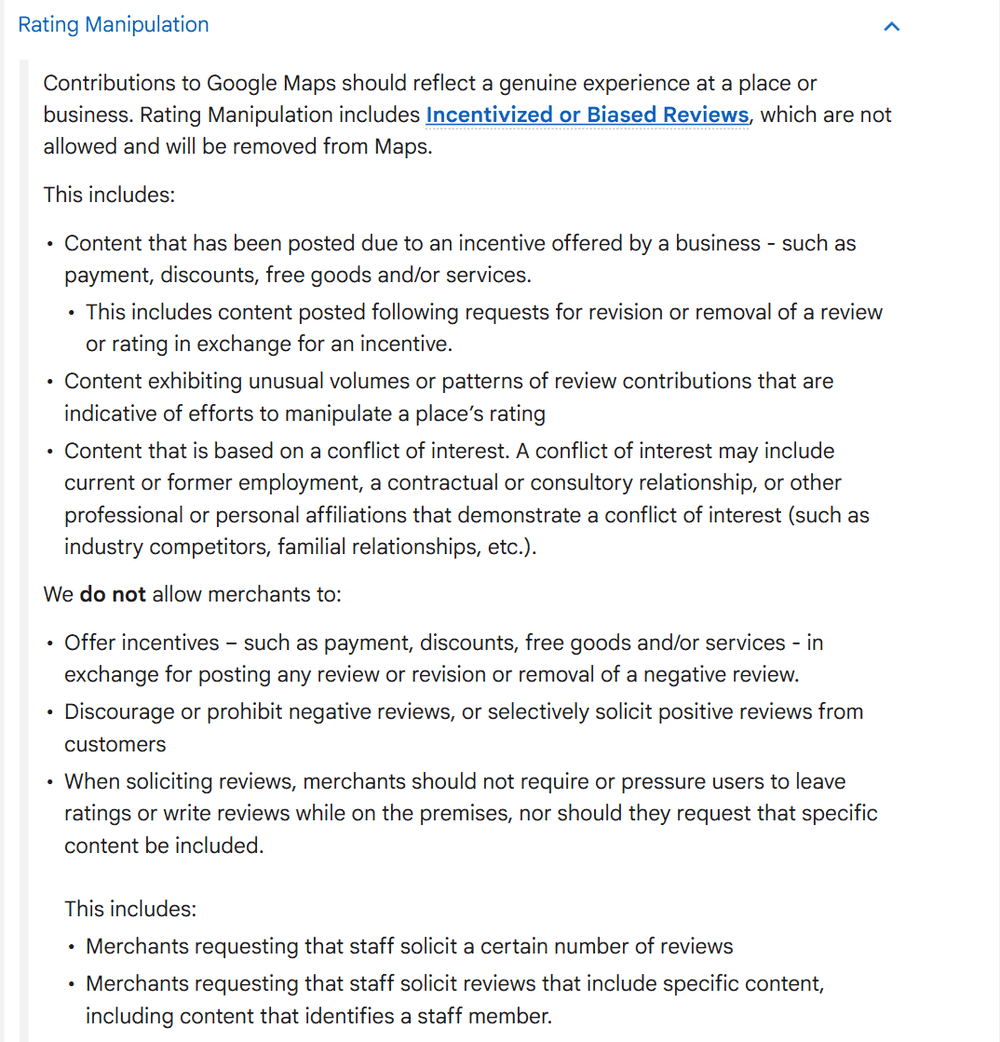
No gating. Google's policy bars merchants from "discourag[ing] or prohibit[ing] negative reviews, or selectively solicit[ing] positive reviews from customers". That is the survey-first pattern, where a customer is asked to rate you privately and only the happy ones are then shown the review link. Several vendors still sell it. It is a breach, and there is more on why in review gating and in Google's review policy explained.
No buying. Bought reviews are what the FTC rule was written for, and the penalties are assessed per violation.
Frequently asked questions
What should a review request email say?
Name the customer, name the job, ask for a review in one sentence, and give one link. Sign it with a person's name. Four to six lines in total. Anything longer than that lowers the response rate rather than raising it.
When should I send a review request email?
The day after the job, in most service businesses. Not at the point of payment, when the customer has not used what they bought, and not a fortnight later, when they have forgotten the detail that would have made the review worth reading.
How many times should I follow up?
Once, three to five days after the first ask, ideally on a different channel. Then stop.
Can I offer a discount for a review?
Not for a Google review. Google prohibits offering incentives in exchange for reviews outright. In the US, the FTC rule separately bans any compensation conditioned on the review expressing a particular sentiment, which catches "tell us how much you loved it" wording even where the incentive itself would be allowed.
Should I send a text or an email?
Send on the channel where you have a working contact detail and consent, and write it as a text if it is a text. A text is read within minutes and has to fit 160 characters. An email can carry a little more context and is easier to ignore. If you have both, most service businesses get the better response from the text and use the email as the follow-up. See SMS vs email review requests for what each channel costs and what the FCC, the FTC and ACMA require.
How many reviews will this actually get me?
It depends far more on how many customers you ask than on what the message says. A clinic seeing 200 patients a month that asks every one of them will out-collect a clinic seeing 2,000 that asks nobody. There is more on what volume does to a rating in five-star Google review requests.