
How to embed Google reviews on your website (4 ways, 2026)
Google has no button that copies your reviews onto your site. Here are the four routes that work, and the rules attached to each.
Lachlan Fea 9 min read
In this article8 sections

There is no button that embeds Google reviews on your website. Nothing in Google Business Profile copies review text onto a page you own, and Google's own embed tool produces a map. To show real Google reviews you need one of four routes: a widget, a code block in your CMS, the Places API, or a screenshot.
The options differ in cost and upkeep, and each has its own rules. Some of those rules are in Google's own terms, and most guides leave them out.
Checked on 6 September 2026 against Google Maps itself, the Places API policies, the Google Maps Platform terms, Google's review snippet documentation, the FTC's consumer reviews rule, and the WordPress and Squarespace help centres.
Can you embed Google reviews for free?
Yes, but not with a tool from Google. Every free option is a third-party widget on a free tier, a screenshot, or Google's map embed, which shows a map card and none of your review text.
I opened the Share panel on a live Google Maps business listing to check. It has two tabs. One is Send a link. The other is Embed a map, and that is the whole of what Google offers. Google's help page for it takes you through the same two clicks: Embed a map, then Copy HTML.
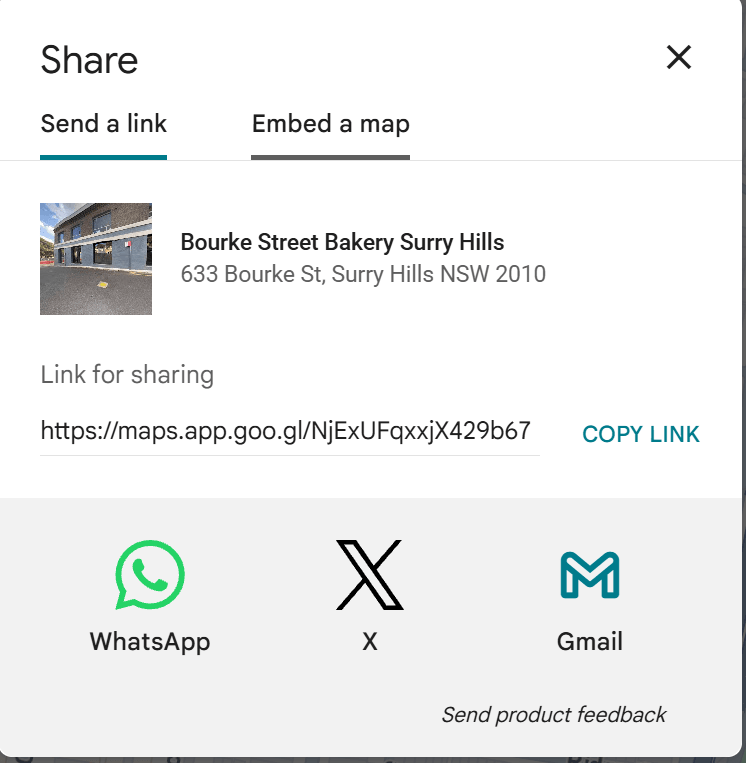
That gap is why the results for this search are almost entirely widget vendors. It is not a conspiracy. It is a product Google never built.
| Method | Cost | Updates on its own | Links back to Google | Best for |
|---|---|---|---|---|
| Review widget | Free tier to a monthly fee | Yes | Usually | Most businesses |
| CMS code block | Free | Yes, the widget behind it does the work | Depends on the widget | Anyone already comfortable in their editor |
| Places API | Per request, plus developer time | Only if you build it | You have to add it | Custom front ends with a developer |
| Screenshot | Free | No | No | A case study, a slide, a flyer |
What a good embed shows
Before you choose a method, decide what the finished block needs to show and how a visitor will check it.
- The review as written. Not the flattering half of it.
- The reviewer's name and the date. A wall of undated praise reads as invented, because a lot of it is.
- A link back to the review on Google, so a sceptic can verify it in two clicks.
- A filter rule you are willing to say out loud. "Four and five stars" is a rule. Picking reviews one by one is not.
That last one is more than taste if you sell in the US, though none of what follows is legal advice. The FTC's Rule on the Use of Consumer Reviews and Testimonials, 16 CFR Part 465, came into force on 21 October 2024. Section 465.7 makes it unlawful to misrepresent that the reviews shown in a part of your site dedicated to receiving and displaying reviews are most or all of what you have received, while you are holding reviews back for being negative.
The FTC's own questions and answers then narrow that in a way most summaries skip. Selective use of positive reviews in marketing sits outside the provision, and sorting so the five-star reviews come first is not covered either. Section 5 of the FTC Act still applies, and the FTC says non-representative reviews in marketing can be deceptive. A filtered widget is not automatically a problem. The problem comes when you present that filtered widget as the full picture. Filter by a rule, put the rule near the block, and link out to your Google profile.
Method 1: a Google reviews widget (fastest)
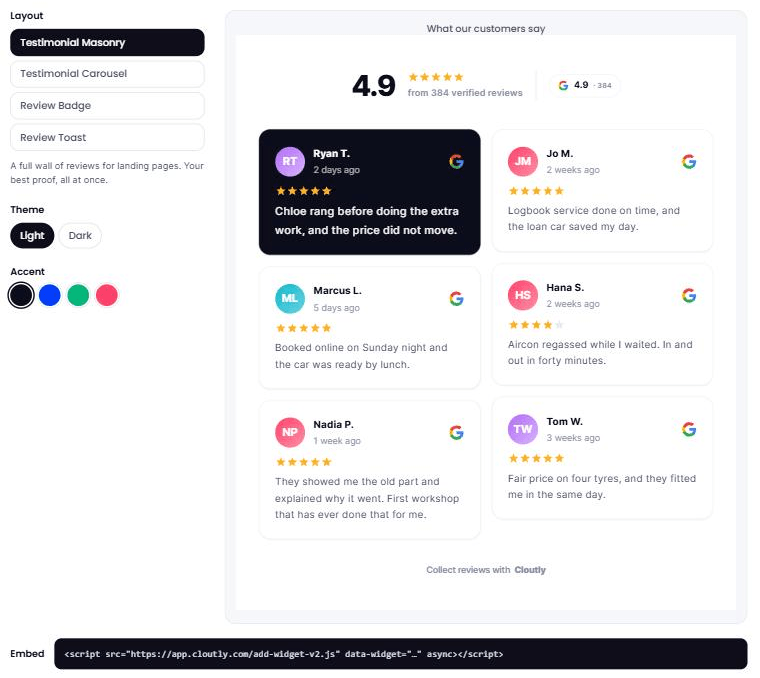
A widget service holds the connection to your Google Business Profile, pulls the reviews, and gives you one line of HTML. It handles the refresh, layout and mobile behaviour. The setup usually looks like this.
- Connect the Google location you want to show. On most tools this is a search for your business name, not an API key.
- Pick a layout. A wall suits a dedicated reviews page, a carousel suits a section inside a longer page, a strip of reviewer avatars suits the space under a button.
- Set the filter, the theme and the accent colour so the block does not look bolted on.
- Copy the snippet. It is normally one
<script>tag with an id in it. - Paste it where the reviews should appear, and publish.
The snippet you end up with looks like this, with a placeholder id:
<script src="https://app.cloutly.com/add-widget-v2.js" data-widget="YOUR-WIDGET-ID" async></script>
The async attribute earns its place. Without it the browser stops building your page while it fetches the widget.
Cloutly (our product) handles this part: you connect a Google location in one click, choose from nine layouts, and paste one snippet that works with Webflow, WordPress, Squarespace or any site that accepts an HTML snippet. The review widgets page shows the layouts.
Whichever tool you pick, check that the script loads asynchronously, that each review links back to Google, that dates are shown, and that you can describe the filter in one sentence. If a tool lets you hand-pick which individual reviews appear, that is the feature that gets you into trouble.
Method 2: add Google reviews to your website in WordPress or Squarespace
Both platforms accept a raw snippet. That means fewer moving parts than a plugin you might forget to update. A reviews plugin is usually the same widget with a settings screen around it.
On WordPress, use the Custom HTML block. Open the page, click the Block Inserter, or type /html in an empty paragraph and press enter. Click Edit HTML, paste the snippet, and press Update.
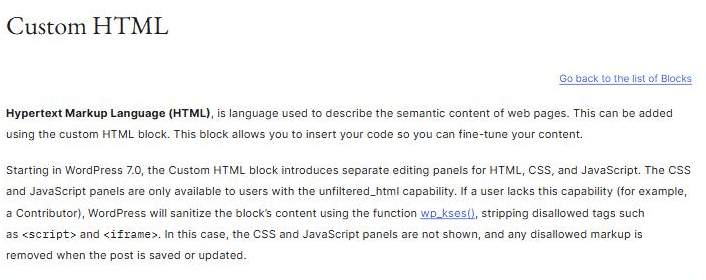
There is a trap in that block worth knowing about before it costs you an afternoon. The WordPress documentation says that from WordPress 7.0 the block's CSS and JavaScript panels only appear for users with the unfiltered_html capability. Without it, and a Contributor is the usual case, WordPress sanitises the block with wp_kses() on save and strips <script> and <iframe> out. The snippet vanishes and nothing tells you why. Have an Administrator or an Editor paste it. On a Multisite network, only a Super Admin can. The plugin route and the page builders are in the WordPress Google reviews widget guide.
On Squarespace, use a Code Block. Edit the page, click Add block or +, choose Code, click the pencil icon, and paste the snippet in. Two details from Squarespace's own page catch people out. A code block set to JavaScript renders your code as text, so leave the Type menu on HTML and let the <script> tags do their work. And JavaScript in code blocks is a paid feature: it is available on Core, Plus, Advanced, Business, Commerce Basic and Commerce Advanced. Plain HTML runs on any plan, but a review widget is JavaScript. For a badge you want on every page, Code Injection puts the snippet in the site header or footer, on Core, Plus, Advanced and some legacy plans. Adding Google reviews to Squarespace walks the plan gates in full.
If you would still rather have a plugin, check when it was last updated and which version of the platform it has been tested against. An abandoned reviews plugin is a security liability sitting on your site for the sake of a layout a snippet would have given you.
On Wix, the same snippet goes into the Embed HTML element rather than a Custom HTML block; there is no Wix app or plugin involved, just Wix's own iframe embed. Adding Google reviews to a Wix website covers the click path, including where Wix's Custom Code screen looks like the site-wide answer and is not.
Method 3: the Google Places API (what it can and cannot do)
This is the route older guides send you down, including the 2023 version of this post. It is legitimate, but more constrained than those guides suggest. The Places API returns place details, including reviews, for a place you identify by its place ID. You pay per request, and reviews are not a cheap field: in Google's data fields table, reviews sits in Place Details Enterprise + Atmosphere, the top tier.
Before you build this, read the Places API policies. They require you to:
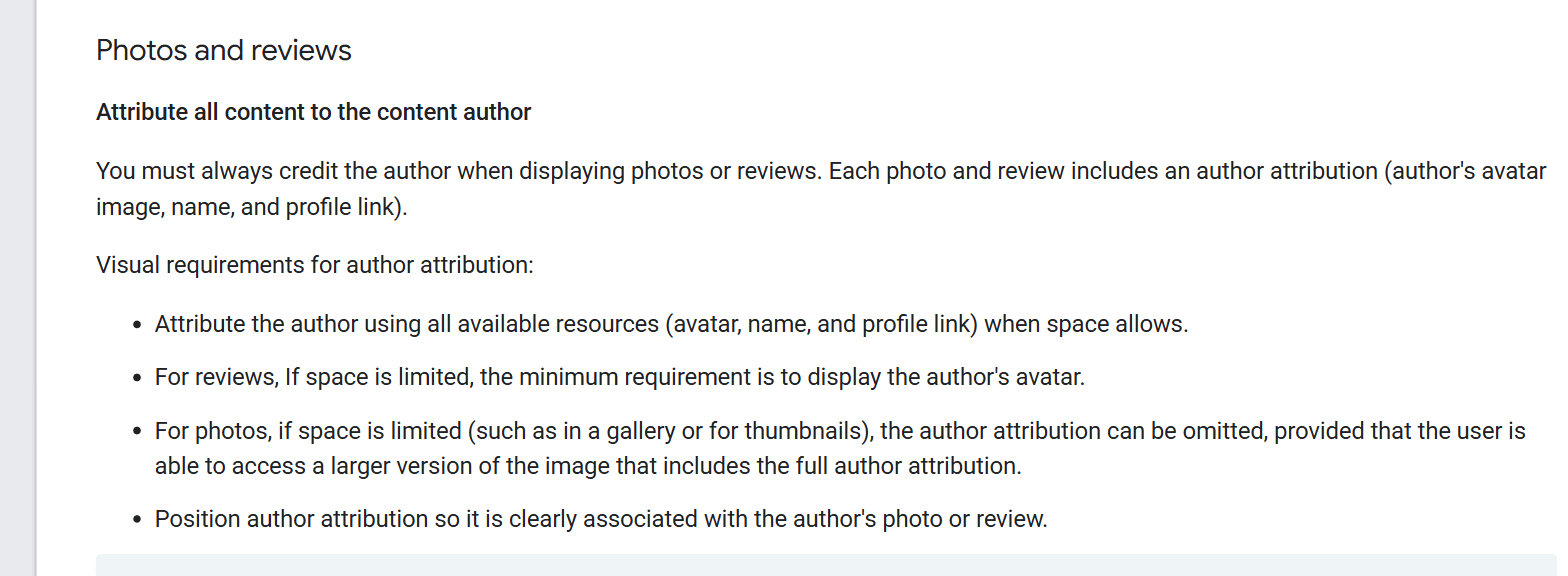
- Credit the author. Every review arrives with an avatar, a name and a profile link, and you must use them. Where space is tight the avatar is the minimum, so a design that strips the reviewer out is not an option.
- Let the reader reach the original. Users must always be able to open the individual review on Google Maps, through the
googleMapsUrireturned with it. - Say how you ordered and filtered. The policy asks for a clear notice covering the order, the filtering and any search criteria applied. The default order is relevance, not newest.
Caching is where the folklore is. You will read that Google allows 30 days of caching. The 30 days is real, it is in the Maps Platform Service Specific Terms, and it covers latitude and longitude values from the Places API. Not reviews. The main terms are blunter: no caching of Google Maps Content beyond what the Service Specific Terms allow, and under the No Scraping clause the list of things you must not do includes copying and saving business names, addresses or user reviews. Place IDs are the exception you can store indefinitely.
So the API makes sense in one situation: you have a developer, you want reviews inside your own components, and you will meet the attribution and disclosure requirements yourself. Scraping the pages instead is worse on every count. It breaks the terms, and it breaks again whenever Google changes its markup.
Method 4: a screenshot (honest, and when it is fine)
Screenshotting a review and dropping the image on a page is the method every guide sneers at. It works for a case study, a pitch deck, a printed flyer or a social post. Those are moments rather than pages, and nobody expects them to update.
As the review block on a live page it fails. It never updates, so it ages in public. There is no link back, so nobody can verify it. The text sits inside an image, so search engines and screen readers get nothing. If you use one anyway, put the review text in the alt attribute, link to the review on Google underneath it, and leave the rating in shot.
Where to put Google reviews on your site so they convert
The default is a wall of reviews on the homepage and nothing anywhere else. Put the block beside the action it should support, such as the booking, quote or checkout button.
- Under the booking, quote or checkout button, as a short strip of proof at the moment someone decides whether to trust you with their money.
- On each location page, showing that location's reviews. A customer choosing your Newcastle clinic does not care about the Brisbane one, and a feed blended across every site throws away the local detail that made the reviews persuasive.
Recency does the rest. Coastline Physio, a fictional two-clinic practice, could put four good reviews under the Book now button on each clinic page and have that block working against them a year later, because the newest one still says 2025. An embed is a commitment to keep collecting. If you stop asking, the page says so, in public, with dates. That is what getting more Google reviews is for, and a Google review QR code at the counter is the cheapest way to keep the feed moving.
Before you embed anything, check how to see all your Google reviews in Google Business Profile. What is on your profile is often not what you think it is.
Do embedded Google reviews help SEO?
Not in the way most pages on this topic imply. The claim usually being made is that you embed reviews and get stars in Google, and you will not get star ratings under your own listing from reviews you host about yourself.
Google's review snippet documentation says so directly. If the entity being reviewed controls the reviews about itself, its pages using LocalBusiness or any other Organization structured data are ineligible for the star review feature. The example Google gives is an embedded third-party widget, naming Google Business reviews and Facebook reviews widgets. Google dropped self-serving review rich results in September 2019 and has not brought them back.
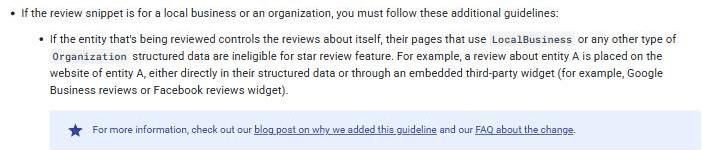
An embed can still help in smaller, practical ways. It adds text to the page in the words your customers use about your service, and it gives visitors a reason to stay instead of leaving to check you out on Google. Structured data is still worth switching on if your widget offers it, because it puts the rating on the page in a form search engines can read. Keep that markup consistent with what a human sees, and keep undisclosed incentivised reviews out of it.
One practical warning. A review widget is third-party JavaScript, and third-party JavaScript is the usual reason a page that used to load fast no longer does. Run a speed test after you add it, not before.
FAQ
Can I show only my five-star reviews? You can filter, and sorting by rating is not suppression under the FTC rule. What you cannot do is present a filtered selection as though it were everything you have received. Set a filter you can describe in a sentence, put that sentence near the block, and link to your Google profile.
Do I need a Google Places API key to embed reviews? No, not if you use a widget or a plugin. Those services hold the connection to Google. You need a key only if you are building the display yourself.
Can I embed Google reviews on Squarespace or WordPress? Yes to both, without a plugin. WordPress takes a Custom HTML block, Squarespace takes a Code Block, though Squarespace needs a Core plan or above before JavaScript will run inside one.
What should I do about a bad review that shows up in the widget? Reply to it on Google first. A one-star review with a good answer under it does less damage than a filtered wall of praise, and there are worked examples of review responses to start from.