
Google review policy in 2026: what businesses can and cannot do
Two rulebooks now govern how a business asks for reviews. They agree on almost everything, and the gaps between them are where owners get caught.
Lachlan Fea 9 min read
In this article10 sections
The Google review policy lets you ask any customer for a review and forbids nearly everything else you might do to influence one. You cannot pay or discount for reviews, cannot ask only the customers you expect to be pleased, cannot pressure someone into reviewing you before they leave your premises, and cannot tell them what to write. Since October 2024 a second rulebook applies to businesses trading in the United States: the Federal Trade Commission's Consumer Reviews Rule, which carries civil penalties of up to $53,088 per violation.
Google's policy and the FTC rule are often explained separately. That misses the situations where they differ, which is where owners get caught.
Verified 6 September 2026 against Google's prohibited and restricted content policy, its Business Profile guidance on getting reviews, and the FTC's final rule and questions and answers for business.
Everything you need to know about Google's review policy
There is no single document called "the Google review policy". There are two.
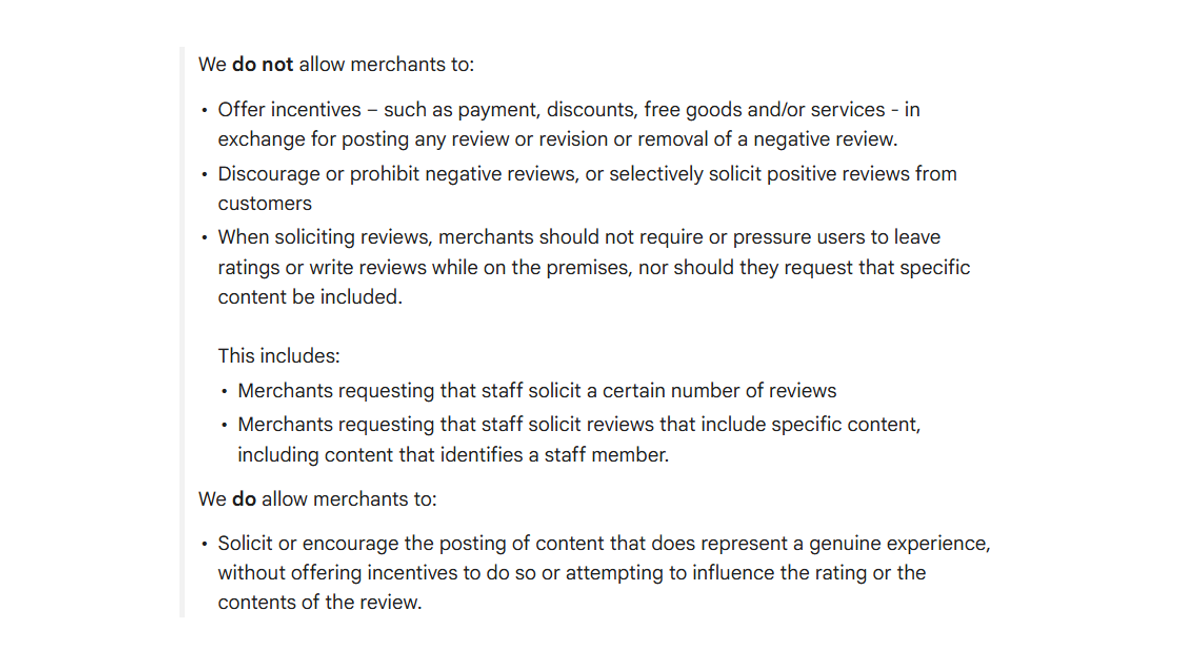
Google's rules live in prohibited and restricted content, which governs everything contributed to Maps and Business Profiles. It is what Google's own Business Profile help links to, and what a moderator applies when you report a review. It covers what a reviewer may write and, in a section addressed to merchants, what you may do to get a review at all. Two of its merchant bullets were added in 2026, on staff review quotas and on reviews that name a staff member.
The law is the FTC's Rule on the Use of Consumer Reviews and Testimonials, 16 CFR Part 465, announced on 14 August 2024 and in force since 21 October 2024. It applies to reviews and testimonials wherever a US business uses them: on Google, on your own site, in an ad. Breaking Google's policy costs you reviews. Breaking the FTC rule costs money.
The two rules meet at the same point. Google puts the positive half of it in one sentence. Merchants may "solicit or encourage the posting of content that does represent a genuine experience, without offering incentives to do so or attempting to influence the rating or the contents of the review". Asking is fine. Steering is not.
What you can and cannot do
Every row is checked against both rulebooks. "Not addressed" means the rule genuinely does not reach that conduct, not that it is a good idea.
| What you want to do | Google's policy | The FTC rule | Verdict |
|---|---|---|---|
| Ask a customer for a review | Allowed | Not addressed | Do it, for every customer |
| Ask by text or email after the job | Allowed | Not addressed | The most effective legal ask there is |
| Hand out a review link or QR code | Allowed, and Google suggests it | Not addressed | Fine |
| Press customers to review you before they leave | Prohibited: no requiring or pressuring "while on the premises" | Not addressed | Give people the link and let them go |
| Ask a customer to mention a service or a staff member by name | Prohibited: no requesting "specific content" | Not addressed | Never script a review |
| Set staff a target number of reviews to collect | Prohibited | Not addressed | Drop the quota |
| Offer a discount, freebie or prize entry for a review | Prohibited outright | Allowed if it is not conditioned on sentiment | Don't. Google is stricter than the law |
| Offer the incentive only for a positive review | Prohibited | Prohibited, penalty-bearing | Never |
| Ask only the customers who seemed happy | Prohibited: no "selectively solicit positive reviews" | "Could violate the FTC Act" | Never. See review gating, below |
| Ask an employee or a close relative to review the business | Conflict of interest, removable | Unlawful for an officer or manager to solicit without a clear and conspicuous disclosure | Don't ask. Anyone who writes one has to disclose the connection |
| Write a review of your own business | Prohibited | Unlawful | Never |
| Buy reviews, or pay to have a negative one removed | Prohibited | Unlawful, penalty-bearing | Never |
| Show a hand-picked set of good reviews on your own site | Not addressed | Not suppression, but non-representative use "could be deceptive" under the FTC Act | Don't present a selection as all your reviews |
| Threaten a customer with legal action to get a review taken down | Not addressed | Prohibited where the threat is unfounded | Reply publicly instead |
| Report a review that breaks a content policy | Allowed and expected | Not addressed | Do it, with the policy named |
The incentive row is the one people misread. Google bans incentives with no exception. The FTC's rule applies when an incentive is conditioned on sentiment. A prize draw open to every reviewer, whatever they write, can be lawful in the United States and still get your reviews stripped from your Google profile. Google is the tighter constraint here, and Google controls your star rating.
What Google's content policies ban in a review
The other half of the policy governs the reviewer. It matters because these categories, and only these, are the grounds on which a review can be reported.
- Fake and misleading content. Fake engagement, meaning any contribution not based on a real experience. Rating manipulation, which covers incentivised reviews, unusual patterns of contribution aimed at moving a rating, and conflicts of interest arising from "current or former employment, a contractual or consultory relationship, or other professional or personal affiliations". Impersonation, misinformation and misrepresentation sit here too.
- Off-topic, advertising and repetitive content. Reviews carrying commentary or a personal rant rather than an experience at your business, advertising and solicitation, links and phone numbers dropped into a review, and content too unclear or repetitive to be useful.
- Inappropriate content. Harassment, hate speech, offensive content, obscenity, personal information, sexually explicit and adult-themed content, violence and gore.
- Restricted, dangerous and illegal content. Alcohol, gambling, tobacco, firearms, pharmaceuticals and other regulated goods, plus dangerous content, child safety violations and terrorist content.
Nothing there says "the customer is wrong" or "we have no booking under that name". A merely unfair review is not removable. That is the commonest reason a report fails. Our guide to removing a negative Google review covers reporting, evidence and appeals in full, and how to spot a fake review covers the evidence that gets one taken down.
Review gating
Review gating is the industry's name for what Google's policy calls selectively soliciting positive reviews. Google's rule is one line. Merchants must not "Discourage or prohibit negative reviews, or selectively solicit positive reviews from customers."
That line has been in the policy for years, and Google enforces it against the profile rather than against the vendor who sold you the software.
The FTC's position is narrower and still uncomfortable. Asked whether a business may seek reviews only from the customers it thinks are happy, the Commission answers that the rule "does not contain a specific prohibition against such conduct. But this practice could violate the FTC Act."
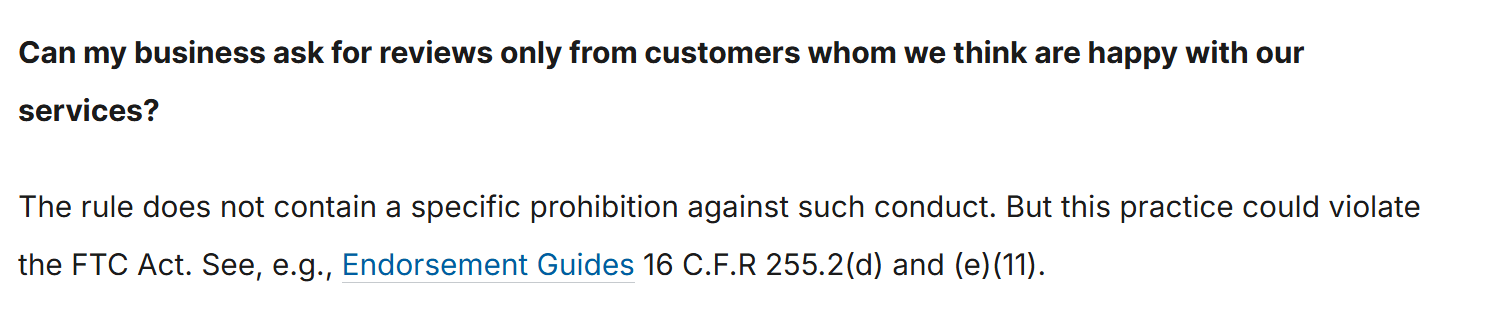
That is as close as a regulator gets to saying "we would rather you didn't".
We do not explain how gating gets built, because no version of it is worth building. Cloutly has not gated a review since 2021 and does not run a rating step in front of the review sites. Everyone who gets the ask gets the same page and the same choice. The longer argument is in our post on review gating.
Don't incentivise Google reviews
Google's wording is broad on purpose. Merchants must not "Offer incentives ... in exchange for posting any review or revision or removal of a negative review", and the policy names payment, discounts and free goods or services as its examples. That reaches the ten per cent off, the free coffee, the monthly draw, the loyalty points and the staff bonus paid per review collected. It also reaches paying a customer to soften or delete a bad one.
The FTC draws its line differently. Its rule "prohibits businesses from providing compensation or other incentives conditioned on the writing of consumer reviews expressing a particular sentiment", and its guidance spells out the consequence: "The rule does not prohibit giving incentives for reviews, as long as there isn't an express or implied requirement that the reviews have to express a particular sentiment."
A condition can be implied. A sign reading "leave us a 5-star review and get a free dessert" is sentiment-conditioned whatever the small print says. In December 2025 the FTC sent warning letters to ten companies over fake reviews and incentives offered for five-star reviews, noting that penalties of up to $53,088 per violation "can quickly add up". On the paid end of this, we wrote about buying Google reviews separately.
The FTC rule on fake reviews, and what it changed
Before October 2024 the FTC could sue over fake reviews under the general ban on deceptive practices, but recovering money was slow. The Consumer Reviews Rule made specific conduct a rule violation and lets the Commission seek civil penalties directly. The conduct was already frowned on. Now it has a price. The rule prohibits six things:
- Fake or false reviews and testimonials, including reviews by people with no real experience of the business, AI-generated reviews presented as real, and selling or buying them.
- Buying positive or negative reviews: compensation or incentives conditioned on the review expressing a particular sentiment.
- Insider reviews without disclosure. An officer or manager may not review their own business, or solicit a review from an employee or immediate relative, without a clear and conspicuous disclosure of the relationship.
- Company-controlled review websites presented as independent.
- Review suppression, meaning unfounded legal threats, intimidation and knowingly false accusations aimed at getting a review taken down.
- Fake indicators of social media influence, such as bought followers or views.
Service businesses often trip over item three. Asking your team to "get the reviews started" at a new location is a solicited insider review, and it needs a disclosure the reviewer will never think to write. The FTC does carve out a general campaign that goes to every customer, even if some of them happen to work for you. Singling out the staff is the part that breaks.
Outside the United States the direction is the same: fake and undisclosed incentivised reviews are banned practices in the UK under the Digital Markets, Competition and Consumers Act, and the ACCC requires an Australian incentive to be offered whatever the reviewer writes and to be disclosed.
What happens if you break the rules
The reviews disappear, quietly. Google rarely tells you which ones it removed or why. In 2025 it blocked or removed more than 292 million policy-violating reviews, put posting restrictions on more than 782,000 accounts and took down over 13 million fake business profiles. A batch of incentivised reviews vanishing overnight is the normal first sign that something in your process is wrong.
The profile can be next. Google restricts content, and then profiles, for a pattern of violations, and a restricted account suspends every Business Profile it manages. That is the scenario that hurts a multi-location operator. Reinstatement runs through an appeal, decisions take up to five business days, and you must upload your evidence within 60 minutes of submitting, so have it ready before you start.
Reviews can also be paused. In April 2026 Google added a response to spam spikes: on detecting a sudden flood it will "quickly remove the fake content, pause new reviews on the profile, alert the Business Profile owner and display a notification banner to let consumers know why contributions are temporarily paused". That one is mostly protection, aimed at extortion attacks, but the banner is visible to customers while it is up.
And in the United States, money. Civil penalties reach $53,088 per violation, and each fake or incentivised review can count as one.
How to get good Google reviews without contravening Google review policies
The compliant method is also the one that produces the most reviews, which is a happier coincidence than it sounds.
- Ask everyone, not the ones you expect to be pleased. A rating is an average, and averages move on volume. Asking your whole list gets you more of it than screening ever will.
- Ask soon, the day the job is done, while the customer still remembers the person who did it.
- Ask once, and make it one tap. A review link or a QR code the customer takes away, not a tablet held out at the counter.
- Don't tell them what to say. Google's policy forbids requesting specific content, and a scripted review reads like one.
- Reply to what comes back. Google's own guidance asks for replies that are professional, short and conversational rather than a sales pitch.
- Never trade anything for it. No discount, no draw, no staff bonus per review.
Doing that for a real customer list gets hard by hand. Cloutly's review campaigns send the ask when your own booking or payment system says the job is finished, treat a repeat customer as one contact asked once rather than one ask per transaction, skip anyone who reviewed you in the last 90 days, and stop the follow-ups when the review lands. There is no rating step anywhere in it. For the tactics in detail, see how to get more Google reviews.
What this means for a service business
Take Coastline Physio, a fictional four-clinic practice. Its front desk has a review tablet, its receptionists have a target of ten reviews a month each, and patients who leave a review go into a draw for a free session. All three breach Google's policy as it stands in 2026, and the draw is close to the conduct the FTC's warning letters describe.
The fix is small. The tablet becomes a review link on the discharge summary. The quota comes off the receptionists and the ask moves onto the practice management system, which already knows when an appointment finished. The draw stops. The number of patients asked does not change, and the reviews that arrive are ones Google will keep.
If you check one thing this week, check that every customer who gets your review request sees the same thing. If they don't, that is gating, and it is your profile that carries the risk, not the vendor's.
Frequently asked questions
Can I ask my customers for Google reviews? Yes. Google is explicit that merchants may solicit or encourage reviews representing a genuine experience, as long as you offer no incentive and make no attempt to influence the rating or the content. Asking every customer, once, soon after the job, is squarely within policy.
Can I offer a discount for a Google review? No. Google prohibits offering payment, discounts or free goods and services in exchange for a review, with no exception for unconditional offers. In the United States an incentive tied to a positive review also breaks the FTC rule.
Can I ask only my happy customers to review me? No. Google's policy bars merchants from discouraging negative reviews or selectively soliciting positive ones. The FTC says its rule contains no specific prohibition on the practice but that it could still violate the FTC Act. Ask everyone and take the result.