Blog GoogleGuides

How to add your business to Google Maps, step by step (2026)

Getting on the map takes ten minutes. Verification is the part that fails, and it is the part nobody covers properly.

Lachlan Fea 10 min read

In this article9 sections
Illustrated storefront, map pin and check shield

To add your business to Google Maps, go to business.google.com/add, select Add your business to Google, enter your name, category and either an address or a service area, then complete the verification option Google gives you. If the listing already exists and nobody has claimed it, open it in Google Maps and select Claim this business instead.

That part takes about ten minutes. Verification is where people get stuck, so most of this guide is about that.

One thing to clear up first. If a guide tells you to sign in to a Google My Business dashboard, it is describing something that no longer exists. Google renamed the product Google Business Profile and moved single-location management into Search and Maps, so the settings open over the top of your own search result. Business Profile Manager at business.google.com is still there, but it is for running several profiles at once.

What Google needs before you start

You qualify if customers can come to you or you go to them: "If your business either has a physical location that customers can visit, or travels to customers where they are, you can create a Business Profile on Google" (Guidelines for representing your business on Google).

Three rules on that page decide whether your listing survives its first year.

The first is the name. Google wants "your business's real-world name, as used consistently on your storefront, website, stationery, and as known to customers", and its own worked example turns "Midas Auto Service Experts" back into "Midas". Bolting a service or a suburb on the end to win a search is the most common reason a new profile gets suspended.

The second is one profile per location. If you show an address, Google also expects "permanent fixed signage of their business name at the address". A virtual office or a PO box does not qualify.

The third is that a service area is not an address. Google caps how far one reaches: "The boundaries of your profile's overall service area shouldn't extend farther than about 2 hours of driving time from where your business is based."

One rule Google does not give you: use an account the business will still control in five years. Prising a profile out of a departed marketing manager's personal login is slow work.

How to add your business to Google Maps, step by step

  1. Sign in to the Google account you want to own the profile.
  2. Go to business.google.com/add and select Add your business to Google.
  3. Enter your business name exactly as it appears on your signage.
  4. Choose your primary category. You can add nine more later, but the primary one does the heavy lifting, so pick the closest match, not the broadest.
  5. Add your address if customers visit you, and drop the map pin on the actual door. If you travel to customers, skip the address and set service areas instead.
  6. Add a phone number and website. Google allows up to three numbers.
  7. Complete the verification option Google offers you.
  8. Once verified, finish the profile: hours, description, attributes and photos.

Google's help page showing the four steps to add a business, followed by the steps to claim an unverified business from Google Maps

Steps 1 to 7 are one sitting. Step 8 decides whether customers act on the listing, and it has its own section below. Edits are reviewed rather than published on the spot: "A review of your edits usually takes about 10 minutes, but sometimes it can take up to 30 days" (Add attributes).

How to verify your business on Google

Verification is Google checking the business exists and that you are the one running it. You do not get to choose how: "Verification methods are automatically determined by Google and can't be changed." What you are offered depends on your business type, the public information Google holds, your region and your hours (Verify your business on Google).

MethodWhat it needsHow long
Phone or textAnswering the business number, or an SMS code. "Interactive Voice Response (IVR) systems won't get the code"Minutes
EmailAccess to the address shown on the verification screenMinutes
Live video callSomeone at the location during opening hours, on a device that takes video callsReviewed on the call
Mail (postcard)The exact mailing address. "Most codes arrive within 14 days" and codes "expire after 30 days"Up to two weeks
Video recordingOne unedited take of at least 30 seconds, filmed and uploaded on a mobileUp to 5 business days
InstantAn already-verified website in Search Console, or a bulk uploadInstant

Google's verification page stating that verification methods are automatically determined and cannot be changed, with the four options and a five business day review

Postcards are no longer the default. Google's own advice: "If your business is eligible for video verification, we recommend that you use this option."

What the verification video has to show

It has to be "an unedited, unique, and complete recording with no breaks", at least 30 seconds long, and "recorded and uploaded from a mobile device through your Business Profile" (Verify your business with a video recording). Film it live. Google will not take a clip from your camera roll: "pre-recorded videos aren't allowed, and you can't record it offline and upload it later". Keep other people's faces out of the shot, along with bank, tax or ID numbers. Shoot landscape so the signage is readable.

Google's video verification rules: the video must be unedited, at least 30 seconds, shot on a mobile, and must not show sensitive numbers, private information or other people's faces

In that one take it has to prove three things.

  • Where you are. Street signs, building numbers or a neighbouring business, so Google can match the footage to the pin on Maps.
  • That the business exists. For a storefront, signage on a permanent fixture with the name matching the profile. For a service-area business, the tools, workspace or branded clothing you work with.
  • That you run it. Access other people do not have: the till, the back office, the staff area. A permit or invoice in the profile's name also works.

When verification fails

A rejection arrives as a Review issues notification with the reason, and you can fix it and submit again. Four failures worth planning for:

  • The postcard never arrives. Codes expire after 30 days, so request a new one rather than waiting. Check the address on the profile is exactly what your postie expects, unit number included.
  • The video was rejected. Almost always because it stopped short of proving management access. Film the part where you unlock something.
  • You run out of options. If the profile tells you there are no more ways to verify, contact Google support rather than keep resubmitting.
  • You are asked for the same evidence twice. Resubmit rather than starting again, and do not create a second profile while you wait. Google allows one per location, and a duplicate is a second problem stacked on the first.

Adding a business with no shopfront

If customers do not come to your address, you are a service-area business: one that "visits or delivers to customers directly but doesn't serve customers at their business address". That covers most trades, mobile therapists and cleaners. If you do both, Google calls it hybrid, and its example is a dine-in restaurant that also delivers (Manage your service areas).

Google's service area page defining service-area and hybrid businesses, and the Edit profile then Location steps for adding up to 20 areas

Set it up under Edit profile, then Location. Next to Service area, select Edit, choose your areas and save. You can list up to 20 by city, postcode or region, and an approved change takes up to 48 hours to appear.

Three rules people miss. A service-area business gets one profile for the whole area it serves, not one per suburb. If you do not serve customers at your address, remove the address, because a business with no permanent on-site signage is not eligible as a storefront. And if you sell age-restricted goods such as alcohol, you need a storefront and cannot run as service-area only.

Verification still happens at your registered address, not in the areas you serve.

Your business is already on Maps and you do not own it

Google builds listings from its own sources, so plenty of businesses are on Maps before anyone claims them. What happens next depends on whether it is verified.

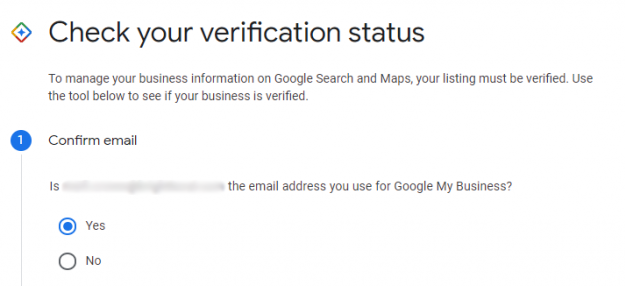
Nobody has claimed it. Search for the business in Google Maps, select Claim this business, then Manage now, then verify as above. On mobile, tap the About tab first.

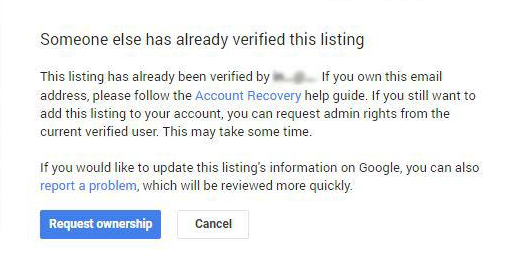
Someone else has verified it. Usually an old agency, a former partner or a franchisee. Go to business.google.com/add, enter your details, select your business from the list and choose Request Access. "The current profile owner is then notified by email and has 3 days to respond." A rejection still leaves you able to suggest an edit and to appeal. If nobody responds, you may be able to claim the profile by verifying it yourself, though Google notes "the option to claim a profile isn't always available" (Request ownership of a Business Profile).

Start this before you need it. Three days is only three days once somebody is actually reading the email.

What to fill in once you are verified

You will find all of these under Edit profile on your own Google Search result, or Business, then Edit profile in the Google Maps app (Edit your Business Profile).

FieldWhat to do with it
CategoriesOne primary, up to ten in total. Google's guideline: "Use as few categories as possible to describe your overall core business"
DescriptionUp to 750 characters. What you do and who for, not adjectives
HoursRegular hours, special hours for public holidays, and separate hours for delivery or a kitchen that closes earlier
Phone and websiteUp to three numbers. Use the one a human answers
AttributesWheelchair access, outdoor seating, payment types, and identity attributes such as women-owned or veteran-owned
Opening dateThe month and year you opened
Photos and videoLogo, cover photo and business photos. Cover photo placement "isn't guaranteed"

Short names are on the way out, by the way: Google no longer lets you create or edit one. Once you're live, editing your Google Business Profile covers what happens after you save a change to any of this.

The photo and video specs Google actually publishes

Google's photo and video guidelines: JPG or PNG, 10 KB to 5 MB, 720 by 720 recommended, 250 by 250 minimum, video up to 30 seconds and 75 MB at 720p

Google publishes these numbers on its own page (Manage your Business Profile photos and videos).

SpecPhotosVideo
FormatJPG or PNG
File sizeBetween 10 KB and 5 MBUp to 75 MB
Recommended resolution720 px by 720 px720p or higher
Minimum resolution250 px by 250 px
LengthUp to 30 seconds

Google does not publish a separate image size or aspect ratio for posts, whatever other pages tell you. Use the specs above and keep text away from the edges, because the crop differs between Search and Maps. On quality Google is blunt: no heavy filters, because "the image should represent reality".

Posts come in three types, updates, offers and events, and they expire. "Posts older than 6 months are archived unless a date range is set" (Create posts on your Business Profile).

Do you need a Google Business Profile optimisation service?

There is no hidden panel. An agency on a monthly fee edits the same fields you just read about, adds photos, answers reviews and watches for suspensions. With one or two locations, do it yourself: an afternoon covers the lot, and after that it is fifteen minutes a month. Buy help when nobody internally owns it, or when you have been suspended.

How to get reviews on your Google Maps listing

Reviews are the one part of the profile you cannot fill in yourself, and the part customers read first.

Google gives you a link and a QR code for exactly this. Open your Business Profile, select Read Reviews, then Get more reviews, then Copy. The QR code can only be generated in a desktop browser, so save the image once and reuse it (Create a review request link and QR code). Google suggests receipts, thank-you emails, the end of a chat and a card in the shop.

Two limits, plainly. Paying for reviews is out: "Offering incentives, like free or discounted goods or services, in exchange for customers to post reviews, change reviews, or remove negative reviews is considered fake & misleading content and is strictly prohibited." And never put a rating step in front of the link so that only happy customers reach Google. That is review gating. It breaks Google's policy and produces a profile nobody believes.

Ask every customer, and ask close to the moment the job was finished, because that is when people still remember the detail worth writing down. Getting more Google reviews covers the timing properly, seeing all your Google reviews covers where they land, and if one goes missing, why a Google review is not showing up is usually the answer. Google is not the only profile collecting them, so claim Facebook and the review sites that matter in your trade too. Much of what lands on Maps comes from Local Guides.

Keeping several locations consistent

One profile per location still holds, so ten shops means ten profiles and ten sets of hours to keep right.

Manage them together rather than one at a time. Google's advice for anyone starting with more than one is to "create a business group", which is also how you give an agency or a new marketing hire access without handing over ownership, since "they can access all current and future profiles placed in the group" (Create and manage business groups).

At volume, Business Profile Manager takes a spreadsheet: select Add profile, then Import profiles, fill in the template and upload it. That spreadsheet is also how bulk verification is requested (Create a bulk upload spreadsheet), and at ten or more locations you can bulk upload photos the same way.

The harder problem is drift. Hours change at one site, a number gets updated on the website but not on Maps, and nobody notices until a customer turns up to a closed door. Cloutly's listings management keeps one record per location, publishes hours, phone and address to Google Business Profile and Facebook after you approve a preview of exactly what will change, and checks Google's public view, Yelp, TripAdvisor and Facebook against that record weekly.

If two sites share a name, multiple Google locations with the same name covers how to keep them apart. When one closes, removing a business from Google covers the right way to do it, which is rarely deletion. The name, address and phone have to match everywhere else too, which is NAP consistency.

FAQ

How long does it take for my business to appear on Google Maps? Verification review takes up to 5 business days. Phone, text and email codes are usually minutes; a postcard takes up to 14 days. Later edits are reviewed too, usually in about 10 minutes.

Is adding my business to Google Maps free? Yes. In Google's words, you "can manage how your business shows up on Maps and Search at no charge". Verification is free too.

Can I add my business to Google Maps without an address? Yes. Set it up as a service-area business, list up to 20 areas, and remove the street address from the profile.

Why can I not see my business on Maps after verifying? Give the edits time to clear review, then search your exact business name and suburb rather than a category term. A new profile does not appear for "plumber near me" straight away, and that is a ranking question rather than a listing question. Landing in the Google map pack covers what moves it.

Someone else verified my business. What now? Request access through business.google.com/add. The current owner has 3 days to respond, and if nobody does, you may be able to verify it yourself.

Do I need to do this again on Apple Maps? Yes, separately, through Apple Business Connect.