
Multi-location review management: who asks, who replies, and who gets measured
Every site contributes to the rating customers attach to the brand. The review programme has to work for local owners and head office alike.
Lachlan Fea 11 min read
In this article12 sections

Multi-location review management is the job of getting every site in a network asking for reviews the same way, landing every review in one place, and deciding who answers each one. It is a governance problem before it is a software problem. The brand carries one rating in the customer's head, and fifty owners decide what that rating is.
Written for whoever owns that number across 20 to 400 sites. At one site, most of this is overkill.
What breaks as a network grows
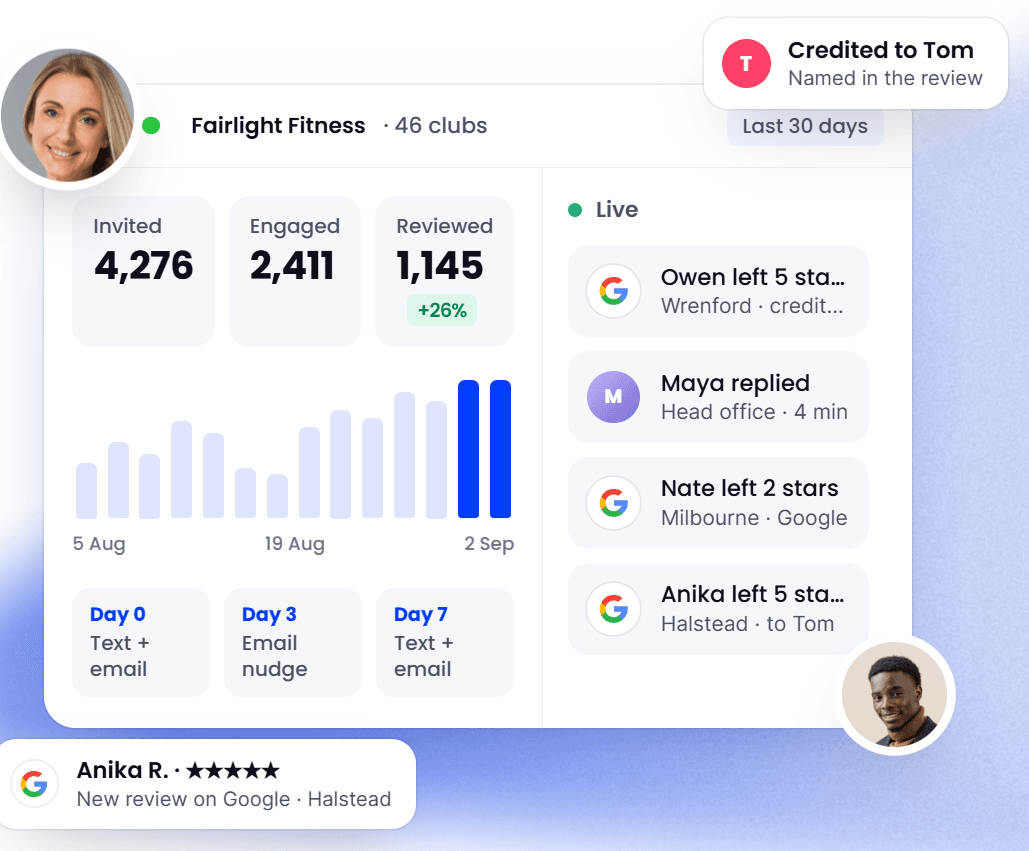
Every site asks differently. One franchisee has a QR code on the counter, another blasts a monthly email out of their own Mailchimp, eleven do nothing, and six point customers at a Facebook page nobody has claimed. Together that produces a rating swinging between 4.1 and 4.9 for reasons unrelated to the service.
The reviews land nowhere central. Each Google Business Profile notifies whoever set it up: a franchisee's personal Gmail, an agency, a person who left in 2023. Head office finds out about a bad quarter at conference, because no list of last week's reviews exists.
And head office replies to everything or to nothing. Everything means a coordinator writing "We're sorry to hear this, please contact support@" under a review about a specific Tuesday, which reads worse than silence. Nothing leaves the silent sites silent.
Underneath all three sits the same fact: a customer does not distinguish between franchisees. They searched your brand, Google showed them the nearest site, and that site's rating is the brand's rating as far as they are concerned. So the network average is a vanity number. A network averaging 4.5 with nine sites at 3.6 is in worse shape than one averaging 4.3 with nothing below 4.1.
Claim and organise every profile before anything else
The unglamorous part, and the one every competing guide skips. Nothing works until you can reach every profile.
- Inventory what exists. Every location, its Google Business Profile, its Facebook page, and who holds owner access to each. Expect duplicates, and at least one profile still owned by an agency the franchisee stopped paying in 2024.
- One profile per location. Google's guidelines for representing your business say there should only be one profile per business, and that locations of a chain in the same country use the same name unless a site consistently trades under a different one. Duplicates split your reviews across two cards and halve the rating that shows. More on multiple locations with the same name.
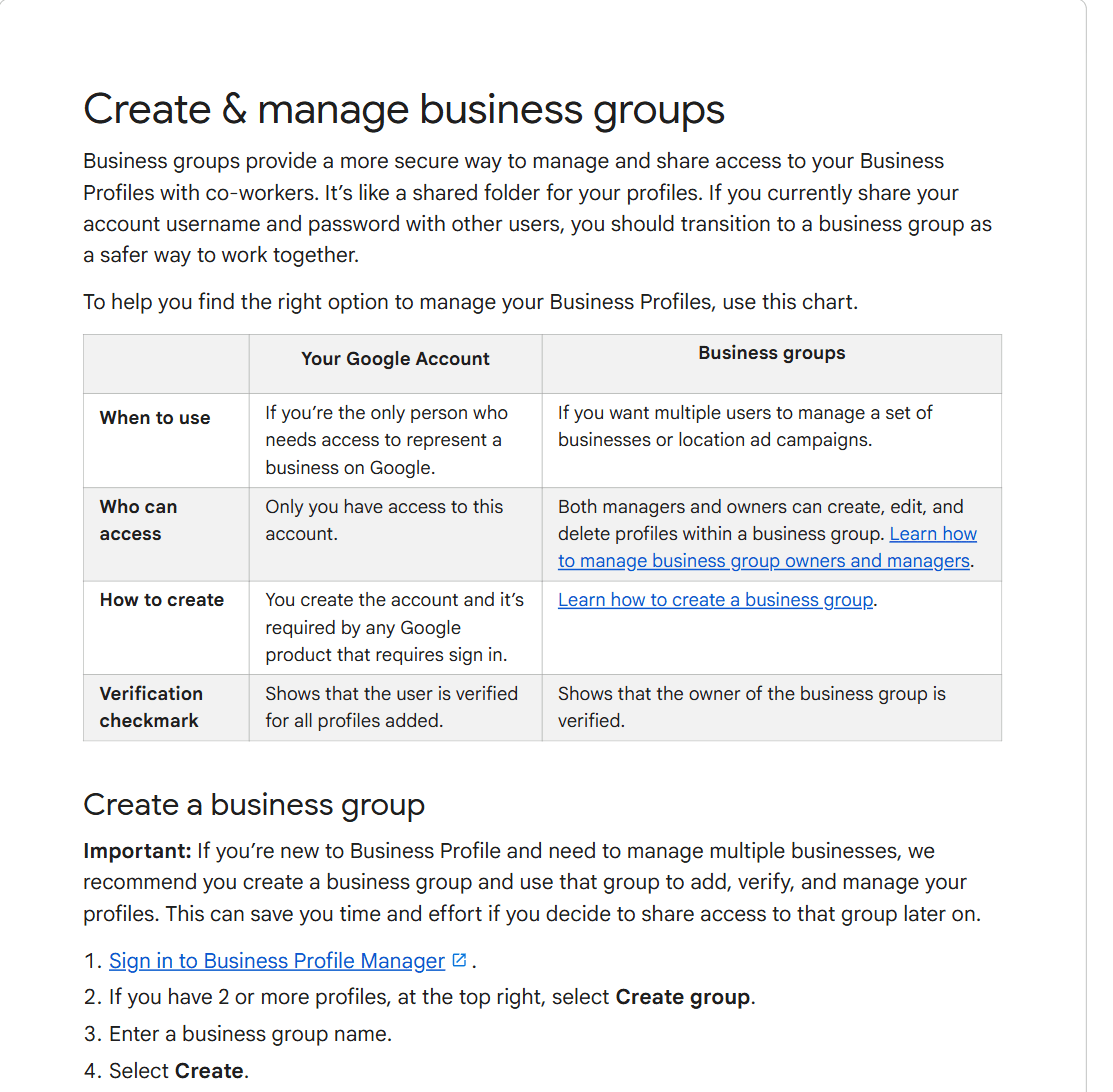
- Put the profiles in a business group. Google describes business groups as a more secure way to share access, a shared folder for your profiles: add a colleague as a manager or owner and they reach every profile in the group, current and future, without anyone handing over a password. Almost nobody sets this up.
- Decide the access model, and write it into the franchise agreement. Owner and manager roles differ in one way that matters: managers can do nearly everything, but only owners can add or remove users and delete the profile. Head office should be an owner on every profile, the franchisee a manager or co-owner. A profile has one primary owner, and that owner cannot step away until they have transferred the role. Settle that now rather than on the day a franchisee sells.
If some sites are not on Google properly yet, start with getting a business onto Google Maps.
Get every location asking the same way
The corporate instinct is a standard: same message, same timing, everywhere. The franchisee instinct is autonomy: my customers, my words. Standardise the trigger and leave a little of the wording local.
The ask fires off whatever system that site already runs on, at the moment it says the job is done: the booking system when the appointment is marked complete, the point of sale when the invoice is paid. If it depends on someone remembering, it happens on quiet days and stops on busy ones.
Then leave the local half local: the location name, the customer's name where you have it, and one line the franchisee writes themselves. Timing, follow-up spacing and the review link are set once at head office. Franchisees will accept a standard they can put their own sentence in front of.
Make it smart rather than loud. At network scale a dumb ask does real damage, because the same customer visits four of your sites. One contact per person however often they return, a second booking moving the existing ask rather than adding another, anyone who reviewed you in the last 90 days skipped, opted-out contacts never re-enrolled, follow-ups that stop the moment the review lands. Without those rules a 200-site network asks one person four times in a month.
And no rating step, ever. The temptation at scale is a filter: ask how it went, send the happy ones to Google, route the unhappy ones to a private form. Do not build it, and do not accept a vendor that offers it. Google's contributed-content policy says merchants must not "discourage or prohibit negative reviews, or selectively solicit positive reviews from customers". The US Federal Trade Commission's rule on consumer reviews, in force since 21 October 2024, bans claiming a review section represents all the reviews submitted when reviews have been suppressed on rating or sentiment. Ask everyone, take what comes, answer it well. The tactics are in how to get more Google reviews.
One inbox for every location
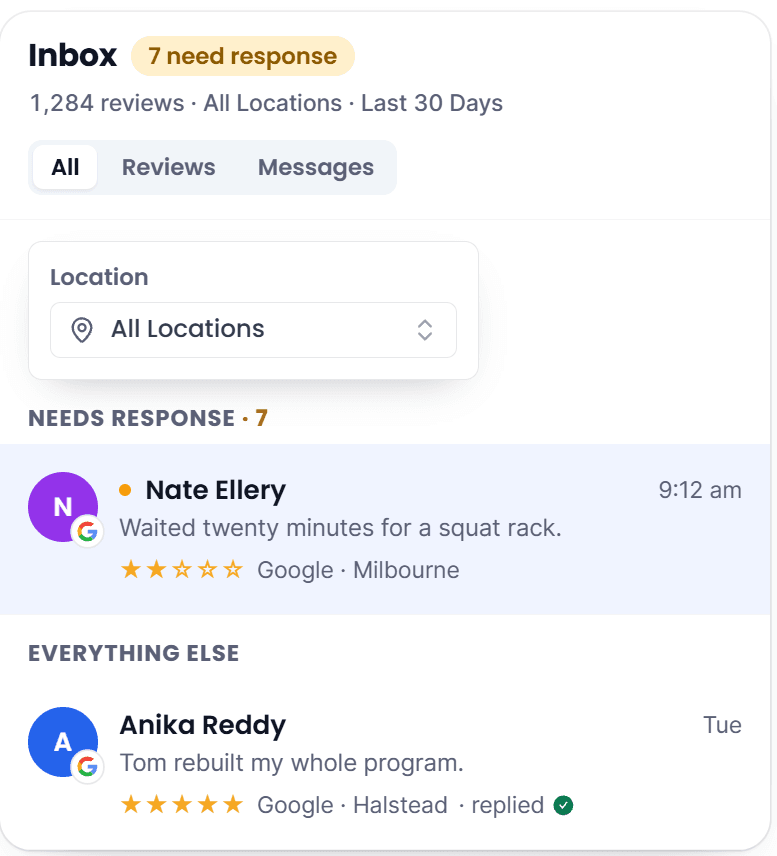
Once the asks run, reviews arrive faster than the current arrangement can absorb. The requirement is one list, every location, filterable down to a single site. That buys you a number for last week without asking anyone, a queue of everything nobody has replied to, and a route for the ones that need head office. A 1-star review naming a staff member, or alleging something legal, should reach head office within hours. It cannot if it only ever notified the franchisee.
Who replies, corporate or the franchisee?
This is the question franchisors lose sleep over, and the competing guides do not answer it. Two clean models exist, plus the hybrid almost every network ends up running.
Corporate replies to everything: consistent voice, no legal exposure, nothing unanswered, and replies that are visibly generic because the writer was not there. It breaks past 30 sites or so, when the volume outgrows one coordinator.
The franchisee replies to everything. Specific, fast, occasionally catastrophic. They know the customer and the Tuesday in question, which is what makes a good reply good. They also argue in public and go quiet in a busy season.
Build the tiered model around the review, not who owns the site.
| Review | Who replies | Standard |
|---|---|---|
| 4 to 5 stars | The location | Within 3 business days, in their own words |
| 3 stars | The location | Within 2 business days, naming what they will fix |
| 1 to 2 stars | The location, drafted or reviewed by head office | Within 24 hours |
| Alleges injury, discrimination, fraud or a legal claim | Head office only; the location is told not to reply | Same day, once the right people have seen it |
| Names a staff member negatively | Head office drafts, the location sends | Within 24 hours |
Two things make that hold rather than sit in a manual nobody opens. The first is saved replies: templates written once at head office, with placeholders that personalise on insert, in a Templates menu in the composer where the franchisee already works. A franchisee will use a good template. They will not open a PDF. Positive review response examples is the starting set, though the 1-star replies get read by the most people.
The second is drafting with a person approving. An AI draft of a review reply, edited and sent by a human, closes the gap between "the franchisee has no time" and "the reply has to be specific". Head office sets the tone; the franchisee edits the two sentences only they could write.
Some franchisees will not reply at all, so write the escalation down before it happens: the standard in the agreement, the unanswered count visible to everyone at conference, head office replying for them after 14 days. The visibility usually does the work.
The league table, and what it does to franchisee behaviour
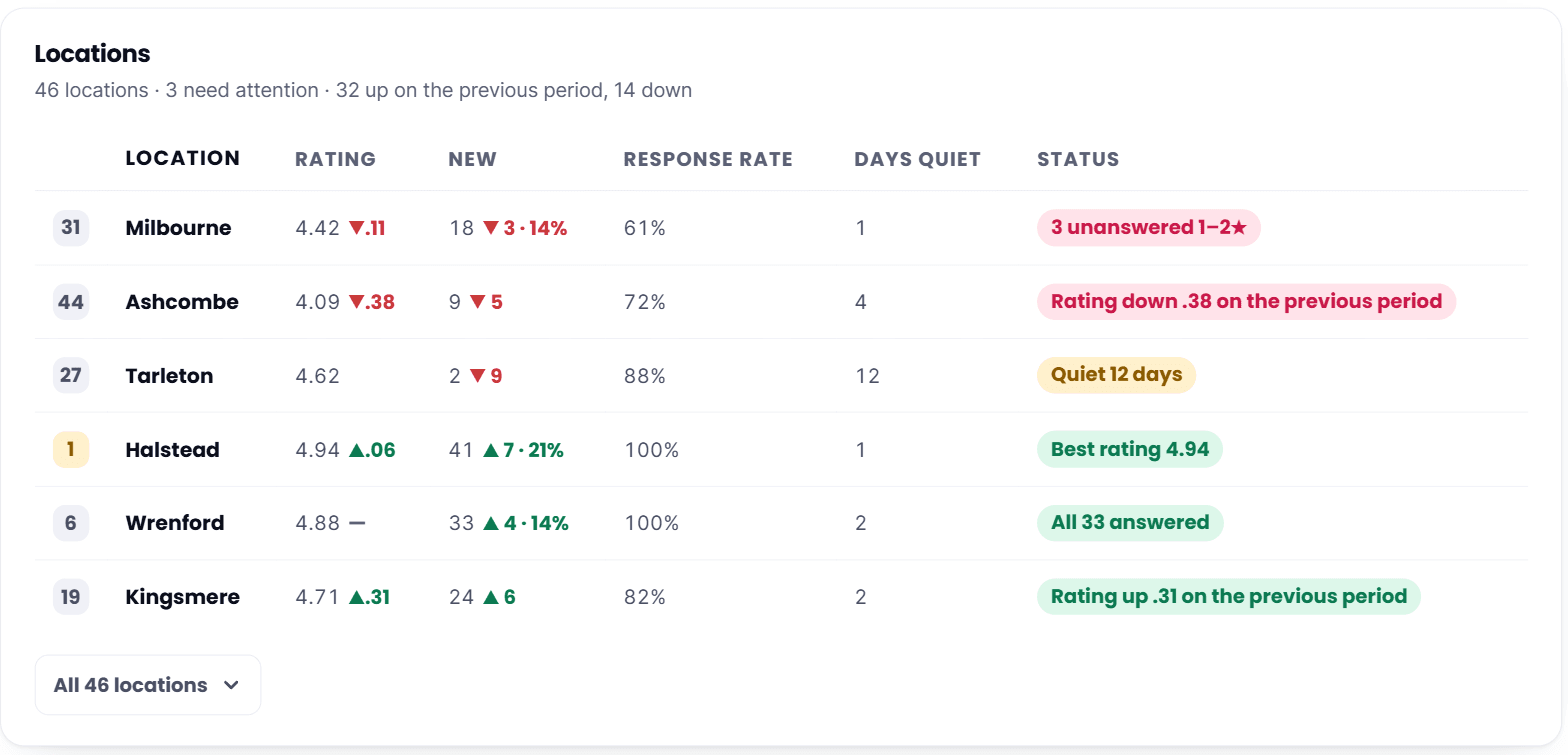
Publish a table of every location, ranked, and update it monthly. It changes behaviour faster than anything else here, for a reason that has nothing to do with software: franchisees compete, and they do not like being 47th.
| Column | Why it is there |
|---|---|
| Rating in the period | The number a customer sees. Print two decimals, because 4.62 and 4.58 are different and 4.6 and 4.6 are not |
| New reviews in the period | The input the location controls. Volume moves the rating; the rating does not move itself |
| Response rate | The clearest proxy for whether anyone at that site is engaged |
| Days quiet | Days since the last review. A site at 22 days has stopped asking, whatever it says |
| Status | One plain flag per row: unanswered 1 to 2-star reviews, rating down on the previous period, quiet for N days, best rating, all answered |
Rank on the period's rating, not the lifetime one. Lifetime ratings are a monument to whatever happened in 2021, and they hide the franchisee who has turned a site around.
Do not show all 200 rows. Nobody reads 200 rows. Show the sites that need attention and the sites doing well, and put the full list behind a click. A table with five problems and three wins on it gets read every month.
Credit inside the site, too. A staff-level view starts the same conversation inside a salon or a workshop, and franchisees often adopt it fastest. Attribution is the catch: matching a name in review text can credit the wrong person, so give each staff member their own review link and let the link do the attributing. That also keeps you the right side of Google's policy, which says merchants should not request that specific content be included in a review, staff identification included.
Read the reviews as themes, not as a score
A rating tells you a site is struggling. It never tells you why, and at 60 locations nobody is reading 4,000 reviews a quarter to find out. The temptation is a sentiment score, a number per location tracked over time. Resist it. A score cannot be checked and cannot be argued with by the franchisee it accuses. What an operations lead needs is a theme with a count and a quote under it. Not "Northgate scored 62 on sentiment" but "wait times were mentioned in 31 reviews at Northgate this quarter, up from 9, and here is one of them in the customer's words".
Cloutly does this as Signals, where a signal is any specific, evidenced mention, either polarity. It is a per-review pipeline Cloutly switches on for an account rather than something you turn on yourself, and every signal carries its denominator and a verbatim quote with a date.
Whatever you use, the test is the same. Can the franchisee check the number, and is there a customer's sentence under it.
Keep the listings consistent across the network
Reviews are half of what a customer sees. The other half is whether the hours, phone number and address are right, and those drift constantly: a franchisee changes their Sunday hours in one place and not the other four, a number is ported, a site moves two doors down. Vendors overpromise here, so be precise about what is achievable.
Google Business Profile and the Facebook page can be written to: name, phone, website, description, address, regular hours and special hours. A field your record does not carry is not pushed, so nothing gets blanked by accident. Name and address changes carry a re-verification risk with Google, so treat those as a project rather than an edit. Yelp, TripAdvisor and Google's public view are watched, not written, which is the honest position for most of the directory web. You get told when the phone number on Yelp disagrees with your record, on a weekly check rather than in real time.
Publish preview-first: a dry run against Google, a field-by-field table of what is there now and what it will become, and a human confirming. Bulk belongs on the publish rather than the edit. Select the venues, preview, publish. A blind fan-out edit across 200 profiles is how a network blanks its own phone numbers. And special hours are usually closures only: a full-day holiday closure can go out across the network, shortened Christmas Eve hours generally cannot. Better learnt in October than on 23 December.
Rolling it out to franchisees who did not ask for it
Head office bought this. The franchisees did not, and a mandate in the next agreement is 18 months away. The networks that have done it well used the same pattern.
- Pick 8 to 12 sites, and not the best ones. Two strong operators, two struggling, the rest ordinary. The strong ones prove it works; the struggling ones prove it works on hard mode, which is the objection you will get.
- Run 30 days and set the number in advance. New reviews per site over the 30 days, against the same 30 days last year. Write the target down first, or the pilot becomes an argument about whether it worked.
- Do the setup for them. Every hour of franchisee effort in week one costs you sites. Claim the profiles, connect the booking or point-of-sale system, load the templates, then hand it over working.
- Report by name at conference, not by email. The pilot sites and their numbers, on a slide, with the operators in the room. This is where the next 40 sites sign up without being asked.
- Roll out in waves of about 20, each owned by a named person at head office for its first month.
You are not selling franchisees a platform. You are showing them what eleven of their peers got in a month, which is the only argument that moves a franchise network. Hospitality groups run the same thing venue by venue, in restaurant reputation management, and where an agency runs it for the network, reputation management for agencies is the other side of the deal.
Measuring multi-location review management
Read the league table per location, never as a network average, and add the one number that exists only at network level: the rating spread, best site minus worst, with the count of sites under 4.0. That is the brand-risk figure, and the one for the executive team. A shrinking spread means the programme is working, even in a month when the average is flat. Keep the monthly exports: in month nine the question is which sites moved, and what they did differently. Whether an assistant names your outer suburbs is a separate measurement, in AI search visibility for multi-location brands.
Franchise reputation management at 20, 200 and 400 locations
The programme is the same at every size. What changes is where the effort goes.
At around 20 sites, one person at head office can hold it. They know every operator by name and can chase a reply personally. The risk is that the whole thing lives in one head and leaves when that person does.
At around 200 sites, chasing people stops working and the standards have to be written down, in the agreement and in the templates. This is where the tiered reply model and the monthly report become the programme rather than a description of it. Just Cuts runs a network this size:
"Cloutly made it easy for us to onboard and roll out across 230+ locations. Our salons saw a 45% increase in reviews in just the first month. It's truly intuitive, effective and backed by a team who genuinely care."
Kelly Gaunt, National Marketing and Brand Projects at Just Cuts Franchising
The number to look at there is not the percentage. It is "the first month", which is what a rollout across 230 owner-operators looks like when the setup is done for them.
At 400 sites and above, head office runs a reporting function rather than a review programme. The work goes regional: someone owns 40 sites, sees their own league table, and is measured on the spread inside their region.
Cloutly is built for networks of 400+ locations, and the multi-location page covers how the pieces fit.
Frequently asked questions
What is multi-location review management?
Running one review programme across every site in a network: a standard ask that fires off each location's own system, every review landing in one inbox, a written rule for who replies to what, and a monthly league table ranking locations by rating, volume and response rate.
Should franchisees or head office respond to reviews?
Both, split by review type. Locations answer 3 to 5-star reviews in their own words. Head office drafts or approves replies to 1 and 2-star reviews, and owns anything alleging injury, discrimination or a legal claim outright. Saved templates make the split workable.
How do you get all franchise locations to ask for reviews the same way?
Standardise the trigger, not the sender. The ask fires off each site's booking system or point of sale when the job is marked complete, with timing and follow-up spacing set centrally. Leave the location name and one line of wording local, so franchisees keep a say.
Can one Google Business Profile cover multiple franchise locations?
No. Google allows one profile per business location, and locations of a chain in the same country carry the same name unless a site genuinely trades under a different one. Group the profiles into a business group so head office holds access without sharing credentials.
How do you compare franchise locations by review performance?
Rank every location on the period's rating, new reviews, response rate and days since the last review, then flag each row with one plain status. Rank on the period rather than the lifetime rating, so a site that has turned around can see it.