
How to ask for a video testimonial: 6 scripts and 4 prompts
Nobody freezes because of the camera. They freeze because nobody told them what to say, and that is a problem you solve before you send the link.
Lachlan Fea 8 min read
In this article9 sections

To ask for a video testimonial, pick a customer who has already left you a written review, wait until the result they paid for is visible, and send one message with a recording link and the questions you want answered. Ask for their honest account, not a good one. Most of the work is in who you pick and when you send.
Video tool vendors write about making the video. The awkward part is the asking, which is what this covers: six scripts, four prompts, the permission line, and the rules the US Federal Trade Commission enforces on anyone who publishes a testimonial.
When to ask for a video testimonial
At the moment of payment your customer is thinking about money. A week later, when the pain has gone or the leak has stayed fixed, they are thinking about you. A video ask bolted onto an invoice almost never works.
The window moves by trade. A physio asks at the session where the customer finally does the thing they came in unable to do. A salon waits two or three days, until they have been out and had compliments. A plumber waits a week, once the fix has held. A B2B supplier waits for the first result both sides can point at, usually 60 to 90 days in. Write your window down, or it drifts to whenever somebody remembers.
Then send at an hour when they can record. Nine on a Tuesday morning lands in a meeting. Late afternoons and weekend mornings get answered.
Who to ask, and why three is enough
Most businesses that struggle to get video testimonials from customers are asking too many of the wrong ones. The best candidate is the customer who has already left you a written review and named a staff member in it. They have done the unpaid work of praising you in public, and they have written the rough draft of what they will say. Your ask is a smaller step than the one they took unprompted.
After that: repeat customers who can describe a clear before and after, and anyone who has said something good and specific to your face. "You've been great" is not a testimonial. "I've stopped waking up at 3am" is. Three good videos is a full set for most businesses.
One line to be careful about. Choosing which customers you feature on your own website is normal. Skewing your public review profile is not, and the FTC's endorsement guides answer that directly.
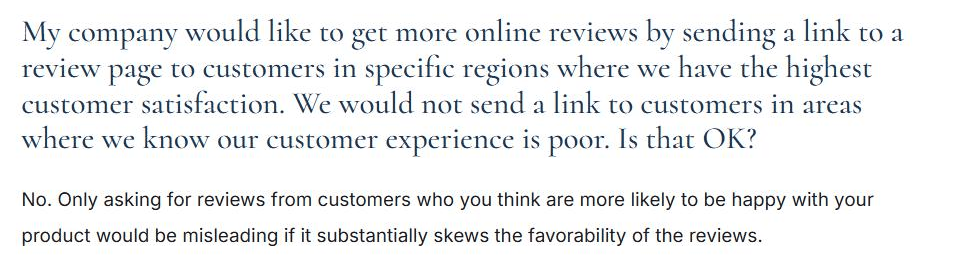
So keep the two jobs apart. Ask every customer for a review. Ask a few of them for a video. And never put a rating question in front of either ask so unhappy people get routed somewhere quieter. That is review gating, and it breaks Google's policy for contributed content too.
6 video testimonial request scripts you can copy
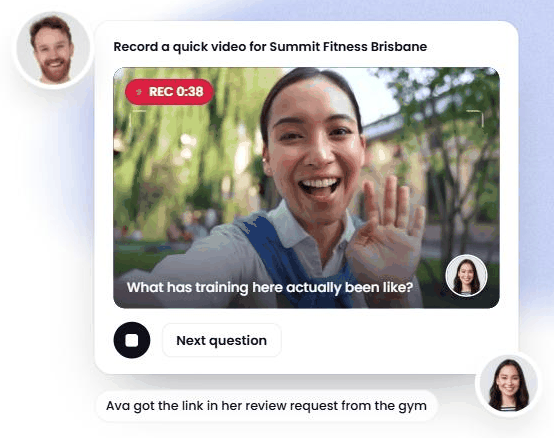
Keep it to one message and one link that opens the camera in the browser. Nobody needs an app, a file to send back or a meeting to book. Put your name on it, because Sam at Coastline Physio gets a reply and "the Coastline Physio team" does not. Then say how long it takes, show the questions and take them to the recording screen in one tap. Send once, follow up once four days later, then stop, the same discipline as a review request email.
Change the names below. Do not tidy the grammar into something you would never say out loud.
1. By text, once the result is visible.
Hi Emma, Sam here from Coastline Physio. You said last week the knee finally let you back on the bike. Would you record 30 seconds about that on your phone for our website? This link opens the camera and puts three questions on screen: [link]. No stress if not.
2. By email, if that is the channel you already use.
Subject: A 30 second favour
Hi Priya,
The new hot water system has been in a month now and you said it's been faultless. We're putting a few short customer videos on the site and I'd like one of them to be yours.
It's 30 to 60 seconds on your phone. The link opens the camera and puts three questions on screen, so you're not staring at a blank recording button: [link]
If you'd rather not, ignore this.
Dan, Ridgeway Plumbing
3. In person, at the salon counter. Asking face to face beats any message, as long as you send the link before they walk out.
"Can I ask you something a bit cheeky? What you said about the colour holding through summer is exactly what people ring us about. Would you say that on camera for 30 seconds? I'll text you the link now, you do it whenever, and if you hate it you just don't send it."
That last clause is what gets the yes.
4. After a five-star written review. Reply to the review publicly and specifically first, the way you would to any positive review. Then:
Hi Marcus, thanks for the review, Nadia passed it on and it made her week. One more ask: would you say roughly that on camera? Thirty seconds on your phone, three questions, the link does the rest: [link]. Either way, thank you. Lane Dental
Never make the video ask a condition of anything, and never offer a customer something in return for saying the right thing.
5. A client of several years.
Hi Ally, we've been looking after Rufus for what, five years now? We're rebuilding the website and I'd rather have you on it than stock photos of people who've never set foot in here. Thirty seconds on your phone, three questions on screen: [link]. Say whatever you actually think. Tess at Brookvale Vet
6. A B2B client, after a result you can both point at. Offering the questions up front is standard here and unnecessary for everyone else.
Hi Renée, the December audit came back clean across all four sites, so before things get busy again: would you record a short video about it? It's for our website and it'd go out with your name and title. Sixty seconds, four questions on screen: [link]. Happy to send them over first if you'd rather see them. Tom, Halvard Commercial Cleaning
What to ask them to say: the four prompts
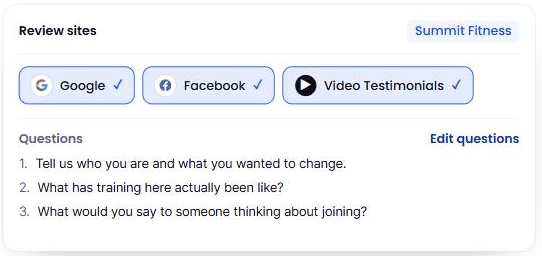
Send prompts, not a script. A customer reading someone else's words looks like a customer reading someone else's words. Four questions is the ceiling. Past four, people start performing.
1. What was going on before you came to us? The setup. Without it nothing that follows means anything. You want the state they were in, not the date they booked.
2. Was there anything that made you hesitate? The prompt nobody sends, and the one that produces the line you will actually use. A testimonial that admits a doubt ("I'd been to two other clinics and assumed this would be the same") is believed, and it hands you the objection your next customer is sitting on.
3. What changed? Be specific. Not "I feel much better" but "I got through a full shift without sitting down". A customer who gives you a number has given you more than the other three answers combined.
4. Who should try us, and why them? Asking "who" rather than "would you recommend us" gets you a description of your ideal customer, in your customer's own words.
Write the four once and use them everywhere. Ask for their honest account. What you may not do is tell them what to say, ask for a positive video specifically, or pay for one.
Keep it to a phone and 60 seconds
A customer testimonial video shot on a phone at arm's length is the format people expect now, and anything that sounds like production loses you the video before it starts. If they ask, and only if they ask: face a window rather than standing in front of one, find somewhere quiet because a phone microphone is hopeless in a cafe, and do one take. Vertical is fine. If they fluff a word, leave it in.
Thirty to sixty seconds is the target and 90 is the outer edge. A slightly awkward real customer beats a polished one, which is the practical argument against hiring an actor. The legal argument is below.
Permission and usage rights
Get permission in writing before the video goes anywhere, and keep the reply. A text saying yes is a record. One sentence covers most of it:
Can we use your video on our website, our Google profile and our social accounts? We might trim it for length. You can ask us to take it down at any time and we will.
That names where it will appear, flags that you may cut it, and gives them a way out. A formal release is worth the trouble for B2B and overkill for a hairdresser.
Then there is the law, which reaches a two-van business as much as a national brand. The FTC's Rule on the Use of Consumer Reviews and Testimonials went into effect on 21 October 2024, covers testimonials and not only reviews, and lets courts impose civil penalties. The FTC's own guidance on it is blunt about who carries the risk: "A business that puts testimonials on its own website is disseminating them and is not merely 'hosting' them. If those testimonials are fake or false, the business could be liable." An actor presented as a customer is the clearest version of that there is.
The rule's incentive provision is written about consumer reviews, reaching compensation "conditioned on the writing or creation of consumer reviews expressing a particular sentiment". For a testimonial the endorsement guides do the same work: an endorsement "must reflect the honest opinion of the endorser", so you can thank somebody for their time but you cannot buy the sentiment. If you gave them a discount, a free session or a gift card, say so where the testimonial appears rather than in a footer. The guides ask you to disclose a connection "that a significant minority of consumers wouldn't expect", and that includes an endorser who is "a relative or employee of the marketer".
One more, and it is the one clinics and gyms trip over: if the video shows a result you cannot prove is typical, the ad "must make clear to the audience what the generally expected results" are. One honest line under the video does it.
Where to use a video testimonial
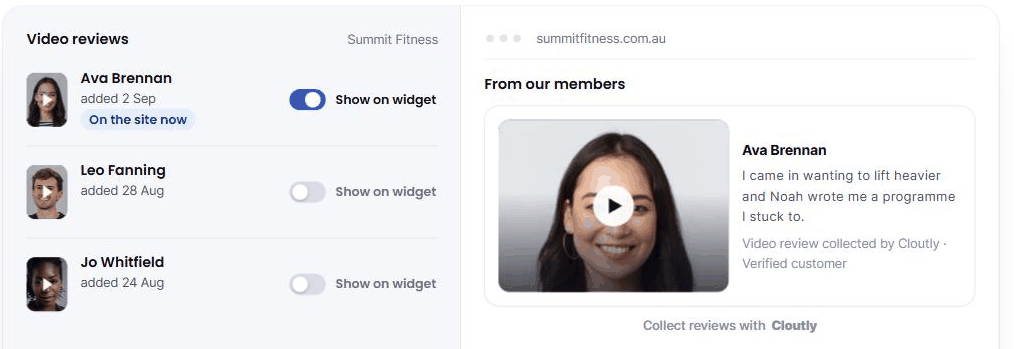
Put it on the page where people decide: the service page, the pricing page, the booking page. A testimonials page nobody visits is where good videos go to be ignored. In review widgets a video sits alongside the written reviews rather than in a gallery of its own.
It also belongs on your Google Business Profile, as an Update post rather than as a review. Google's help page says an Update takes "a description, photo, video, and an action button with a link", and those posts sit in the Updates or Overview tab. They do not appear in your reviews and they do not move your star rating.
Then social, with the captions burned in. Most people watch muted, and an uncaptioned testimonial is a person moving their mouth. Label every video with the customer's first name, their suburb and what they came in for.
Running it across several locations
A network has the opposite problem to a single site. The ask is easy. Keeping 40 locations asking the same way is not. Centralise the prompts, the timing rule and the location each video is attached to, and put one person in charge of watching and publishing. The asking itself stays local, in the name of the person the customer dealt with.
Cloutly can carry the video testimonial ask inside the same review request, collect the recording in the browser, and hold it against the customer's record until someone chooses which videos to publish.
Two good videos per location per quarter is a real programme. One per customer is a campaign that runs three weeks and quietly stops.
FAQ
How long should a video testimonial be? Thirty to sixty seconds. Long enough for a setup and a result, short enough that people finish watching and that your customer says yes in the first place.
Can you pay a customer for a video testimonial? You can thank someone for their time. You cannot buy the sentiment, and anything you did give them has to be disclosed wherever the video appears.
Does a video testimonial count as a Google review? No. A testimonial you collect lives on your site, your profile posts and your social accounts. A Google review lives on Google and is what moves your star rating; a video testimonial carries no star rating. The video ask sits alongside your review programme rather than replacing it, and if you want the rating to move, getting more Google reviews is the other half of the job.
What if the video is bad? Do not publish it, and do not ask for a retake unless the audio failed. One usable video from three or four asks is a normal hit rate, which is the argument for asking a few good customers rather than one. On tooling, our comparison of video testimonial software covers the options; the feature that decides it is whether the customer can record in a browser with nothing to download.
Decide where in the job you will ask, then keep asking at that point.