
Remove Glassdoor reviews: what employers can and cannot do
Every other guide on this topic is published by a company that sells review removal, so this one can tell you what Glassdoor actually takes down.
Lachlan Fea 11 min read
In this article10 sections

If you are trying to remove Glassdoor reviews about your company, almost every guide you will find is written by a business that removes reviews for a living. Cloutly does not sell removals and cannot take a Glassdoor review down. This page covers the part those guides skip: what Glassdoor's rules let you flag, and what to do with the review that stays up. Every platform fact below was read off Glassdoor's help centre and the FTC's rule text in September 2026.
Can you delete a Glassdoor review?
No. You cannot delete a Glassdoor review yourself, and Glassdoor will not remove one because it is negative. What you can do is flag it when it breaks a specific Community Guideline. Glassdoor answers a flag within 72 business hours, and its decision is final.
Glassdoor calls itself a neutral platform: it does not act as the finder of fact and does not take sides between an employer and a reviewer, because it cannot verify what happened. Its page for employers is blunter. "We will not tell you who wrote a review." "We do not remove companies from our platform." "Final content decisions are within our sole discretion and we are not open to negotiation." Nor can you pay your way out: Glassdoor says employers cannot pay to have reviews removed, and that clients buying its branding products agree to that in their contracts.
What Glassdoor will actually remove
Glassdoor removes content that breaks the Community Guidelines. It does not remove content that is unflattering, one-sided or, in your view, wrong.
| What the review contains | Example | How it tends to go |
|---|---|---|
| Confidential or proprietary company information | Source code, customer lists, budgets, an unannounced acquisition | Strong. Glassdoor names these categories as things it acts on |
| A negative comment about an identifiable individual who is not a senior leader | A named shift supervisor accused of something | Strong. Names are fine when the mention is positive or neutral; negative comment is allowed only about people at the top with broad influence over the workplace |
| Profanity, threats of violence, or discriminatory language aimed at a person or group | A slur, or a threat against a person | Strong |
| An advertisement, an external link, or text lifted from somewhere else | A competitor's pitch pasted into a review | Strong |
| A second review of the same type, for the same employer, within a year, from one person | Two company reviews in nine months | Moderate. Glassdoor removes reviews where it finds evidence of abuse of that policy |
| A review filed against the wrong company | It describes a different employer with a similar name | Moderate, if it is obvious on the face of it |
| A review by someone who never worked there | A competitor, or a candidate never interviewed | Weak. Reviewers self-certify, and Glassdoor generally will not consider evidence from a party with an interest in removal |
| A breach of an NDA or a non-disparagement clause | "This breaks the contract they signed" | Very weak. Glassdoor says it has no way of knowing who is right |
| Something you believe is false or defamatory | "None of this happened" | Very weak on its own. See the legal section below |
| A harsh but honest opinion | One star, "worst place I have worked" | Nothing to flag |
A moderator needs a sentence that breaks a rule. A review that says the culture is brutal is opinion and it stays. The same review, if it names a junior team leader and accuses them of something, has a removable line in it, and that line is what you flag.
How to remove Glassdoor reviews: flagging, step by step
There are two routes. Anyone can report a review from the review itself; employers get a second route through the Employer Center, which needs a free employer account.
To report from the review, click the ellipses icon in its top right corner, click Report, and pick a reason from the drop-down. The seven options are: this review violates Glassdoor's guidelines, contains false information, the same person has written multiple reviews, was written by management or HR, is for the wrong company, I want to comment on this review, and none of the choices above apply. If a text box appears, you get 400 characters to explain yourself, and only Glassdoor's Trust and Safety team sees what you write. Then click Submit.
From the Employer Center, open the Reviews tile, find the review, click the Flag icon below it, explain yourself in the box if one appears, and click Send.
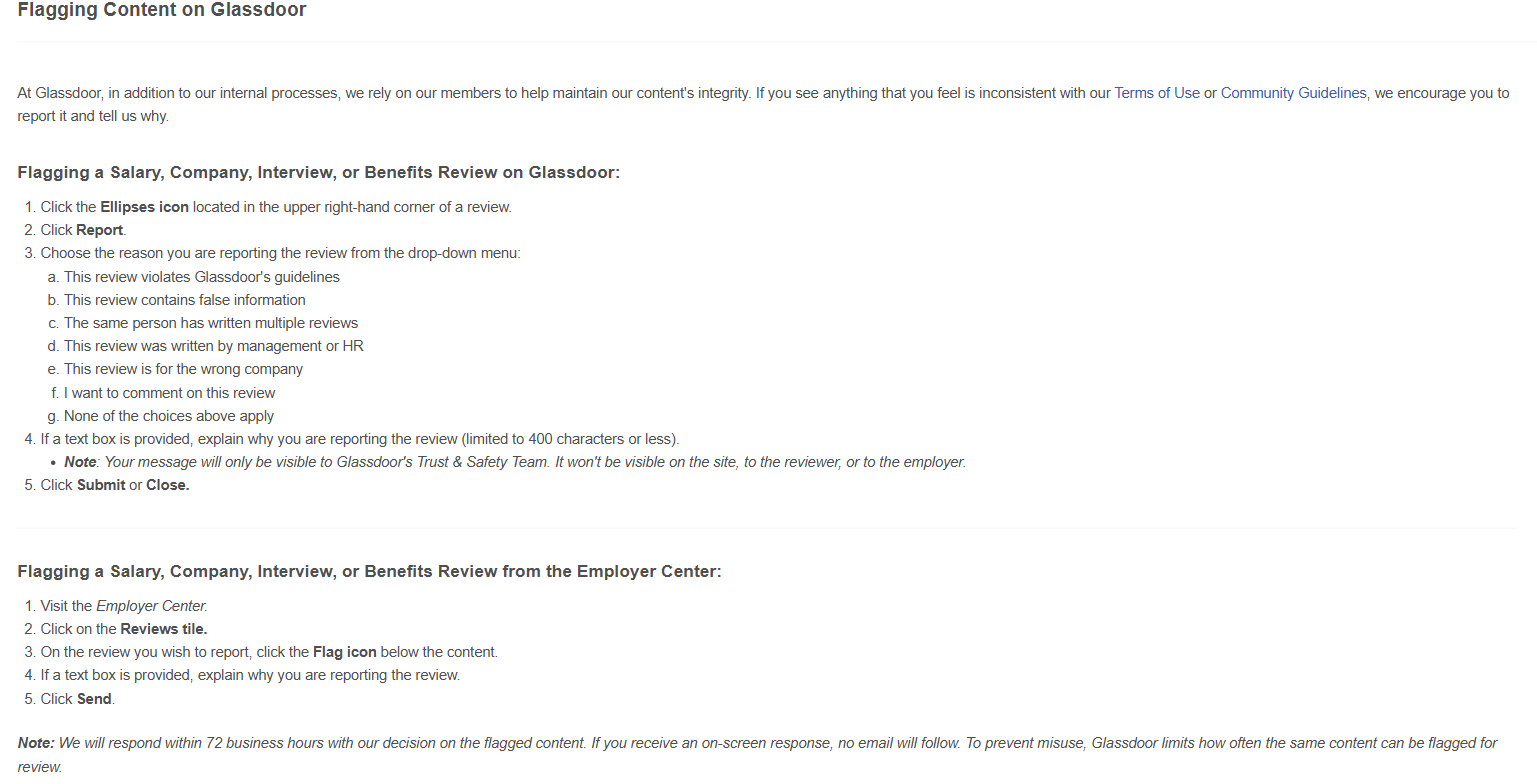
Glassdoor's flagging article, 7 April 2026. Both routes reach the same moderators.
The explanation box is where the flag is won or lost, and 400 characters is no room for a grievance. Name the guideline, quote the sentence that breaks it, stop. A moderator reading "this review names a shift supervisor and accuses them of theft" has something to act on. One reading "this review is unfair and is hurting our hiring" does not. Glassdoor also limits how often the same content can be flagged, so re-flagging weekly under a new reason is not a strategy.
What happens after you flag it
Glassdoor responds within 72 business hours with its decision. Business hours, not calendar hours, so a Friday afternoon flag realistically lands the following week. If the answer comes back on screen, no email follows it, which catches people out.
The review comes down, the review stays up, or the reviewer edits it and a trimmed version reappears. There is no appeal: final decisions sit at Glassdoor's sole discretion and it does not negotiate. You can flag a different line under a different guideline if there genuinely is one, but re-litigating the same complaint does not work. Unless you can point at a sentence that breaks a rule, plan on the review staying up. In that case, focus on the reply.
When it is a legal removal, and when that is a mistake
This is general information, not legal advice, and the law differs by country and state.
Defamation needs a false statement of fact, not an opinion. "The manager was rude and the place is chaos" is opinion, protected almost everywhere. "The company failed its safety audit in March" is checkable, and if it is false and it cost you, you may have something. Almost every angry review is the first kind.
Glassdoor will not hand you a name either. If you sue a user and ask for their identity, it objects and often fights in court, and it usually wins. In Glassdoor v. Superior Court (9 Cal. App. 5th 623, 2017) the California Court of Appeal held that a plaintiff must make a prima facie showing that the specific statements are actionable before anyone is unmasked. Glassdoor publishes the rest of those cases itself.
Then there is the cost of winning. Glassdoor warns that lawsuits draw more attention to a review than the review ever did, that media outlets cover them, and that where it believes a suit is meant to suppress speech it may publicise the situation. Acting against a former employee over what they wrote can also hand them an employment claim on top of the one you started with. Be careful with the threat itself, too: the FTC's rule treats an unfounded legal threat used to get a review taken down as review suppression in its own right.
Legal action is worth costing out when a review discloses genuinely confidential information, names and accuses an individual employee, or was written by someone you can show never worked for you. Flag it first in all three, because the flag is free and takes three days. As for the removal services filling the rest of this search page: they file the same flag, through the same form, read by the same moderators. Glassdoor applies the same rules to clients as to everyone else, and any guarantee of an outcome contradicts its published policy.
The rules on asking employees for Glassdoor reviews
Older guides, this one's 2022 version included, told employers to ask staff for positive reviews to outweigh a bad one. That advice is now a liability. Here is why.
Glassdoor welcomes employers encouraging honest reviews and bans buying them. Money, bonuses and prizes are out, and so is asking staff to show proof they posted, because that breaks the anonymity the reviews depend on. Glassdoor removes positive reviews where it has evidence employees were compensated or coerced, and if the practice persists it can post a Glassdoor Alert on your profile and review pages: a public notice sitting on top of the thing you were trying to fix. What it calls acceptable is a general, voluntary ask at an all-hands or in a company memo, saying plainly that reviews are voluntary and anonymous.
The second layer is American law. The Rule on the Use of Consumer Reviews and Testimonials took effect on 21 October 2024, and 16 CFR § 465.5(c) covers a manager who asks their own people for reviews. If a manager solicits reviews from employees, agents or immediate relatives, or asks employees to get them from relatives, and those reviews appear with no disclosure of the relationship, the manager is exposed whenever they discouraged disclosure, never asked for it, or knew it was missing and did nothing. So ask for the disclosure, in writing. The FTC says the first line of the review is enough, and courts can impose civil penalties for knowing violations.
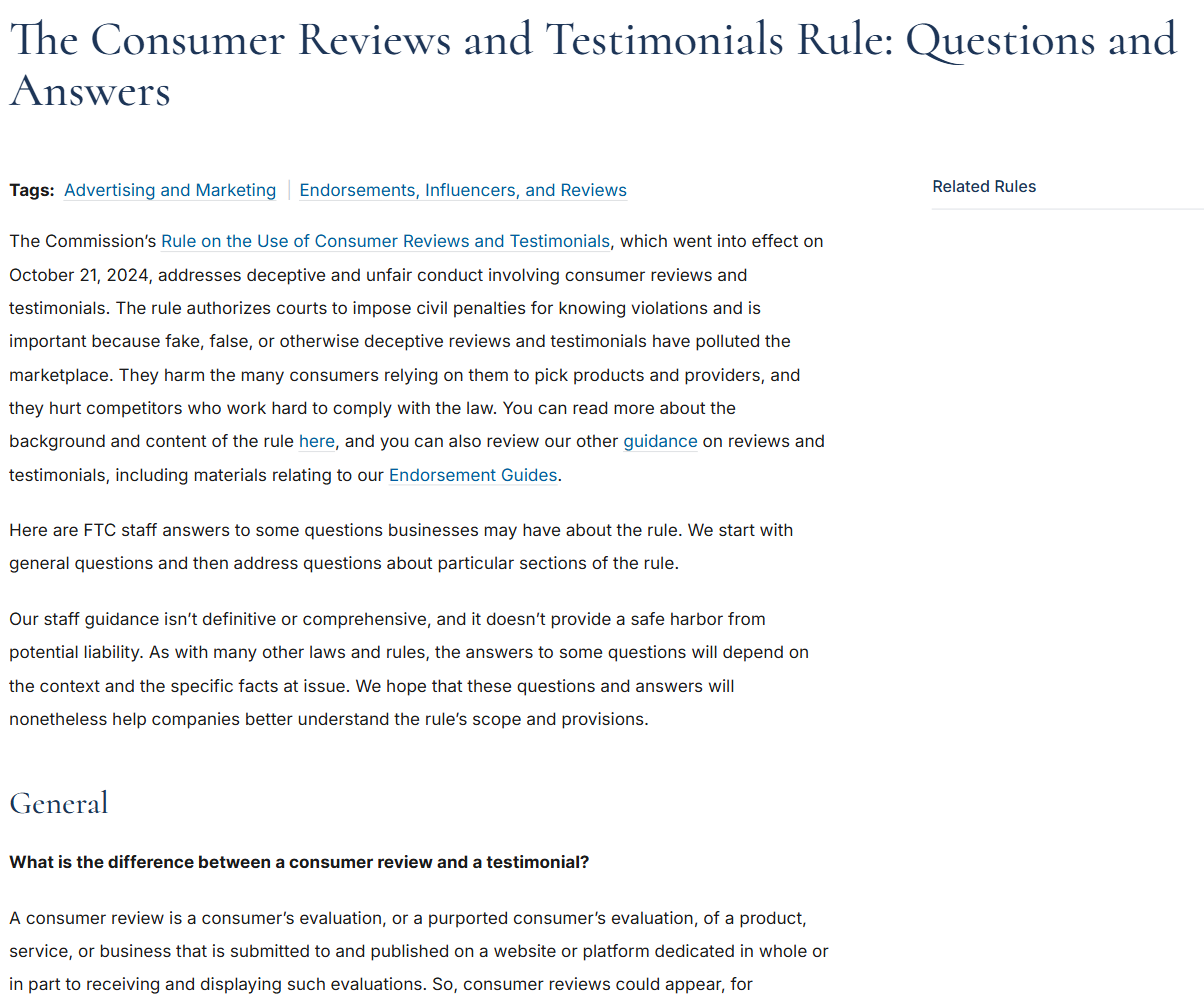
One caveat: the rule is written around consumer reviews and has not been tested on employer-review sites, where the reviewer is an employee rather than a customer, though running the same play on Google or Facebook puts you squarely inside it.
The practical version covers both rule sets. A general, voluntary invitation to everyone is fine. A manager leaning on their team is not, and neither is an incentive. A push timed to bury one review is what both rules exist to catch, and it is obvious anyway: a profile that sat still for two years and then took fourteen five-star reviews in a fortnight reads as exactly what it is.
The same principle applies on the customer side of your business, which is why we do not build review gating and never have.
Are Glassdoor reviews anonymous?
Yes, from where you sit. A review shows Current Employee or Former Employee, usually a job title and a location, and no name. Glassdoor states flatly that it will not tell you who wrote a review.
Two things complicate that. Glassdoor holds identity data, because it requires a verified email address or social account from everyone who posts, and may ask for an employer email address or check employment history. And anonymity is not absolute in court, as the section above sets out.
Neither changes what you should do: nothing. On a small team you can often guess who wrote a review from the detail in it, and acting on that guess is the worst move available to you. It identifies the person to everyone else reading, Glassdoor's guidelines prohibit revealing another user's identity, and disciplining someone over a review creates a retaliation claim far more expensive than the review. Write the reply for the next candidate instead.
How to respond to a negative Glassdoor review
You reply from the Employer Center: click Reviews, choose Employee Reviews or Interview Reviews, find the review, write in the text box and click Add Comment. Two limits shape the response. Your response is capped at 400 characters, and it is the only comment allowed on a review, so you get the last word and you get it in about four sentences. The reviewer is emailed. Responses are moderated after they post, so one that breaks the guidelines can show briefly and then be removed.
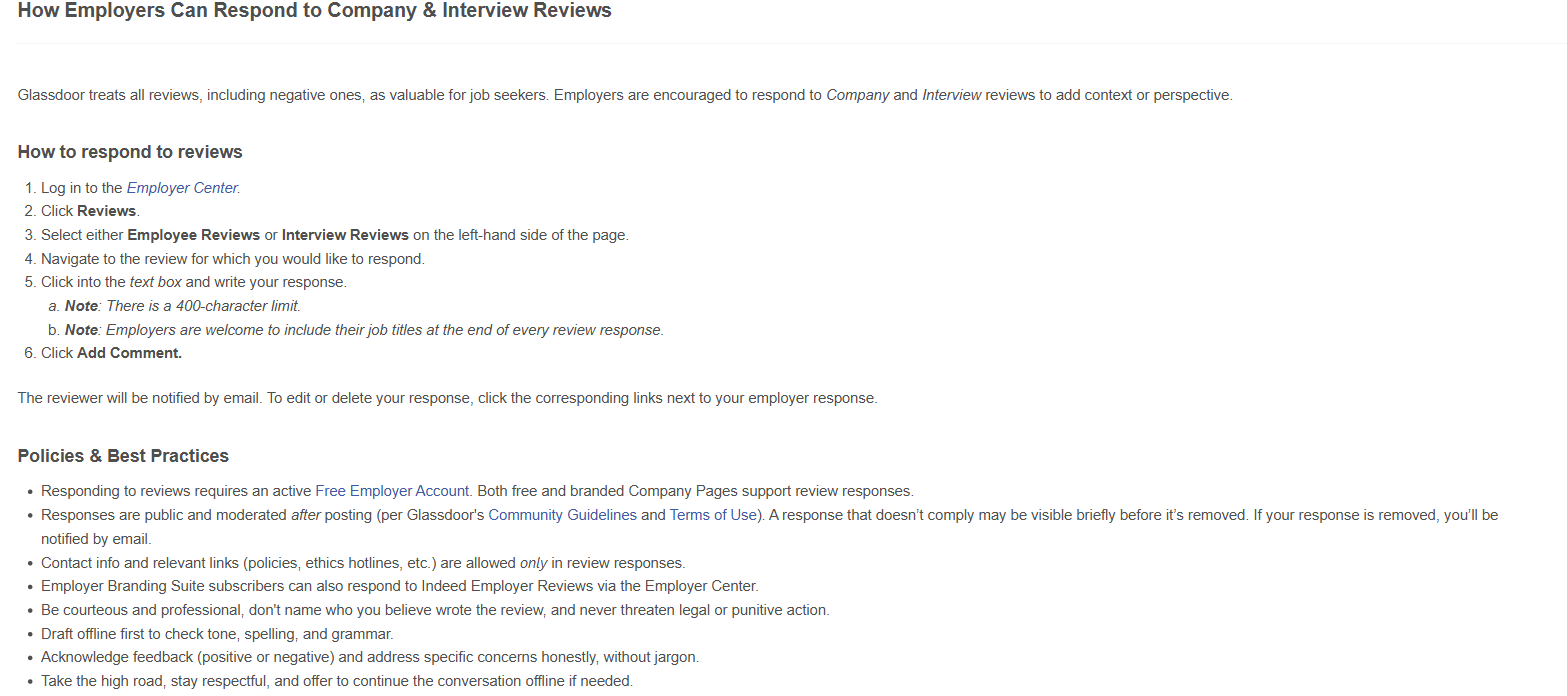
Glassdoor's employer response article, 15 August 2026. Its first piece of advice is to draft offline.
Four rules cover almost every case.
- Reply inside a week. After that it reads as damage control.
- Add context, do not argue the facts. You are writing for the reader who cannot judge which of you is right.
- Say nothing about an individual's employment. Not their dates, not their performance, not why they left. Glassdoor tells employers not to name who they think wrote a review, and never to threaten legal or punitive action.
- Give one real way to continue offline. A named role and an address, not "reach out to HR".
Five worked replies, all inside the character limit, with fictional employers.
The former employee with a specific grievance. Two stars at Kestrel Logistics about rostering: shifts posted late, weekends changed at short notice.
Thanks for writing this. Late roster changes were a real problem in the warehouse last year and we should have fixed them sooner. Rosters have gone out a fortnight ahead since April, and weekend changes now need a manager's sign-off. If you want to talk it through, our people lead is at people@kestrellogistics.example.
The anonymous rant with nothing to hold. One star, all adjectives, no incident. Decline the fight and admit the limit, and do not write "this is a fake review" unless Glassdoor has told you it is.
We're sorry your time here ended this way. There isn't enough detail here for us to look into anything specific, and we're not going to speculate publicly about who wrote it. If you're willing, our operations manager would like to hear the specifics at feedback@fernvalecare.example. Either way, thank you for the time you gave us.
The review that names a manager. Three stars, naming a team leader in the cons. Respond without confirming, denying or discussing the named person, then flag the naming separately if it breaks a rule.
Thank you for this. We take what you've described seriously and have started looking at it through our formal process, which means we won't discuss any individual here. If you'd like to give us more detail, our HR director is at hr@marlowbright.example. We'd rather hear it directly than not at all.
The one-line one star. Four words of text, or none. Keep the reply short, because a long one reads as defensive.
Thanks for the rating. We can't tell from this what went wrong, and we'd like to. If you have two minutes, our practice manager reads everything sent to hello@pinehavenvet.example.
The fair criticism you agree with. Four stars at Northbridge Plumbing, and the con is accurate: no structured progression for the trade team. Agreeing is allowed.
This is fair. We didn't have a defined progression path for the plumbing team and we knew it. There's one now: three levels, published rates and a review every six months. Thanks for saying it plainly, and for the four stars while you were at it.
Positive reviews deserve a line too, and two sentences is enough: thank the person, name the thing they mentioned, stop. A wall of gratitude under every five-star review reads as manufactured. Our positive review response examples cover the same craft on the customer side.
What responding does for your hiring
Replying does not change your star rating, and it does not dilute the review it sits under. Anyone selling you that idea is selling something else as well.
It changes how the review reads to candidates. Glassdoor's own advice is that users view a company more favourably when it responds calmly and thoughtfully, and since your response is the only comment allowed on a review, the last thing a candidate reads is yours. Your rating is set by the next hundred people who work for you. Your reply is read by the next hundred deciding whether to.
The operational half is seeing the review in time, and the review sites do not all email you. Glassdoor is one of the 39 review sites Cloutly reads, so new reviews land in one place alongside Google and Facebook instead of being found a month late.
For the customer-facing version, our guide to removing negative reviews from Google covers Google's policy grounds and appeal path, and how to spot fake reviews covers the evidence you need before reporting one anywhere.
Frequently asked questions
Can an employer delete a Glassdoor review? No. Employers cannot delete reviews and cannot pay to have them removed. You can flag a review when it breaks a specific Community Guideline, from the review itself or through the Employer Center, and Glassdoor decides. It will not remove a review for being negative or inaccurate in your view.
How long does Glassdoor take to remove a review? Glassdoor responds to a flag within 72 business hours with its decision. That is business hours, so a flag raised late in the week is usually answered the following week. If the decision appears on screen, no email follows. Final decisions are at Glassdoor's sole discretion and there is no appeal.
Can you find out who wrote a Glassdoor review? Not through Glassdoor, which says it will not tell you who wrote a review and will object if you subpoena it. A court can compel disclosure, but under Glassdoor v. Superior Court a plaintiff generally has to make a prima facie showing on the review's specific statements first. Guessing internally is the bigger risk.
Can you ask employees to leave Glassdoor reviews? You can make a general, voluntary ask, at an all-hands or in a company-wide memo. You cannot offer money or prizes, require proof someone posted, or have managers pressure their own reports. Glassdoor removes reviews it finds were incentivised or coerced, and the FTC's rule targets manager-solicited reviews that carry no disclosure.
Can you sue over a Glassdoor review? Sometimes, but rarely usefully. Defamation needs a false statement of fact, and most reviews are opinion, which is protected. The cost, the publicity and the risk of a retaliation claim usually outweigh the review, and an unfounded legal threat is its own problem. Flag it first, then reply well.